Sunday, December 13, 2015

210. Dying Alone


     Dying is by nature solitary, yet we want someone there to see us out.  When Sarah Bernhardt died, the person who mattered most was at her side – not any of her numerous lovers, but her son, who was with her to the end.  And when AndrĂ© Gide died, he too had the person who mattered most to him at hand: the young man, now married and with a family, who had been his lover as a boy, and who came to him in spite of his familial obligations.  Many such stories can be told.

     These people were lucky.  But in the city there are many who live alone, die alone, and sometimes the body isn’t discovered for days.  If no one claims it, it is shipped off to Hart Island, a small, forbidden island in Long Island Sound near City Island in the Bronx, where the anonymous, the indigent, and the forgotten are buried in plain pine coffins stacked three deep in a common grave dug by inmates from Riker’s Island.  Why is this island forbidden?  Because it is covered with the crumbling remains of abandoned buildings used by facilities long since gone, dilapidated structures that one risks one’s life in visiting.  (See post #49 for more on Hart Island.)  To die alone in the city and be buried on Hart Island is a thought to haunt us all: the saddest end conceivable.  And Hart Island, open as a final resting place since 1869, holds 800,000 such coffins, with more arriving daily.

File:A trench at the potter's field on Hart Island, circa 1890 by Jacob Riis.jpg
Digging graves at Hart Island, 1890.

     Sometimes someone who is by no means indigent or forgotten ends up on Hart Island.  I recall a squib in a New York newspaper from the 1870s reporting that a man just off the boat from one of the British Caribbean islands had exhibited erratic behavior, including hallucinations, and died.  His fellow passengers reported similar behavior on the boat, symptoms typical of delirium tremens and the last, fatal stage of alcoholism.  When no one claimed the body, it was sent off to Hart Island and buried there.  Soon after, relatives looking for him arrived from the Caribbean, and from descriptions were able to identify him and take possession of the body for burial at home.  He was a wealthy planter, but hopelessly given to drink.  His body was reclaimed, but most of those buried then and now on Hart Island, though numbered carefully, will never be identified.

     Recently the New York Times surprised its readers by running on the front page of its Sunday edition an article by N.R. Kleinfield entitled “The Lonely Death of George Bell,” recounting in detail precisely the kind of death so many city residents dread.  I will recount it in summary here, but urge interested viewers to read the entire article (see the source note following).

     A neighbor in the Jackson Heights apartment building in Queens detected a fetid odor from the apartment and dialed 911.  The tenant hadn’t been seen for several days, and his car, parked on the wrong side of the street, had been ticketed.  The firemen came, jimmied the door open, entered.  The police followed, found an apartment crammed with things, a jumble of possessions strewn on the furniture and floor, heaps of litter, trash: the den of a hoarder.  And collapsed on the living room floor was a puffy body, decomposed, unrecognizable.  They assumed it was George Bell, the resident, though no one knew for sure.   

     Now began the complicated routine of a complex of city agencies.  An investigator from the medical examiner’s office was summoned to see if a crime had been committed, and he quickly concluded that there was no sign of a forced entry, no bullet wounds or blood on the body, therefore no evidence of crime.  A Fire Department medic formally declared that the man was dead, and the body, zipped into a human remains pouch, was taken to the morgue at Queens Hospital Center, where it was placed in a refrigerated drawer. 

File:A Scene in the New York Morgue.jpg
Identifying the dead in New York City's first morgue, on the grounds of
Bellevue Hospital in Manhattan, 1866.

    Next came the attempt to locate next of kin, but neighbors didn’t know of any.  Finding some names and phone numbers in the apartment, detectives called them but got nowhere, for the man presumed to be George Bell evidently had no wife or siblings.  Meanwhile fingerprints were taken at the morgue – not easy, given the condition of the body – and sent to city, state, and federal data bases, but without results. 

     After nine days with no contact with next of kin, the medical examiner reported the death to the Queens County public administrator, an obscure official whose office manages estates when there is no one else to do so, usually in the absence of a will or known heirs.  Twelve days after the body was discovered, two investigators from the administrator’s office clad in ample white hazmat suits, whole-body garments worn as protective gear against hazardous materials, entered the cluttered apartment to search for clues that might identify the deceased occupant and his heirs.  Bad as this apartment was, they had seen worse: an apartment so cluttered that when the resident died, she died standing up, unable to fall to the floor, and another where the investigators were driven out by swarms of flies. 

File:SL-1 - Dismantling of the foundation piers.jpg
Workers in hazmat suits, dismantling a pier.

     The inspectors inspected the bed, a lumpy fold-out couch in the living room, and a soiled shopping list discovered in the kitchen, where the faucet didn’t work and the stove, being without knobs, was unusable.  A table and some drawers yielded $241 in bills and $187.45 cents in coins, all duly noted.  A bear’s head and steer horns were mounted on the wall, plus some pictures of planes and warships, and photos showing a parachutist coming in for a landing, with a certificate recording George Bell’s first jump in 1963.  Chinese food cartons and pizza boxes were everywhere, showing how the deceased had eaten.  In the clutter were six unopened ironing board covers, packages of unused Christmas lights, and four new tire-pressure gauges, evidence of a hoarder’s blind urge to accumulate.  The investigators left but returned twice more, finding more papers and cash, but no cellphone, computer, or credit cards that might yield useful information.  Said one of them, chastened by his work here and elsewhere, “I don’t want to die alone.”

     Back in the public administrator’s office a young caseworker, officially termed a “decedent property agent,” scrutinized the salvaged photographs and papers while wearing rubber gloves.  The photos showed a child with a holster and toy pistols, a man in uniform, men fishing – ordinary scenes that revealed almost nothing useful.  But an unused passport issued in 2007 identified the holder as George Main Bell Jr., born January 15, 1942, and gave the names of his parents.  There were also greeting cards from friends, and some tax returns prepared by H&R Block that gave information about George Bell’s estate, which amounted to several hundred thousand dollars.  So the hoarder was hardly impecunious, which simply heightened the mystery of his hoarding.  Finally, there was a will, dated 1982, dividing his estate evenly among three men and one woman of unknown relation, and specifying that the remains be cremated.  Now at last the investigators had something tangible to work with, and the mystery of who George Bell was began to be resolved.

     Letters went out to the four heirs, but only one responded: a man in upstate New York who had not been in touch with George Bell for some time.  The deceased’s car was sent to an auctioneer, a funeral home was selected, but queries to doctors’ offices and hospitals furnished no results.  The medical examiner filed an unverified death certificate stating the cause of death as hypertensive and arteriosclerotic cardiovascular disease, with obesity a significant factor.  Though city law requires burial or cremation within four days of discovery, an exemption in this case was granted, pending conclusive identification of the remains.  Meanwhile the unplugged refrigerator had to be removed, its rotting food and roaches disposed of, following which it was sent to a recycling center.   Months passed.

     At last, a bit of luck: in response to queries sent out far and wide, a radiologist reported that he had X-rays of George Bell dating from 2004.  Retrieved from a warehouse, they were compared to X-rays taken by the medical examiner’s office, and they proved at last – four months after his death – that the body was indeed that of George Bell.  A rented hearse took the remains to the funeral home, where they were placed in a wooden coffin and sent on to a crematory for cremation, with no mourners, no member of the clergy: the simplest, bleakest disposal conceivable.  The cremation required three hours, and some days later an urn containing the ashes (the “cremains”) was deposited in a storage area.

     George Bell’s car, a Toyota, was auctioned off and sold for $9,500, beating expectations.  His watch fetched three dollars at another auction, and six husky men from a junk removal service broke up George Bell’s furniture and scooped up his cluttered belongings and shoveled them into trash cans and bags.  It took seven hours, and the stuff was taken by trucks to a Bronx dump that paid good rates.  The workers took a few items for themselves: a set of Marilyn Monroe porcelain plates, an unopened package of socks, some model cars, a television.  A worker wearing George Bell’s boots cleaned up his apartment.


File:A dump in Boa Vista, Cape Verde, December 2010.jpg
Where our treasured belongings may one day end up.
Ximonic

     By law, George Bell’s assets could not be distributed for seven months after his death, allowing time for creditors to appear.  Meanwhile the heirs were traced via the Internet; two had died; the others, long out of touch with him, were surprised at being named in his will.  Distant cousins were found and included as heirs; one had never even heard of George Bell.  The apartment, the last asset to dispose of, was sold to a neighbor for $215,000.  The estate was finally tallied at $540,000, which commissions, fees, and other expenses reduced to $264,000.  Fourteen months after the man’s death, checks to the heirs went out. 

     Interviews with people who had known George Bell filled in a few details of his life.  He had been in the moving business and developed a close friendship with one of the heirs; a thickset, brawny man, Bell had been known to his friends as Big George.  One surviving friend told how George had a prankish streak.  Once, when moving the furniture of a financial firm, he slipped notes into the desk drawers: “I’m madly in love with you.  Meet me at the water cooler,” and “There’s a bomb under your chair.  Your next move might be your last.”  Yet no one really knew him, knew what made him tick.  He had almost married, but broke it off when the bride’s mother insisted on a prenuptial agreement; but the intended bride, now deceased,  was named in the will.  In 1996 George Bell had injured his shoulder during a moving job and had retired, getting workers’ compensation and Social Security disability.  His old friends had died or drifted away.  His life became empty, but he had one good friend in the neighborhood with whom he went fishing and talked by the hour.  Even he had no idea that George Bell had become a hoarder; he felt that George had died of sadness.  “I miss him,” he told the interviewer.  “I would like to see George one more time.  He was my friend.  One more time.”  So ends the story, skimpy as it is, of George Bell, who died alone in the city. 

      Should the Times have pried into the life of this lonely man who in his last years kept to himself and concealed his hoarding?  In spite of its length – 8,000 words – over three million people have read it either in print or online.  Many readers wrote to the Times’s Public Editor with praise, one calling it the best thing he had ever read in the Times, while another said that it deserved a Pulitzer Prize; a few raised the issue of privacy, questioning the Times’s showing photos of the cluttered apartment and mentioning old love letters and medical records.  But when the author consulted Bell's closest surviving friend and his heirs, they all were in favor of the story being published, and Mr. Kleinfeld himself said that George Bell “was a stand-in for all the people who die these lonely deaths.”  Among the Letters to the Editor that the Times printed, one called the article a “lyrical novella,” another saw it as eloquently describing the reality of hoarding in the city, and one declared it a “callous violation of George Bell’s privacy.”  I understand all these views, but personally I think the article was justified; it reports on a sad fact of living in the city: the lonely deaths of people who live alone.

     George Bell’s story reminds me of a 1911 novel by the French author Jules Romains, Mort de quelqu’un (The Death of Someone), which tells the story of a childless widower, a man so ordinary that when he dies, only his aged parents remember him for any length of time.  When they die, the memory of him likewise dies, and it’s as if he had never existed on this earth.  Though I read it long ago, it haunts me to this day.

     Whether we die alone or with loved ones on hand, do any of us have a right to be remembered?  It’s a chancy business.  Catullus, a major Roman poet, is known today because a single manuscript of his survived the Middle Ages and was discovered crammed between a wine vat and a wall in a monastery.  And of the works of the Greek poet Sappho, renowned in ancient times, we have only one complete poem, quoted in its entirety by a later author; of all the rest, only fragments, likewise quoted, remain. 

     And what about those of us who lack the talent – and perhaps the luck – of Catullus?  Do we have a right to be remembered at all?  The answer depends on our belief system, or lack of one.  Some might say no.  Others might insist that our every thought, word, and deed exists in the mind of God and therefore has eternal life.  This last, though wonderfully consoling, requires a spiritual commitment.  Maybe it’s true … and maybe not.  But if George Bell’s death haunts us, it’s because he is us, or may be, and his lonely death is the very death that we all fear, especially in the city.

     Does it have to be this way?  No, not in a caring community.  One such community is Monhegan, the small island off midcoast Maine where Bob and I used to vacation.  One of the most colorful of the year-round residents was an artist named Lynne Drexler, with whom we were slightly acquainted.  She came off as one tough cookie, bossy and sharp-tongued, with a voice like dark molasses, speaking her mind with utter indifference to what other people thought: a free spirit if there ever was one.  At midday, when the island dock was crowded with islanders and visitors awaiting the arrival of the daily mail boat from the mainland, I often saw her walk the length of the dock, greeting no one and looking neither to neither left nor right, while others babbled all around her.  What the point of this silent promenade was I never fathomed.

     Lynne’s paintings, bold splotches of color as assertive as herself, sold well to summer visitors and fetch high prices today.  For all her off-putting ways, she did have friends among the islanders and would receive them in her house, sitting on a couch in white sneakers, a glass of whiskey in one hand and a cigarette in the other.  Bob and I and some others were invited there once, not for whiskey but for tea.  Instead of inviting her guests to partake of the goodies spread out on a table, she slouched down out of sight and voiced barbed opinions on a variety of subjects, her  voice projected from some hidden nook at the other end of the room.  Finally we realized that it was up to us to help ourselves, and when I went to the table to do so, I discovered her at last, sprawled on the floor in a corner, cigarette in hand.  It was the strangest affair I’ve ever been invited to, a Mad Hatter’s tea party where none of the usual rules held fast.

     Why am I mentioning Lynne Drexler now?  Because of what happened when she learned she had terminal cancer with only six months to live.  “Well, I guess I’m going to croak,” she announced, without a trace of self-pity, but with an edge of defiance.  She wanted to die on the island, where there was no doctor, no nurse, and just one paramedic, so her neighbors  formed a volunteer hospice group of eight who, as her condition worsened, took turns staying with her round the clock.  She lasted a year, and when she died, all eight of the group were with her, one holding one hand and another the other, while they played her recording of Mozart’s Don Giovanni, which she loved.  After she died, one of them leaned over and kissed her on the forehead, knowing full well that, living, she would have hated it.  She is buried on the island in the little hillside cemetery that I have often visited, sometimes to look at old gravestones, sometimes to hunt rare wildflowers, and once in vain hopes of witnessing the weird mating ritual of the male woodcock, performed only in springtime at dusk.


Lynne Drexler's grave, with her white house in the background.
Barbara Hitchcock

Barbara Hitchcock


     When we go, will we be as lucky as Lynne Drexler and have loving friends around us, or as unlucky as George Bell, who died alone and collapsed amid the clutter he had secretly amassed?  A thought to haunt us all.


     Coming soon:  Cemeteries: Green-Wood and Woodlawn fight for our remains.  In the offing: Con men, cheats, and thieves. 

     The book:  Once again, many thanks to all those who bought my collection of posts.  Available from Amazon and Barnes & Noble and elsewhere.

No Place for Normal: New York / Stories from the Most Exciting City in the World


     ©  2015  Clifford Browder


Sunday, December 6, 2015

209. Buildings That Change


New York is in perpetual flux and always has been.  This post is about buildings that change, buildings that undergo amazing metamorphoses.  We'll start back in the nineteenth century.

Grand Central Hotel

The slender man, wearing an elegant gray overcoat, top hat, and polished boots, stood at the top of the hotel stairs, revolver in hand, eyeing the top-hatted fat man in a cloak halfway up the stairs.

     “I’ve got you now,” said the man at the top of the stairs; he fired one shot, then another.

     The fat man, a perfect target at point-blank range, staggered, grasped a handrail, managed not to fall.  “For God’s sake,” he shouted, “will anybody save me?”

     The slender man fled into the hotel, where he was soon apprehended.  Alarmed by the sound of the shots, hotel employees came running, helped the wounded man up the stairs and into a vacant room.  Word of the shooting spread like fire through the city, doctors flocked, newspapers stopped their presses and prepared a story.  The fat man lasted the night, then died.

 A bellhop witnessed the shooting.  From
Frank Leslie's Illustrated Newspaper.
      Such was the fatal shooting, on January 6, 1872, of Colonel James Fisk, Jr., robber baron, impresario, and commander of the Ninth Regiment of the New York National Guard, who, after President Grant, was the most reported-on man in the nation.  The shooting was all about the charms of Miss Helen Josephine Mansfield, Fisk’s former mistress and the present inamorata of the assailant, Edward S. Stokes, a handsome but impecunious man-about-town whose attempts to get money out of Fisk had proved fruitless.  Fisk was given an elaborate military funeral and shipped off to his home town of Brattleboro, Vermont; Miss Mansfield disappeared; and Stokes survived two trials for murder, was convicted at a third of manslaughter, served four gentle years at Sing Sing, and was released.

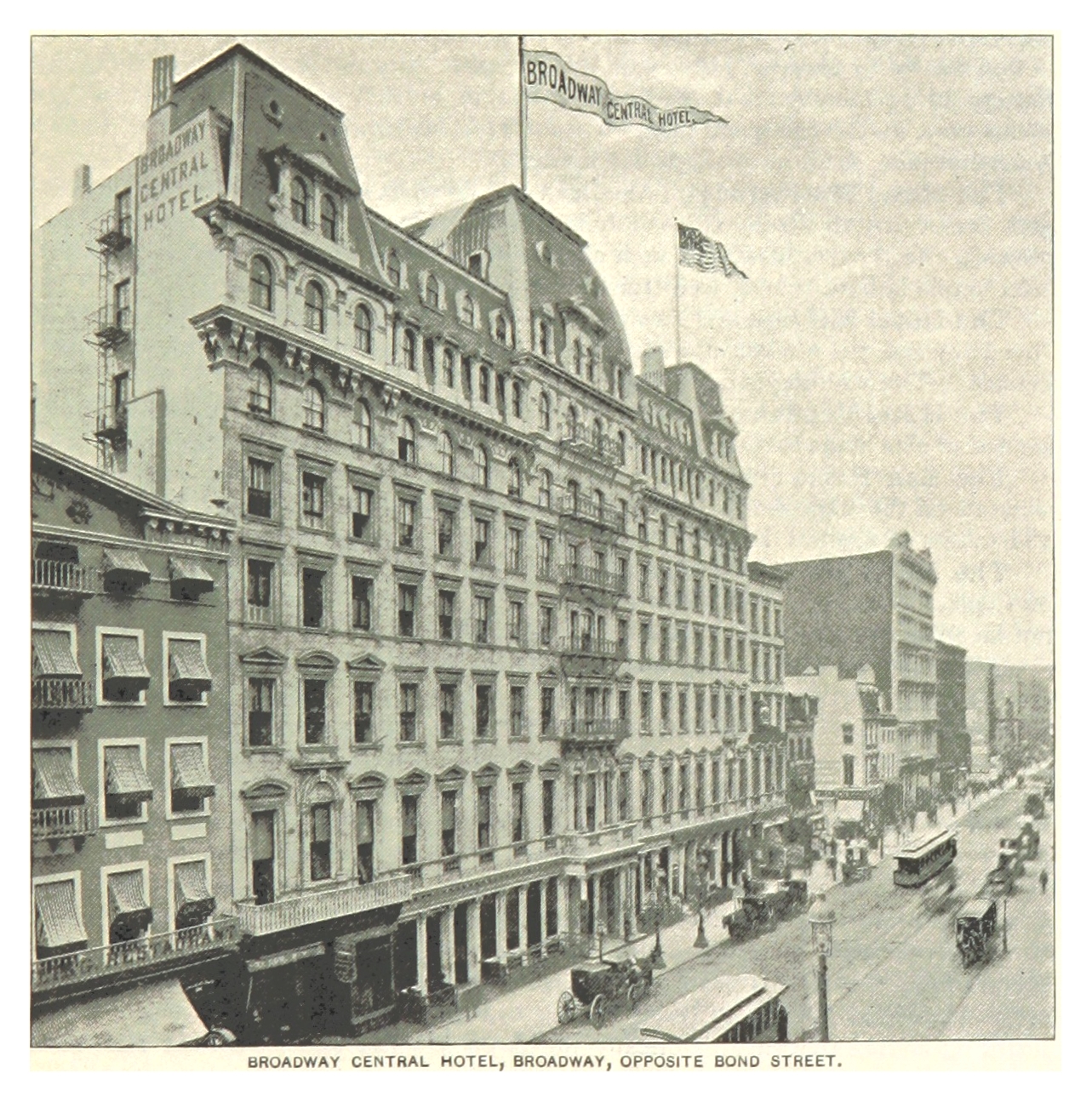
     The point of this story is not to tell once again the dramatic end of Colonel Fisk, which I recounted in another post long ago, but to situate the crime in the Grand Central Hotel and show how, with time, that hotel’s fortunes changed.  In 1870 it had opened on Broadway between West Third and Bond Streets, an eight-story, 400-room hostelry in Second Empire style, with the mansard roofs then fashionable.  One of the largest in the world at the time, it had three elegant dining rooms and sumptuous Gilded Age furnishings.  Fisk had called there because he was visiting the family of a deceased friend who were living there in comfort, thanks to his largesse. 

File:(King1893NYC) pg241 BROADWAY CENTRAL HOTEL, BROADWAY.jpg
The Broadway Central Hotel in 1893.

    In the years that followed, the hotel witnessed elegant society weddings, other fashionable events, and an occasional murder or suicide, but nothing so dramatic and headline-grabbing as the affair of January 6, 1872.  But times and neighborhoods change, owner followed owner, financial difficulties arose, and by the late 1960s the hotel, now known as the Broadway Central Hotel, had become one of the city’s largest welfare hotels, with its share of crime, drug use, and prostitution.  Gone was the glamour of the Gilded Age, but in an attempt to spark it up, six theaters called the Mercer Arts Center moved in, and it was renamed the University Hotel.  But residents reported cracks and sagging walls.

     Early on August 3, 1973, those living there heard “bongs,” “tings,” and “groans,” and everywhere saw plaster falling in the building.  By late afternoon most of the 300 residents had been evacuated.  Then, at 5:10 p.m., a huge section of the building collapsed in a cloud of smoke, bringing a vast pile of tangled wreckage and rubble down on the street.  As firemen later sorted through the rubble, four bodies were found.  The rest of the hotel was torn down and removed, including the ill-fated Mercer Arts Center theaters.  Housing for New York University Law School students stands on the site today.

     Not every old building goes out with a bang, but startling metamorphoses occur.  Long ago, in some printed source I can no longer locate, I saw a mid-nineteenth-century photograph of a church turned into a stable.  I have never forgotten the shock at seeing what had obviously once been a house of God abruptly converted into a house of horses, with teams constantly going in and out those once sacred portals.  And I’m sure that the aroma of piety had similarly yielded to the smell of manure.  So let’s have a look at some other buildings that have changed over time.

May 1: moving day

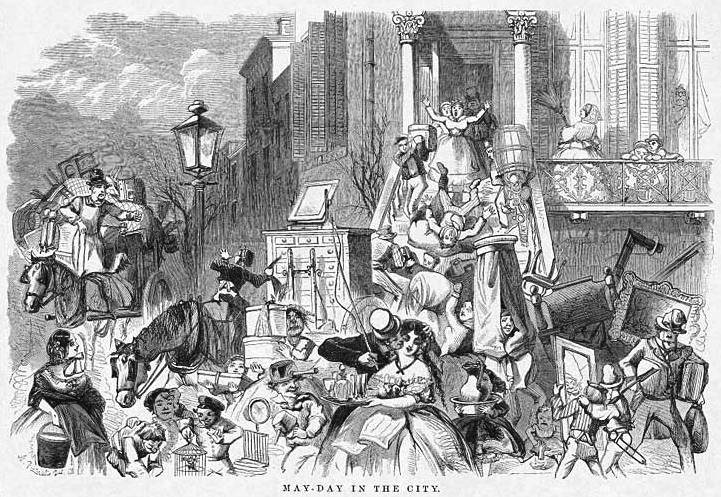
In nineteenth-century New York those changes occurred massively, and convulsively, on May 1 of each year, when both residential and commercial leases expired citywide.  On that day cartmen could charge triple their usual prices and were reserved weeks in advance.  The streets became a jumble of carts and wagons, with cartmen shrieking oaths as they transported people’s furnishings, often as not trading fisticuffs with other cartmen doing the same.  A sign announcing SOAP & CANDLE FACTORY might come down, to be replaced by BOOTS & SHOES, while a family’s precious pianoforte, the showpiece of the parlor, was carried on a cart with special springs, bound for a more sumptuous brownstone fronted by a steep stoop often fatal to bulky but delicate objects in transit.  A jewelry store might become a lager beer saloon; an oyster cellar, a salesroom displaying fancy coffins; and a young ladies seminary, a house of ill repute.  On May 1 anything could happen and often did.

File:Moving Day 1859.jpg
Moving day, May 1, 1856.  Be sure to notice the details; they say a lot.

Carriage houses

One of the most surprising metamorphoses, over time, has been the transformation of carriage houses into highly coveted and high-priced housing.  One sees them all over the West Village, where I live, their wide entrances meant to accommodate carriages but now changed into elegant residential doorways.  Once these little structures housed carriages and teams of horses, with the coachman and his family lodged snugly on a floor above, while the employer’s family occupied a spacious Greek Revival or brownstone mansion on a nearby but more fashionable street.  Occasionally, as at 271 West 10th Street, one sees a metal hayloft hoist projecting from a floor above, originally installed to lift heavy bales of hay up to a second story, or in this case, to a third story, since the 1911 building once lodged a construction firm’s horses on the first and second floors, and a hay loft on the third.  And how did the horses get up to the second floor?  By a ramp, of course.  And what price does this modest little three-floor structure fetch today?  $17.2 million.

Bayview Correction Facility

Another building with a history is the Bayview Correction Facility, a notorious women’s prison at West 20th Street and Eleventh Avenue.  In 1931 the eight-story red-brick Art Deco structure had opened in the rough West Chelsea neighborhood as the Seamen’s House, a Y.M.C.A. accommodating some 250 merchant seamen whose ships docked at nearby piers.  As New York declined as a port, it ceased to serve that function and in 1967 was sold to the city, which turned it into a drug-treatment center.  But the 1973 Rockefeller drug laws imposed long prison sentences instead of rehab on offenders, so in 1974 the building  became a prison, and in 1978 a women-only facility that was soon plagued with reports of staff sexual misconduct, unsanitary conditions, and poor medical care.  In other words, it rivaled the Women’s House of Detention, another scandal-ridden facility that loomed like a dreary Bastille in the heart of Greenwich Village, whose genteel residents (myself included) were scandalized by the often obscene exchanges of inmates with their friends on the street below.  And just as that Bastille was in time demolished to the satisfaction of almost all, so the Bayview, which closed as a prison in 2012 following flooding caused by Hurricane Sandy, has now found itself besieged on all sides by gentrification and likewise a candidate for demolition. 

     Surrounding the ex-prison today are art galleries, an entertainment complex just across the street, and a shiny new condominium.  But the Bayview, for all its sordid past, had been designed by the same designers responsible for that marvel of Art Deco, the Empire State Building, and therefore, though not landmarked, seemed worth saving.  The neighbors feared yet another luxury housing development, but a happy compromise has been found: it will be gutted and converted into offices to be rented out primarily to nonprofits providing services for women.  And to spice it up, there will be landscaped terraces and an art gallery, and a refurbished swimming pool lined with mosaics of fish, and a chapel with stained glass windows showing seafaring scenes.  (Those windows won’t be Chartres, but let’s not quibble.)  In addition, a six-story annex added in 1950 will be demolished and replaced with a glass-walled atrium.  So how trendy can you get?  All in all, the neighbors are delighted … and relieved.

File:Venus knox martin bayview.jpg
Knox Martin's "Venus."

     Covering the entire south wall of the building, by the way, is an abstract mural entitled “Venus” by artist Knox Martin, which dates from 1970, prior to the Rockefeller drug laws and long predating gentrification, back in a time when art for the masses was "in."  It’s a huge affair, an abstraction with big patches of red, blue, green, and pink, but what it has to do with Venus, philistine that I am, I can’t imagine.  Let’s just say it ain’t Botticelli.  Commercial interests have hankered for the space, then visible from miles away, but the fastidious Correctional Services didn’t want Venus covered over with ads for jeans or beer.  And today?  The mural is almost entirely obscured by architect Jean Nouvel’s “vision machine,” a super modern 23-story residential tower at 100 Eleventh Avenue completed in 2010.  So vision trumps Venus; so it goes.

Metro Theater

Few buildings have undergone more dramatic and often depressing metamorphoses than old movie theaters built in another age.  The Metro Theater on Upper Broadway between 99th and 100th Streets opened as the Midtown (a misnomer) in 1933, in the pit of the Depression and long before television, back when movies were one of the few recreations accessible to people on a budget.  An Art Deco gem with a terra-cotta façade, it featured, above the marquee, a medallion, illuminated at night, with two female figures back-to-back, holding the masks of tragedy and comedy.  Needless to say, such a fancy façade, not to mention the elaborate interior, announced a theater showing first-run films, a movie theater at the top of its kind.  Adaptable, in the 1950s and 1960s it showed foreign films and other non-mainstream fare – just the sort of films that I was then seeking out in small art theaters in Greenwich Village, having lost interest in the concoctions of Hollywood.  By the 1970s, with television co-opting the film-watching audience, the theater had stooped to showing second-run films and finally, like so many desperate movie houses struggling to survive, pure porn.  (As if porn could be “pure.”)  Reviving as an art house in the 1980s, with a name change from Midtown to Metro, it showed first-run films again in the 1990s, before decline resumed, forcing it to close in 2004.  

Metrotheaternyarchimges

     Abandoned since then, it became a shuttered eyesore in a neighborhood again on the rise.  Having a façade landmarked in 1989, the Metro posed a problem: what to do with an aging movie house, its interior long since gutted, that had become an eyesore, a structure too small to accommodate the multiplex theater of today.  To further complicate the matter, the theater's lack of windows, and its jutting landmarked marquee casting shadows on the entryway, made it undesirable as retail space.  The Metro was now a once glamorous lady desperate to age gracefully, but to whom the years had not been kind.  

Metrotheateremblem 
     Since the theater’s closing, numerous deals have been announced.  It was going to become an Urban Outfitters clothing store, the home of a nonprofit arts education group, a member of the Alamo Drafthouse Cinema chain, serving beer.  But year after year the marquee posted the phone numbers of real estate dealers hoping to find a tenant, and no tenant appeared.  Many neighbors hoped it could house a cultural institution of some sort, but this was not to be.  Finally, after a year of negotiations, a deal was announced last October: the Metro will become a Planet Fitness gym.  Not even a trendy high-cost gym, but a gym costing only $10 a month.  “At least it isn’t a Duane Reade,” the local city councilman remarked.  What the figures above the marquee, with their masks of comedy and tragedy, think of this dĂ©nouement, I dare not venture to ask.  But at least the old Metro is saved.

American Bible Society Headquarters

For 49 years the American Bible Society has been headquartered at 1865 Broadway, at the corner of Broadway and West 61st Street, in Manhattan.  Today, it’s surprising enough to learn that a nondenominational society founded here in 1816 to print Bibles and ensure their widest possible distribution has been located in congested, secular New York, in a 12-story building towering above the hectic, converging traffic of nearby Columbus Circle, crossing which on foot, even in a marked crossway and with the light, makes me nervous.  But there it is, or rather, there it has been since 1966, when it moved from its previous home on chic Park Avenue, another surprising address.  But today the Society seems hardly at home in this neighborhood of cloud-scratching super luxury high-rises and the tenants they attract.

File:Amer Bible Soc 61 jeh.JPG
The Bible Society building in 2008.

     The building itself is 1966 functional late Modernist, nothing godly or sanctified about it, but of course it was an office, not a place of worship.  One observer has suggested that the twelve deep recesses of its façade, one at each story, might hint of the twelve tribes of Israel or the Twelve Apostles, but let’s not push it; it was a secular building with a saintly purpose.  Back in its heyday, and the heyday of Protestant missionary work worldwide, the Society by 1893 had printed 56,926,771 Bibles and helped in the translation, printing, or distribution of Scriptures in 95 languages and dialects the world over.  Needless to say, times have changed; it stopped printing Bibles in 1922, and moved from one site to another before settling down in Columbus Circle.  And if that structure fails to inspire, it’s worth noting that it was decidedly innovative, being the first in the city to be built with load-bearing exterior walls made of pre-cast concrete panels, unlike the usual soulless high-rises of the time, with heavy interior steel frames and diaphanous glass skins.  (Don’t let “diaphanous” mislead you; most of them are dull indeed to look at.)

     And today?  The Bible Society, citing the building’s need of repairs and the high cost of doing business in New York, is moving to Philadelphia; in fact, it has moved already.  And the building itself, not landmarked, will it be refurbished and preserved?  No way; sold to a developer for $300 million, it has a date with the wrecking ball.  I doubt if tears will be shed, but replacing it will be a sleek 40-story glass-and-masonry tower with ground-floor retail space along Broadway and luxury apartments above, including, I’m sure, a super luxury penthouse: a concoction that may or may not inspire rhapsodies of praise.  As always in this city, flux.

     One casualty of the change is the Museum of Biblical Art, also housed in the building, which, just after attracting record crowds to an exhibition featuring the Renaissance sculptor Donatello, has also had to close.  Likewise affected was a bronze sculpture by Lincoln Fox installed in front of 1865 Broadway in 2007; entitled “Invitation to Pray,” it showed, seated on a bench, a life-size Jeremiah Lanphier, who founded the Fulton Street prayer meeting in 1857, a year of financial convulsion that drove some to despair and others to religion.  Leaving plenty of room for others on the bench, the statue attracted passersby, though less for prayers than “selfies.”  Their online comments include praise of his shiny bronze clothes, “he looks like he wants company,” and “ick.”  But Jeremiah has not been demolished, nor will he be moving to The City of Brotherly Love.  He now sits in the lobby of King’s College, a Christian liberal arts college located far downtown at 56 Broadway, another island of piety in secular New York.

Not exactly Michelangelo, but why quibble?  It's been saved.

BROWDERTHOTS

These are profundities so deep that I hesitate to share them with others.  But I'll risk two today:


A rose in full bloom
is a raunchy miracle.
Lilies are obscene.  

Envy the creators.
Their navels hiss,
                             their armpits sing. 

If these are too much for you, I promise to suppress them in the future.

     The book:  Many thanks to those of you who have bought it.  Still available from  Amazon and Barnes & Noble and elsewhere.

No Place for Normal: New York / Stories from the Most Exciting City in the World


    Coming soon:  Dying alone, the dread of many New Yorkers, and what happens if you do.  A tale of hazmat suits, hoarding, X-rays, pranks, and cremains.

     ©  2015  Clifford Browder