As a kid I was fascinated by forbidden
houses. In suburban Evanston, a very
genteel and unthreatening suburban community, there were two kinds: houses
under construction and houses ripe for destruction.
At the end of our one-block street, toward
the end of World War II a victory garden suddenly gave way to workmen gouging
out an excavation, pouring cement for a basement, rearing up skeletons of
walls, installing a second floor and the beginnings of a roof. Which meant that, after a long hiatus brought
on by the Great Depression, residential construction was resuming at last, even
before hostilities had ceased. And next
to the first construction site more workmen started building a second house right
smack next to the first.
On warm summer evenings, long after the
workmen had departed but when light still lingered, and on Sundays when no
workmen appeared, all the kids in the neighborhood, myself included, were drawn
irresistibly to the construction sites and began poking, climbing, crawling
over the half-finished houses. Probably
a warning was posted somewhere forbidding just such intrusions, but none of us
noticed or cared. It was thrilling to
explore the finished first floor, with its vertical beams marking walls-to-be;
to peer down into the dark depths of the basement; and, not without risk, to
climb warily up a ladder to the second floor, with gaping holes below that
might reach all the way to the basement.
It was an adventure to climb up, but coming down was riskier, and you
could see the gaping space below you.
None of us was ever injured, but with hindsight I can see that what we
were doing courted danger. One weekend I
didn’t venture into the houses, but many
others did, and were caught when the police arrived and took down their names,
so they could notify the families. This
intervention put a damper on our adventures, and in time the houses were
completed, sold, and occupied; the new residents had no realization that their
domiciles had once drawn all the kids in the neighborhood like a magnet.
As for the houses ripe for destruction,
they loomed up here and there, the contents emptied: strange hulking
presences that likewise tempted me and some of my friends to explore them. The floors sagged, gaps in the flooring gaped, and everything about the structure suggested a crumbling haunted house. Again with hindsight, I marvel that none of
us ever fell through a hole to the basement or was otherwise injured. I don’t recall any posted warnings; perhaps
it never occurred to anyone that a crumbling structure soon to be demolished
would attract the young and spice their lives with adventure.
 |
| Just the kind of house that lured us, though this one is in a rural setting. Nicholas A. Tonelli |
One of these crumbling houses proved
indeed to be haunted. Three of us, now
in our teens, ventured by chance one night into a deserted old house without
even a flashlight to guide us. When we
groped our way into what must have been the living room, in search of what we didn’t
even know, suddenly one of us asked the others, “What is this?” With his foot he was
gently prodding some soft unseen lump on the floor.
Eerily out of the darkness came a man’s
voice: “It’s a human being, son.”
We froze, speechless. Some vagrant – in
middle-class Evanston they were a rarity – had taken refuge there, hoping for a
good night’s sleep, only to have his sanctuary invaded by a trio of teen-age
interlopers. Saying nothing, we tiptoed
away. Minutes later we were out on the
street, and so was he, routed from his sanctuary. He walked slowly on ahead of us, in the very
direction we were going, and out of sheer curiosity we followed him. A block or so later he turned to confront us,
a big stick in his hand.
“Why are you following me?” he asked, a mix
of anger and suspicion in his voice.
“We aren’t!” we protested, mouthing what
was only a half lie, since we were going that way anyhow and had no intention
of harming him.
He eyed us warily a moment, then turn and
continued on his way. This time we
didn’t follow him, intimidated just a bit, and perhaps chagrinned slightly at having robbed him of his refuge and his sleep.
And that was the only haunted
house adventure of my childhood, and a tame enough one at that.
Two other forbidden houses fascinated me
in Evanston. Walking home from grade school, I
often passed a castle-like stone house with a tower that had a narrow stairway winding
upward round its surface. Those stone steps intrigued
me: where did they lead? On them I could imagine Robin Hood and the villainous Sir Guy of Gisbourne engaged in a climactic duel that only one of them could survive. One day, summoning up my courage and hoping
no one was home, I approached the tower and began mounting the narrow
steps. As they curled round the tower, I
discovered that they simply came to an end, the other steps having over time
crumbled away. Quickly I retraced my
steps and left the premises, aware now that the steps led nowhere and maybe
never did. But the castle-like house
still fascinated me.
I never saw the other house but got
reports from my brother, who ranged far and wide on his bike. He told me of a handsome old house near the
lakefront occupied by an aging recluse who lived alone and had no visitors;
receiving all her supplies by delivery, she was never seen outside. Adjoining the house was a garage, and on the
driveway leading to it there was an old car that had been there for decades,
exposed to all the elements and slowly, like the resident, decaying with age
but, unlike her, visible to all.
Of course there was a story. Long ago she and her young husband had
returned from their honeymoon and moved in.
The very first day they were there, he for some reason lingered in the
garage with the car’s motor on, until he was overcome by monoxide and
died. This sudden tragedy plunged the
bride into a state of shock from which she never really recovered. From that day forth she never left the house
and was never again seen by her neighbors.
Removed from the garage, the car still sat on the driveway, a grim
reminder of the tragedy of years before.
In time the car, the house, and the recluse became a legend.
My fascination with forbidden houses did
not end as I reached man’s estate, but it submerged for years, even decades, as
my attention was drawn to a myriad of other preoccupations and adventures. But recently the possibility of a forbidden
house right here in New York City was awakened in me by an article in the New York Times. It told how, four decades ago, a
19-year-old photographer named Bob Troiano was cruising in his Volvo along
Richmond Road in the New Dorp section of Staten Island when he happened to
notice, at no. 2475, behind a rusted iron gate and a centuries-old stone wall,
an old Italianate mansion, its entire façade fronted by a spacious portico, its
roof topped by a cupola. For Mr. Troiana,
it was love at first sight.
“You knew it was a forbidden place,” he
later explained, “but also unforgettable.”
Not until 1990 was he able to buy the
house and pass through the forbidden gate, which by then was rusted shut. The 20-room mansion, he now knew, had been
built in 1855 by a commander of the New York militia who in 1889 sold it to a
German American confectioner named Gustav Mayer. Mayer’s daughters Paula and Emily never
married, for no man was good enough for the father, but the sisters lived on in
the house, painting frescoes of their travels on the walls. In their later years they too became
recluses, confining themselves to their second-floor bedrooms and lowering
baskets from a window to collect groceries, mail, and laundry. Finally, in the 1980s, they and their nurse
moved out.
The house Mr. Troiana had bought was in a
state of advanced decay. It took him a
whole year just to make two rooms on the first floor livable for himself, his
wife, and his daughter. Next, he set to
work on the rest of the house, tearing down unsteady walls, stabilizing those
worth saving, and rebuilding the windows with their original wavy glass. To preserve an authentic atmosphere, he hid
all utilities, all switches, outlets, and ducts. Except for the renovated first floor where he
lived, the house was preserved in a state of controlled decay, with chipped
paint, cracked plaster walls, exposed beams, handsome marble fireplaces, and
ornate molding.
As word of the house got out, Mr. Troiana
was approached by agents wanting to use the house as a setting for fashion
illustrations and articles. Yes, the fashion
industry, though obsessed with the newest and latest, was enamored of an old
house with an eerie atmosphere. Hostile
to the idea at first, in time Mr. Troiana agreed. Since 1992 scores of models have been
photographed there, including one descending a staircase with a madman in
distant pursuit.
Will these fashion shots and the house’s
notoriety persist? Maybe not. Mr. Troiana has put the mansion up for sale
for $2.31 million – admittedly, a rather steep price, though it includes a free
exterior renovation by himself. He is
thinking of relocating to the Southwest, but if he can’t get his price, he’s
quite willing to live on in the house.
Many editors, directors, and photographers hope that he will stay.
What makes a house forbidden? Mystery, crumbling grandeur, a hint of
danger or scandal or the sinister. It
may attract you or repel you, but either way you can’t ignore it.
 |
| A skeleton in the Monster Manor, a nonprofit haunted house built each year by volunteers in San Diego and open to the public. |
One variant is the haunted house, which I
became aware of in my childhood through films and radio, this last conveying it
through creaking doors, sinister footsteps, and whispers or screams in the
night. The haunted house probably dates
back to the advent of the Gothic novel in eighteenth-century England, with
melodramatic tales of horror set in half-ruined medieval (or pseudo-medieval)
castles and abbeys – a vogue that persisted well into the nineteenth century
and that even, with variations, survives today.
Nineteenth-century literature made good use of it; think of the role of
the mysterious house (not necessarily Gothic) in Hawthorne’s House of the Seven Gables, Poe’s Fall of the House of Usher, and Charlotte Bronte’s Jane Eyre.
Not to mention the English country houses to which Sherlock and his
sidekick Watson were summoned, when some baffling mystery required a rational
solution. And for a twentieth-century
haunted house one can’t do better than Faulkner’s short story “A Rose for Emily,”
which I strongly recommend to anyone not put off by a touch of the morbid.
For me, conditioned by film and radio, the
classic haunted house is a three- or four-story Victorian mansion with
gingerbread molding, numerous balconies, dormer windows sprouting from steep
roofs, towers and turrets topped by conical roofs, and often a cupola at the
very top. It must have many rooms where
secrets can fester, ghosts stalk. A
prowling malefactor would feel cramped in a bungalow, inhibited in a
duplex.
 |
| ProfReader |
 |
| A Federal-style house on West 10th Street today. Brownstones had elegance, Federal- style houses had charm. Beyond My Ken |
There was little room for classic Victorian mansions in the congested
city of New York, but its history offers several forbidden or mysterious
residences. In the 1830s and 1840s the
most desirable residential area in the city was Bond Street, which ran the
short distance between Broadway and the Bowery.
Its elegant red-brick Federal-style row houses had marble street-front
trim and sloping roofs with two dormer windows.
Here on this quiet, tree-lined street lived the city’s elite: prosperous
merchants and bankers, former cabinet ministers, an ex-Secretary of the
Treasury, Congressmen, and briefly, Major General Winfield Scott, whom the
Mexican War would soon vault to fame.
But by the 1850s the fashionable residents had decamped, put off by insidious
signs of decay, notably a proliferation of dentists’ offices, and regarding one
of these there hangs quite a tale. For even
in this neighborhood, once the very epitome of taste and propriety, scandal and
violence could erupt.
Residing at no. 31 Bond Street in 1857 was
Dr. Harvey Burdell, a dentist of exceptional skill and the author of several
authoritative works on dentistry. He was also, it would seem, quick-tempered and
quarrelsome, and may have been guilty o/f sexual predation and real estate
fraud. He lived on the floor above the
parlors, with his office in the rear room on that floor. Somehow he had made the acquaintance of Mrs.
Emma Augusta Cunningham, a widow with four children, who then moved into the
building with her family to become his housekeeper … and, it would seem, his
mistress. He leased the house to her and
she ran it as a boarding house – another precipitous downward step for the once
exclusive neighborhood. But Burdell’s
relationship with her was a stormy one.
She wanted him to marry her, but he was not inclined to do so. He accused her of theft of a promissory note,
and she had him arrested for breach of promise of marriage and slander, though
these disputes were settled out of court.
But her lease would expire on the following May 1, at which time he
planned to lease the building to another tenant and so be rid of her.
On the morning of Saturday, January 31,
1857, the young man employed by Burdell to take care of his office discovered,
upon entering, the body of his employer lying dead on the office floor in a
large pool of blood, his features black, his tongue protruding. Physicians and the police were summoned, and
further investigation revealed blood on the floor and walls of the hall
outside, and a bloodstained sheet and nightshirt in a storeroom in the
garret. The doctor who examined the
corpse concluded that Burdell had been strangled by a cord, but also noted
fifteen deep wounds in the body. The
heart was pierced in two places, both lungs penetrated, and the carotid artery
and jugular vein severed. There had
obviously been a struggle, yet no one in the house reported hearing any
screams.
A coroner’s inquest followed and continued
for two weeks amid tremendous excitement. Thousands attended Burdell’s funeral at
fashionable Grace Church, and at the inquest Mrs. Cunningham threw herself on
the casket and exclaimed, “Oh, I wish to God you could speak and tell who done
it!” She then testified that she had
married Burdell secretly in 1856, and as verification produced a marriage
certificate signed by a Dutch Reformed minister who, when called to testify,
recalled the marriage but could identify neither the victim nor the
housekeeper; it now seems likely that the groom was another man impersonating
Burdell. Other witnesses stated that
Burdell had been in fear of assassination, and that Mrs. Cunningham had boasted
that “she had a halter around his neck and he had to do what she wanted him
to.” The coroner’s jury concluded that
Mrs. Cunningham and a boarder named John J. Eckel were principals in the
murder, following which she was indicted for murder. Press and public hailed the finding, but at
her trial in May 1857, thanks to the efforts of her skillful attorney, she was
acquitted for want of solid evidence linking her to the crime. As a result, the case against Eckel, who may
also have been her lover, was dropped.
But that was not the end of it. If Mrs. Cunningham could prove marriage with
the dentist, she would be entitled to a wife’s share of his estate of $100,000,
and if she bore him a child, she would inherit the entire estate. Conveniently, she began to show signs of
pregnancy, and in due time a child was received from Bellevue Hospital with the
aid of an attending physician. But the
physician revealed that he was working with District Attorney A. Oakey Hall,
the dapper future mayor, to exposed this fraud, following which Mrs. Cunningham
was again arrested. Her attorney got the
charges dismissed for lack of evidence, but the Surrogate’s Court ruled that
she and Burdell had not been legally married, so she could not inherit from
him; for a while she left the city. It
also came to light that Mrs. Cunningham’s previous husband, a wealthy
distiller, had been found dead one day in his chair, following which she had
collected his life insurance in the amount of $10,000. But the fact remains that in the Burdell case
the evidence against her was hearsay. As
for Eckel, he seems to have ended his days in prison. In a memoir published in 1897, forty years
after the murder, Mrs. Cunningham’s attorney, Henry Lauren Clinton, reviewed
the case in detail and still maintained her innocence and the validity of her
marriage to Burdell, while deploring the fraud of the bogus baby.
The Burdell murder was never solved. Burdell and Mrs. Cunningham, who died a pauper
in 1887, both lay buried for years in unmarked graves a few hundred yards apart
in Green-wood Cemetery in Brooklyn. In
2007, at the instigation of an amateur historian, both were given handsome
granite headstones.
The headstones can be the final word on
this sensational case. One wonders how
the next tenant of no. 31 Bond Street felt, upon taking possession of the house
on the May 1 following. Could they
ignore the scandal and trial that had so obsessed the city for months, and the
report of floor and walls smeared with blood?
What had been a seemingly respectable Federal-style residence, differing
little from other such structures on the block, might be viewed by some as
cursed, a forbidden house indeed.
Another nineteenth-century structure
meriting the label of “forbidden house” was the Old Brewery, reputedly the city’s
worst tenement, located near the Five Points, reputedly the city’s worst slum, which
I have already mentioned in post #25 (Sept. 22, 2012). Built in 1792 as a brewery, a new owner –
said to be a respectable church deacon, but certainly an enterprising gentleman
– bought it in 1837 and partitioned it into small apartments so as to get income
from rents. By 1850 the dilapidated
building was notorious, its three hundred residents including thieves who
disappeared into a maze of dark hallways where the police hesitated to follow,
as well as real and fake crippled beggars, drunks, harlots, and the very
poor. A dark, narrow lane running beside
it was known as Murderers’ Alley, in confirmation of rumored murders on the
premises, as well as tunnels and hidden rooms housing buried treasures and
buried bodies.
In 1850 the New York Ladies’ Home
Missionary Society of the Methodist Episcopal Church established a mission school
in the neighborhood and held temperance meetings there as well. In 1851 the Reverend Luckey, formerly the
chaplain to Sing-Sing State Prison, came to the Mission and began visiting the
people in the area, giving counsel and helping them find work. One night in the winter of that year he was
summoned to attend a dying man in the Old Brewery. Though the hour was late, he and one of the
mission converts went, groped their way up creaking stairs, and were led to a
small room near the attic, where a sick man begged Luckey to take him out of
there to a place where Jesus could come.
Luckey got him admitted to the City Hospital, where he married him and
his common-law wife before the man, relieved at being free of the brewery and close to his Maker, died
in peace.
So began the work of the Methodists to
reclaim the Old Brewery and its inhabitants.
In spite of the place’s reputation, the Mission ladies penetrated its
cellars, dark passageways, and attics, conversing with the occupants and
leaving tracts. At first hostile and
suspicious, a man named Brenan who kept a ground-floor grocery and liquor
store next door was won over by the visitors, became a friend to the Mission,
and gave up his liquor business for another job.
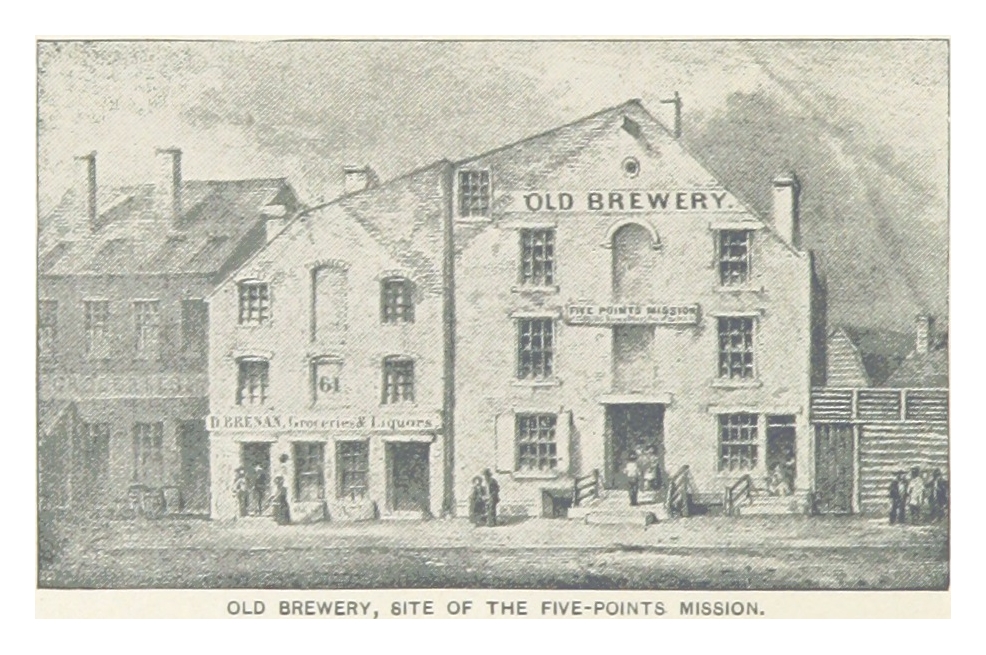 |
| Brenan's liquor grocery can be seen on the left. |
In 1852 the Missionary Society bought the
Old Brewery for $16,000. Rumors were
still rife about buried treasures in cellars and passageways, as well as
vestiges of crime. When a man who had
rented a dark, low cellar, ostensibly to store vegetables, gave it up a month
later, saying it was too damp for storage, behind him he left evidence of
recent digging and the removal of a heavy object from the ground by a tackle. Toward Thanksgiving the Society opened the
Old Brewery to the public, who came by hundreds to explore the premises by
candlelight, peering into damp, moldering rooms, now empty, and through
breaches made in the walls to give free passage throughout. So the forbidden building became known to the
public at last. What became of its
former occupants is not recorded. The
purpose of the Methodists was not to preserve the Old Brewery but to tear it
down and replace it with a brand-new Mission building.
Demolition began in December 1852. While it was underway two well-dressed men
appeared who tried to bribe the night watchman to let them enter the building;
the following night they returned, began probing a soft spot in the yard, but
fled upon discovering that the watchman had summoned a policeman. Several nights later the watchman interrupted
five men in the yard who fled, leaving behind some tools for digging. Some time after that the men evidently returned,
escaped detection, and removed some object, leaving behind the hole they had
dug. All of which suggests that the
rumors of buried treasure – or at least of stolen goods – may not have been
pure legend. As for buried bodies, when,
before the demolition, the floorboards of one room were removed, human bones
were found underneath. Replacing the
demolished structure was a new Mission building, a five-story brick building
with rooms at a low rent for deserving families, a schoolroom, and a
chapel. So ended the saga of the city’s
most notorious tenement.
Yet the most forbidden house of that era
was not the Old Brewery, but a palatial brownstone on the Fifth Avenue at 52nd Street, for
this was the residence – and basement office – of Madame Restell, the city’s
most notorious and most successful abortionist.
Needless to say, the Avenue’s fashionable residents were shocked by her
pursuing her occupation in their very midst, and only two blocks from the rising walls of Saint Patrick's Cathedral. That story has been told in part elsewhere (post #86, Sept. 22, 2013),
so I won’t repeat it here, only to say that the neighbors and passersby,
imagining grisly horrors inside, labeled it a House of Death. This scandal ended only with Restell’s arrest
and subsequent suicide in 1878, following which her grandchildren, upon
inheriting the mansion, turned it into the Langham Hotel. One wonders who the guests might have been,
given the building’s history. But the
hotel continued for decades, probably offering a quiet but luxurious alternative to the hurly-burly of
Broadway.
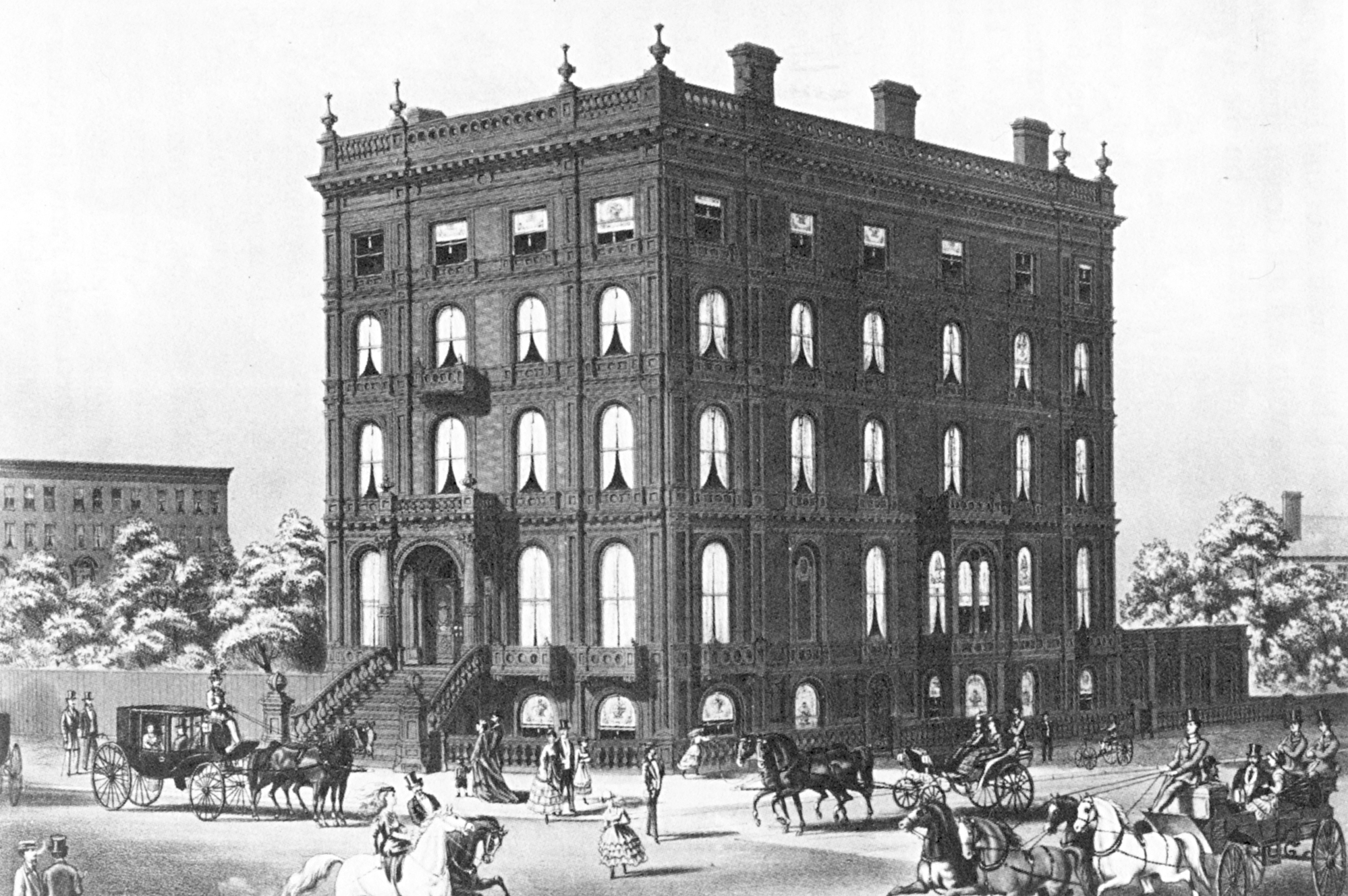 |
| Madame Restell's brownstone mansion at Fifth Avenue and 52nd Street. |
Coming soon: Movie Houses Then and Now: Palace, Sleaze,
and Art. You’ll learn what a strapontin is, how Spanish Gothic could
be combined with Babylonian, why theaters pay a marquee tax, who
patronized the hustlers of 42nd Street, the most crowded
and the emptiest movie theaters I have ever been in, and two haunting movie endings: Greed and Crin Blanc. And after that, terrorism, New York style: Son of Sam.
©
2015 Clifford Browder