 |
| Mailer in 1948 |
I never knew the man, never even glimpsed
him, know him only from his works, only some of which I have read. Nor was he someone I would have cared to
know. Why then this post? Because he’s huge and inescapable, and
because sometimes we feel a morbid attraction to our opposite. And he was certainly my opposite. Consider:
· He was macho, I am not, nor have I ever felt the need
to be so.
· He was straight, I am gay.
· He loved attention, craved it, wallowed in it,
regardless of whether it was favorable or not, whereas I don’t need it, would
prefer to fade away like a flounder into sand.
· He liked to box and made a big thing of it, whereas I
don’t. (See the personal aside below.)
· He was drug- and booze-ridden, out of control; I am
not.
· He was capable of physical violence, whereas I, to the
best of my knowledge, am not.
· He was a successful writer, I am not. (Published, yes, but hardly successful in the
usual sense of the word.)
· He was a womanizer and went through six wives and any
number of mistresses, whereas I am by nature monogamous, have been in one gay relationship for 46 years.
And so on and so on. But by defining this renowned egomaniac in
contrast with myself, I risk making this post as much about myself as about
Mailer. And this from someone who claims
not to be an egomaniac himself! Well,
we’ll see.
I first heard of Mailer – as did most
people – when his war novel The Naked and
the Dead was published to great acclaim in 1948, though I didn’t read it
until years later. It’s a good novel,
though I’d hardly call it his best work,
as some critics do; but it launched him, at age 25, into fame and notoriety,
which he reveled in and would enjoy for the rest of his life.
It was in the 1960s, and as a journalist,
that Mailer really came to my attention, gripped me, impressed me. I read his essay “The White Negro:
Superficial Reflections on the Hipster,” first published in 1957, though I read
it a little later, when I was flirting with Beatnik culture and in a mood to
break away – for a while – from the safe middle-class life I was living and
experiment with peyote. But I was hardly
a hipster, wasn’t into jazz, which Mailer associated with apocalyptic orgasm
(he was always big on orgasm) and with living for instant gratification. (For instant gratification and mindless
escape I’ve always preferred dancing – wild, crazy dancing, and I don’t mean
the waltz.) Especially controversial in
the essay was Mailer’s citing the murder of a white candy-store owner by two
18-year-old blacks as an example of “daring the unknown.”
 |
| The march on the Pentagon |
Then came the Vietnam War, which Mailer
vigorously opposed, and his award-winning book The Armies of the Night (1968), recounting his participation in the
march on the Pentagon by tens of thousands of war protesters on October 21,
1967. He is of course the center of the
account, but hardly glamorized. He sees
the stars of the demonstration as the novelist, the poet, and the critic:
himself, Robert Lowell, and Dwight Macdonald (though there were plenty of
others, too). What does Lowell really
think of him as a novelist? he wonders, then reflects that Lowell may be
wondering what he, Mailer, thinks of Lowell as a poet. Does Mailer perhaps prefer Allen
Ginsberg? The goals of the march are
gradually whittled down by what the authorities will allow, but the march does
take place, with Mailer, Lowell, and Macdonald conspicuously in the lead.
Mailer knows he risks arrest, and thinks
longingly of the party that awaits him afterward, if he is free to attend, a party
that promises to be tasty (perhaps not quite the word he used, but close). When they get to the Pentagon, they are met
by ranks of National Guardsmen. Mailer
is confronted by a young Guardsman who is obviously nervous but tells him to go
back. Mailer presses on and gets
arrested. Reporters ask him about the
arrest, and he replies that it was done quite correctly; there was violence
elsewhere, but he did not experience or witness it. He spends a night in jail with hundreds of
other protesters. Some of them approach
him, but he spurns them as mindless; finally he is released.
What I esteem in Mailer’s account of the
march is his honesty: the compromises, the self-doubt, the need to create a
public image of the protest and the calculations that went into it. He is totally convincing.
Again, I find him at his best in Miami and the Siege of Chicago (also 1968),
his account for Harper’s Magazine of
the tranquil Republican convention and the turbulent Democratic convention of August
1968. Irving Howe once observed that
there were two Norman Mailers: a “reflective private Norman” and a “noisy
public Norman.” True enough, and the
noisy one often obscures the reflective one, but in his journalism the
reflective one prevails. At Miami, where
he always refers to himself as “the reporter,” he is admitted by mistake to a
Republican Grand Gala from which the press has been excluded, and senses in the
wealthy and powerful Republicans present an enduring faith in America as “the
world’s ultimate reserve of rectitude, final garden of the Lord.” Following that he describes with intelligence
and understanding the “New Nixon,” a Nixon chastened by recent political
setbacks that could easily have ended his career. His take on Nixon at his only press conference,
prior to his winning the nomination on the first ballot: still uneasy with the
press, guarded and unspontaneous and devoid of charisma, but showing the kind
of gentleness that ex-drunkards acquire after years in Alcoholics Anonymous,
and fielding questions with a newfound dignity and modesty. And this from an observer who admittedly up
till now had always been hostile to Nixon.
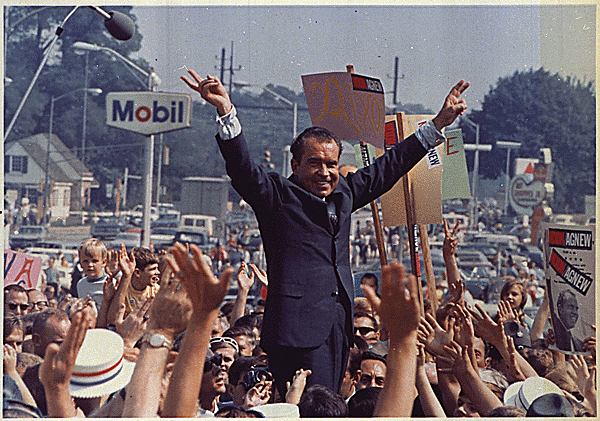 |
| Nixon and supporters, 1968 |
Memorable as well is the reporter’s
observations on Nixon’s reception for delegates, this again prior to the nominations. Here Nixon and his wife greet patiently the
long line of followers eager for a few seconds with their revered candidate,
who shakes the hand of each and gives them a few precious seconds of greeting. And who are these followers back in that distant
pre-Tea Party time? Not the biggies
present at the Gala, but the little Republicans: small-town druggists and bank
tellers and high school principals, widows with a tidy income, retired doctors,
minor executives, farmers who own their own farm, salesmen, librarians, and
editors of the local newspaper – older Wasps from the Midwest and Far West who
lead quiet, orderly lives and adore their candidate in a way to deep for
applause. These are Nixon’s people and
he knows it and is at ease with them, as he never quite is with the press. This is sensitive reporting from a reporter
for whom these people have to be aliens, since he is the Brooklyn-raised son of
a Jewish immigrant father and now hobnobs with (and sometimes head-butts and
punches) literary lions and the elite of the urban intelligentsia.
(A personal aside: They are my people too, or were, since I grew
up in a middle-class suburb of Chicago that was quietly but staunchly
Republican, my father a corporation lawyer, and our neighbors Chicago businessmen,
local merchants, university professors, the night editor of a Chicago
newspaper, and a dentist -- good, solid, orderly folk for whom the name of
Roosevelt was anathema and who surely voted for Nixon, as for Eisenhower and
Dewey before him.)
A further surprising conclusion of the
reporter: Too long a damned minority,
perhaps it is time for the Wasp to come to power again. The Left, he opines, lacks a vision
sufficiently complex to give life to America; it is too full of kicks and pot
and orgy, the howls of electronics and LSD.
And again, this from a man steeped in booze and drugs, ever ready for an
altercation or a fight. As for Nixon, in
his acceptance speech he pledged “to bring an honorable end to the war in
Vietnam,” proving once again that, for all his faults, politically he was no
fool.
What a contrast were these tranquil scenes
in Miami with the riotous events of the Democratic convention in Chicago later
that same month of August! There, in the
wake of the assassinations of Martin Luther King and Robert Kennedy earlier in
the year, all the furies of the war protest movement converged, joined by
anarchists and Yippies and Students for a Democratic Society (SDS) and other
groups, for a dramatic confrontation with Mayor Daley’s police and National
Guardsmen. Bearded, balding, and spectacled,
Allen Ginsberg showed up prepared to calm the Yippies’ Festival of Life with
his meditative chant of OM. With him
came Beat author and heroin addict William Boroughs, and French author and
ex-thief Jean Genet, both of whom Esquire
magazine had commissioned to
cover the convention. Whatever their
stated motives, in counterculture circles Chicago promised to be a rich stew of
protest that no one wanted to miss out on.
To understand the two conventions in
August 1968, one needs to understand the events preceding them in that eventful
year. Here is a brief chronology:
· January 16. The
first manifesto of the newly organized Youth International Party announces that
the Yippies will be in Chicago in August for a Festival of Life, coinciding
with the Democratic convention, which they label a Festival of Death. The threats of LBJ (President Johnson) and
Mayor Daley will not stop them, they insist.
· January 31. The
North Vietnamese launch the surprise Tet Offensive throughout South Vietnam,
catching the U.S. and South Vietnamese forces off guard; even the U.S. embassy
in Saigon is briefly invaded. The
attack is repulsed, but, contrary to statements by the Pentagon and the Johnson
administration, it proves that North Vietnam is far from defeated in the war.
· March 12.
Senator Eugene McCarthy of Minnesota, an opponent of the war, wins 42% of the New Hampshire primary
vote to President Johnson’s 49%,
surprising everyone by the strength of his support. He is now the hope of the antiwar movement.
· March 16.
Senator Robert Kennedy of New York announces his candidacy, splitting
the antiwar movement. McCarthy’s supporters
denounce Kennedy as an opportunist and Johnny-come-lately for having entered the
contest only after McCarthy showed the strength of that movement (an opinion that I at the time
shared).
· March 31. Aware
of his growing unpopularity, Lyndon Johnson stuns the nation by announcing he
will not seek reelection. The race to
succeed him is now wide open.
· April 4. Martin
Luther King is assassinated in Memphis.
Black ghettoes in many cities, including Mayor Richard Daley’s Chicago,
erupt in riots. Daley, who rules Chicago
with an iron hand, tells the police to shoot to kill any arsonist or anyone
with a Molotov cocktail in his hand.
Reported in the press, this order causes a sensation and becomes highly
controversial.
· April 23. To
protest university administration policies, Students for a Democratic Society
(SDS) and militant black students occupy buildings on the Columbia University campus and seven days later are
violently evicted by police. These
events are emblematic of campus unrest throughout the nation, as students rebel
against authority, and young men threatened by the draft burn their draft cards
and vow, “Hell no, we won’t go!”
· April 27. An
antiwar march in Chicago organized by the National Mobilization Committee to
End the War in Vietnam ends with police beating many of the marchers.
· April 27.
Vice-President Hubert Humphrey, a longtime liberal, announces his candidacy. A supporter of Johnson’s policies, he gets
the backing of the Democratic establishment.
· June 5. Robert
Kennedy is assassinated In Los Angeles.
His supporters are in disarray, disliking both McCarthy and Humphrey.
· August 8. The
Republican convention in Miami Beach nominates Richard Nixon as their
presidential candidate.
· August 10. Urged
on by many Kennedy supporters, after some hesitation Senator George McGovern of
South Dakota announces his candidacy only two weeks before the Democratic
convention. Long an opponent of the war,
he is backed by many Kennedy followers.
· August 26-29.
The Democratic national convention in Mayor Daley’s Chicago, with antiwar
demonstrators out in force. Daley has
vowed that “No thousands will come to our city and take over our streets, our
city, our convention.” The stage is set
for a violent confrontation.
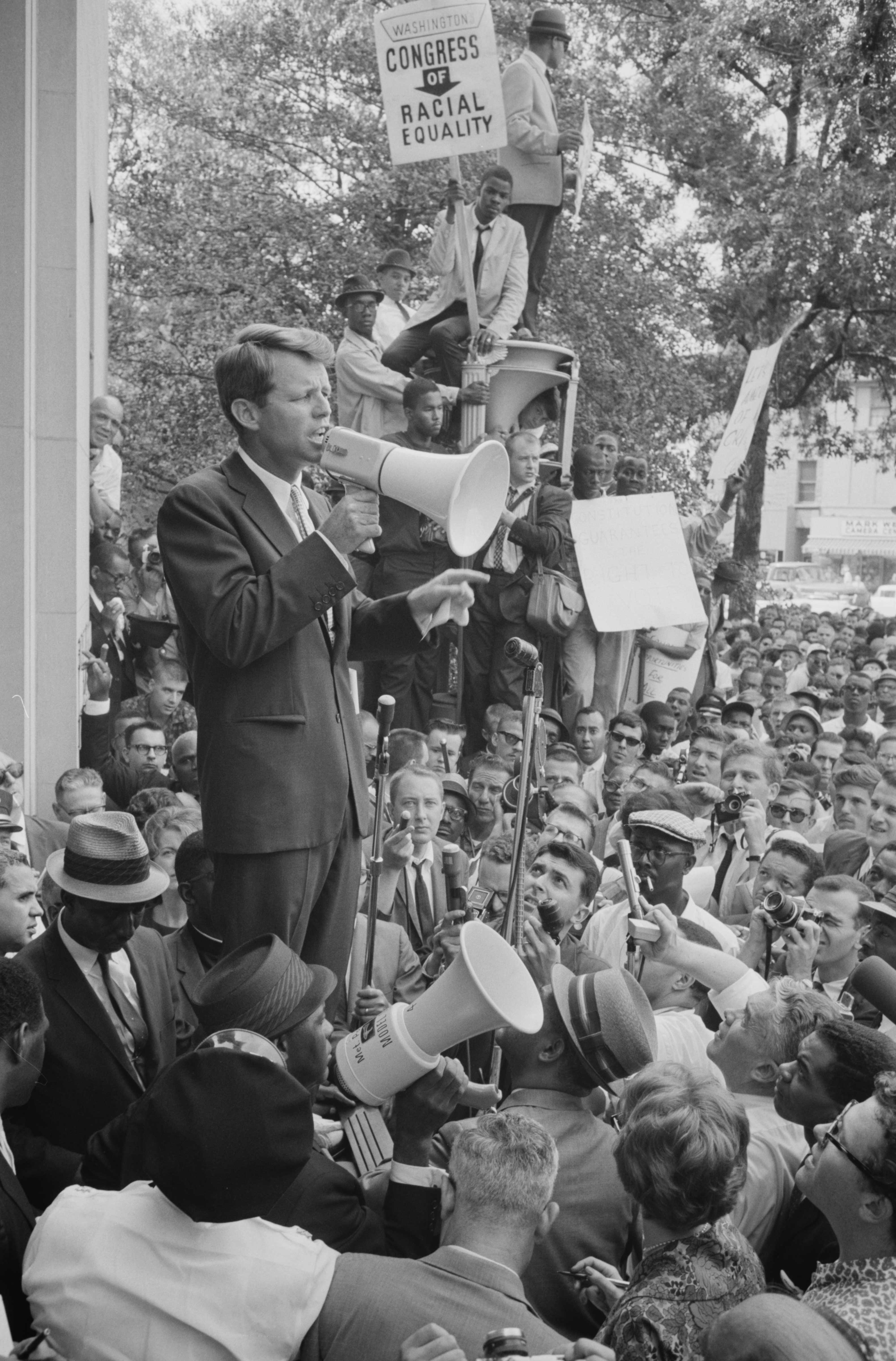 |
| Robert Kennedy in 1963. He knew how to reach people. |
Mailer liked Chicago, quickly realized
that Chicagoans resembled the people of Brooklyn he grew up among: simple,
strong, warm-spirited, sly, rough, tricky, and good-natured. (With most of this I agree, having grown up
in a Chicago suburb.) But he was there
for other reasons. Like many, he mourned
the loss of Robert Kennedy and for an antiwar candidate found himself stuck
with Eugene McCarthy, whom he remembered from a cocktail party in Cambridge
soon after Kennedy’s death. At the party
McCarthy had looked weary beyond belief, his skin a used-up yellow, as he tried
to answer the inevitable idiotic questions of others. McCarthy was not a mixer, Mailer concluded,
and a man too private for the mixing required in politics, seeming less like a
presidential candidate than the dean of the finest English department in the
land. (I had reached a similar
conclusion from the fact that he was also a poet. A poet in the White House? – no way! In some countries, perhaps, but in this one,
never.)
 |
| Eugene McCarthy. Too much of a thinker to be President? |
When McCarthy arrived now at the airport
in Chicago and was welcomed by five thousand enthusiastic supporters, he seemed
full of energy and happy. But when he
addressed the crowd for a few minutes, he spoke mildly with a certain
detachment; they wanted fire, he gave them ice.
When Mailer encountered McCarthy with some friends a few days later in a
restaurant, the senator, no longer a serious candidate since Humphrey had been
chosen, seemed relaxed and in good humor.
Yet when Mailer looked across the table at the senator, he saw a
toughness in his face. A complex man, probably
too complex to be President.
 |
| Hubert Humphrey, with the famous smile that helped win him the name of the Happy Warrior. |
For Hubert Humphrey, Mailer has less to
say. In sharp contrast to McCarthy, he
arrived with almost no one to greet him at the airport, just a handful of his
staff. He would then go against political
common sense and forfeit any chance of winning by remaining Johnson’s boy,
afraid to face the collective wrath of the President and the military-industrial
establishment by coming out against the war.
But while a divided and turbulent
Democratic convention was proceeding inside the International Amphitheatre, on the
city’s south side near the stockyards, outside in the streets an even more
turbulent drama was unfolding. Mayor
Daley had decreed that no one would be allowed in the parks after 11p.m., so
thousands of protesters decided to remain.
And since Daley had decreed that the protesters would not be allowed to
march, they vowed to march whenever and wherever they wished. Daley had massed thousands of police and National
Guardsmen, but there were thousands of demonstrators, making violent clashes
almost inevitable. And clashes there
were, night after night. When not
fighting the police, the young demonstrators shouted “Dump the Hump!” (meaning
Humphrey), sang “We Shall Overcome,” and called out “Join us!” to bystanders,
some of whom actually did.
 |
| Mayor Daley (left) with President Johnson. |
Witnessing some of these events and
getting reports about others, Mailer provides vivid descriptions of many. He
himself, being Mailer, manages to get arrested twice by the National Guard, but
is released when brought before the officer in charge. Here are some of the highlights of his
reporting, which he supplements with firsthand Village Voice accounts of events that he missed:
· Allen Ginsberg in Lincoln Park chanting OM and
tinkling his finger cymbals peacefully, with William Boroughs and Jean Genet
close by, when huge tear-gas canisters come crashing into the center of the
gathering, sending people running and screaming in all directions, while a line
of police advance, swatting at stragglers and crumpled figures on the ground,
until angry fugitives swarm into the streets, blocking traffic, fighting
plainclothesmen, setting fire to trash cans, and demolishing police patrol cars
with a rain of missiles.
· The police tear-gassing protesters in Grant Park, with
the wind blowing the gas across Michigan Boulevard into the Conrad Hilton, a
huge looming structure housing the Humphrey and McCarthy headquarters, many
delegates, and much of the press, who suffer smarting eyes and burning throats, and from
their windows see the drama unfolding below.
· A delegate, addressing the kids in the park, calls up
to the delegates and campaign workers in the Hilton (his voice presumably
amplified), “If you are with us, blink
your lights,” and lights begin to blink in the Hilton, ten, then twenty, then
fifty, till whole banks of lights at the McCarthy headquarters on the 15th
and 23rd floors flash on and off, and the crowd of bruised and
bloodied kids, in spite of the sour vomit odor of the Mace that has been used
on them, in spite of everything, cheer.
· While Mailer watches safely from his 19th
floor window in the Hilton (he admittedly has no appetite for tear gas or
Mace), the police chase demonstrators, beat them, bloody them, only to find
them reforming their ranks to taunt and challenge them again, till the police,
in what becomes an out-and-out police riot, charge a crowd of bystanders
watching quietly from behind barriers in front of the Hilton, crushing the
bystanders against a plate glass window that shatters, tumbling the people into
the hotel bar, where the police follow to beat the occupants, including some
who had been quietly drinking at the bar.
 |
| Police attacking demonstrators outside the convention. |
· Demonstrators, reporters, and McCarthy workers, along
with doctors beaten by the police when they tried to help wounded
demonstrators, stagger into the Hilton
lobby, blood streaming from their wounds, amid the stench of tear gas, and of stink
bombs hurled outside by the Yippies.
· In the convention hall Senator Ribicoff of Connecticut
nominates George McGovern, saying that with him as President “we wouldn’t have
those Gestapo tactics in the streets of Chicago,” at which point Mayor Daley
leaps to his feet, shakes his fist at the podium, and shouts insults that most
of those present can’t hear, but that TV lip-readers throughout the country
interpret, rightly or wrongly, as “Fuck you, you Jew son of a bitch!” The incident provokes roars from the floor
and a buzz from the gallery. (Ribicoff
was indeed Jewish.)
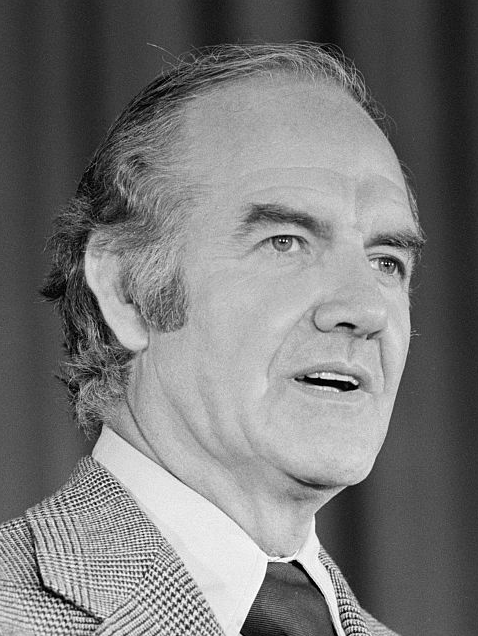 |
| George McGovern |
When the balloting began, there were no
surprises, for Humphrey was nominated on the very first round; masterminding
events from his ranch in Texas, where he was safe from the rowdy welcome his
appearance in Chicago might have provoked, LBJ had managed things well. But thanks to the TV cameras, the world had
witnessed what went on inside and outside the hall, and the bruised and
bandaged protesters knew it, shouting “The whole world is watching,” and
considered the whole riotous event a victory.
There were excesses on both sides, but far more on the side of Daley and
his goons. Mailer reflects on the thin
line that divides the police from criminals, observing that the mass of
policemen are a criminal force restrained by their guilt, and by a sprinkling
of career men working earnestly for a balance between justice and authority.
Watching the televised events in Chicago, the
nation decided, I suggest, that it needed someone safe and sane in the White
House, someone speaking with a voice of moderation: Richard Nixon. And so it came to pass.
Note: This post has focused on Mailer the
journalist in Chicago and leaves out much else that happened there; anyone
unfamiliar with the story should read a comprehensive account, including the
subsequent trial of the Chicago Seven, leaders of the antiwar demonstrations
who were charged with conspiracy and inciting to riot. The next post will tell how Mailer stabbed
his second wife, assaulted Gore Vidal twice, ran for mayor of New York, helped
get parole for a convicted murderer still capable of murder, and managed to be
legally married to three different women sequentially in the space of one
week. Plus two Mailer-inspired personal
asides: one on me and my brief career in boxing (Mailer fancied himself a boxer;
I did not), and one naming which famous deceased writers I would want to avoid
(Mailer being one of them) and which ones I would like to hang out with.
Coming soon: More Mailer, as indicated above. Then: Hell House, the Latest Form of Christian Terrorism.
Coming soon: More Mailer, as indicated above. Then: Hell House, the Latest Form of Christian Terrorism.
©
2014 Clifford Browder


