Sunday, March 10, 2019

399. The Magic of Trash: Finders Keepers, Ptolemy, and Voodoo


BROWDERBOOKS


My latest:


 The Eye That Never Sleeps eimage.jpg


A story of the strangest friendship that ever was: a dapper young bank thief and the detective hired by the banks to apprehend him.  For more about this and my other books, go here.  

Fascinating New Yorkers has been reviewed by The US Review of Books.  Reviewer Gabriella Tutino says, "There's something for everyone here in this collection of profiles, and it serves as a source of inspiration for readers who love NYC."  For the whole review, click on US Review.

                   The Magic of Trash:
    Finders Keepers, Ptolemy, and Voodoo


         The streets and sidewalks of New York have tales to tell. One never knows what one may find there.  I don’t mean the big stuff like discarded furniture, but little stuff dropped by accident or thrown away as trash.  The Metropolitan section of the Times of February 24 of this year has an Album page with photos and  text by Sara Barrett.  Under the caption “Lost and Found” she lists lost items she has found on the pavements of the city, with photos that she began taking of them, framed as the items were by crosswalk stripes, cracked asphalt, and black dots of sidewalk gum.  The photos show a key, gloves, a small bag spilling out yellow sticks of French fries, a little toy truck, and one or two items that I can’t make out.  Each dropped item has a story, though one will never know it.   

         To round out her piece, Barrett adds an anecdote told her by a friend. One Thanksgiving the friend saw a man carrying out of Whole Foods a large tray with what looked like a family dinner: turkey, stuffing, cranberry dressing, mashed potatoes, cornbread, pie, the works.  Alas, he stumbled and it all went on the ground.  Food everywhere – what a photo it would have made!

         I too have my stories about dropped or lost items on pavement.  I’ll start with one that grieves me to this day.  I had done a freelance editing job for Johnson Reprint, an affiliate of Harcourt Brace Jovanovich.  By way of extra thanks, the in-house editor wrapped up for me a replica of Ptolemy’s map of the world, a 2nd century BCE map based on the geographer Claudius Ptolemy's Geography (circa 150 BCE).  Used for centuries thereafter, the map was featured in the text I had edited, which was to appear in a limited edition, a costly collector's item accompanied by the replica.  I was thrilled to have the replica and planned to mount it on the wall of my apartment.  As I walked through midtown to the subway, I stopped to rearrange the several items I was burdened with, and in so doing left the Ptolemy map behind.  Only when I got home did I discover its loss, too late to retrieve it: gone!  Whoever found it found a rare item, and must have wondered how and why it had been left on a midtown street.  I hope they found a good use for it.
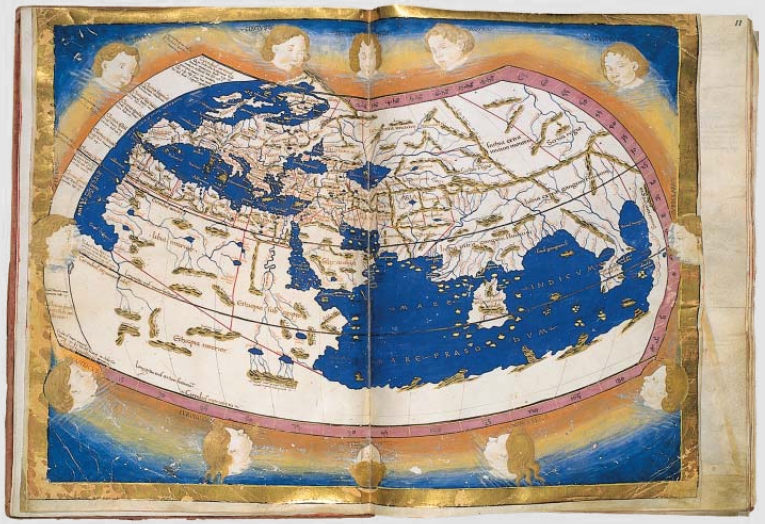
File:Ptolemy World Map.jpg
Ptolemy's map of the world, as reproduced in a European monastery in 1467.  Accurate for Europe and North Africa, 
hazy for the Far East.

         In that case I was the loser, but I have often been the finder.  In or next to an overflowing trash can on West 4thStreet in the Village I once found a law student’s class notes, now discarded perhaps in celebration of getting his degree and moving on.  The notes meant nothing to me, but they were bound in binders that I could indeed use, so I tossed the notes and trotted off with the binders.

         A few years ago, on the day following the annual Gay Pride Parade in June, I found a discarded little rainbow flag attached to a splintered stick.  I grabbed it, repaired the splintered stick with tape, and display the flag annually every June.

File:Rainbow - DC Gay Pride Parade 2012 (7171189629).jpg
Tim Evanson


         Once a lost item delivered itself to me.  One windy afternoon I saw a large black umbrella come flying through the air.  It drifted up, then down, and finally bounced and skittered along over the pavement.  I quickly grabbed it, and discovered it was missing its U-shaped handle, but was otherwise intact and usable.  I waited for a few minutes, expecting to see its owner, holding the handle, come dashing after it, but no one appeared.  Finders keepers.  So I took my trouvaille home, and it served me well for years.

         For decades I have been the guy who finds pens, especially push-point pens.  I have found them on sidewalks in the city, in parks, along highways, and even on wilderness trails.  Half of them worked, half didn’t.  Thanks to those that did, I’ve rarely needed to buy new pens.

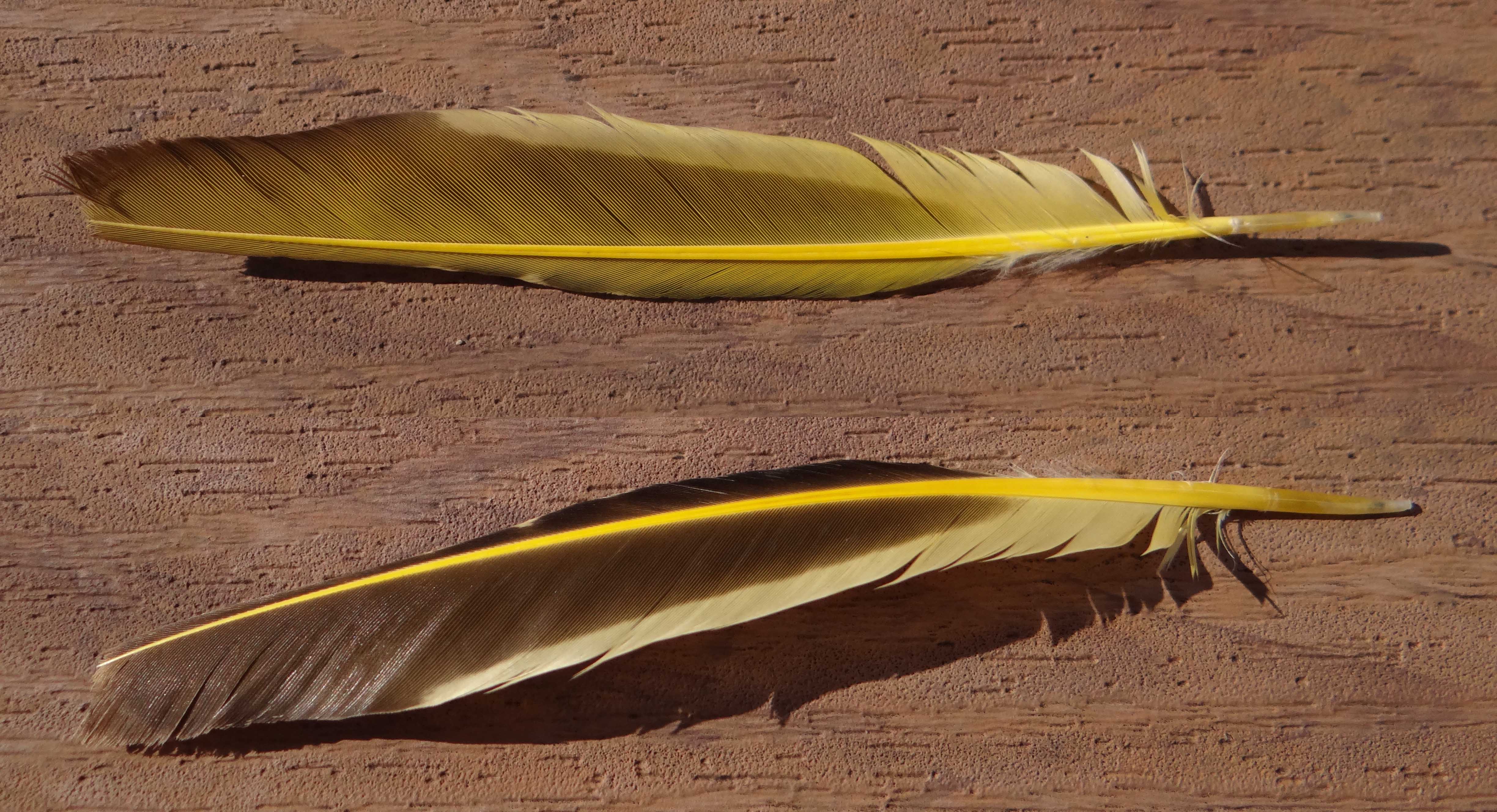
         Another item I keep an eye out for on the streets is feathers; I need them for my hats, especially my Aussie outback hats, of which only one now survives.   When new, these hats have a smart look with one brim pinned back to the crown; adding a feather gives them a nice jaunty touch.  Back in my hiking days I found bright yellow flicker feathers, probably the result of a hawk’s kill.  But those days and hikes are over, so I have to settle for pigeon feathers, which are only dull gray or a mix of white and gray.  How I yearn for color!

File:Feather on Grass.jpg
A pigeon's feather.  Not much color here.
Prosthetic Head

File:Yellow feather.jpg
Flicker feathers.  See why I prefer them to pigeon feathers?
Yellowfeather

         Another find: a panel of blonde wood, about 9 by 16 inches, that was leaning against a trash can on Seventh Avenue.  On an impulse I picked it up, admired its finish, and discovered why it had been discarded: a thin crack.  But the crack blended in nicely with the grain and was hardly noticeable, so I took it.  Today it sits in my downtown-facing bedroom window, with a Christmas cactus on it, though I hope to move the cactus elsewhere, so I can admire the panel itself.  I love woody things.

         The oddest find I ever had was not on the street but inside.  Going up the monumental stairs inside the front entrance of the public library building at Fifth Avenue and 42ndStreet, I found there on the steps what looked like a pair of men’s briefs.  Dumbfounded, I paused and looked again.  Yes, men’s briefs.  Why and how they got there, I will never know.  I went on up the stairs, wondering, and wonder to this day.

         If I included parks and gardens, I could add two items that litter such spaces throughout the country: orange peels and used condoms.  Such deposits cause foreign visitors to assume that Americans make lots of love and eat an inordinate amount of oranges.  But to these two items I would add a third: plastic spoons.  

File:Orange peels-02.jpg
Everywhere.  As for the other, you know what they look like.
Saycheeeeeese

And whenever, in the past, I hiked a trail that for a little while went alongside a highway, as I once did in Pelham Bay Park, the ground along that highway was littered with items thrown from cars: plastic cups and spoons, cigarette butts, empty matchbooks, crumpled tissues, newspapers and magazines, broken combs – whatever.  Motorists blithely toss things out the window and think they’ve disposed of them, which for themselves they have; but their trash hasn’t disappeared, it’s there for someone else to pick up – or not pick up.  Let’s face it, Americans are pigs.  We think a yard or garden is an ashtray, and a park a trash dump.  And we could do so much better.

File:"Viewing" Site for Visitors at Portland Airport - And the View They Leave behind Them 05-1973 (4272364454).jpg
Portland Airport
U.S. National Archives

File:Missione del Guaricano-discarica di Duquesa.jpg
It's bad in the U.S., but it could be worse.
This is in the Dominican Republic.

Twice25
         And that’s not all.  Hiking on a trail on Staten Island, just past Moses’ Folly – the looming, unfinished overpasses of a Robert Moses throughway that Staten Islanders succeeded in stopping – I used to go down a steep descent to a streambed, and then up again to another stretch of canceled highway.  At the bottom, near the stream, loomed four or five strange shapes combining rusty metal, glass, and verdant overgrowth: abandoned automobiles that people had dumped there and left, and which nature had slowly covered with growth.  Well hidden, these relics at least were not eyesores; in fact, they had a certain weird beauty, a touch of surrealism.

File:1942 Chevrolet Army Truck (15381347214).jpg
GPS 56

         Getting back to the city’s streets and sidewalks, I will note that some items are strictly seasonal.  In winter, gloves., usually just one.  In spring, the shed white petals of the Callery pear tree (Pyrus calleryana), an import from China now planted as a shade tree.  The second most common shade tree in the city, every April it explodes into masses of white blossoms.  Everyone sees the blossoms, but apart from a few botanists, I’m the only one who knows the name of the tree, a source of great petty delight to me every spring.  But it’s best not to sniff the blossoms, since they smell of rotting fish and semen.   Whew!  And who or what is “Callery”?  No idea.

File:Callery pear pyrus calleryana tree blossoms.jpg
Lovely to look at; don't sniff.

         In summer, tiny wildflowers poke up through cracks in the sidewalks.  Not lost or dropped items, to be sure, but since I’m the only one to notice them and even seek them out, I include them anyway, so I can enjoy another great petty delight.  

         Similarly, in the fall the bright golden yellow of seaside goldenrod (Solidago sempervorens) pokes out on the sides of numerous Hudson River piers, whose renovated parklike surfaces rest upon the rotten wood of the original piers. Cracks and crevices in those old piers hold the tiny pockets of soil that nourish the plants.  Looking down from the railing lining the edge of the piers, I rarely fail to see the goldenrod’s clublike spikes of flowers and thick, fleshy green leaves – the last goldenrod of the season to bloom.

File:Solidago sempervirens L. (ASTERACEAE), Flor de Cubres.jpg


                  Every autumn, along the streets of the West Village, one sees the fan-shaped, bifurcated leaves of the gingko tree (Gingko biloba) turn yellow and fall to the ground.

File:Ginkgo biloba 010.JPG
Being unique in shape, the leaves are easy to recognize.
H. Zell
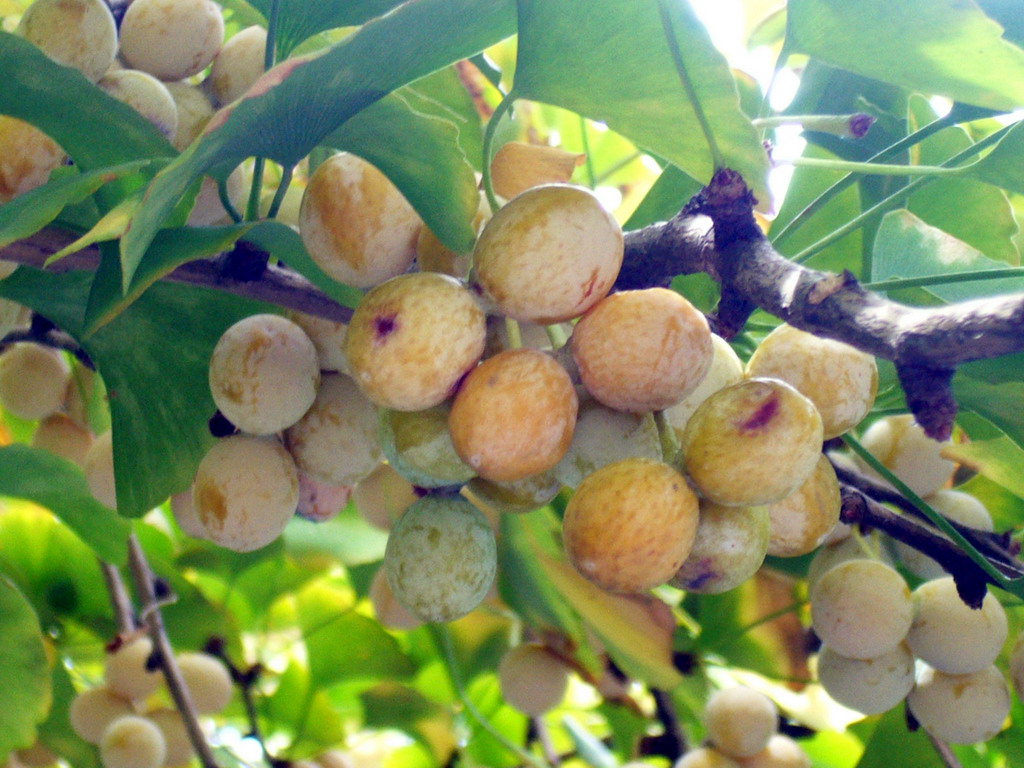
Another import from China and the only surviving species of its family (it dates back some 270 million years), it does well in urban environments and is planted widely as a shade tree.  In the fall it litters the ground with its nutlike seeds, but few passersby even notice, unless they squash one on the pavement.  

File:Ginkgo biloba seeds-002.jpg
Gingko fruit.  But to get at the seeds is work; 
you have to crack the nut open.

But in Pelham Bay Park I have seen older Chinese women plucking the fruit up from the grass.  Why?  Because the seeds are used in traditional Chinese cooking, and in Chinese medicine as well – a medicinal use that Wikipedia insists is not justified by controlled studies.  Also, extracts from the leaves are sold as dietary supplements beneficial for cognitive function, but here too Wikipedia finds no supporting scientific evidence.  Wikipedia, it should be noted, is notoriously hostile to alternative medicine, and should not be taken as the final word in such matters.  The controversial nutritionist Gary Null endorses such uses of gingko, and rails against the prejudices of Wikipedia.  Personally, if I were afflicted with memory loss and lack of attention, I’d give gingko a try, preferably under the guidance of an experienced professional.  The seeds have also been used as aphrodisiacs, but then, what hasn’t? (Examples: chili peppers, avocado, bananas, chocolate, honey, watermelon, olive oil, figs, artichoke, cherries, pumpkin seeds, carrots, and oh yes, that much vaunted myth of my teen years, Spanish fly.)


         The weirdest of my finds occurred years ago in Van Cortlandt Park, when in an open area I came upon a burnt site sprinkled with chicken feathers.  A burnt site by itself is not unusual, for families often picnic in the parks.  But why the feathers?  Then it hit me: voodoo.  I know little about voodoo, but it is practiced here among the Haitians.  Farfetched, you say?  So I thought, at first, but upon reflection I was sure. There was something about that site that suggested it, something weird.  Voodoo ceremonies often involve fire and the sacrifice of animals -- in this case, chickens.  So back then voodoo was being practiced in Van Cortlandt Park, and may still be practiced there today.

.File:Voodoo Experience 2009 (31 of 37).jpg
Voodoo celebration in New Orleans, 2009.  
But nothing like this, surely, in Van Cortlandt Park.
Joe Van


Coming soon:  ???


©  2019  Clifford Browder   

Sunday, March 3, 2019

398. New York vs. the Suburbs


                                           BROWDERBOOKS

My latest:


 The Eye That Never Sleeps eimage.jpg


A story of the strangest friendship that ever was: a dapper young bank thief and the detective hired by the banks to apprehend him. For more about this and my other books, go here.

                             A  BROWDERCHIRP

At the Vatican conclave of bishops called by the Pope to examine clerical abuse of minors, Archbishop Carlo Maria Vigano accused the Pope of protecting abusive gay clerics and called for his resignation.  His Eminence deems it appropriate that the meeting's opening date coincided with the feast of St. Peter Damian, an 11th-century monk who fought against sins of sodomy in the church.  But some church historians questioned the saint's relevance as a model, since he had also denounced as immoral a Byzantine princess who had introduced the practice of eating with a fork.

         NEW  YORK  vs.  THE  SUBURBS

         Big cities and suburbs often seem at odds.  Not surprising, since suburbs are people by refugees from big cities, and by others who are repelled by the idea of ever living or working in a city city.  Suburbanites think of themselves as neat, clean, honest, and law-abiding, as opposed to those deluded hordes of residents subject to the noise, dirt, congestion, and corruption of their metropolis.  I grew up in Evanston, Illinois, the first suburb north of Chicago, and this was certainly true of Evanstonians, sophisticated though they were in many ways.  Howard Street, the boundary, was lined on the Chicago side with liquor stores, whose owners and their political allies, having gobbled up Rogers Park, the neighborhood just north of Howard Street and once an independent suburb, looked with lust on innocent Evanston.  Certainly it was a tempting target, being headquarters of the WCTU and the driest of very dry communities.  But the Evanston dads who commuted to jobs in Chicago, as mine did, were very much a part of Chicago too, and many an Evanstonian snuck across Howard Street, or drove west to get beyond the bounds of Evanston, to stock up, ever so discreetly, on their supply of liquor.  So suburbs are linked indissolubly to their big city, unlike, say, New York upstaters who can assert convincingly that they depend in no way on the Big Apple, and would be quite happy if it managed to somehow disappear.  (Except, of course, that state tax revenues from New Yorkers help pay for various statewide amenities that upstaters too enjoy.)

         That said, let’s have a look at how my deceased partner Bob, a Jersey City boy turned inveterate New Yorker, viewed the suburbs during what he called his Proustian adventure of February 23, 1991, and recorded the next day in his diary.  For on that occasion he and his aging mother were taken by relatives to Wayne, New Jersey, to visit his widowed Tante Martha, age 88, his mother’s older sister, now living in a nursing home in that community.  The home, a sprawling one-level complex, smelled and looked like a hospital, and Martha was allowed a pitifully small space with a narrow bed, small table with artificial plants, a calendar on the wall, a closet, and a shared bathroom.  Martha looked much as she had when Bob last saw her eight years earlier, except for her swollen legs, the result of frostbite from over a year earlier, when she fell in her garden and lay helpless on the ground for hours, before anyone discovered her.  Always dominant, she talked endlessly, reminding Bob of a  Samuel Beckett play or a scene from his novel Malone Meurt.  At times she looked at Bob’s mother and told her of her sister Hedwig in Jersey City, unaware that Hedwig was right there in front of her.  Yet her voice was clear and she seemed marvelously healthy, her nutmeg-colored skin making Bob’s mother seem pale by comparison.

         By noon Bob and his mother found themselves in the plush living room of his cousin Fred and his wife Donna, and the real suburban adventure began.  There was not one book in sight. – for Bob, a telling  detail.  Instead, on the coffee table there were photos, and on the piano stool, sheet music.  Fred looked older, having gray hair, and lines on his face that spoke of years of hard work.  Years and years and years dominated the conversation and how everyone had changed.  But when Donna told Bob that he hadn’t changed, he was aware of the makeup on his face, but pleased, being determined to be himself (albeit gay, though only his mother knew it) and project a younger Laggy.  They then sat around the dining room table and had coffee and cakes, and two hours later, after Donna took some photos, they disbanded. 

         We were in a suburban fantasy land with a lush blue sky overhead, extraordinarily vital air, and also an awful sense of the kind of remoteness I experienced in Stafford, Virginia, almost a year ago.  WAYNE and STAFFORD, where in each place you look out a window and see clarity of light, but, baby, no New York Times paper machine and no Chinese restaurant a block away.  Except for the automobile, there is no quite feasible way of buying a container of milk.  One can walk, but it requires stamina and time.

So ended Bob’s visit to the fantasy land of suburbia, where he rarely ventured and and could not imagine living. 

          What then was Bob’s life like in the city?  Let’s just have a look at the month of March 1991, as recorded in his diary, usually written at the Hunan Spring restaurant at the corner of West 11th and Bleecker, one block from our building.  I’ll give only the highlights.  The first March entry is on the 3rd.

March 3.  Had his friend Hugh Manning over for dinner and a slide show of his recent visit to the Grand Canyon.  Gave Hugh a Navajo silver/turquoise/coral piece of jewelry that he bought at the Canyon; Hugh loved it.  Did the slide show to Wagnerian music and cognac.  / Remembers being recently accosted in a friendly way by a Chinese man he didn’t recognize – probably well-tipped waiter from a restaurant. / When Hugh was here, he and Cliff and I made an impromptu phone call to Mary Stanley in Bath, Maine, having once rented rooms in her summer home on Monhegan Island.  Wonders if Mary, now close to 90, had ever experienced passion, love, or kindness.

March 5.  Contemplating retirement from Jersey City Public Library, learned that his health insurance will continue after retirement.  Hopes then to visit Nantucket at least once a year. / Picked up his tax return at H&R Block; will get a substantial refund, can buy a new desk chair and living room drapes, and pay off part of his charge account debt.

March 7.  Must work another 2 or 3 years to get Social Security and Medicare coverage. / Got good report from Dr. Fox; blood pressure okay. / Saw two Diaghilev ballets by the Joffrey at the State Theater. / From the restaurant can see the apartment above the White Horse Tavern where Hortense Seliger, his mistress (briefly) of many years ago, once lived.  Hears conversation of two gay men at a nearby table: “I don’t give my love easily, but he just hates me.”

March 11.  Angry confrontation with his friend and coworker Natasha in Reference Department at the library. / Great evening with Cliff last Saturday; tender, breathtaking sex Sunday morning. / Saw mother in Jersey City, sitting in silence, waiting…  Took her to dinner at the Lincoln Inn.  Saw old friend and fellow librarian Joan there with her lover, Tony.

March 13.  Cold-warm weather as spring approaches. / Saw Joffrey production of Romeo and Juliet; memorable. / Edith, my virgin lesbian, with whom I attend concerts; an insomniac, frustrated. / Thinks of two women friends who won’t fully accept him as gay: “Bye, sucking shit-assed bitches!”

March 18.  Saw more Joffrey. / Showed Grand Canyon slides to Natasha and her husband Lee Saturday night, did dishes till 2 a.m. / Loquacious straight male duo nearby babble about cinema production, scripts, directors.  New York is the film capital of, hmm, the world.  Their derogatory attitude toward women.

March 21.  Political nonsense boiling again at library.  Director may be demoted and a new director brought in.   Wore yellow sweater to work to commemorate renewal of spring.  “I was a yellow rose, a finch, a pale antique coin.”

March 21.  At restaurant, remembers Hortense again; no time now to write her now.  “My final Manhattan has suffused me deliciously.”

March 24.  Fire in our friend Ed Kennebeck’s building on West 4th Street, but quickly controlled.  Arson?  Gay bashing?  Owners of ground-floor boutique are gay.  Detectives on the case.  Ed came over briefly, his clothes smelling of smoke. / Italian dinner with Cliff at the Napoli on Spring Street. / “In a week, a shitty Christian Easter.”   Will take Mom to dinner.

March 28.  Spoke for 10 minutes to the Library board, defending the integrity of the Reference Department; needs a full staff of six professionals; applauded by coworkers.

March 29,  Good Friday.  Took mother to beauty parlor, then to lunch at Lincoln Inn.  The Inn a geriatric club, the old gals wearing much jewelry and lipstick, and adoring their cocktails.  Coming back, remembers Hortense, with whom he once saw Parsifal on Good Friday.

April 1. Arthritis in finger; pain. / Cliff and I dined with Mom yesterday, Easter, at the Inn; we all had turkey.  Gave the hostess an expensive Dior dusting powder; she was delighted.  Cliff shows sincere interest in his mother.  She glowed.

         So much for March 1991.  Two thoughts:

·      Slide shows of the Grand Canyon, Joffrey ballets, a frustrated virgin lesbian friend, Italian and Chinese dinners, babble about cinema production, a suspected gay bashing…  No, Robert would not have been happy in Wayne, New Jersey, or any other suburb.  He needed New York, its cultural riches, its dangers, its diversity.


·      To have helped another human being fulfill him/herself sensually is no small thing.  Desire is holy.

Coming soon:  The Magic of Trash: Finders Keepers, Ptolemy and Voodoo.


©  2019  Clifford Browder  


Sunday, February 24, 2019

397. Artists or Whores? Geishas, Nautch Girls, and the Dancers of Lahore

                      BROWDERBOOKS

My latest:


 The Eye That Never Sleeps eimage.jpg


A story of the strangest friendship that ever was: a dapper young bank thief and the detective hired by the banks to apprehend him. For more about this and my other books, go here.


Artists or Whores?  Geishas, Nautch Girls, and the Dancers of Lahore

         This post takes a glance at certain occupations of women in foreign settings that have always enjoyed a somewhat ambiguous status.  I have no personal knowledge of these occupations or the societies that created them, but have consulted knowledgeable friends.  We’ll look first at the geishas in Japan.  We’ve all heard of them and, as Westerners, wondered to what extent their services include sex.  In other words, are they highly trained call girls or not?

The Geishas of Japan

         That Japan, which I have never visited, is a fiercely male-dominated society was first made clear to me when a gay friend who had married a Japanese woman explained,  “In Japan, if a husband wants to go out alone for an evening, the wife doesn’t ask any questions.”  Being addicted to gay sex, my friend took full advantage, and his wife, traditionally raised, let him do it and slowly began to understand where his true sexual preferences lay.  So far as I know, they stayed together, and as he got older, he had companionship at home to cushion the loss of youth and its adventures.  Not that I recommend such an arrangement for everyone; I felt sorry for the wife. That said, on to the geishas.

         The word “geisha” means “art person” or “entertainer,” and the traditional geisha must be proficient in music, dance, storytelling, and small talk.  The profession emerged in the eighteenth century, and its predecessors were indeed high-class prostitutes catering to the male elite.  The first geishas were in fact men who entertained clients waiting to see the most popular courtesans of the day.  So the confusion of geishas with high-class prostitutes dates from the very beginning of the profession.  In time the male geishas disappeared, and many geishas became entertainers only, artists whose services did not include sex.  Their role was distinctly different from that of the wife, who had to be modest, sober, responsible.  And the geisha was single; if she married, she had to leave the profession.


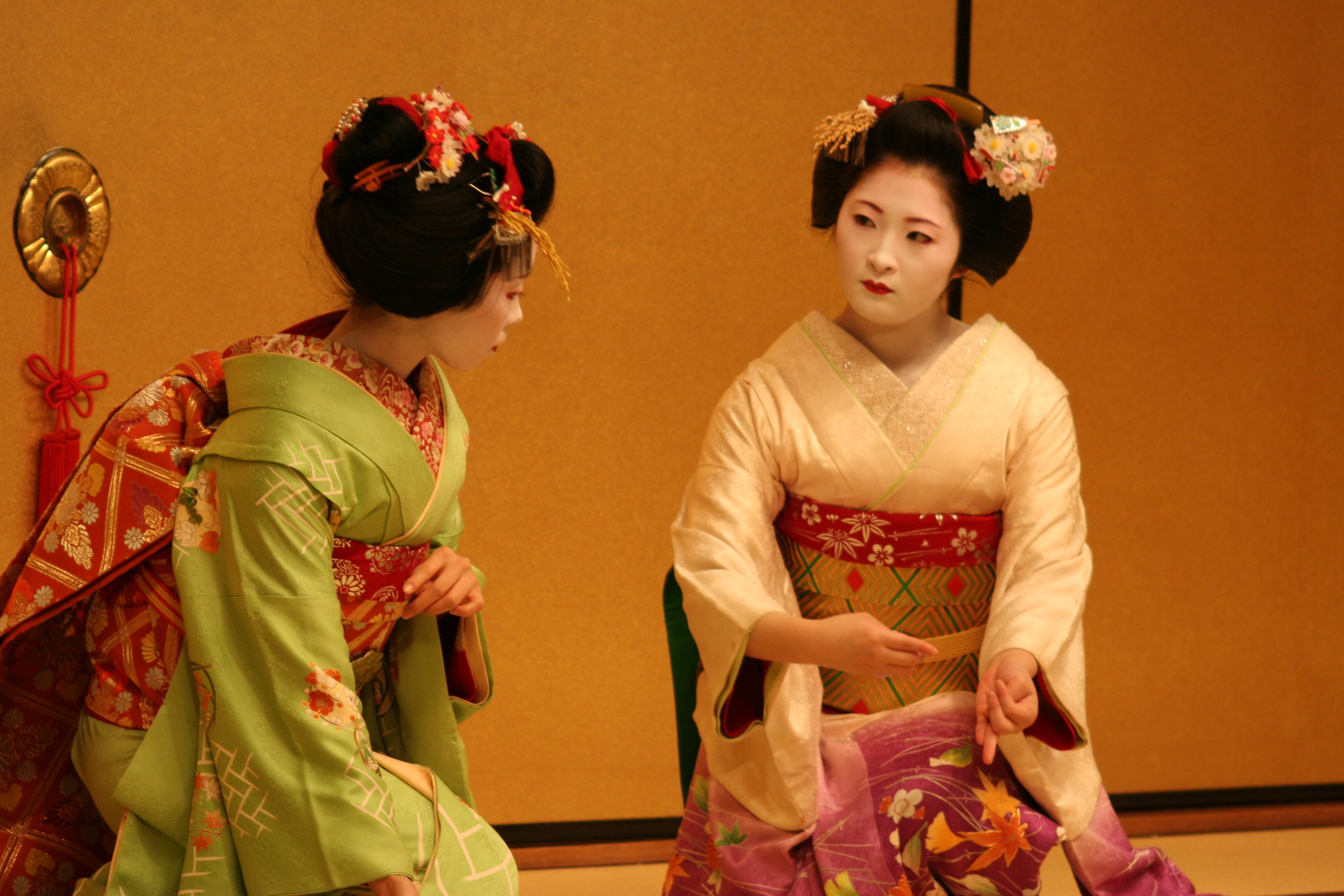
File:Geisha dance.jpg
Geishas dancing.
Jon Rawlinson

         In the aftermath of World War II, women had to go to work in factories or otherwise contribute to postwar reconstruction, and fewer women became geishas.  At the same time, prostitutes servicing the GIs began referring to themselves as “geisha girls.”  But there was also an effort to return to the traditional role of entertainment only, for which a rigorous training was required.  Geishas lived in geisha houses in what were called “tea house districts” or “entertainment districts,” though successful ones might move out and live on their own.  A geisha could have a boyfriend or lover, but this was quite apart from her life as a traditional geisha, which might involve flirting, but no sex.

         The 1953 Broadway play The Teahouse of the August Moon, later made into a movie, was a gentle spoof on postwar Americans trying to Westernize and democratize a village on the occupied island of Okinawa and getting “Easternized” instead.  One of the funniest scenes in the film is when a geisha tries to teach her movements to a bunch of village women; the contrast between her graceful movements and the clumsy ones of the fat and sweaty villagers is hilarious.  The play was even done on Okinawa with an authentic geisha playing the geisha.  Though Okinawans would in time have many complaints about the American occupation, the Americans’ ability to laugh at themselves was appreciated at the time.


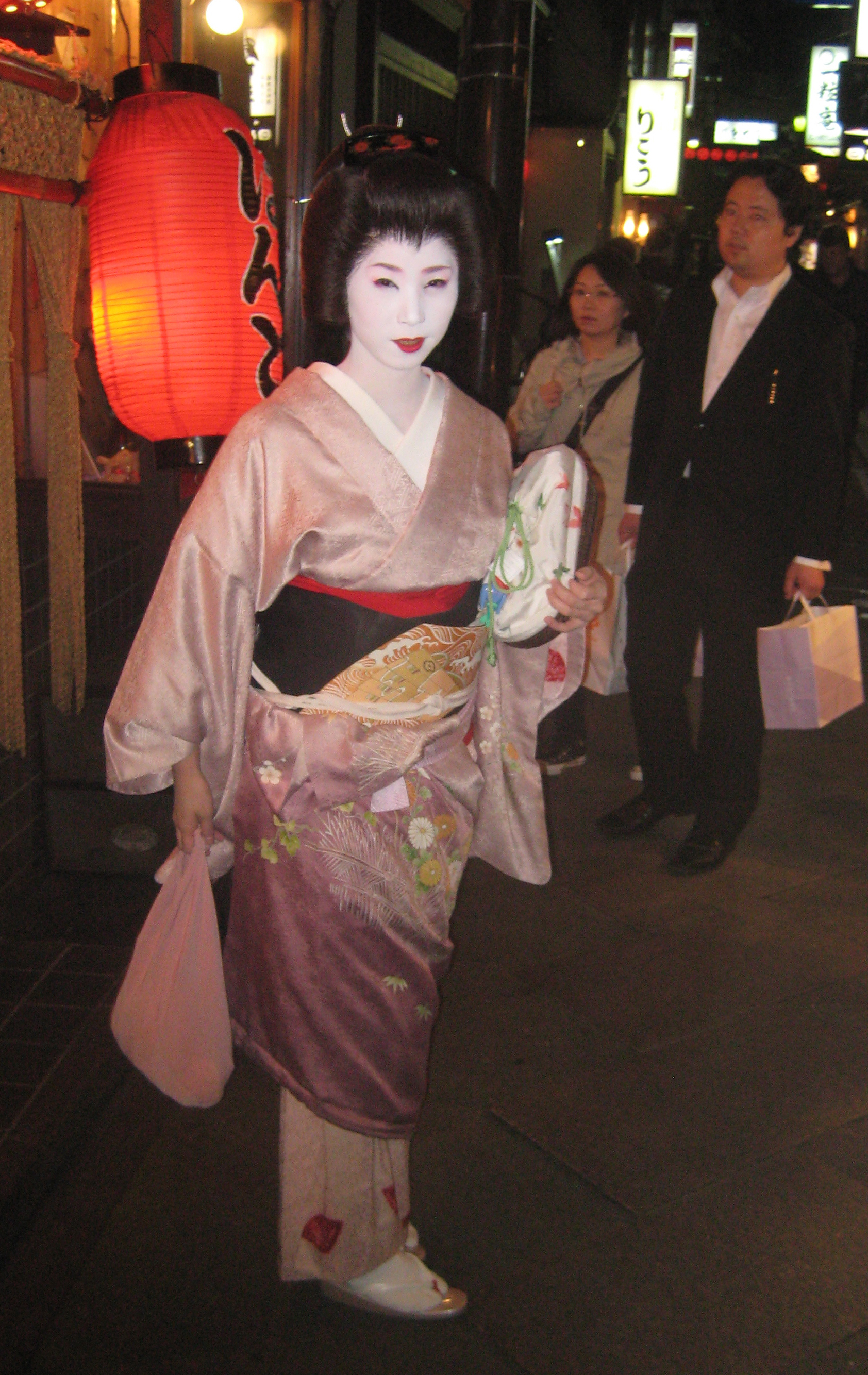
File:Geisha in Kyoto.jpg
A geisha in Kyoto today.
James Trosh

         And today?  The training of a geisha is, and always has been, long and arduous, and the kimonos and other accessories are costly.  Young women who choose to enter the profession may go deeply into debt to their mentors.  As a result, fewer young women are tempted to do so.  A geisha’s life is glamorous chiefly from the point of view of the male consumer.  When one sees a geisha today in Kyoto, a friend informs me, she is tightly scheduled and always in a rush.  Though geishas are not prostitutes, prostitutes have dressed in similar attire, causing confusion.  Also, Japanese men pressure geishas for sex and often succeed.  So the geishas still exist, but their profession is under siege.  And even by tourists, who pester them in the streets of the entertainment districts and even tug at their kimono sleeves, wanting to take their photograph.

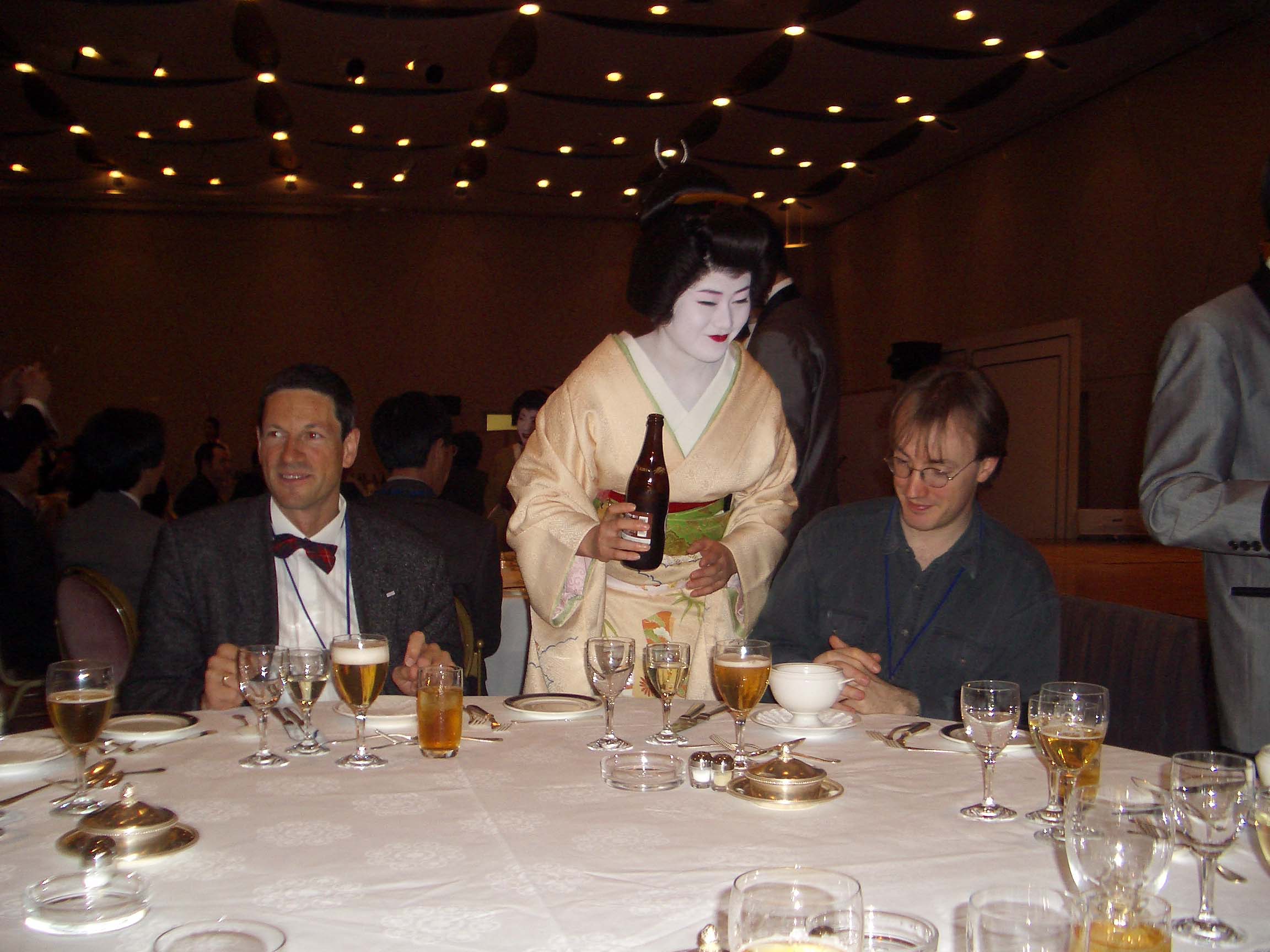
File:European banquet with geisha.jpg
A geisha at a banquet of Europeans today.
Steven & Courtney Johnson & Horwitz

         And how do the geishas stand in the eyes of feminists?  Japanese feminists have seen them as exploited, but many geishas insist that they are liberated feminists who support themselves while living in a women-centered society where males function only as guests: a special smaller world within the larger male-dominated society that is Japan.

The Nautch Girls of India

         Years ago I read a long Indian novel about life in India either just before independence or soon after.  Among the many characters was a dancer past her prime and concerned about the future of her daughter, who by tradition would become a dancer, too.  The dancers obviously enjoyed an ambiguous status, still in demand but not accepted by polite society.


File:Weeks Edwin Sketch Two Nautch Girls.jpg
Two nineteenth-century Nautch girls; a painting.

         A friend of mine from Calcutta told me how her great-grandfather and his friends debated earnestly over which renowned dancer, or Nautch girl, should be invited to dance for them on a holiday.  The dance was held in a hall from which the women of the household were excluded.  Paid well, the dancer gave them a spectacular performance, with confetti-like bits of colored paper on the floor that she kicked up into sprays of many colors.  My friend’s grandmother viewed the dancers as glorified prostitutes.


File:Nautch girls, Hyderabad; a photo by Hooper and Western.jpg
Two Nautch girls in Hyderabad; an 1860s photograph.

         Nautch girls existed in the Mughal period in India, when, in the sixteenth and seventeenth centuries, Muslim emperors ruled northern India.  Quite distinct from the temple dancers who performed for the Hindu gods thought to reside in a temple, Nautch girls performed for the ruling elite, and to do so were taught, at an early age, the art of music and dance and reciting poetry.  They were specialists in refined conversation, and used their beauty and charm to entertain their wealthy clients.  Often they had a long-term monogamous relationship with one client, who might be a British officer, a nawab, a rajah, or a wealthy landowner.  They flourished throughout India, but those from Lucknow, a prominent cultural center, were especially in demand and could charge high fees.  But when British women and missionaries began arriving in India, they put a stop to the Nautch girls seducing the British men.  Many influential Indians likewise began condemning the dancers, whose glory days were over.  Once independence came to India, the government did away with the large landowners, who then could no longer patronize the dancers, and the Nautch girls became a thing of the past.


File:Nautch Dancing Girls by Charles W. Bartlett, etching.jpg
Nautch girls dancing; a 1920s etching.

The Dancers of Lahore

         What prompted this post in the first place was an article in the Times of January 6, 2019, whose caption announced: They Once Danced for Royalty.  Now It’s Mostly Leering Men.  In an interview a Pakistani dancer tells how she once danced in rooms adorned with plush velvet pillows and fine carpets to the music of a troupe of trained musicians, entertaining the wealthiest men of Pakistan.  But now she travels with a boom box and dances for ogling men who want just one thing: sex.  Quite a comedown for a profession that for centuries performed in palaces for maharajahs and their guests.  Once a respected tradition akin to the geishas of Japan, the dancers offered not sex but refined companionship; they had to have knowledge of the arts, music, and even politics.  But it was always a risky occupation, especially for young dancers who might be sexually exploited.  Yet some of the dancers acquired wealth and influence, and even married into the elite. 


File:Nautch India.jpg
A dancer performing, 1899.

           The dancing girls of Lahore were closely related to the Nautch girls of India, for in the Mughal period and the time of the British Raj there was no Pakistan separate from India.  When British rule came to what is now Pakistan in 1858, the dancers were criticized by the Victorian colonizers as examples of the voluptuous indolence of the East.  But the dancers persisted, and more than one colonizer became colonized.  When independence came to Pakistan and India in 1947, and with it, violence, many Muslim dancers in northern India fled to Lahore, the cultural capital of Pakistan, where the art form enjoyed a renaissance.  If a dancer was courted over time by a customer, she might finally enter into a monogamous relationship with him and bear his children.  But as Pakistan became a more conservative Islamic state, it became less tolerant of the dancers, who were driven underground.  Now a dancer waits discreetly at home for phone calls from men who want to entertain their friends.  Some young dancers have fled abroad, but there are those who remain and insist that their art form is legitimate and strive to keep it alive.

In the West Today

         In male-dominated societies some women have always found ways to acquire a degree of independence, and these women in Japan, Pakistan, and India are good examples.  That they were at times confused with prostitutes reflects the fact that there were also gifted and successful courtesans who also achieved a degree of independence.  In Western societies these Eastern traditions did not exist, but some women escaped male dominance by presiding over salons frequented by the ruling elite, or by taking the veil and in time becoming a mother superior in charge of a community of nuns.  And in all societies some women have specialized in providing refined companionship and diversion to men other than what their wives could provide.

         In seventeenth and eighteenth-century France, ironically, marriage was a way to freedom.  Unmarried girls were closely supervised, so they could make a satisfactory marriage, but married women enjoyed considerable freedom.  This is seen in one noble’s dictum to his wife following their wedding night: “Madame, I give you full freedom, except for princes of the blood and lackeys.”  Princes of the blood posed political risks, and lackeys, being mere servants, were too demeaning, but otherwise the world – meaning the male world – was hers to conquer, preferably with a bit of tact, and he would be doing the same with women.  Of course one can question whether marital freedom was true freedom for women, or simply a form of subjugation by sex.


File:Ninon de Lenclos by L.F.Elle.gif
Ninon de Lenclos, a noted courtesan of seventeenth-century France.  She frequented salons, had one of her own,
encouraged the young Molière, and years later left money 

to the young Voltaire so he could buy books.  Power of a kind.

         In England and the U.S. the cause of women’s liberation was taken up by militant suffragettes, who after years of campaigning finally did win the vote.  But in the U.S. it’s no coincidence that Prohibition followed, banning the saloons that working-class males had always seen as their home away from home, and where much of their wages might disappear, before they went home to a peeved wife needing money to run the household and feed the kids.  One man’s (or woman’s) freedom can be another’s subjugation.  


Carrie Nation, a fiery temperance campaigner,
who took an ax to U.S. saloons and their contents.

           In France, women got the vote only in 1944, because the male ruling elite, fiercely anticlerical, were afraid that the women would vote for Catholic candidates.  And when I visited friends in Germany in 1953, my closest German friend, no stodgy conservative, thought American women much too independent.  And when his younger brother came to this country and served in the Air Force, he married not an American, but a young woman from Germany.  How it will go in the future for this country, where feminists have in many ways triumphed, but are still campaigning for more, I don’t profess to know.  But it will be interesting to watch from the sidelines as the fight sparks on … and on.


Source note:  For information about the dancing girls of Lahore, I am indebted to a Pakistani friend and to the Maria Abi-habib article mentioned earlier, which appeared in the International section of the New York Times of Sunday, January 6, 2019.

Coming soon:  Sin.