Sunday, August 16, 2015

193. Networking among the Sagehens


     The invitation, by e-mail:

PLEASE JOIN US
NEW YORK CITY NETWORKING EVENT
Thursday, July 30, 2015 – 6:30-8:30 pm
The Princeton Club
Nassau Room – 4th Floor
15 West 43rd Street
New York, NY 10036

So it read, the announcement beckoning all Sagehens in the New York area to an evening of networking, hosted by a ’77 alumnus, Managing Director of Group Risk Management for a well-known bank.  “Register now!” it directed.

     Sagehens?  Yes, I confess I’m not a lion or tiger or wildcat or cougar or eagle, but a Sagehen, this being the time-honored designation for all those who attend, or have attended, Pomona College in Claremont in distant sunny southern California.  But hardly a loyal and devoted Sagehen, since I have never attended an alumni gathering or class reunion in all these many years, and am now in touch with not a single other Sagehen, barring a distant friend in Florida.  About to hit my keyboard’s DELETE, I held off, beset by doubts and temptations.  Should I go or not?  After getting more info – bring your business cards, dress “business casual” -- I amassed thirteen arguments against and thirteen for.

     AGAINST:

1.    I’ve never consciously networked, hardly know what networking is.
2.    I’m long since retired, don’t need professional contacts, if that’s what it’s all about.
3.    I have no business card.
4.    I’m of the class of ’50, will be the oldest one there, the ancient of days.
5.    What can I say to a horde of eager young graduates stuffed to the gills with energy, hopes, and ambitions?
6.    The Princeton Club sounds posh and exclusive.
7.    The host, a managing director of Group Risk Management (whatever that is), sounds intimidating, must reek of prestige and success.
8.    They probably want money from me.
9.    I can’t wear shorts, since “business casual” excludes them.
10.  Getting there involves braving the rush hour.
11.  Rain is predicted.
12.  I harbor memories of two horrendous events – one in my freshman year and one in my junior year – that at the time left me in shock.
13.  I’m eighty-six; be prudent.

     FOR:

1.    Out of sheer curiosity, I should learn what networking is.
2.    I’m a writer, can’t retire.  I can tell them – ever so discreetly – about my blog, my novel, and the forthcoming book.
3.    I can show them – ever so discreetly – the postcard with my novel’s title and sexy cover illustration.
4.    As the ancient of days I can fake an aura of wisdom.
5.    All is grist to my mill.  I’ll do a post for my blog about them.
6.    The Princeton Club sounds posh and exclusive.
7.    Maybe I’ll find out what Group Risk Management is.
8.    Free eats, free drinks.
9.    I’ll wear a blue polo shirt, get compliments because blue is one of Pomona’s colors.
10.  I’m a veteran New Yorker, can handle anything.
11.  I have an umbrella.
12.  Time heals; focus on today.
13.  I’m eighty-six; dare!

File:Bapon Group.png
This is what I got, when I googled
"Networking."  Not much help.

Bapon.7g


File:BasicDesignNetwork.png
And this was no help either.
GNOME


     As the time to depart approached, I was inclined to go, but vowed not to join in any rah-rah stuff, as for instance:

Push on, Pomona, to a victory,
Push, Pomona, push!

(Admittedly, I don’t have the words quite right.)  Or, worse still:

Sagehens, sagehens,
Quack!  Quack!  Quack!

All right, that last is probably my invention.  Ducks quack; I don’t know what sagehens do, if anything.  In fact, I don’t know what they look like, except for Cecil Sagehen, an outsized replica that was a symbol and mascot of the college, until nefariously spirited away by those wicked Occidentals, our perennial football rivals.  (I assume that Cecil was finally recovered.)


Stuffed Cecil Sagehen
Cecil Sagehen, as marketed on campus today.
     A half hour before my scheduled departure, it was pouring rain; I was definitely not going.  Then the sun came out … briefly.  So I grabbed my umbrella and went.

     Getting there was not half the fun.  At 6 p.m. I exited the subway at Seventh Avenue and 42nd Street and was assailed by the glaring lights of Times Square, mobs of commuting New Yorkers, and hordes of tourists taking photos right and left.  Wherever I headed, the crowd was against me, and here and there I spotted a depraved-looking individual – always male, always solitary – who looked pathetically or menacingly out of it.  (Ah, the diversity of New York!)  I finally made it up to less crowded 43rd Street and marched confidently ahead – in the wrong direction.  Seeking Sixth Avenue, I arrived instead at Eighth, had to turn around and go the other way.  (Veteran New Yorker, indeed!)  Finally arriving at 15 West 43rd Street, I found it fenced off for renovation, went in by an improvised entrance, threaded my way through a labyrinth of narrow corridors, found an elevator, and got to the fourth floor.

File:Crowded TIMES SQUARE at night time.jpg
Tourists plus commuting New yorkers: it couldn't get worse.
Prayitno

     Greeted by welcomers, I was given an I.D. tag with my name and the telltale “’50,” went in.  The Nassau Room was a long room adjoining a terrace, with a big table heaped with appetizing dishes, waiters moving efficiently about, and a bar lined with bottles.  No sooner in, I was greeted by the host, he of Group Risk Management expertise, who proved to be cordial and suave – a delightful gentleman who even laughed at my jokes.  He and the viands assured me that the horrendous trip there was worth it.

     More alumni entered -- young and old, but most of them buoyantly, vibrantly young – and the networking began.  The murmur of conversation grew to a babble, and the babble to a roar.  To warm myself up for the adventure, I helped myself to some rolls or dumplings or whatever – the food was on the Chinese side and tasty – and a glass of cool white wine that was sure to relax me into the hubbub of networking.  And my contacts began.

     A young woman of the class of ’09 approached me and introduced herself as a Brooklyn-based editor and writer, obviously eager to connect with another writer.  We found lots of things to share:

·      Writers can’t make a living writing, have to have a regular job and write in their spare time.
·      She’s on her first novel, is doing just that – writing in her spare time.
·      She’s nervous because she’s not sure how the novel will end; my advice: not to worry since the characters, if fully realized, will take over and dictate the ending.
·      The importance of the cover illustration, once a book is published; I showed her a postcard with the title and sexy cover illustration of my gay-themed novel, told how it hooked readers at a book fair.
·      Writers are lousy at self-promotion, don’t network enough, would rather be home at their desk or computer, doing their thing.
·      Was she nervous here?  “Of course!  I’m a writer!”  No further explanation needed.
·      My out-of-print biography of Madame Restell, the abortionist, would probably find readers today, but I lack the time and patience needed to type it into my computer; she gave me the name of an outfit where I could hire someone for the job.

The Pleasuring of Men
That sexy cover.

Networking?  You bet!  So there we were, two writers most at home writing at their desk or computer, sharing the hopes and miseries of the trade, and giving each other useful tips.  And the age difference?  Irrelevant!

     A hush fell over the babbling throng as the host, the Group Risk Manager, formally welcomed us and announced the presence of that rarest of rarities, an alumnus of the class of ’50, namely me.  Applause, all eyes on the vanishing species.  I flashed what I hoped was a benign patriarchal smile, seasoned with wit and wisdom.  He then introduced the Assistant Director of Alumni Learning and Career Programs, with whom I had already corresponded by e-mail, thus learning that collared polo shirts were “in,” shorts “out.”  She directed us to the relevant tables – Arts & Humanities, Social Sciences, and Natural Sciences -- so we could connect with alumni of similar interests, but urged that the networking be cross-generational: don’t just talk to your classmates, make new acquaintances both older and younger.  That said, she turned us loose.

File:Damian. The Ancient of Days.jpg
The Ancient of Days, per a 14th-century fresco.
I'm afraid I can't measure up.

     I at once made a beeline for Arts & Humanities, presided over by a gracious lady of the class of ’72 with whom I promptly shook hands and exchanged few words.  A bunch of us of all ages clustered around the table, and lively conversations ensued.  A young Pakistani woman (’08) and I shared a host of comments and insights:

·      Did she like New York? --  Adored it!  Wouldn’t live anywhere else.  Had traveled, knew other cities, but on coming here knew at once that this was where she had to live.
·      Did New York’s size put her off? --  Hardly.  She came from a city of twenty million.
·      Her work? – Coordinator for Educational Research and Marketing at the New York Historical Society Museum & Library, where I had once done tons of research for a historical novel.
·      A Pomona reminiscence of hers: too much student drinking, really out of hand. – My recollection from long ago: yes, some drinking, but usually within limits and generally not out of hand.
·      A unique Pomona reminiscence of mine: stuck in Claremont without a car one spring vacation while everyone else headed for the beach, I learned all the exotic trees in town, especially loved the Mexican pepper tree, whose crushed leaves gave off an aroma of pepper, and even more, the leaves of the eucalyptus, emitting a heady fragrance that I found intoxicating, even voluptuous. – Her response: I grew up among eucalyptus trees, which amazed me, since I thought the eucalyptus came from Australia.  (True enough, but it has been transplanted throughout the world.)
·      A view shared by all in the group: New York is not for everyone.  No ill will toward those who, having visited, are glad to go back home to a more tranquil setting.


File:Eucalyptus luehmanniana 1.jpg
Eucalyptus leaves, giving off the most voluptuous
aroma I have ever known.

John Tann
     Right next to the Pakistani alumna, wedged in between her and me at the table, was another alumna who introduced herself as Leslie Britt, class of ’98, the executive director of Voices UnBroken, a small Bronx-based nonprofit dedicated to providing young people from minority communities with the means for creative self-expression.  To further explain, she distributed to several of us a glossy mag with pictures of staff and young people in workshops in group homes, juvenile detention centers, and prisons, with samples of their poetry.  Her mention of “nonprofit” immediately triggered memories of my volunteer work years before with another small nonprofit, the Whole Foods Project (see vignette #8, May 20, 2012).  More shared insights followed:

·      The dreary and unending task of having to raise money for a nonprofit, when what you really want to do is fulfill your mission.
·      The sad, grim truth: no money, no nonprofit.
·      How she was carefully eased into her position, but even so has had to learn by doing.
·      Did she ever go to Riker’s Island? – “Of course!  Lots of times.”
·      Riker’s Island: the very mention of it evoked in me images of the city’s biggest prison complex on an island in the East River, an overcrowded facility notorious for strip searches, beatings, rape, suicides, and mentally ill inmates found dead in their cells after days of neglect. – “All true,” she said.  “And there are sixteen-year-olds at Riker’s,” she added: a fact that chilled me to the bone.
·      What does she do at Riker’s? – Writing workshops, to get these kids to express themselves, to write poetry, to improve their reading, to work with others, to think about long-term goals.
·      My take on it: “You’re creating hope.”  She agreed.


     I talked briefly to others as well and had great success with my two well-practiced witticisms:

·      “I’m class of ’50.  1950, not 1850.”
·      A “sales handle” (marketing tool) for my forthcoming book: British novelist Angela Carter’s observation: “London is a man, Paris a woman, and New York a well-adjusted transsexual.”

     And I even talked to a waiter, an older man serving as bartender.

     “Is this job boring or doable?”

     “It’s a great job,” he answered.  “I love it.  It puts me in touch with nice people.”

     I then confessed that I’d never been to a networking event before and was the oldest one there.

     “You’re good for another twenty years,” he said with a grin.

     I left him with a look of complicity between us; a delightful momentary bond.

     When I left at about 8:20, things were still going at a roar.  Had I been able to stay longer, I’m sure I’d have had more lively conversations, but I wanted to get home to my partner Bob, whose home-care aide left at 8.  On the way home I found myself walking west along West 14th Street past the Salvation Army’s regional headquarters, a masterpiece of Art Deco architecture that most people stride right past without giving it even a glance.  I lingered there for a few minutes, peering through a grilled gate into the grotto-like entrance, savoring another pleasant surprise on this evening of surprises.

     So what are my final impressions of this networking event, unique in my experience?  It was delightful and well worth attending, a festival of success.  The attendees were young professionals on their way up, and older alumni who had some sort of achievement under their belt and could relate easily to the young.  Ah, but who wasn’t there?  The elderly and sick, the defeated and desperate, the addicts and alcoholics, the failures, the lost.  Given the nature of Pomona alumni – well-scrubbed middle-class achievers – the numbers of the lost are probably minimal, but I know too much about human nature to assume they are nonexistent.  More power to the achievers; I wish them well.  But I am sad for those who, for whatever reason, couldn’t or wouldn’t join us.  There are dark stories out there that will never be known. 

File:College Avenue Gateway, Pomona College.jpg
The gateway to the college, with the inspired thoughts of the college's third president,
a minister and theologian.  But some of us snuck in anyway.

Waifer X
     One disappointment, just one: nobody noticed my blue polo shirt. 

     I once told an alumna of my suburban high school that, being the pen pal of a gay inmate serving a twenty-year sentence for sex with a minor, I hoped to be the class bad boy.  Her answer: “You haven’t a chance.  We’ve got murderers and international drug dealers!”  With that kind of competition – never explained in detail -- I knew I was outclassed.  Hopefully, Pomona has never harbored any of those persuasions, though you can never be sure.  I’m not in touch with my classmates, but for the most part I’m certain that the dwindling number of survivors are reasonably well off and not steeped in turpitude and crime.  One, I know, inherited great wealth and owned a castle in Ireland, and another amassed a fortune as an expert in arranging corporate mergers.  I’m not in their league financially, but then, neither are a lot of my classmates.  But I’m glad that I now know of an alumna who is committed to helping young people trapped in the criminal justice system here in New York.  Since that event I’ve read samples of poetry by the kids in her programs:

Incarceration is a journey
Being stuck here
I didn’t know it would hurt me
Optimistic words, spoken by an attorney
Silence to my ear…
   (J.R., age 13)

Paint me like I am
Paint me proudly
With bright colors
And a fresh paintbrush…
   (N.C., age 15)

It’s not fun being bullied
Or harassed by the way you look,
Smell or act, or your age group
I think people shouldn’t judge me
I am my own person
It’s not about being popular
Or the best at everything…
   (S.F., age 12)

I wish I could live forever
running in a field of pink roses
surrounded by nothing but
a red rose tree
Why have things turned terrible?
When it just started getting better
I don’t understand
I forget…
   (A.J., age 17)

     We all have to follow our dream, whatever it may be, but Leslie Britt and Voices UnBroken are on the front line, doing something truly significant.  Castles in Ireland and corporate mergers are all very fine, but this is what really counts.  Without networking, I’d never have known. 

     My forthcoming book:  No Place for Normal: New York / Stories from the Most Exciting City in the World, a collection of posts from this blog, will probably be available both in a print version and as an e-book in September.  The final proofs have been sent to the printer, and the copyright application has been sent off.  

     Coming soon:  Wild New York.  Central Park at night: skulkers, prowlers, ravagers, doing things you wouldn't believe.  Only for the hardy of heart.  Also, West Harlem terrorized, and an aging stud, his fans and many mates.

     ©  2015  Clifford Browder


Sunday, August 9, 2015

192. Westbeth: Artists and Transistors


     Westbeth, like the former Village Nursing Home, is one of several old buildings that loom up in the West Village, massive and squat, buildings that don’t soar but have a history to tell.  A nonprofit housing complex offering affordable living and working space to artists and arts organizations, Westbeth occupies a whole city block bounded by West, Bethune, Washington, and Bank Streets near the Hudson River, and derives its name from the first two.  I have often visited there, for a sculptor friend of mine named Marion had a spacious apartment and studio on the second floor. 

Westbeth, as seen from West Street.


     Like so many residents, Marion, the daughter of a kosher butcher in Rockaway, was a dedicated artist who couldn’t make a living from her work, and was grateful to be living in Westbeth when Village rents kept going up, and to have finally obtained Medicaid, and maybe a reduced rent from the city, without which she couldn’t have survived financially.  I loved visiting her apartment/studio and seeing her sculpture on display, much of it semiabstract with motifs suggesting vegetation; two of her pieces, small columns about a foot high showing stylized buds opening, stand on the mantel in my bedroom/desk area.  A friend of mine once glanced at them and dismissed them as vaguely vaginal and distasteful.  Vaguely vaginal, perhaps, but not distasteful; all her work suggests organic life and growth, the irrepressible Big Mama that I have celebrated elsewhere and hope to celebrate again.  (See post #59: “Earth Goddesses: Big Mama.”)

     Life in Westbeth, despite the reasonable rents, was not idyllic.  Marion complained of having to fight for access to a kiln in the basement; about scaffolding for construction work that the city erected outside her window and left there for months on end, blocking her light; and about her trouble getting a social worker to visit her as she aged.  She was full of stories about friendly and unfriendly neighbors, about residents who had somehow snuck in and continued to reside there, even though they were clearly not artists  and therefore not entitled to a Westbeth apartment.  But there were amenities too: free movies once a week, and an exhibition in another part of Westbeth where she displayed her work and actually made some sales.  The cash from those sales, a rare boost to her meager income, she then stashed away in her apartment, fearful of losing Medicaid money and a reduced rent if she put it in a bank.  Alas, she then forgot where she had stashed it and fretted endlessly until, as I recall, it finally turned up.

File:Western Electric complex NYC 1936.jpg
Bell Labs in 1936, with the West Side Line running right through it,
above Washington Street.

     Such was the Westbeth that I came to know, but Westbeth hadn’t always been Westbeth.  It had originally been built in the years following 1880 as a complex of thirteen buildings ranging from 3 to 13 stories that served from 1898 to 1966 as the headquarters of what in 1925 became Bell Telephone Laboratories, an affiliate of AT&T and the largest industrial research center in the United States, a self-styled “idea factory” where some 4,000 scientists and engineers collaborated to explore areas of science likely to shape the future of the communications industry.  It was AT&T’s monopoly on the telephone industry, giving it immense power and wealth, that made possible this commitment to long-term research and development.  Freed from concerns about funding, teams of researchers – physicists interacting with mathematicians and chemists and engineers – worked on projects that took years to complete; what counted was the final result, and failure was not penalized.  From this hotbed of creativity came such wonders as these:

·      The vacuum tube, a basic component in early twentieth-century electronics
·      The first experimental talking movies
·      The condenser microphone
·      The first digital scrambled speech transmission system, used by the Allies in World War II
·      Radar, employed by the Allies in World War II to detect enemy ships and planes at great distances
·      An early version of television
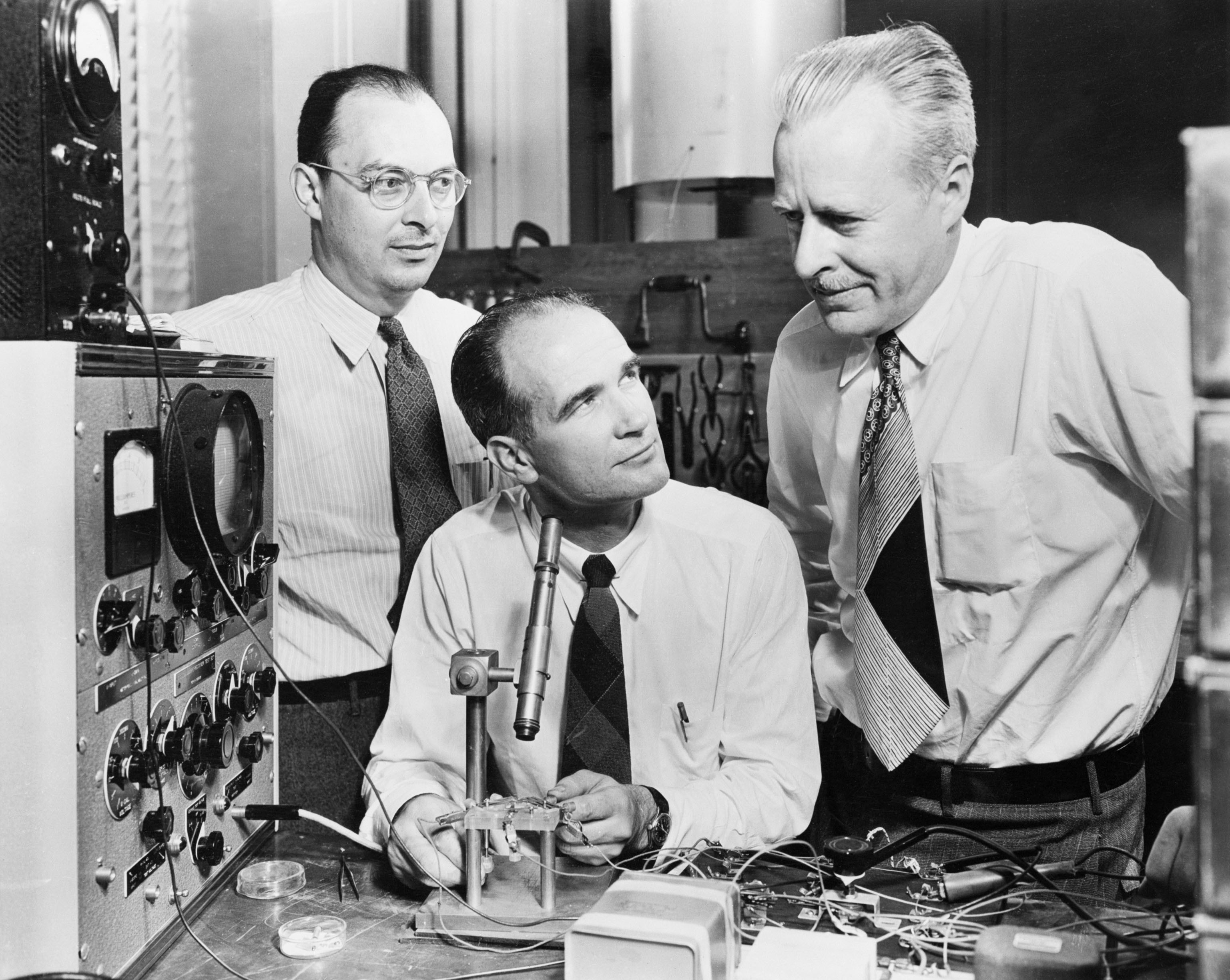
·      The transistor, a device essential to modern electronics systems
·      The first electrical and digital computer

     If some of these creations baffle you, as they do me, don’t worry about it, just rest assured that, technologically, they make our life today possible.  And if a layman had peeked into the complex back then, what was there to see?  Engineers bent over tiny devices or contemplating massive machines.  Blackboards with formulas in chalk.  Men in shirtsleeves clustered around mysterious devices.  Everywhere, tubes, cables, dials, tangles of wires.  It would all have been complex, weird, baffling.  But these workers were inventing the future.  All in all, a tough act to follow.

File:Zone refining Bell Labs 1954.jpg
Bell Labs technicians with the first zone refining equipment, 1954.

File:Bardeen Shockley Brattain 1948.JPG
Inventors of the transistor, 1948.

File:Replica of first transistor.jpg
Replica of the first transistor, invented in December 1947.
So now we all know what a transistor is and what it does.

Revol Web

    Running right through the complex’s east (Washington Street) side was the New York Central Railroad’s West Side Line, an elevated rail line that moved freight, including that of Bell Laboratories, to and from factories and warehouses without disturbing the West Side’s ground-level traffic.  With the growth of interstate trucking in the 1950s, rail traffic declined throughout the nation, rendering the West Side Line obsolete.  The southern section, including the part running through Bell Labs, was demolished by 1960, though the abandoned tracks remained.  I know, because they were visible right outside Marion’s second-floor windows.  In another marvelous transformation, in recent years those weedy tracks have been turned into the much-visited High Line park.

     When Bell Labs, needing more space and more modern facilities,  relocated to New Jersey in 1966, the complex remained empty for two years until the philanthropic J.W. Kaplan Fund and the National Endowment for the Arts conceived a novel idea: not to demolish this huge pile of brick and granite and then build something strikingly new, as most developers would have done, but to convert the existing structures into a low- to moderate-income rental housing project, the biggest of its kind in the world, to provide living and work space to people involved in the arts.   

     Since the project was without precedent, it had to be explained to numerous agencies in order to enlist their support.  Complicated negotiations followed with AT&T, the owner, which had no intention of selling the complex for a song; with the city to get a tax abatement and create a special zoning district for living and work space in an industrial zone; and with the FHA (Federal Housing Administration) in Washington to obtain a subsidized mortgage.  Slowly over a two-year period, under the supervision of Richard Meier, then relatively unknown but in time an acclaimed award-winning architect, the novel idea became reality.  It was hoped that the project would serve as a model for the conversion of other urban industrial buildings into housing for artists.

     Westbeth opened in 1970. To be admitted, applicants had to undergo rigorous review by a selection committee determined to eliminate students and weekend dabblers, and to accept only professionals of proven full-time commitment.  At the same time, the greatest possible diversity was desired: artists, dancers, composers, musicians, choreographers, actors, writers, photographers, and filmmakers.  What awaited the lucky chosen ones were 383 loftlike units that were unpartitioned, so the occupants could decide how to divide their unit between living space and studio.  Because of the undesirable neighborhood, commercial tenants were harder to find, but right from the start the Merce Cunningham Dance Company rented a top-floor space for its studio and has been there ever since.

     The Far West Village at that time was desolate and deserted, and some found it even scary, with plenty of drugs and promiscuous gay sex on the abandoned old piers of the nearby riverfront at night.  Many of those moving in found the building itself, with its long, labyrinthine corridors, also a bit scary, and depressing and seedy as well, with the appearance of a penitentiary, but since when had struggling artists known anything better? 

     The novel idea of rehabilitating old industrial buildings, instead of tearing them down and putting up new ones, was generally greeted with approval.  Ada Louise Huxtable, the New York Times architecture critic, was especially positive, hailing Westbeth’s open apartment plans as “a first step out of the steel trap of FHA rules.”  And the pioneering example of Westbeth facilitated  the subsequent mass conversion of lofts and cast-iron buildings in Soho and elsewhere into artists’ studios and galleries.

File:Westbeth Artists Community Courtyard.JPG
A Westbeth inner courtyard, 2012.  A part of
Westbeth I have never seen.

Muncharelli
     Westbeth is owned and operated by the Westbeth Corporation Housing Development Fund, Inc., a not-for-profit corporation governed by an unpaid board of twelve directors, three of whom are tenants.  New applicants for admission are now accepted only after review by a committee of residential tenants in their field, and must meet certain income requirements as well.  (Though some others slip in, as Marion’s stories attest.)  It was originally thought that creative people would reside there at the beginning of their career; then, as they became better known and prospered, they would move out.  But as the Village underwent gentrification and rents continued to rise, few residents wanted to leave.  Over the years the population aged, waiting lists grew longer, and finally, in 2007, the lists were closed; those already on them face a 10- to 15-year wait.  Westbeth is now a retirement community where residents exit only feet first.  It was added to the National Register of Historic Places in 2009, and in 2011 was designated a landmark by the New York City Landmarks Preservation Commission.

     Landmark or not, Westbeth has experienced vicissitudes, some of them distinctly unpleasant.  In 1971 a woman was raped there, and another woman who was not a resident walked in, went up to the roof, and jumped off, landing with a smash in the courtyard, her mangled remains lying there under a sheet for hours, until the authorities finally removed them.  Then a Westbeth resident likewise went up to the roof and jumped.  “Deathbeth” and “Westdeath” some of the residents began to call it, and several with children who had just moved in moved right back out.  Finally, on the heels of these events, photographer Diane Arbus was found by a friend in her bathtub, wrists slit, her body already decomposing.  Definitely not a good year for a bastion of creativity.  But did the old residents move out?  Are you kidding?  In New York City a reasonable rent trumps all.

              The Westbeth community, like any community, has known gossip, factions, and feuds.  Still, it is a very special community, unique.  A man scavenging the garbage cans in the courtyard may look like a homeless intruder, but he’s just an artist collecting items for his art.  A neighbor mumbling to herself isn’t crazy, simply a writer engrossed in her writing and working out a problematic paragraph.  And where but in Westbeth should Barton Benes live and work, filling his place with voodoo totems, a blackened human toe, and a squirt gun with HIV-infected blood, making art out of death?  (See post #33, November 11, 2012.)

              Even so, the place harbors more than its share of the unhinged.  An opinionated journalist got unsigned letters slipped under her door reacting to her published articles, as for example: “Precancerous lump and mental illness, you poor dear” – a complete misinterpretation of an article about getting a mammogram.  And after complaining about a barking dog that kept her awake at night: “Dog hater!”  But the biggest insult anyone can utter is simply, “You aren’t really an artist.”  Yet for all that, tolerance reigns; the rare tenant evicted for antisocial behavior was a drunk who urinated out his window and brought bedbugs and prostitutes on crack into his apartment.

     With the construction of the Hudson River Park in the 1990s, displacing the crumbling piers and the seedy wildness they invited, gentrification began creeping into the neighborhood, and now luxury housing surrounds Westbeth, and the Meatpacking District abounds in pricey coffee shops and trendy bars and restaurants.  Some tenants hope that the influx of new money will mean sales of their work at the complex’s monthly exhibits, while others evince skepticism, certain that their new moneyed neighbors, if they have any interest at all in art, will prefer costly items by big-name artists.  But all agree that Westbeth is the only place in today’s Village where artists can survive.

     When I last saw my friend Marion a few years ago, she was depressed; now in her early 80s, she had fallen once in her apartment and feared she would fall again.  But when I and a mutual friend began looking at her sculpture, she pulled herself out of her funk and explained in detail how each piece had come into being; her accounts were fascinating, and she glowed.

     Some time after that I learned that she had left Westbeth, but not feet first.  Having fallen again, she realized she couldn’t live there alone any more, and her godson got her into an assisted living facility upstate.  When I phoned her there once, she was depressed again, hating the food, feeling exiled and out of it (whatever “it” might be).  But when I phoned a second time, she was cheerful, for her godson had come to visit her.  Did she need anything?  No, not really, except an occasional phone call or a card.  And her art – that assemblage of sculpture that had so fascinated me in her studio at Westbeth?  Her godson has assured her that it’s in safe keeping, though what this implies she didn’t seem to know or want to know.  Gone, I suspect, though I don’t know where or how.  But some earlier pieces signed by her can be found on the Internet, selling for $6,000 an item.  One thing is certain: Marion herself won’t see any of the proceeds, if proceeds there should be.

     As the longtime Westbeth residents age, there will be more stories like Marion’s, few of them with happy endings.  Yet my partner Bob’s doctor, who sees a number of patients in Westbeth, most of them in their nineties, assures me that they are a very special breed, more intellectual than most people their age, and probably were so back when they moved in.

     On Monday, October 29, 2012, Hurricane Sandy sent a four-foot tidal wave rolling up Bethune Street from the river, flooding the basement of Westbeth with nine feet of water and knocking out all electrical equipment, boilers, and pumps, leaving the entire complex without electricity, heat, or water.  At the same time the telephone lines went down, and even cell phones for a while didn’t work.  No one had expected anything like this; advised by management, residents had filled their bathtubs with water, but it wasn’t enough for a crisis that lasted for days.  Plunged into darkness and with all the elevators out, tenants had to climb up and down many flights of stairs to fetch food and water.  The whole building soon smelled of unflushed toilets, rotting food and, rising from the basement, a stench of flood water, paints, solvents, and detergents.  In their flooded basement studios some artists lost a lifetime of work, and musicians, precious equipment and instruments; Martha Graham’s dance company suffered a $4 million loss of sets and costumes. 

     As the outage continued, some tenants left to find shelter with friends or relatives; others, unable to manage the stairs, could only wait in a cold, darkened room, hoping someone would come to their aid.  Crowning the disaster was the arrival of tourists who out of curiosity barged in and wandered about, gawking, but never offering to assist in any way.  But Westbeth is a caring community, and residents did check in with their elderly or disabled neighbors.  Those who waited in a darkened room did at last get help, when a someone with a flashlight arrived with food, water, and warm clothing.

     Only after four days did management let tenants back into the basement, where everything was contaminated by filthy water, and it was a week before half the complex had its power restored, and another week for the rest, and even then the elevators didn’t work.  But through the worst of it a wonderful camaraderie prevailed, and people who barely knew each other exchanged warm greetings and shared tales of woe.

     Is Westbeth also threatened financially?  According to an article by Catherine Revland last May in the West View News, a free monthly newspaper covering the West Village, it could well be.  “Will Westbeth be the Next St. Vincent’s?” reads the caption, referring to the much lamented demise of the Village’s only full-service hospital, now demolished to make way for more luxury housing.  Ms. Revland’s article starts by quoting the website of Ramscale Productions, which announces, “Quintessential New York location!  Spectacular sunset views!”  The website further entices prospective clients with photos of a penthouse and adjoining terrace with elegant guests being served drinks and goodies by waiters in immaculate white far above the riverfront and the river – a site, Ramscale insists, that is ideal for wedding parties, product launches, fashion shows, and film and TV productions in the hottest neighborhood in town. 
Ramscale revels, high above West Street and the river.
Ramscale

     Is this Westbeth, the home of artists of limited means?  Yes, for Ramscale has a long-term lease on the Westbeth penthouse and terrace and sublets the space to clients.  Meanwhile Westbeth’s artist residents face staggering rent increases to pay more than $10 million in hurricane damage repairs and a major façade restoration, while Ramscale rents out its penthouse and terrace for as much as $10,000 a day, without having to pay a penny toward repairs.  What gives?

     Residents applying for admission to Westbeth must prove they have a low-to-modest income, but no such restrictions apply to commercial tenants.  Yes, there are commercial tenants too, Ramscale prominent among them, and the revenue from such tenants has always been much less than that from the artist residents.  The Westbeth board of directors once justified this by citing the undesirability of the neighborhood, but today, thanks to gentrification, the neighborhood is eminently desirable.  The Far West Village, now rid of the abandoned riverfront piers and the sleazy S-and-M bars of the Meatpacking District, and wonderfully enhanced by the High Line park, is, from a real-estate point of view, “hot.”  Indeed, it’s torrid.

     In spite of this, the Westbeth board refuses to reveal any information about the income from commercial rents, insists that such information is confidential, and has taken steps to block any legal action by residents to obtain it.  As for the complex’s finances, in response to Ms. Revland’s article Executive Director Steven A. Neil points out that Westbeth’s complete tax returns are available from the IRS and from Westbeth itself, as required by law.

     The tenants are sure that that Ramscale’s lease of the penthouse is remarkably undervalued – in effect, a “sweetheart” deal.  So Ms. Revland asks if Westbeth, like St. Vincent’s before it, will face a sudden financial collapse, after being assured for years by its board that everything is in order.  Past boards took Westbeth to the brink of bankruptcy twice; the current residents are determined to not let it happen again.  Again in response, Mr. Neil states that in 2008 Westbeth took legal action to evict Ramscale, and that, under the settlement finally reached in 2014, Ramscale has commercial leases for two units on the 13th floor at “reasonable” rents, and that it is not entitled to renew those leases when they expire.

     Let’s hope that Mr. Neil’s explanations are valid.  If Westbeth should go the way, not just of St. Vincent’s, but also the Archive Building and the Village Nursing Home – not to mention the Palazzo Chupi (see post #187) – and end up offering still more luxury housing in the West Village, it would be an unspeakable atrocity.  There’s no sign of that as yet, but the situation bears scrutiny.  Westbeth is, and must remain, unique.

     A note on AT&T:  In 1974 the Department of Justice initiated an antitrust suit against AT&T.  When the suit was settled in 1982, AT&T’s local operations were divided among seven regional companies christened “Baby Bells.”  The end of AT&T’s monopoly of the telephone business also meant the end of the golden age of Bell Labs, for AT&T, given its reduced revenues, felt it could no longer finance the long-term research and development that had characterized its laboratories.  Still, that was not the end of Bell Labs.  Recently, when I happened to glance at the print on the glue traps I use to fight the bugs invading my apartment, what did I find?  “Bell Laboratories, Inc.  Madison, WI.”  Not a product on the scale of radar or the transistor, but useful nonetheless.

     Coming soon:  Networking: to find out what it is, I invade the exclusive Princeton Club, play the ancient of days, commune with fellow Sagehens, meet a woman whose work takes her to Riker’s Island regularly, and another who isn’t put off by New York’s size, since she comes from a city of twenty million.  “But what is a Sagehen?” you ask.  All shall be revealed.

     ©  Clifford Browder  2015