Sunday, September 21, 2014

145. New York Brownstones


 First, the material.  What is it?

A soft sandstone quarried in northern New Jersey and Connecticut and shipped by barge to New York City to be used in the construction of row houses.  It served chiefly to cover the houses’ brick façades; brownstone residences, like the Greek Revival houses before them, were basically built with bricks.

When were brownstones built?

File:A Nero Wolfe Mystery brownstone on Upper West Side.jpg
An Upper West Side brownstone, used in
the TV series A Nero Wolfe Mystery.

WFinch

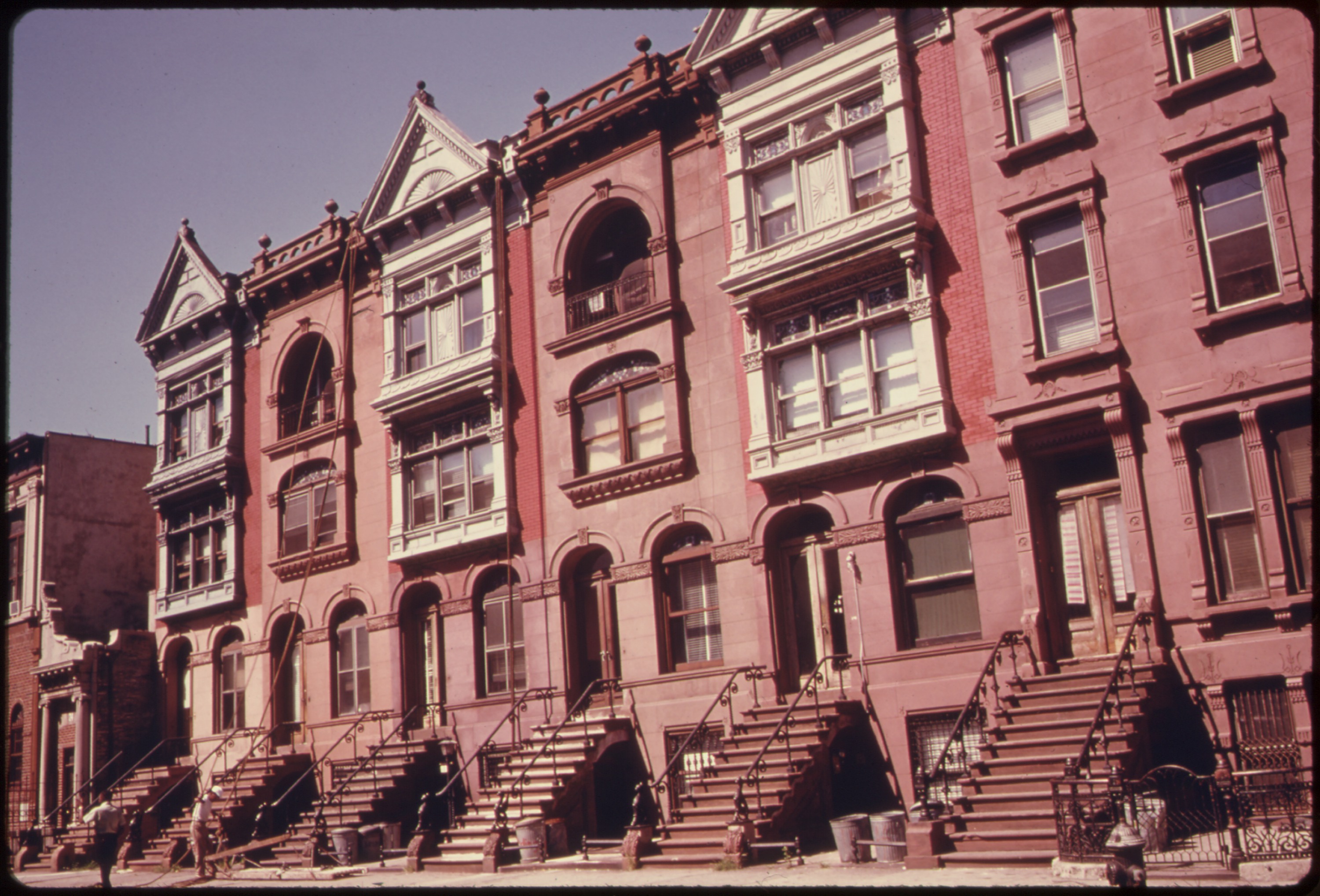
In Manhattan, in the 1850s and 1860s, when the Italianate style was in vogue.  By the 1880s brownstones were being built on the Upper West Side of Manhattan, where Queen Anne and Renaissance styles replaced the earlier and simpler Italianate.  And throughout the rest of the century brownstones were being built in various neighborhoods of Brooklyn, their façades adorned with bay windows and balconies.


File:TURN OF THE CENTURY BROWNSTONE APARTMENTS BEING PAINTED AND RENOVATED BY THEIR OWNERS IN BROOKLYN, NEW YORK CITY... - NARA - 555889.jpg
Brooklyn brownstones, late nineteenth century.

Why?

The growing affluent middle class wanted residences more impressive in appearance than ordinary brick, and more durable than wood.  Also  brownstone, being soft, could be shaped and sculpted so as to provide decorative detail on the façades.  People fell in love with brownstone, which took on a deep chocolate color with time; they thought it was elegant, distinctive, genteel, and “Romantic” (Romanticism and broody moodiness were “in”).  The brownstone residence became a symbol of bourgeois comfort and status.  (A side thought:  If chocolate is Romantic, would vanilla be Classical?)

Italianate style

The popular Italianate style brownstone, first developed in Great Britain, included these features:

·      A steep front stoop, thought to be stately and elegant, though it took energy to negotiate it; ascending, one supposedly left the hurly-burly of street and sidewalk life behind and accessed something nobler and more genteel.
·      An impressive front doorway with double doors topped by a rounded arch and a projecting hood and flanked by pilasters, informing all who managed to get up the stoop – formal callers, ministers, doctors, lawyers, and such -- that this was a residence of wealth and refinement.
·      A basement door under the stoop to accommodate the lower orders:  deliverymen, tradesmen, servants, and other social inferiors.
·      A basement (sometimes called a garden floor, since its rear door led  out to the garden) and four stories.
·      Tall first-floor windows.
·      Handsome cast-iron railings for stoops and area fences.
·      A flat roof with a boldly protruding cornice (the horizontal projection at the top of the building), providing a sharp limit to the structure’s monumental rise.
·      By the 1860s, a steeply sloping mansard roof installed above the cornice, a hot new architectural feature imported from Second Empire France, adding a fifth story with dormer windows.
·      A parlor floor with three parlors, each one with sliding doors opening into the next, the first two often serving as a single deep parlor and the last as a dining room, the food coming up from the kitchen below by that marvelous new invention, the dumbwaiter.
·      Folding wooden shutters to shield the parlor floor from the view of nosy passers-by who, looking up from the sidewalk, could at best see only a patch of ceiling and maybe a chandelier (I know, because I’ve tried).
·      Ornate decorations sculpted in the brownstone, foliage and cutesy little animals and strange mythological faces and scrolls and curlicues.

File:124-128 East 37th Street.jpg
Brownstones with mansard roof, East 37th Street, Manhattan, late 1860s.
Beyond My Ken

What amenities did they have?

·      Heat:  A coal-burning furnace in the cellar, generating hot air that was conducted in pipes to the lower floors, and coal-burning fireplaces for the top floors where servants resided.  Coal provided a steady heat far superior to what wood-burning fireplaces had once provided.

·      Lighting:  Gaslight for the lower floors, kerosene lamps for the upper floors with the servants’ rooms.  Oil was discovered in Pennsylvania in 1859, making kerosene readily available, since it is obtained by distilling petroleum.  The kerosene lamp then replaced the whale-oil lamp.

File:CEILING MEDALLION IN NORTHWEST PARLOR FIRST FLOOR, FROM EAST - Bowling Heights, 3610 Old Crain Highway, Upper Marlboro, Prince George's County, MD HABS MD,17-MARBU,8-23.tif
Chandelier suspended from ceiling medallion.
Gaslight chandeliers lit the parlors.

·      Running water:  Since 1842, when the city began getting clean water from upstate reservoirs, anyone who paid the water tax could have running water in their homes.  The result: indoor plumbing providing  plentiful water for cooking and dishwashing, for shower baths and tub baths whenever you liked, and for that miracle of modern miracles, the flush toilet, replacing primitive improvisations that I don’t have the heart to describe.  From 1842 on, soap sales presumably went up, while perfume sales declined.  All over Manhattan a joyous chorus rose of showering burgers reveling in the miracle of running water.  No wonder nineteenth-century Americans believed in Progress.  But tenement dwellers still had to rely on the well in the yard and tote their water in.


What was a brownstone parlor like?

Volumes could be written … and have been.  The Victorian parlor was the shrine and sanctuary of the affluent middle class, its best stab at propriety, calm, and culture, its chance to put its best foot forward.  Plush and velvet abounded, Brussels carpets ran from wall to wall, elegant little spindle chairs dared intruding males to risk their bulk upon them, and antimacassars pinned to the backs of overstuffed sofas and armchairs protected the sacred upholstery from masculine locks reeking of Macassar oil.  More ornamental now than essential, white marble fireplaces gave off a lustrous sheen, and over them the mantel featured a large bronze or marble clock backed by a  gilt-framed mirror rising five or six feet, or even eight feet all the way to the ceiling. 

File:Whittemore House - parlor.jpg
This parlor was heavy on floral adornments.  Some of them settled for a few pressed rose petals.


File:Emlem Physick Estate LOC Highsmith.jpg
This one features fringed curtains, plus antimacassars on the armchair and sofa.

From the walls ancestors in gilt frames stared dourly down, or perhaps, more benignly but grandly, the master and mistress of the house.  Displayed prominently was that inevitable symbol of bourgeois refinement, the pianoforte, its gleaming ivory keys awaiting the deft fingerings, at family gatherings, of the young ladies of the household, nervously anxious to reveal their accomplishments.  Cluttered on whatnots were assorted bibelots, framed locks of the dear departed, and stuffed birds under glass.  A cool gloom prevailed, and by day shades or drapes were drawn, and shutters closed, lest sunlight smite the damask.  Here, in an atmosphere scented with cedar and cinnamon and lavender from pomanders and potpourris, the mistress of the house presided; children were to be seen but not heard; and males of all ages were on their best behavior, never quite at ease, their conversation scrubbed and disciplined.  Loud talk was discouraged, arguments banished, smoking forbidden; gentility reigned supreme.   

File:DETAIL VIEW OF MANTEL IN NORTHEAST PARLOR FIRST FLOOR, NORTH WALL - Bowling Heights, 3610 Old Crain Highway, Upper Marlboro, Prince George's County, MD HABS MD,17-MARBU,8-25.tif
The white marble fireplace could dominate the room.  The logs would be
 for show; hot air from the furnace usually heated the parlor.

And the other rooms?

File:Brede-LilleBrede-green-bed.jpg
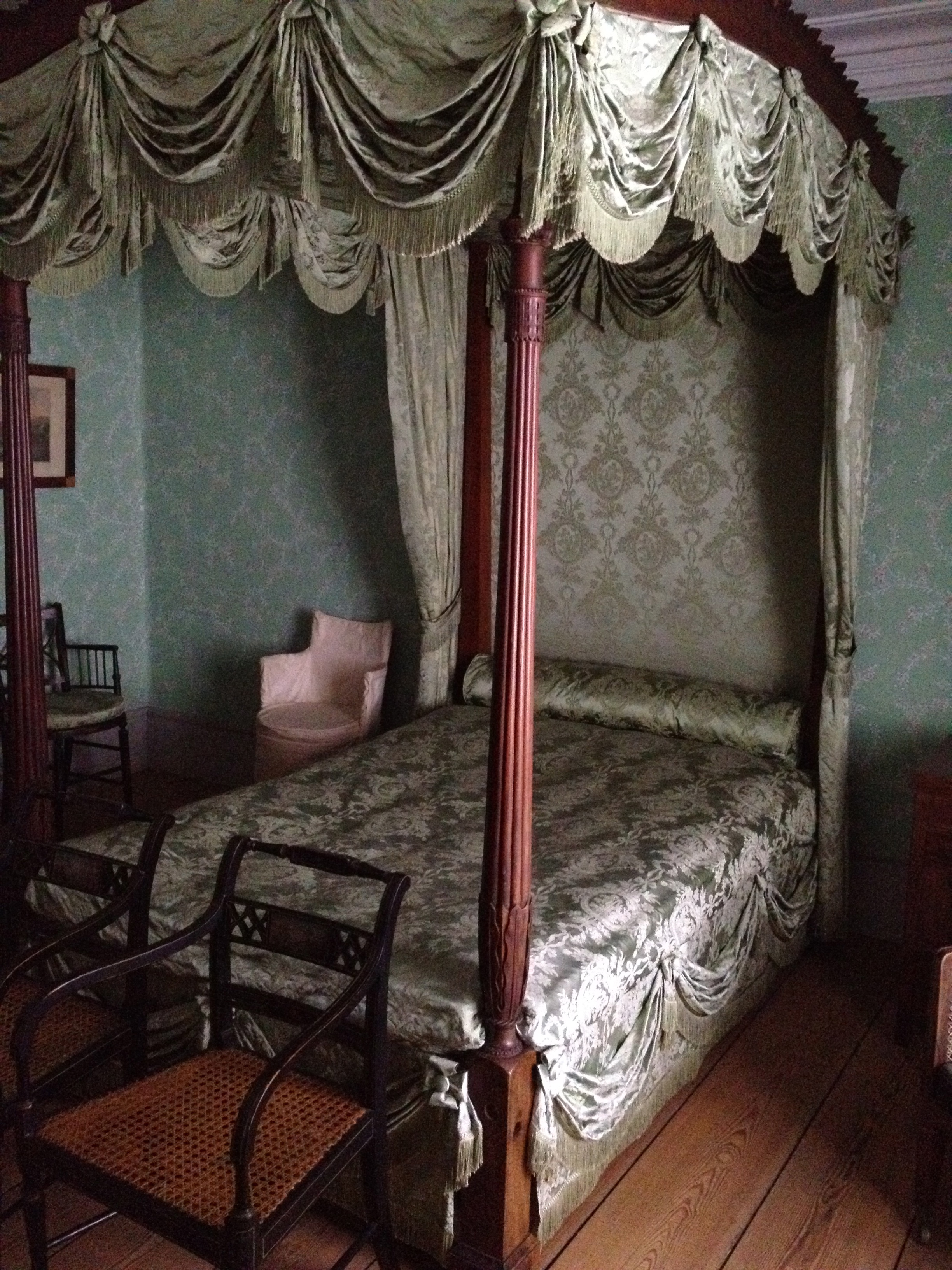
Sleeping in a bed like this, you had to feel important.
Twdk
The dining room, the back parlor on the parlor floor, matched the front parlor in elegance and refinement; here, attended by servants, the family could dine in state.  On the second floor the front room was often a sitting room or library where the family could gather casually and relax, without the formality required by the parlor; it was the forerunner of today’s living room.  (The parlor, on the other hand, has no equivalent today; it disappeared with the Victorian mores that created it.)  The back room on the second floor was the parents’ bedroom, featuring an imposing four-poster and having access to a bathroom that, in some instances, was regal in splendor, with a marble or mahogany washstand with gleaming silver-plated faucets, a commode of polished porcelain, and a polished metal or marble tub; the air was scented with fragrant powders and soaps. 

The third and fourth floors had bedrooms for the children.  At the very top, often including a fifth floor under a mansard roof, there were small rooms for the servants, who usually had to do without running water, gaslight, and central heating, relying instead (as their masters had a generation earlier) on coal in the fireplace, a wash basin with a pitcher, and the indignity of the  chamber pot, and for their weekly bath, a tub or sink in the kitchen.  (In some brownstones, even so, heat from the coal-burning furnace in the basement reached even the topmost floors.) 

With five floors and up to sixteen rooms, a brownstone afforded privacy to parents, children, and servants, but at the cost of endless climbing and descending stairs.  Brownstones were not for the weak of limb, though an ailing master or mistress might install themselves, bed and all, on the parlor floor and receive callers there in state.


Are there any old brownstones left on Fifth Avenue?
File:Salmagundi-club-47-5th-avenue.JPG
Dmadeo
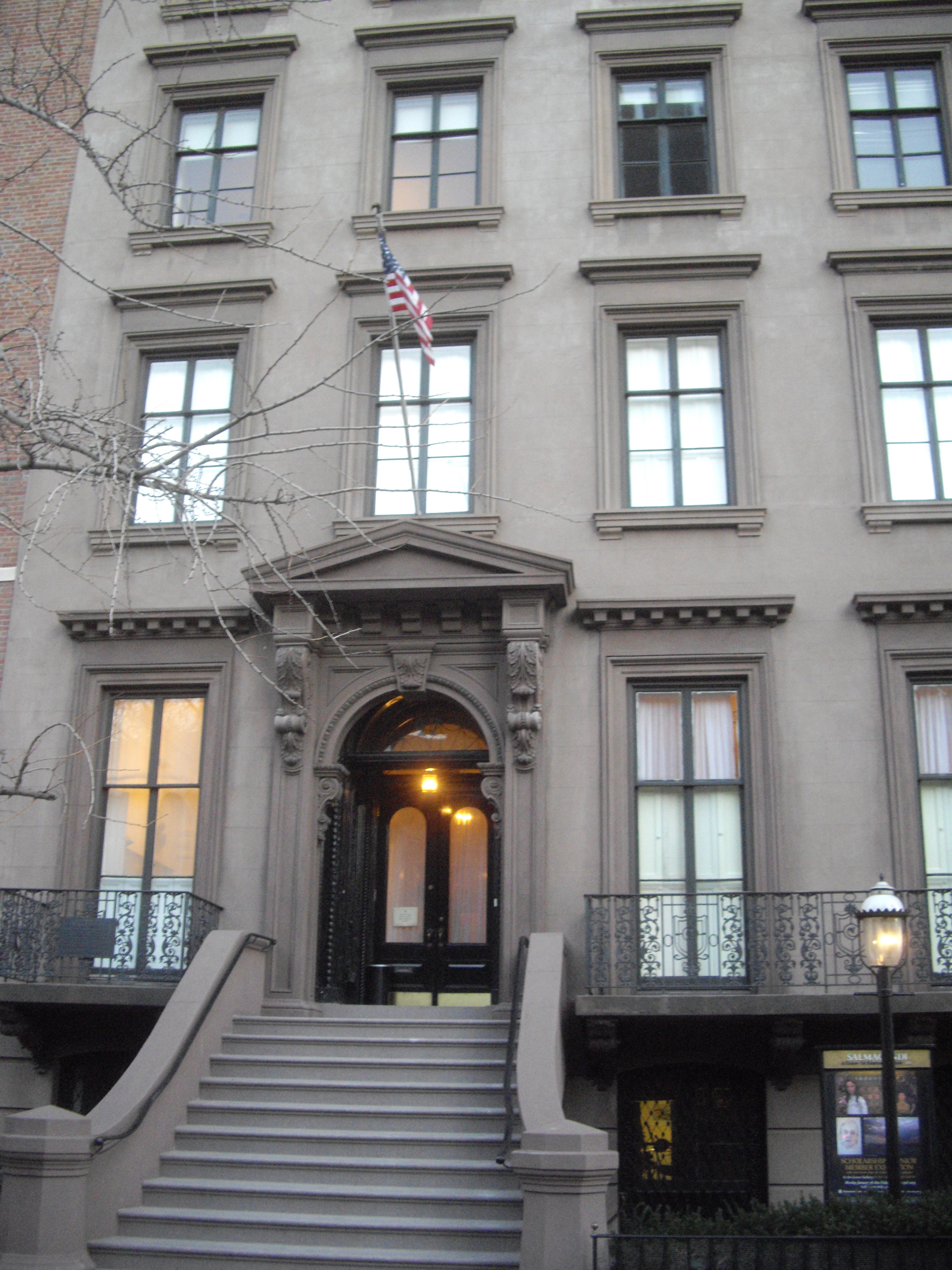
To my knowledge just one, at 47 Fifth Avenue, between East 11th and 12th Streets in the West Village.  Built in 1853 as a residence for Irad Hawley, the first president of the Pennsylvania Coal Company, and his wife, it showed the world that the Hawleys and their coal business were doing quite well.  And how could they not be?  Coal was in great demand for heating interiors, and for powering both the many palace steamboats gliding smoothly over the Hudson, and their screechy upstart rivals, the railroads.  The building’s exterior still has the classic features of the early Italianate brownstone: an imposing stoop rising to an entrance with double doors flanked by pilasters and topped by a rounded arch and a projecting hood; tall parlor-floor windows; and four floors topped by a cornice.  The stoop, however, isn’t centered, having two parlor-floor windows on the right, and one on the left, with balconies.  Inside, some vestiges of the old brownstone remain, notably the two front parlors joined into one, each with a white  marble fireplace with foliage and figures in relief, and a chandelier suspended from a ceiling rosette; between the parlors are four Corinthian columns with elaborately carved capitals.  One can well imagine the Hawleys receiving guests in front of such fireplaces aglow with coal, under chandeliers ablaze with gaslight.  Since 1917 the building has housed the Salmagundi Club, a nonprofit center for artists and collectors that offers art classes and exhibitions.

The parlor fireplace.
Salmagundi Club

Who maintained a brownstone?

Not the owners.  Yes, they paid bills for the necessary services and labored to keep up appearances, but the real work was done by the servants, sometimes black, more often Irish.  In the mid-nineteenth century an affluent New York family had at least 6, probably 7: a cook, a waiter, a parlor maid, an upstairs maid, a laundress, a houseman, and probably a coachman; ordinary middle-class families made do with 3: cook, waiter, and maid.  The servants cooked, washed, scrubbed, dusted, polished, stoked the furnace, removed cinders and ash from the fireplaces and resupplied them with coals, trimmed the wicks and cleaned the chimneys of the kerosene lamps, and toted the trash out to the curb for collection.  After a hard day’s work they would trudge wearily upstairs to their ill-heated rooms on the top floors, perhaps lighting their way with a candle until they lit a kerosene lamp in their room.  If there was a garden in back, that needed tending too, unless a gardener was hired.  The coachman would be lodged separately, usually upstairs in the coach house, a small two-story structure on a nearby side street where coach and horses were lodged.  (Ironically, though certainly not luxury housing at the time, coach houses today are sought after by tenants willing to pay a high rent.)


Were there freestanding brownstone houses also?

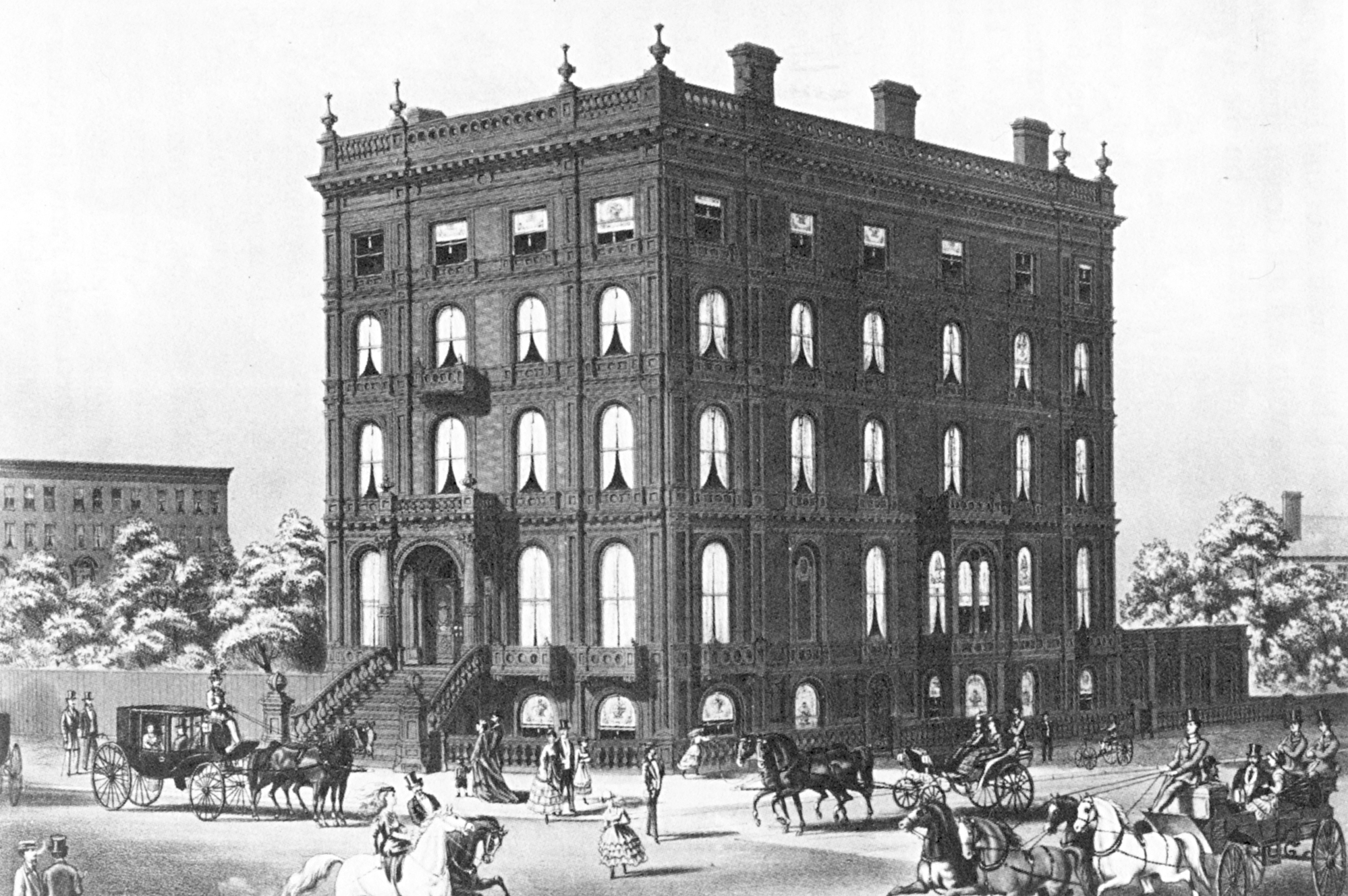
Not many, given the soaring land values in Manhattan; except for the very wealthy, row houses were the rule.  But there was one freestanding brownstone mansion that managed to be the most scandalous residence in the city: a handsome four-story structure on the northeast corner of Fifth Avenue and 52nd Street with a steep stoop rising to a monumental entrance, its recessed doors flanked by pilasters and topped by a protruding ornamental hood.  In 1864 a lavish housewarming revealed the interior to guests and the press: three vast ground-floor parlors in bronze and gold with yellow satin hangings; enormous mirrors with mosaic gilding; ceilings adorned with costly frescoes by Italian artists; and an abundance of paintings, curios, bronzes and statuettes, candelabras, and ornamental clocks.  Even the upper floors were on display: the second floor, with the hosts’ sumptuous master bedroom; the third, with servants’ rooms with Brussels carpets and mahogany, and a picture gallery; and the fourth, with a billiard room and ballroom.
File:Lohman residence, New York.jpg
The Lohman residence.  Driving up Fifth Avenue to Central Park, you couldn't miss it.
Courtesy of the Museum of the City of New York

Definitely not on conspicuous display was the silver plate bearing the engraved word OFFICE that later appeared on a gate in the railing at 1 East 52nd Street, just around the corner from the main entrance.  There, steps descended to a basement side entrance where heavily veiled women were seen furtively coming and going by day.  This was the office of the mistress of the mansion, Mrs. Charles Lohman, better known as Madame Restell, the town’s most notorious – and successful – abortionist.  That she should reside so sumptuously on the city’s most fashionable avenue only two blocks from the rising walls of Saint Patrick’s Cathedral, and just across the street from the spacious grounds of the (O irony!) Catholic Orphan Asylum, was an enduring scandal of the Gilded Age, constantly whetted by visitors innocently asking who lived in that palatial brownstone that drew every eye.  Imagining dire happenings in its shadowy interior, knowledgeable New Yorkers labeled it a palace of death.


What became of brownstones?

In Manhattan, taste changed.  What looked fashionably dark and “Romantic” in the 1850s came to look like cold chocolate, dingy and depressing.  When the Vanderbilts and Astors and other moneyed clans built their mansions on the Upper Fifth Avenue from 1880 on, they preferred brighter limestone residences in the French-chateau style.  But brownstones continued to be built on the Upper West Side in Manhattan, and in many neighborhoods in Brooklyn, where they sprouted balconies and porches and bay windows alien to the formal and rather severe earlier Italianate style.  By the end of the nineteenth century, however, people were complaining about soft brownstone crumbling and cracking and flaking, which further doomed brownstone construction.  Since then, many brownstone façades have been replaced with brown cement-based masonry, a cheaper alternative.  Still, brownstones had a certain aura that persisted, and the second half of the twentieth century saw a brownstone renovation movement take hold in older cities throughout the East, often with impressive results.

File:22-32 West 96th Street.jpg
Six brownstone row houses on West 96th Street, built in 1891-92 in the Renaissance Revival style.
Beyond My Ken 

What happened to the brownstone quarries?

The last New Jersey quarries ceased operation in the 1930s, owing to lack of demand.  When the quarries in Portland, Connecticut, were flooded by a 1936 storm and proved impossible to drain, they shut down.  In the mid-1990s a geologist named Mike Meehan reopened the ground on the edge of the Connecticut quarries and sold brownstone for historic and restoration projects and lavish private homes.  But in 2012 his quarry, the last of its kind in the region, finally shut its doors, to the great regret of preservationists trying to match the brownstone of old residences; it marked the end of an era.  But in his retirement Meehan, a true lover of brownstone, planned to use some of the remaining little slabs to make birdbaths and benches, not to sell but for the fun of it. 

File:PostcardPortlandCTBrownstoneQuarry1911.jpg
Quarries in Portland, Connecticut, in 1911.

     A tale of two cities: Prague and New York:  A friend recently told me two contrasting stories.  His aunt was on a bus tour in the Czech Republic when suddenly she had symptoms of a serious heart problem.  Alerted, the authorities sent a nurse from Prague to take her back there and see her into a hospital.  After several days in the hospital she was ready to fly back, as planned, to Holland.  The nurse accompanied her to the airport, went through security with her, and saw her onto the plane.  Only when the nurse saw his aunt comfortably settled in her seat did she leave her.  My friend’s comment: the Czechs treated her wonderfully!
     His other story:  A friend of his was dying of AIDS.  He left a New York hospital, had a relapse, wanted to return to the hospital, where he was known and his medical records were available.  No, the rule was that he had to go to the nearest hospital, where he was unknown.  Admitted there, he showed the staff his living will, refusing various kinds of treatment and resuscitation procedures.  The staff ignored the living will completely and gave him all kinds of unnecessary and futile treatments, so as to run up the bill.  Finally, when they trundled in some monster machine for yet another procedure, my friend objected.  “Are you a relative?” they asked him.  “No,” he said, “but his mother is downstairs.”  Alerted, the mother refused the treatment emphatically, and the staff did not insist.  His friend then died more or less peacefully.  All of which says a lot about Czech vs. American health care.

     Coming soon:  Ralph Fasanella and his take on Joe McCarthy, the Rosenbergs, Watergate, and a crucified iceman.  In the offing (in no particular order): Wall Street cheats; Dorothy Norman, the woman who knew everyone (Nehru stood on his head for her -- literally); and maybe two holy men who were no strangers to publicity and who wanted to make you feel good: a media-savvy and very photogenic archbishop whose remains are now in archiepiscopal dispute, and the Power of Positive Thinking.

     ©  2014  Clifford Browder


Sunday, September 14, 2014

144. Smells of New York


      If you ask New Yorkers what their city smells like, their immediate and vigorous answer will include such items as these:

·      Garbage
·      Dog poop
·      Urine
·      Sweat (from other people, as in the subway)
·      Chemical vapors
·      Gas
·      Mold
·      Grilled meat from block parties
·      Diesel fumes
·      Smells from halal and hot dog vendors

File:AT STATEN ISLAND LANDFILL. GARBAGE BROUGHT BY BARGE FROM MANHATTAN IS DUMPED AT OUTER EDGES OF LANDFILL AREA - NARA - 549797.jpg
The Staten Island Landfill, where garbage from Manhattan used to be brought by barge, to be dumped at the outer edge of the landfill.  The landfill has since been closed, but imagine the aroma wafted by breeze to the nostrils of Staten Islanders.  No wonder they wanted to secede!

Summer, of course, is the worst season for unpleasant smells, since the heat “cooks” the garbage and other undesirable deposits.

File:Great Danes and Chihuahuas by David Shankbone.jpg
Man's best friend, but ...
David Shankbone

     To these I’ll add another provided by a friend who lived for many years in Brooklyn: the sickly sweet smell of mice dying in the walls after the landlord has spread poison, a smell that lasts from ten days to two weeks until their little bodies desiccate.  For my friend this is quintessential olfactory New York.

     And if you press New Yorkers for some positive olfactory experiences, they’ll think a minute and perhaps come up with

·      Toasted bagels
·      Fruit tree blossoms in spring
·      The aroma from a pizzeria, with hints of yeasty bread, cheese, and sausage
·      In Brooklyn, the aroma of freshly roasted coffee emanating from several little wholesale coffee companies hidden in brick buildings
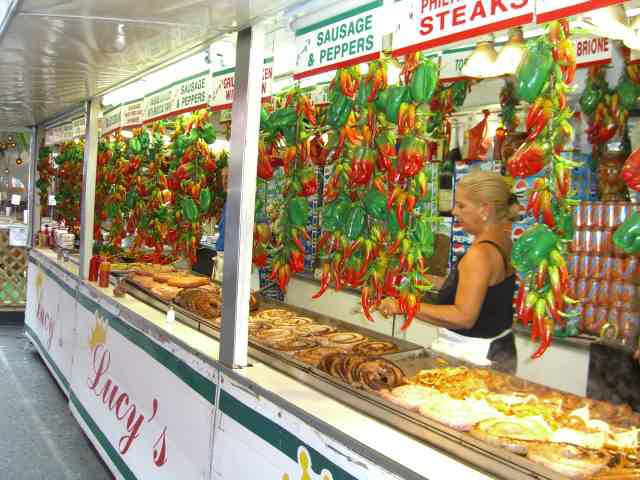
·      Italian sausage cooking at stands at the annual Feast of San Gennaro in Little Italy

File:06SanGennaroFestival.jpg
Sausage stand at the Feast of San Gennaro.
Nightscream
     Obviously, the negative experiences outweigh the positive ones.  And New Yorkers complain: 13,054 odor complaints to 311 (the city’s complaint and information number) over the last four years, or about eight gripes per thousand residents.  And to judge by the number of complaints, Manhattan is the smelliest borough by far.  Unless, of course, it simply has the most residents willing to lodge a complaint, which may well be the case.

     To the smells already mentioned, I’ll provide a few more, both pleasant and unpleasant, from my own experience.

·      The aroma of fresh baked bread emanating from some invisible bakery nearby, especially delicious on a cold winter night
·      On the street, the acrid smell of fresh asphalt when a pothole has just been filled
·      Roasted chestnuts from sidewalk stands in the fall
·      Hot air from dry cleaners, sometimes with a chemical edge to it that is probably toxic
·      A smell of rubble, plaster, and splintered wood heaped in dumpsters outside residences or shops undergoing renovation, their interiors, when glimpsed from the sidewalk, totally gutted and devastated
·      Exhaust fumes from buses as they pull away from the curb
·      In parks, the cloyingly sweet summer fragrance of Canada thistle and milkweed flowers, the soothing scent of a wild mint and, in the fall, a rich cidery tang from rotting apples scattered on the ground under apple trees
·      When pavement is being replaced, a smell of wet cement

File:CanadaThistleSK.jpg
Canada thistle, a fragrance that intoxicates.
SriMesh
File:Vandalism or history in the making - geograph.org.uk - 885583.jpg
Wet cement plus graffiti.  The photographer wonders: vandalism
or history in the making?  Will it one day be another Pompeii?

Basher Eyre

     Yet many smells escape me, for my sniffer isn’t the most efficient.  So let’s consult an expert.  A neuroscientist in town last spring to register the smells of a New York morning stood outside Grand Central Station during the morning rush hour and reported the following:

·      A toasted onion bagel
·      The “briny, salty, fishy” smell of the East River, delivered by the breeze
·      A “really powdery, moist, kind of sweet smell” from steam rising from underground

And inside the terminal, where shops abound:

·      High-end coffee (instead of the cheap coffee of the 1980s)
·      After-shave
·      Toothpaste
·      Disinfectant from trains
·      Brown-black shoe polish
·      Cheap air freshener from a Town Car coming from a man’s suit

And outside again, going toward Bryant Park:

·      Hot dogs
·      Doughnuts
·      The “sour, tangy, birdy smell of pigeons”
·      Cigar smoke

File:Man with many pigeons in Washington Square Park, New York.jpg
They're hard to get away from, but you don't have to feed them.
JoeinQueens
     There speaks a true expert, a scientist of smell.  And recently, on a so-called Smellwalk in Brooklyn, participants who sniffed trash cans and doorways and even trees reported such smells as these:

·      Garlic
·      Acqua di Gio cologne from a European tourist
·      Recently chewed gum in a trash can
·      Cigarette smoke
·      A marijuana joint
·      Blended wheatgrass

But when the tour organizer, who has led walks to create Smellmaps of various European cities, was asked for the characteristic smell of New York, she reflected a moment, then announced, “A warm, musty smell that comes from the cellar.”  Not, I confess, a smell that I have experienced. 

     Every so often an unusual smell – unusual for the city – arrives to spice our urban living.  In April of this year New Yorkers awoke to a heady smell of windborne smoke whose source was easily located: a brush fire in New Jersey a good hundred miles away.  And periodically, from 2005 to 2009, a mysterious maple-syrup-like aroma visited our nostrils, its source an enigma.  Finally, in 2009, Mayor Bloomberg announced triumphantly that the probable source had been detected: fragrance-processing plants in New Jersey making use of fenugreek seed, a spice employed in this country more for industrial than culinary purposes.  Not an unpleasant odor, but many New Yorkers were of the opinion that New Jersey should keep its smells to itself.  (I shan’t chronicle the smells of northeastern New Jersey, which combines extensive marshland, a pig farm, and an oil refinery.)

     The city of New York, then, teems with smells, some offensive and some not, though New Yorkers tend to emphasize the stinks.  For perspective, let’s have a look at nineteenth-century New York and see how it compares.

     By all accounts, nineteenth-century New York stank.  Sidewalks were often piled high with kitchen slops, cinders, coal dust, broken cobblestones, and dumped merchandise, while the streets were rich in horse manure that, in rain, became a thick, ankle-deep slime that smelled like bad eggs dissolved in ammonia.  And when dry weather prevailed, the thick traffic on streets like Broadway ground the manure into dust that blew up from the pavement as a piercing powder that covered the clothes of passersby, invaded their nostrils, stung their eyes, and even blew into their residences to assail the furniture and upholstery.  And in any weather there might be a dead horse in the street.  Only the arrival of the horseless carriage relieved the city of these pestilential smells. 

     And that wasn’t all.  The middle class lived in handsome, well-scrubbed  brownstones on Fifth and Madison Avenues and their side streets, well removed from the seedy West Side of the 30s and 40s, which housed the gas facilities that provided them with gaslight, and such urban amenities as stables, distilleries, hog pens, slaughterhouses, tanneries, swill milk dairies, breweries, and a varnish factory, all of which emitted their distinctive aromas.  But if the wind was from the west, this symphony of smells could find its way eastward to the fashionable shops and restaurants and hotels on Broadway and to the brownstone neighborhoods as well. 

     So how did people cope?  By holding handkerchiefs to their nose.  Ladies, if they had to face these affronts to gentility, sprinkled flower scents on their handkerchiefs, behind their ears, and on perfumed sachets that they carried with them.  But the best solution was to retreat into the sanctity of the home and guard it with vigilance, and so arose the cult of the parlor.

     The parlor was the shrine and sanctuary of the affluent middle class, its refuge from the nasty smells – and nasty sounds and sights – of the turbulent city outside.  It was a feast of velvet and brocade, a stage for the gleaming white keys of a pianoforte, an assemblage of bibelots on whatnots, its shaded sanctum scented with cedar and lavender and rose.  Here one received callers of note, prominent among them the minister of one’s church.  In such an atmosphere one could forget for a while the reek of manure-laden streets, a whiff of hog pens and distilleries, and clouds of eye-stinging dust.  (More on the parlor in a future post.)

File:Victorian Parlor.jpg

     Another feature of nineteenth-century New York was a section of the city where no lady ever set foot, except to take a ferry or steamship: the waterfront.  But that waterfront offered a unique assortment of smells, as its docks welcomed ships from every major port in the world.  A stroll there brought to one’s nostrils an amazing sequence of aromas: fresh pineapple from a stand; sawn wood from a steam engine cutting up firewood; gas smells from a riverfront gas works; garbage smells from a mountain of refuse fed continually by a line of carts, while ragpickers crawled over the trash to scavenge bits of food, or shoes or scraps of metal to sell to the junk man; smelly hides being unloaded from a ship; hogsheads of tobacco ready to be shipped abroad; hints of tea, palm oil, and strange spicy aromas from crates and barrels being unloaded on docks serving the China, Australian, and African trade; a fine mist of flour as a grain elevator delivered flour from a spout to be weighed, bagged, and carted off; a smell of coal as workmen grimy with coal dust and sweat unloaded coal from a canal boat; and a smell of brine from an oyster market, and fish smells from a fish market.  Such a roster of smells reveals the tremendous activity of the waterfront in those days, and what the city has lost commercially since, albeit with an improvement in relative tranquility and waterfront recreation.

Ragpickers scavenging in a mountain of trash, 1866.

     Let’s return now to the smells of today and end by mentioning two less than enticing aromas imposed on us by those longtime friends of mine, the trees.  An import from China, the gingko (Gingko biloba) is a common shade tree here with distinctive fan-shaped leaves that turn yellow in the fall.  At the same time it bears its fruit, tawny or yellowish little balls that litter the ground, the smell of whose fleshy pulp has been likened to dog poop, an odiferous cheese, rancid butter, or vomit.  If one endures the smell and if, wearing disposable gloves to prevent irritation to the hands, one removes the pulp, inside is a greenish nut that some consider tasty.  Having endured the stink, cracked the shell, and fought through to the nut, I once tried it but found it uninteresting, not worth the ordeal required to harvest it.  Furthermore, if consumed in quantity, it can be toxic.  In the city the fallen nuts get crushed by pedestrians on the sidewalk, and people wonder where that offensive smell comes from.  Yet up in the North End of Central Park I have seen Chinese ladies gathering the fruit on the ground, whether for culinary or medicinal purposes, I do not know, since Chinese tradition sanctions both.  My conclusion: leave the gingko fruit to the Chinese ladies, who probably know what to do with it; only the hardy should mess with it.

File:Ginkgo biloba (Schönbrunn) natural monument 20081122 101 Fruit.jpg
Fruit of the gingko.
Wolfgang H. Wögerer
     And if, strolling the city’s streets in spring, you should detect an odor that some have described as a mix of (ahem!) semen and rotting fish, though others just say semen, don’t assume some oversexed teenager has been active in the vicinity.  Instead, look around and see if you don’t find one or several trees bearing quantities of little five-petaled white flowers that, if  sniffed, prove to be the source of this wanton odor.  Such is the callery pear (Pyrus calleryana), another import from Asia and the second commonest shade tree in the city, which puzzled me for years until I finally consulted the city and they identified it.  I knew it only as a mystery tree with white flowers in the spring; I had never stuck my schnozzola into its blossoms to discover this surprising -- and for some, offensive – odor. 

File:Pyrus calleryana flowers s2.JPG
Charming to look at ... until you sniff.
Alpsdake
    Finally, to end on a more positive note, I’ll mention McNulty’s at 109 Christopher Street (yes, that street) in the West Village, which boasts of being the country’s leading purveyor of choice coffees and rare teas.  Entering, you encounter the aura of a bygone era with sacks of coffee and chests of tea with obscure markings from faraway lands all around you, and even scales reminiscent of the nineteenth century.  Above all, one’s sniffer is intoxicated by the mix of aromas: oolong and herbal and black and green teas from India and Kenya and Sri Lanka and China, and coffees from Indonesia and Hawaii and Jamaica and Costa Rica and Columbia and Uganda and Ethiopia and Yemen and – but why go on?  A rare symphony of aromas, unique, unforgettable.

File:Mcnultys1895.jpg
Alphachef


     My Gauge of Estimation:  Just devised, it’s self-explanatory.  Very subjective; feel free to challenge or supplement it.

The Gauge of Estimation

My rating of the living creatures known to me; a purely personal judgment, riddled with prejudices, flexible, subject to change.

I admire (from most to much)

1.    Activist American nuns (they’ve even gone to jail for their convictions)
2.    Nurses
3.    Dalai Lama
4.    Honeybees (industrious, well organized, essential as pollinators)
5.    Doctors Without Borders (they have guts)
6.    Teachers (minus a few bad apples; overscrutinized, underpaid)
7.    Greenpeace (they have guts too)
8.    Senator Bernie Sanders of Vermont
9.    Senator Elizabeth Warren of Massachusetts
10. Jimmy Carter (a better career post-White House)
11. Immigrants (we need them; they work hard)
12. Organic farmers (ditto)
13. Spiders (they have a bad press, eat flies and mosquitoes; I never kill them)
14. Investigative journalists (fewer now, when we need more of them)
15. Salvation Army
16. Painted buntings (our most beautiful songbird, but I’ve never seen    one)
17. Michelle Obama (I’d vote for her)
18. Snakes (U.S.; beautiful, harmless unless provoked)
19. Labor unions (to counterbalance corporations)
20. Bald eagles, falcons, hawks (fiercely beautiful)
21. NAMBLA (North American Man/Boy Love Association) (they fight a lonely fight, plead only for consensual relationships)
22. Apple (in spite of its faults; endlessly inventive, and I love my Mac)

Pending  (I haven’t decided, may need more info; from hopeful to less hopeful)                    

1.    Pope Francis
2.    Mayor de Blasio
3.    Chelsea (on her own at last; we’ll see)
4.    Poets (poor things, so sensitive and so alone)
5.    FBI (at least, not as bad as the CIA)
6.    New York’s Finest (we need them, but …)
7.    Bill (brilliant but at times stupid -- Monica, etc.)
8.    Hillary (wants so much to be President)

I dislike (from much to most)

1.    Sarah Palin  (but keep her around for laughs)
2.    Blue jays  (the bullies of the bird world)
3.    Worms (they serve a purpose in the biosphere, but…)
4.    Putin
5.    Mosquitoes (they love my blood)
6.    Governor Andrew Cuomo (eliminated his own Commission to Investigate Corruption; in my eyes, a hack politician)
7.    Cockroaches
8.    Justice Clarence Thomas (came up the hard way, but I believe Anita Hill)
9.    Fundamentalists (they commit the sin of simplicity)
10.  Bankers (the big guys, not the small fry; manipulative, irresponsible)
11.  CIA (because…)
12.  Terrorists (of all stripes; takes in more people than you may think)
13.  Koch Brothers (one is bad enough, but two…!)
14.  The tobacco industry (at least their lies are known)
15.  The Tea Party crowd (partisanship first, the nation last)
16.  NRA (National Rifle Association) (even nine-year-olds should shoot)
17.  ALEC (American Legislative Exchange Council) (secretive, far-reaching; too often they write the laws our states adopt)

I hold in the utmost contempt (from much to most)

1.    Bedbugs
2.    Telemarketers (recorded messages, incessant, stupid)
3.    Dick Cheney (his finger in every dirty pie)
4.    Bullies
5.    Monsanto (the company I love to hate; GMOs, etc., and their ex-execs infest our government!)
6.    Vermin
7.    Congress (except for a few good souls, two of them noted above)
8.    New York State Legislature (the lowest you can get)


     Coming soon:  Brownstone and brownstones (the material, the residence, the Victorian parlor).  Then: Ralph Fasanella and his take on Joe McCarthy, the Rosenbergs, the Cold War, Vietnam, a Crucified Iceman, and so much more. 

     ©  2014  Clifford Browder