Sunday, November 10, 2013

99. Along the Docks, circa 1870


     This post will take us on a tour of the North River (Hudson River) and East River docks on a summer day circa 1870.  Our waterfront today has been prettified with parks and bike paths and dog runs and tennis courts.  Now we’ll see what it looked like circa 1870.  We’ll start on the North River at 34th Street and stroll south along West Street to the Battery.

     34th Street, North River.  Moored beside a pier is the offal boat, a small sloop piled high with the smelly carcasses of horses, cows, pigs, dogs, and cats that died in the city’s streets.  Scattered on the pier, barrels and tubs and hogsheads of blood and entrails from the slaughterhouses.  The offal boat will take this smelly cargo upriver to a bone-boiling plant that will turn it into leather, manure, soap, fat, and bone for soup and buttons.  So 1870 New York was recycling already.  Nothing for us to worry about today, since the internal combustion engine has supplanted horsepower in all but name.  Or is there?  What becomes of all those derelict cars and trucks?  Have you ever seen an automobile graveyard with its acres of rusting vehicles?  Those graveyards are always expanding, taking ever more space.  Will there always be enough space?  How will it ever end?  Hmm…  But let’s get back to the 1870 waterfront.  It’s rather smelly here on this pier, so let’s move along.

     Below 34th Street.  Brigs unloading bushels of potatoes.  Workers taking loads of cabbages from canal boats and tossing them into wagons.  Unloaded heaps of fruit.  Hungry street kids snatch a peach or two and flee.

     A mammoth grain elevator, a huge hulking wooden structure that dwarfs every 
other building in sight, where a steam-driven belt with buckets scoops up loose grain from the hold of a canal boat and hoists it up into its cavernous interior, where it will be stored temporarily in bins, then delivered through spouts into the hold of an ocean-going steamer for delivery to the England and Holland and Germany.  So grain from distant Ohio and Indiana, tens of thousands of bushels of it, finds its way to New York by barge via the Erie Canal and is hauled down the Hudson River by tugs to New York, where it is transshipped and sent to Europe to feed hungry populations no longer able to feed themselves.  New York City is essential to global trade.

     Farther along, everyone looks black, like a team of grimy demons: men in undershirts, smirched with coal dust, in the hold of a canal boat, shoveling coal into buckets that are raised mechanically to the dock.  That coal from the mountains of Pennsylvania, brought to the city via the Delaware and Hudson Canal, will be carted off and dumped in cellars, then fetched up in buckets and pails to burn in fireplaces with an orange glow, giving heat.  Or shoveled into furnaces to heat the boilers that make steam to drive the pistons of steamboats and locomotives, becoming power and speed.  Like all Americans, New Yorkers are awed by power, while speed makes them giddy and drunk.

     Next, an iron works.  From the outside we see flames leaping in a dark interior, and hear giant machines screech and groan and pound.  Iron from western Pennsylvania, to be shaped into shafts to reinforce buildings that can  now be taller and feature large glass display windows to tempt hordes of shoppers along Broadway.  Or made into boilers and propellers and sugar mills and lathes, or steel rails for railroads sprinting across prairies and deserts and mountains all the way to the blue Pacific.  Or melted and poured from vats into molds for marine engines with a white-hot hiss and glare that parches the face of onlookers and inspires in them visions of hell. 

File:Novelty Iron Works.jpg


File:Forges at the Novelty Iron Works.jpg
Inside an iron works: the forges.

     And now a lumberyard with whining steam-powered saws.  And a monster of a cotton press, its giant jaws clamping on a bale of cotton, compressing it to one foot thick.  Seventy bales an hour of Southern cotton to be shipped to the mills of Manchester and Leeds to be turned into muslins and calicoes that will be shipped back to New York and sent by rail to the rest of the nation.  Likewise shipped to New York will be silks and ribbons and laces from Lyons for the adornment of ladies of fashion, of whom New York has an inordinate number, all inordinately eager for the latest French fashions and frilled bonnets whose cost puts a grievous dent in their husbands’ budget but proclaims to the world that they are in the vanguard of fashion, they are chic, they are “in.”

File:1880s-fashions-overview.jpg
Fashions of the 1880s, or, why the textile mills of Europe kept busy.

     Sugar refineries towering twelve stories high refining raw sugar brought to the city by brig and schooner from the slave plantations of Cuba; piles of brownstone and brick hauled in by sloop from the nearby counties, to be used in the elegant houses of the affluent; and distilleries producing tiger’s milk, diddle, or the oil of joy (we had countless names for it) to sate the lusty gullets of Americans.


photo
Inside a sugar mill: cooling and barreling the sugar.

     The “Hotel de Flaherty,” a tin-roofed shed patched together with wood, stone, mud, and plaster, offering overripe apples, dusty candy, and smoked sausages at 2 cents each, while hogs grovel outside by the door.  Mr. Flaherty’s establishment doesn’t tempt us, we move on.

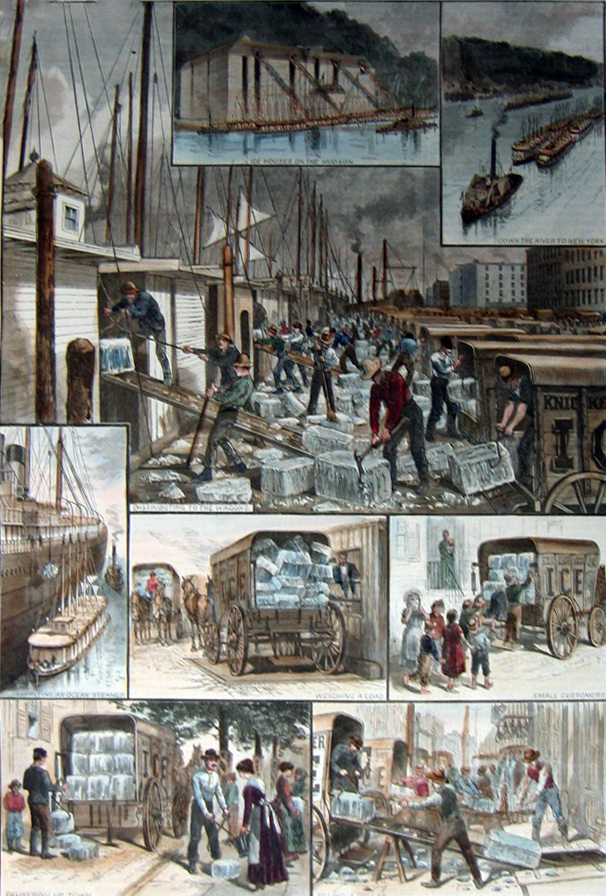
     Ice wagons loading ice from barges at a dock.  The ice, harvested the previous winter from the upper Hudson by ruddy-faced men with hand saws who cut it into chunks 12 inches thick, has been stored in sawdust-insulated huge dark riverside barns and now, tugged downriver on hundreds of barges, it will be hooked into wagons and hustled off by whip-cracking drivers through the steaming summer streets, to be tonged into homes or slid down ramps into cellars of fancy restaurants and hotels.  Even without refrigeration New Yorkers will have their frothy cold schooners of beer in beer gardens, their fine white wines at Delmonico’s, the prince of restaurants, and the chilled lemonades and tinted sherbets that they sip and nibble genteelly in ice cream parlors on Broadway.

File:New York Ice trade colour.jpg
The New York City ice trade, all phases.

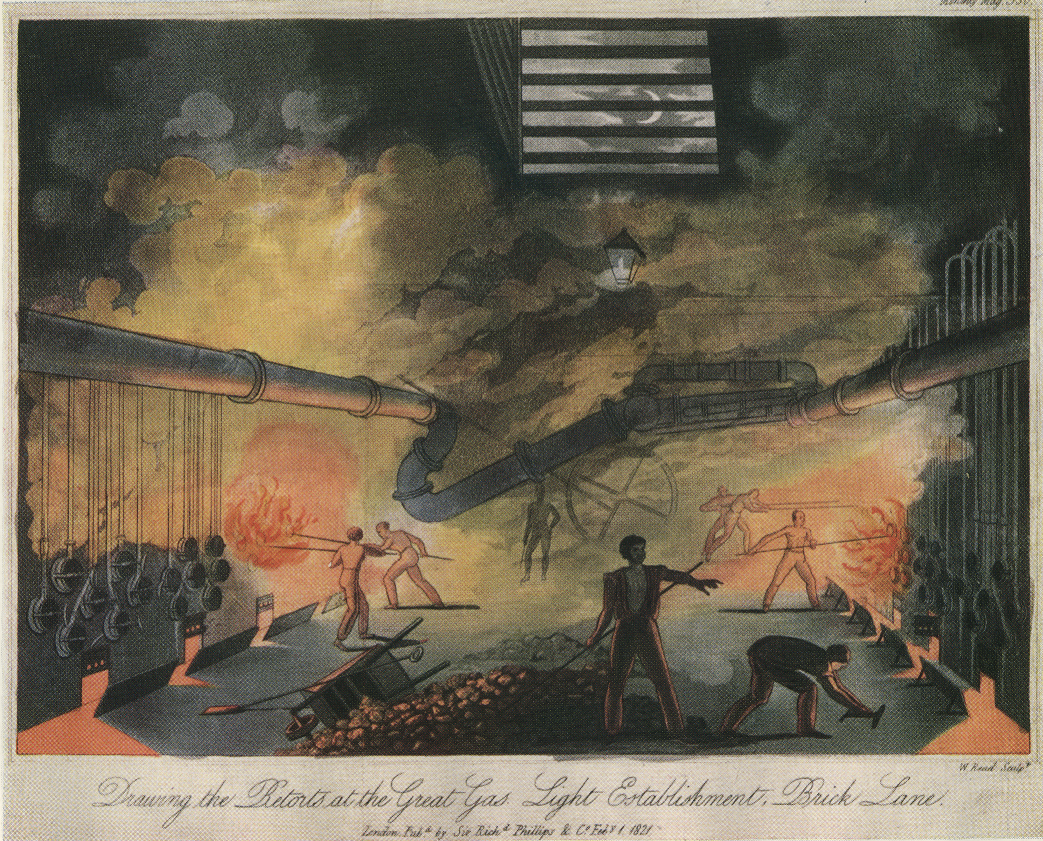
     18th Street.  The looming retorts and gas holders of the Manhattan Gas Company.  Ugly, sprawling, and smelly, gas works are located on the waterfront, far from the city’s fine residences.  Here, coal is scooped into red-hot retorts and burned there and 


File:Drawing the retorts at the Great Gas Establishment Brick Lane.png
Inside the retorts of a gas works.  Not something you would
want near your residence.
its vapors carried off to be stored in gas holders, giant bulbed bellies of iron, then conveyed through underground pipes to hotels and restaurants and the bibelot-crammed homes of the rich.  There it becomes light, glowing from globed chandeliers, or from polished glass boxes of streetlamps along the Fifth Avenue and Broadway and other thoroughfares where lamplighters light them at twilight and snuff them at dawn.  Thanks to gaslight, pickpockets work in the evening, hotel lobbies glow, and Fisk’s Opera House presents in a stellar glare imported Spanish dancers, music by Offenbach, and cataracts with real water, climaxed by 100 Beauties 100 hiking their ruffled skirts, as 200 shapely legs kick high in that talked-about scandal from Paris, the  TERPSICHOREAN  AEROSTATICS  OF  THE  DEMON  CANCAN.

Yes, gaslight helped.

      Just offshore, a towering floating derrick with cables and pulleys that with only 1 horsepower and five men has lifted a sunken boat laden with 300 tons of coal.  Once again, the machine has triumphed.

     11th Street.  You think you’ve experienced noise and bustle so far?  Hardly.  Here we leave the quieter docks – yes, quieter -- dealing with grain, lumber, sugar, iron, and ice, and come to the docks of the shipping lines linking New York to Boston and New Orleans and San Francisco and Liverpool and Le Havre and Hamburg and Canton and Jakarta and Bombay. Surging across West Street come arriving and departing travelers, porters carrying baggage, and clerks with letter bundles scurrying after captains toting mailbags, all of them fighting past wagons blocking horsecars blocking stages amid shouts and curses of drivers, lumber spilling from a cart, mountains of barrels and bales, a black-garbed minister distributing tracts and Bibles to whoever will take them, and smells of fish, brine, tar, and molasses.

     The oyster market.  Rows of anchored oyster boats where men pry open oyster shells with knives, toss the oysters in pails of water.  Wagons take on loads of baskets of oysters that will be consumed by New Yorkers everywhere, in fine and not-so-fine restaurants, in oyster cellars, and even at stands in the street, as they relish glistening blue points on crushed ice with a wedge of lemon, or plump saddle rocks plucked from the groin of the sea.

     Slips where Coney Island sand is stored, so housewives can scour their pans and kettles and keep them bright.  Sand too for the floors of saloons, where untutored males of the lower classes, and even some tutored males of the upper classes, still have a habit of spitting. 

     10th Street.  Winches rattle, tackles run, officers whistle and gesticulate and halloo, as a gang of men in a hold strain to hoist a huge mahogany log out with tackle.  Mahogany from the steaming jungles of Honduras will be used in the fine furnishings of the palace steamboats of the People’s Line, where ordinary Americans can revel in luxuries reserved for the wealthy and titled in Europe.

     Under the piers of these docks are dense forests of pilings that only the smallest skiff can negotiate, a hidden world shadowy even by daytime where harbor thieves hide stolen goods that they hope to sell to licensed junkmen in boats who ask no questions.  From time to time policemen search under the piers and clean out the stashes of stolen goods, but more goods will be stashed, and the game goes on.

     Below Canal Street, a garbage dump where a long line of carts on a high pier dump refuse onto a lighter moored below.  Crawling over the huge mound of trash like a horde of maggots are men, women, and children scavenging bones, coal, rags, and old metal to sell to peddlers, and even scraps of food that they devour greedily.  Smells of burnt wood, ashes, shit.


Stock Photo #4048-6369, Poor people scavenging garbage dump looking for rags, coal, and bones, on a barge docked at the foot of Beach Street, New York City.


     The Albany boat landing, where fashionables leaving for Saratoga scramble aboard amid the hubbub of cart drivers, cabs, baggage men, vendors, and the roar of escaping steam from the boats.  By August, everyone who is anyone flees the heat of the city, leaving behind the budget-strapped unfortunates who can only pull their front curtains shut and avoid being seen on the street, so the neighbors will think that they too are enjoying the amenities of Long Branch or Saratoga.  So it is in this distant time before air-conditioning.

     The Washington Market, between Vesey and Fulton Streets.  A sprawling old structure topped by a belfry.  In the early morning, a jam of wagons heaped high with meat from the Jersey slaughterhouses, produce from the garden patches of uptown shanty dwellers, and butter and cheese from Westchester farmers, all of them clattering down the narrow muddy lanes between the stalls where their crates, baskets, and barrels are unloaded while geese honk and chickens cluck.  


Gray-smocked vendors hawk their wares: dangling from hooks, carcasses of beef, deer, ducks, turkeys, rabbits, even the huge shaggy bulk of a bear; glistening heaps of silver-gray fish; huge yellow mountains of cheese; and baskets of peaches, plums, onions, and potatoes attended by ruddy-faced market women in broad-brimmed hats.  The first buyers flock: caterers from the best restaurants and hotels, among them Lorenzo Delmonico in a dark coat and top hat, scrutinizing the soft velvet plumage of a heap of fowl, pinching and sniffing, then tossing one bird, then another, into a wicker basket, his spoils destined for the tables of the city’s fanciest restaurant, the fabled Delmonico’s on 14th Street.  There, railroad men and politicians and foreign visitors and the city’s elite dine genteelly in the evening in a high-ceilinged room lit by crystal chandeliers, at tables with gleaming crystal and silverware, served by waiters who glide noiselessly over deep-pile carpet.  Yet even as Lorenzo Delmonico makes his careful selection, barefoot boys and old women pick at garbage sweepings nearby that even dogs reject. 

     At last, an island of silence, a plenitude of calm: the Battery, with its fine view of the river and harbor, where smoke-belching steamboats mingle with  three-masted sailing vessels and smaller schooners and sloops, and ferries plying to and from Brooklyn and Jersey and Staten Island, and even rowboats here and there.  But did I say peace and quiet?  An old woman tending a peanut and pineapple stand suddenly erupts at some visitors: “Get out wid ye, spittin’ all over me pineapples!  Do yees think I’ve got nothin’ to do but be washin’ me slices all day after yees?”  We move on.

The Battery, 1872.  A Currier & Ives print.  

     From here we’ll continue our imagined walk up South Street along the East River circa 1870 and see what today’s South Street Seaport, a historic district with renovated commercial buildings and sailing ships, can only give a hint of.

     North of Market Street, bowsprits of anchored sailing vessels jut high in the air overhead, while stevedores hustle huge bales and barrels and crates onto wagons and off of them, and iron-wheeled drays clatter on cobblestones amid smells of whale oil and sawn wood and brine.  Facing the docks are rows of old brick buildings housing sparmakers and riggers, and sailmakers’ lofts over the offices of shipping lines, and ship chandleries with everything needed for a ship: barometers and sextants and quadrants; cordage, paint, canvas, and oils; buoys and bells, windlasses and bilge pumps; and even cutlasses and axes that conjure up visions of seamen in old sailing vessels fighting off boarders from a British man-o’-war, or hordes of pirates armed with poisoned darts in the Sunda Straits.  Forges glow in ship smith shops where hammers clang on anvils, saws whine in spar yards, as shipwrights shape long timbers into spars, and a crowd of ragged boys watch, wide-eyed, as an aproned figurehead carver with a hammer and chisel hews out the shape of a bare-breasted sea nymph to adorn the bow of a ship.  Here, even in this age of steam, the age of sail still holds.  
South Street, 1827.  The heyday of sail, before steamships began crossing the Atlantic.


     Above Wall Street, a brig from the Guinea Coast of Africa, having survived the deaths of a mate and two crewmen from yellow fever, unloads palm oil to be used in soaps and as a lubricant, and ivory needed for billiard balls, fancy buttons, jewelry, and the keys of pianofortes, fingering which young ladies in hushed parlors demonstrate their genteel accomplishments to guests.  (Which brings to mind an old joke:  “What do you think of her execution?”  “I’m in favor of it.”)

     At the foot of Pike Street, huge dry docks side by side.  Using a steam engine, four men jerk a ship up out of the water for repairs.  In the next dock over, two hundred workers peg away at a steamer’s bottom, scraping off barnacles, cleaning and repairing it. 

     Pier 54, at the foot of Grand Street.  Huge blocks of Italian marble are hoisted from the holds of vessels by creaking windlasses, to be taken by cart to the marble cutters, who will saw and hew them into smaller blocks and slabs that will become ornamental fronts of houses, baptismal fonts for churches, and monuments to the dear departed.  But some blocks are destined for studios where home-grown Michelangelos will labor to transform the frumpy consorts of Chicago hog butchers and Pennsylvania oil barons into sculpted magnificence, into music of stone.

     Near 12th Street, a sudden hush: the coffin of a skipper dead of a fever at sea is being borne down the gangplank of a ship.  Stevedores stand silent, hats off, until a hearse bears the coffin off.  Then, just as suddenly, the noise and bustle resume.

     We could go on a bit along South Street and see more shipyards and iron foundries and gas works, but this would simply repeat, and it’s late in the day and we’re tired, so we’ll end our tour here.

     Day’s end: sunset on the North River and East River docks.  In the fading ruddy glow, piers grow dim and anchored ships loom with darkened hulls and rigging, and water shines with the blackness of night.  Straggling teams pass with the last loads of the day, then silence.  Watchmen make their rounds, yawning; suspicious shadows skulk; gruff sounds from a groggery; ragged street kids fall deep asleep on cotton bales; harbor thieves in small boats glide noiselessly, on the lookout for unguarded spoils.  A brief repose for the docks until, in the wee morning hours, the first market wagons lurch and grate and creak.

     Such were the docks circa 1870, when city and nation were in the throes of the Industrial Revolution, with machines taking on more and more tasks once performed by men and horses and mules.  At the Centennial Exposition in Philadelphia in 1876, multitudes flocked to Machinery Hall to see machines press bricks, pump water into thundering Niagaras, spin cotton, print newspapers, drill metal, grind bone into dust.  And some giant Krupp cannon as well.  “What will you do with all these things?” wondered Thomas Huxley, the English champion of Darwinism.  Today we might ask the same of cell phones and laptops and tablets.


File:Krupp Exhibit - 1876 Centennial Exhibition - Philadelphia - print.jpg
Krupp artillery at the Exposition.  What will you do with all these things?
In this case, the answer came in 1914.

      But the New York of 1870 knew what to do with machines and ships and docks.  It was not neat or subtle or just, but it did things.  It transshipped huge quantities of goods and turned iron into boilers and sugar mills, marble into memorials, ivory into piano keys, offal into leather and glue, and smirchy coal into the miracle of light.  Then as now there were thieves and cheats and manipulators, but the city did things, and did them big.

     Today the waterfront has dog walkers, joggers, cyclists, and sunbathers, but no grain elevators, sugar refineries, iron works, or dry docks.  What happened?  First, competing ports offered services at lower cost; New York  always was – and still is – an expensive place to do business.  Next, railroads, and later trucks and airlines, took on traffic that once went by water.  In the twentieth century racketeers got control of the unions, with little concern for maintenance of the waterfront, or for damage to the port’s reputation.  And from the 1950s on, containerization came in, requiring more space than the port of New York could offer, so that a lot of business went to the vast facilities of the port of Newark.  After that, much of the waterfront fell into decay, until the current movement to restore it and use it for recreation.  Once dirty and cluttered and busy, now it is clean and green.
File:Line3174 - Shipping Containers at the terminal at Port Elizabeth, New Jersey - NOAA.jpg
Containers at the Port Newark-Elizabeth Marine Terminal.  New York could offer no
such space as this.

     Source note:  Much of this post is drawn from my unpublished historical fiction, which draws on primary sources that include old prints of the time and two articles by journalists who described a day’s walk along the docks.

     Election results:  As expected, New York City has a new mayor – a Democrat, after all these years!  Bill de Blasio, who stands 6 foot 5, promises many longed-for changes, and multitudes cheer.  This is the honeymoon; it won’t last long.  Being mayor of this city is not the pleasantest job.  New Yorkers love to croak and complain, and the mayor spends half his time in Albany, begging the governor and legislature to let him raise a tax or two or otherwise attempt to govern.  And it’s a dead-end job: to my knowledge, no mayor has ever become a presidential candidate, whereas many a New York State governor has aspired to the White House, and a few have even succeeded.  So we’ll see how our 109th mayor fares.

     Coming soon:  Guzzling New York, and why Prohibition has never succeeded here; the city’s long-term romance with the oil of joy.  After that: mayors of New York, including the most honest, the most corrupt, the most elegant, the most good-looking, the most fun-loving.  In the offing: Lighting in the city; from candles to neon signs. And transportation: how New Yorkers did – and didn’t – get around; gigs and landaus and broughams, horsecars and stages, races and jams (not the kind you eat), the first gas buggies, the horrors and delights of the subway. 

     ©  2013  Clifford Browder

Sunday, November 3, 2013

98. My Suicides and Further Thoughts on the Subject


     Just three.  At least, three that I remember.  The first one, and probably the most significant, took place far from New York, in the tranquil Chicago suburb of Evanston, where I grew up.  It was the year after my college graduation, when I was marking time hoping for a Fulbright scholarship that would get me to Europe, while reading and rereading the English poets and  taking beginning Greek with Professor Dorjahn at Northwestern.  Dorjahn, the head of the tiny Classics Department, was a crusty and demanding teacher who loved teaching this course, the gateway to Greek and the classics.  He had been known to reduce sensitive females to tears, so in the first semester was relieved to find only hardy males in this class of five.  A staunch Republican, he thought nothing of denouncing President Truman as a haberdasher out of his depth, but for all his crustiness and prejudices, we loved him.  Which, come to think of it, has nothing to do with suicides.

     As the months wore on, the gray vapors of depression began to infiltrate my being.  Reading poetry and taking Greek was fine, but it was hardly a  life in itself.  I was living at home after four years of college elsewhere, had lost contact with my Evanston friends, dated rarely, had little social life.  Not being used to introspection – at least, not the kind that probes deep into one’s own psyche – I found myself borne slowly on the current of my moods.  Attracted at this point to neither men nor women, I was in a strange limbo of indifference and abandonment, one that even today I have trouble understanding.  Excitement over something I was reading, or my progress in learning Greek, alternated with withdrawal, with alienation from everyone and everything around me.  And of all this, not a word to anyone.  Then I would snap out of it, read more, learn more; but sooner or later the gray mood crept back in.

     One evening that fall or winter, when that mood was upon me, without further reflection and almost like a sleepwalker I slipped out of the house unnoticed by my family, went to the garage, and in the darkness sat in the driver’s seat of my father’s car and, after a few moments of hesitation, turned the motor on.  The garage doors were shut, so monoxide poisoning was possible, even probable, and I knew it.  But the motor started with such a roar that it alarmed me and, fearing discovery, I quickly shut it off.  I then left the garage and slipped back into the house, still unnoticed by anyone.  Was I relieved, alarmed, amused by this fiasco?  I don’t recall.  Was it just a game that I intended to lose?  I doubt it.  The risk was real, and if the motor had come on with a gentle purr, I could well have seen the matter through.

     After that, sensing a need for change, I took a part-time afternoon job at a local insurance company, retrieving applications from the files when the staff had need of them: a menial job, but one that shook me free of those gray vapors.  If the Fulbright didn’t come through, I resolved to go to New York and find a job; I had to get free of family and a suburban life that depressed me.  But the Fulbright did finally come through, and from then on I was feverishly brushing up my French, with no time for either sex or depression.  So ends the account of my first suicide, hitherto untold to anyone.

File:Suicide prevention-DOD.jpg
A suicide prevention poster of the Department of Defense.
Suicide is common among returning vets.

     Fast forward now to 1965.  (I love “fast forward,” it’s so with-it, so twenty-first century.)   I’m a college French teacher now in New York, unattached, a very unpublished poet, but with many friends, many interests, few of the latter related to teaching nineteen-year-olds French.  A friend of mine got a volume of poetry published, and I was invited to a celebration of the event given by some mutual acquaintances.  I went, found a friendly crowd imbibing wine, and there, prominently displayed on a bureau, the volume, of which I later received an autographed copy.  Toward the end of the party it was obvious that the poet and some of his friends were going out to a dinner to which I was not invited.  But another friend, going out with some other guests for dinner, invited me to join them; for some reason I refused. 

     Instead, I went home, lapsed again into the gray mood of depression, and without reflection turned the oven on without lighting the gas, kneeled down, and stuck my head in, covering it with a towel so as to keep the gas from spreading and dissipating.  I remained in this awkward position for quite a while, breathing in deeply and hoping to gently pass out and shuffle off this mortal coil.  But I remained stubbornly alive and alert, and finally, deciding the whole business was ridiculous, got up, turned the gas off, and went to bed.

     Why had I done this?  Jealous of my published friend?  I don’t think so; I wished him and his volume well.  Depressed because I was not invited to the dinner party?  Maybe, but neither was the other friend who invited me to join his friends for dinner.  More to the point, I suspect, was my dislike of teaching – a dislike whose growing intensity I dared not admit to myself – and my frustrated wish for a relationship, as opposed to occasional sex with strangers.  It was still the era of the Mafia-run bars, crowded on Saturday nights, smoke-filled, and guarded by a thug at the door: not my preferred habitat by a long shot.  And my frustration as an unpublished writer probably counted for something as well. Yet even today, with hindsight, I can’t explain the incident adequately; it simply happened.

     “History repeats itself, first as tragedy, second as farce,” Karl Marx famously observed.  So it was with me and suicide, if we grant the first two attempts the grandiose label of tragedy; the third was certainly farce.  It must have come a year or two after the second suicide.  I had contemplated various possibilities, albeit with a certain detachment.  Suicide by jumping out a window was no good; I lived in a third-story apartment.  Besides, the dizzying plunge would be terrifying, and my splat on the pavement below might injure some passerby with whom I had no quarrel; pedestrian safety must be considered.  Suicide by revolver would be quick, neat, and clean, and once you twitched the trigger, no chance for reappraisal; alas, I had no revolver.  Finally I settled on a novel method: suicide by aspirin.  Granted, I had never heard of it succeeding; in fact, I had never heard of it at all.  But it seemed worth trying, and maybe, just maybe, it might work.

File:Regular strength enteric coated aspirin tablets.jpg
Fine for headaches.  But suicide???
Ragesoss
   So one evening when that gray mood was upon me, I emptied a whole bottle of aspirin, swallowing one tablet after another, then went to bed and fell asleep, wondering if I would ever wake up.  The next morning I did, unmistakably alive, but with a feeling of weakness, a foul taste of aspirin in my mouth, and a craving for ice cream, a craving like I had never known before, worthy of a pregnant woman, and specifically for vanilla.  Too weak to go out, I phoned a friend, told him I was under the weather and asked him to bring me the ice cream; no word, of course, of the aspirin.  This he gladly did and, being a former ministerial student, he lingered a while and exhibited a most sympathetic bedside manner.  After he left, I devoured the ice cream, probably a whole pint at least.  It seemed to work wonders, since the aspirin taste diminished and I felt stronger by the minute.  But that awful taste, the faintest hint of it, hung on for days.  As did my sense of the ludicrous.  Suicide by monoxide has a certain minimal dignity, and suicide by the oven stops just this side of the ridiculous.  But let’s face it, suicide by aspirin plunges deep into the realm of absurdity.

     Such was my third and last suicide.  Often I escaped depression by simply going to bed and sleeping, a far better solution than alcohol or drugs. Then the gray vapors vanished, and with them the urge to suicide, owing to two changes: I quit teaching, I met my partner Bob.  These games faded in memory, became definitively a thing of the past.

     Were these attempts simply a game, a toying with fate that I had no real intention of pushing through to completion?  It’s hard to say.  A game, perhaps, but always with risk.  There are better, less dangerous games to play.  But the games served a purpose; following each attempt came a long period of calm and equanimity totally free of depression.  As Nietzsche observed, “The thought of suicide is a great consolation; it gets one through many a bad night.” 

     None of my friends or family had any inkling of all this, not one.  And certainly not my students, since every Monday morning I showed up on the campus as well scrubbed as ever, ready to leaven the sodden weight of grammar with attempts at quicksilver wit. 

     Why do I now relate all this, having never revealed it before to anyone?  Two reasons: it’s an ancient story, and with distance I see the humor.  But what I don’t fully grasp to this day is the motivation, which I can only  surmise.  The young man of those years is in many ways a stranger to me, and a baffling one at that.  How complicated we humans are, what a tangle of motives and frustrations, a mystery even more to ourselves than to others!

File:Fumer peut entrainer une mort lente et douloureuse.gif
"Smoking can cause a slow
and painful death."  But
the French still love their
cigarettes.
      My suicides were at least a frank attempt at self-destruction.  There are many other forms of suicide, less obvious and often unavowed.  My brother smoked for twenty years, knowing he had emphysema; he coughed horrendously at night, slept but was not rested, and finally collapsed and died within minutes.  My father too smoked for years, knowing it was doing him no good; he bribed his two sons not to smoke, but he himself, with his health deteriorating, finally succumbed to a stroke.  And a friend of Bob’s and mine, a gentle spirit, snacked for years on junk food, never ate a full and healthy meal, and finally died of pneumonia, his immune system hopelessly weakened, when antibiotics failed.  Sad cases, all of them, and to my way of thinking, suicide.

File:Woman smoking a cigarette.jpg
Slow suicide.
Oxfordian Kissuth

File:Empire State Building all.jpg
A mecca for suicides.
Jiuguang Wang
     New York City has seen its share of suicides; the Empire State Building and the subway system, like San Francisco’s Golden Gate Bridge, are  magnets for them.  More than thirty people have jumped from the upper parts of the skyscraper and usually succeeded in their attempt.  Two survived: one was blown back by a gust of wind and suffered a broken hip; the other landed on a ledge and was pulled to safety with only minor injuries.  In 1947 a fence was erected around the observation deck after five attempts in three weeks.

     Three suicides in New York come to my mind, beside which my attempts seem trivial.  In 1875 the board of the People’s Line, one of the two dominant steamboat lines on the Hudson River, forcibly retired Captain Alanson P. St. John, age 77, because of his age and ill health.  The captain had been on the river for over forty years, skippering boats from New York to Albany.  He knew every mile of that run, loved boats and everything about them, and loved being on the river.  At times he seemed depressed.  On April 23, 1875, he came from his home in New Jersey to inspect his favorite boat, one named for him, the St. John, then undergoing repairs at the foot of 19th Street.  Chatting on deck with the first mate, he seemed in the best of health and spirits, following which he entered the steward’s room alone.  Five minutes later a shot rang out.  Rushing inside the cabin, the workmen found the captain slumped dead in a chair, a smoking revolver in one hand, his features as composed as in sleep.  The coroner’s verdict was suicide “while laboring under temporary aberration of mind.”  Some of his friends attributed his depression to ill health, but others knew better: he could not live away from the river.


File:Madame Restell's suicide.jpg     Another suicide of that era is more troubling.  In 1878 Ann Lohman, age 67, alias Madame Restell, the city’s most notorious and conspicuously successful abortionist, was arrested by Anthony Comstock, agent of the Society for the Suppression of Vice.  Learning that she might be sentenced to years in prison, bringing shame upon her two beloved grandchildren, she who all her life had exhibited remarkable fortitude and contempt for public opinion lost her habitual self-possession and became distraught.  The day before her trial, she stalked about her sumptuous Fifth Avenue palace, trembling and moaning and wringing her diamond-studded hands, convinced they would convict her on one charge or another, that everyone was against her, that she had no friends.  “What shall I do?” she muttered over and over again.  “Why don’t they leave me alone?”  Her family tried to console or distract her, but to no avail.  Dazed among the bric-a-brac, she uttered broken monologs, whispered, started, wept.  Finally she went to bed, seemed calmer, fell asleep.  Early the next morning her maid noticed the door of the second-floor bathroom was open, saw her mistress’s nightgown lying on a chair, knocked, got no answer, entered, and beheld madam’s nude body half immersed in the bathtub, one arm spotted with blood, her head reclining, her throat slit from ear to ear, a sight that sent the maid shrieking from the room.  The coroner found an eight-inch kitchen knife in the tub, concluded that, given the deceased’s calm features, death must have been instant and painless.  Madam’s profession had required a strong will, settled nerves, and  a steady hand; in her final moments they served her well.  The press almost unanimously hailed her passing, the Times calling it “a fit end to an odious career.”  Though she was said to be the fifteenth offender whom he had driven to suicide, Comstock felt in no way responsible; as Secretary of the Society for the Suppression of Vice, he closed out her file with the comment, “A Bloody ending to a bloody life.”

     These first two suicides I learned of while researching my two biographies; the third one, one of the most sensational in twentieth-century New York, I learned of only recently.  On May 1, 1947, Evelyn McHale, age 23, went up to the 86th-floor observation deck of the Empire State Building and jumped to her death.  Her hurtling body landed with a crash on a United Nations limousine parked in the street below, smashing its roof.  Four minutes later a photographer who happened to be nearby photographed her body, her face surprisingly composed in the midst of twisted metal and shattered glass.  She had left her coat and a note on the deck: “I don’t want anyone in or out of my family to see any part of me.  Could you destroy my body by cremation?  I beg of you and my family – don’t have any service for me or remembrance for me.  [Then, crossed out but legible:]  My fiancé asked me to marry him in June.  I don’t think I would make a good wife for anybody.  He is much better off without me.”  According to her wishes, she was cremated.  When her fiancé saw her the day before, she had seemed completely normal and happy.  She became known as the city’s most beautiful suicide, but her motivation remains unclear to this day.

File:Day view from Empire State Building observatory Manhattan, New York City, United States (9892436955).jpg
Observation deck of the Empire State Building today.  This
barrier might have stopped Evelyn McHale.

Boris Dzhingarov

     Evelyn McHale’s story, imperfectly known as it is, is a warning that  potential suicides can conceal their depression from others, even those closest to them.  Never assume that you know anyone completely; deep in our psyche we all harbor secret closets, locked drawers.

     Evelyn McHale’s death inspires another reflection as well.  One key ingredient in the formula for suicide is a keen sense of unworthiness: if God there is, I’m not worth his attention, or anyone’s.  Even for those not inclined to suicide, demeaning oneself is no small weapon in the arsenal of survival and evasion; it gets one off so many hooks. 

     Some societies see suicide as permissible, even honorable, under certain circumstances, though not traditionally our own.  I see no reason why someone terminally ill, especially if in great pain, should not be allowed to end their suffering.  And should assisted suicide be permitted?  Again, in the case of terminally ill patients, I think so.  I applauded Jacob (Jack) Kevorkian ("Dr. Death") for helping such patients end their misery -- at least 130, by his own count -- and deplored his arrests and trials.  Three trials ended in acquittal, and one in a mistrial; he was finally convicted of second-degree homicide in Michigan and served over eight years in prison before being granted parole for good behavior in 2007.  Certainly he had provoked the authorities, even dared them to arrest him, but public opinion now seems to be turning in his direction, as Oregon, Washington, and Vermont have legalized physician-assisted suicide in the case of terminally ill patients.  Kevorkian died in 2011.
  
     The thought of suicide, however momentary, visits most of us at one time or another; adolescents are especially vulnerable, and veterans who have seen too much war.  What guards us against carrying out these urges?  Here are my suggestions:

·      A lasting and rewarding relationship.
·      Sustained creativity, as found in writers, artists, dancers, composers, and entrepreneurs.
·      Fear of the unknown.
·      A meaningful belief system.
·      A keen sense of responsibility to others.
·      A hearty sense of humor (as opposed to sardonic wit).
·      Contact, even superficial, with others.  Suicide is usually a solitary event.
·      A sense of wonder at the natural world around us.

     I would especially stress the last.  I find wonder in the arching magnificence of trees, in tiny flowers, in patterns of lichens and slime molds, in sunrises and sunsets, the flight of egrets and the haunting sounds of loons, in the scintillating magic of light on water, and the starry infinitudes of space.  “My sense of God is my sense of wonder about the universe,” said Alfred Einstein.  His religion is my religion, too, with maybe a dash of Taoism thrown in. 


File:Oak Tree Silhouette.JPG
RhinoMind


File:Slime Mold Olympic National Park North Fork Sol Duc.jpg


File:Blackbird-sunset-03.jpg


File:Night Sky Stars Trees 02.jpg


     Election note:  Next Tuesday, hot on the heels of Halloween, we have a mayoral election in New York.  The Republican candidate, Joe Lhota, comes off in photos as a nice little man with a mustache.  He has a good record as an administrator and showed some fire in the mayoral debates, but this is a big city that wants a big mayor, and Bill de Blasio, the Democratic candidate, seems to fill the bill.  It doesn’t hurt that he has an African American wife (who considered herself a Lesbian until she met him), and a fifteen-year-old son with an afro who charmed viewers when he appeared on television.  (There are New Yorkers who ask, “Is de Blasio the one with the kid with an afro?”)  De Blasio is far ahead in the polls.  There are many significant issues at stake, but I mention the preceding to show how voters are swayed by the superficial.  Such is democracy as we know it. 

File:Bill de Blasio and family.jpg
Our next mayor?  Bill de Blasio with his wife, son, and daughter at a rally.
Chirlane McCray

     Coming soon:  A walk along the waterfront, circa 1870: the offal boat, the Hotel de Flaherty (not Zagat rated), how things were kept cold before refrigeration, how coal from Pennsylvania helped pickpockets, where harbor thieves hid what they stole, how New York helped feed the hungry mouths of Europe, and where you could buy a whole carcass of bear.  But no bike paths, dog runs, or tennis courts.  After that, maybe a post on New York mayors past and present: the most colorful, the most fun-loving, the most corrupt, the best-looking, the most honest, the most elegant, etc.

     ©  2013  Clifford Browder