Sunday, September 8, 2013

86. Walter Winchell, a New Kind of Terrorist


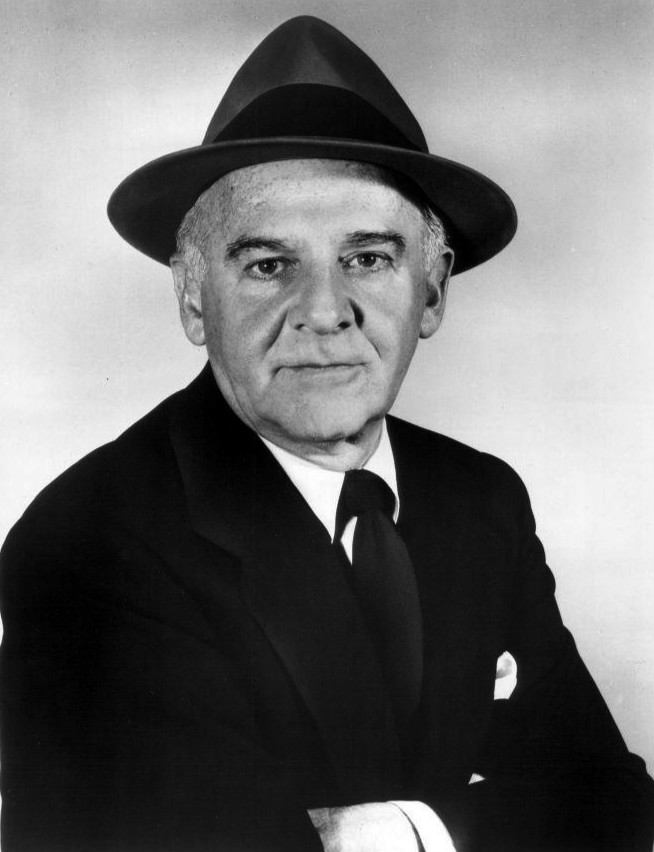
File:Walter Winchell 1960.JPG
Winchell in 1960, with his signature fedora.
     "Good evening, Mr. and Mrs. America, and all the ships at sea!  Let's go to press."  Along with this, the sound of a telegraph key, giving a sense of urgency.  So began the broadcast that I heard so many times back in the early 1940s. The voice was crisp, terse, vibrant; it cut you like a knife.  A series of facts followed at breakneck speed, each one fired like a bullet.  The speaker's style was energetic, unique, differing greatly from the quiet dignity and smugness of H.V. Kaltenborn, the self-proclaimed dean of American newsmen, and the orotund pronouncements of Gabriel Heater, whom my father christened "the angel Gabriel," and who announced importantly, "Good evening, everyone, there's good news tonight!"

     The vibrant, cutting voice was that of Walter Winchell (1897-1972), whom I knew only from his staccato performance on the radio, but about whom I would in time learn abundantly more.  He seemed the epitome of the New Yorker, brash, self-confident, abrasive.  Indeed, he was born to a family of Jewish immigrants from Russia and grew up in East Harlem, escaping poverty first by performing in vaudeville and then by becoming a newspaper columnist.  By the mid-1920s he was making a name for himself as a Broadway gossip columnist reporting on the rich and famous, their romances and marriages and divorces, but he had connections to mobsters as well.  In 1929 he was hired by the New York Daily Mirror, where in time he launched the first syndicated gossip column, and a year later he made his debut on radio.

     Can a gossip columnist have too many contacts?  In Winchell's case, yes.  His gangster connections soon made him fear for his life because he knew too much, so in 1932 he vamoosed to the fair clime of California, only to return a few weeks later with a newfound enthusiasm for G-men, Uncle Sam, and the flag; soon he was a close friend of J. Edgar Hoover, whose FBI had never looked so good to him.  By the time I first encountered him in the early 1940s his column was carried by hundreds of newspapers nationwide, and his radio audience surpassed that of the most popular comedians of the day.  He was then at the height of his power and influence.

     In print and on the air Winchell bent, stretched, enriched, and abused the English language, putting a stamp on it all his own.  Two people in love were "sizzling" or "garbo-ing it," newly marrieds were "welded" or "lohengrinned" or "merged," and a divorced couple were "sharing separate tepees."  A pregnant woman was "infanticipating," and the happy parents would soon join "the mom and population."  Other Winchellisms include "sextress," "messer of ceremonies," "shafts" (legs), "debutramp" (debutante), "Chicagorilla" (gangster), and "giggle water" (liquor).  He referred to Broadway as "Baloney Boulevard" and the "Hardened Artery" of the city, and to Times Square as  "Hard Times Square."

     Some of his quips were also memorable: "Nothing recedes like success."  "Gossip is the art of saying nothing in a way that leaves practically nothing unsaid."  "I usually get my stuff from people who promised somebody else that they would keep it secret."  "Hollywood is where they shoot too many pictures and not enough actors."  "An optimist is someone who gets treed by a lion but enjoys the scenery."

     Winchell's columns and broadcasts were meant to shock and surprise, and sometimes to infuriate.  He was, or pretended to be, a moralist, judging the fools and villains out there, vast numbers of nefarious persons and events.  From 1930 on he was a regular at the Stork Club, which later moved to 3 East 53rd Street, where it became New York's most prestigious nightclub.  Holding court like a prince at Table 50 in the ultra exclusive Cub Room, Winchell summoned athletes, movie stars, debutantes, and royalty into his august presence, where he plied them for information about themselves and others.  They went because they were afraid not to.  A hostile Winchell could skewer you with scandal, impale you on barbs of scorn.  So they wooed, flattered, and cajoled him, giving him tidbits of gossip he could use.  Just as Hedda Hopper and Louella Parsons dominated Hollywood, he held Broadway in a reign of fear.  The syndicated columnist was a new kind of terrorist, hobnobbing with celebrities, learning their secrets, exercising vast power by threatening to tell all.  Few of us are without haunting deep fears and reservoirs of shame.  Winchell and his Hollywood counterparts knew this and used it without pity.

     In the 1930s Winchell eulogized President Roosevelt, who invited him to the White House,  and J. Edgar Hoover, who gave him tips from the FBI.  One of the first to denounce Hitler and pro-Nazi groups in America, he also supported civil rights for African Americans and attacked the Ku Klux Klan.  So far, he would seem to have been on the right side of history.  But after World War II that  changed.  As the Cold War loomed, he became an ardent supporter of Senator Joseph McCarthy and, like him, detected Communists everywhere and saw himself as the nation's savior.  When the New York Post ran a series criticizing him, he counterattacked viciously, labeling it the"Compost," the "Postinko" and the "Postitute," and calling its columnists "presstitutes."  In 1951 the singer Josephine Baker asserted that she had been refused service at the Stork Club and that Winchell, who was in the restaurant, had refused to come to her aid.  Winchell insisted that he knew nothing of the incident, which may have been the case, but he was attacked by others, and rival columnist Ed Sullivan announced that he despised Winchell as symbolizing evil and treacherous things in America.

     I never encountered Winchell face to face, but my friend Ken told of an encounter with relish.  It happened at Lindy's restaurant, another legendary midtown haunt at 51st  Street and Broadway, made famous by Damon Runyan's stories.  Ken was at a counter in front, buying a wedge of their famous cherry-topped cheesecake to take out, when suddenly all around him he heard awed whispers:  "Walter Winchell ... Walter Winchell ... here comes Walter Winchell!"  Sure enough, striding in like a conqueror, came Winchell.  As he brushed by Ken, he jostled him.  Furious, Ken spun around and delivered a quick kick to his ankle.  Winchell gave no hint of a reaction, but marched on into the nether depths of the restaurant, where he was no doubt persona most grata.  Of all my friends and acquaintances, Ken is the only one who ever assaulted a demigod.


File:Lindys Restaurant Broadway and 51st Street New York City.JPG
A postcard showing Lindy's, including the famous cheesecake.

     As McCarthy's influence faded, so did the demigod's; he began to be seen as ruthless and arrogant.  The growing popularity of television helped accelerate his demise, since the nervous energy that worked well on radio made him look, in the words of an actor who saw him essaying TV, "like a strange, nervous elf."  His radio show was canceled, he lost his column when the Mirror folded.  By the late 1960s he was a has-been, and in 1969 he announced his retirement, saddened by his son's suicide and a daughter's failing health.  The man once wooed and feared by the famous spent his last years as a recluse at the Ambassador Hotel in Los Angeles, far from the Broadway he had loved.  In 1972 he died of cancer; his funeral was attended by one person, his surviving daughter.  Indeed, nothing recedes like success.


The Stork Club

Sherman Billingsley, November 1944.
Billingsley in the Cub Room, 1944.
Would he have let you in?
     The famous Stork Club was owned and operated by Sherman Billingsley (1896-1966), a native of Oklahoma where, before establishing himself in New York, he served fifteen months for selling illegal booze.  In 1929 the ex-bootlegger with gangster connections opened the Stork Club as a speakeasy on West 58th Street.  How Billingsley came up with the name is a mystery, since he later had no recollection of it.  His gangster involvement is said to have led to his kidnapping and the murder of the rival mobster responsible, following which Billingsley bought out his gangster partners and began to operate a bit more respectably ... and safely.  The first club was closed by the authorities in 1931, after which he moved it to East 51st Street and then, in 1934, after the repeal of Prohibition, to its final location at 3 East 53rd Street, where it became the famous Stork Club of cafe society history.  Walter Winchell was an early regular, proclaiming it "New York's New Yorkiest place," and his column brought many patrons flocking, as did Ethel Merman, with whom Billingsley had an affair, and who brought in the theater crowd.  In gratitude, a waiter was assigned to her just to light her cigarettes.

     Soon, movie stars and other celebrities, the wealthy and the notorious, show girls and politicians and playboys, and an assortment of international riffraff were mingling there and being reported on by Winchell and other columnists.  It was the meeting place of power, money, and glamour, but also of people watching people, celebrities being watched by non-celebrities.

 photo StorkClubDance.jpg

     If it was hard to gain entrance to the main dining room, it was even harder to access the inner inner sanctum of the Cub Room, reserved exclusively for recognized celebrities who could party there unannoyed by fans.  Seated at Table 1 in a plain or pinstriped suit with a flashy tie and a welcoming grin, Billingsley, his receding dark hair neatly combed, presided carefully, using hand gestures to indicate to the staff who deserved attention, who deserved special attention, who deserved little attention at all, and who should be got rid of as soon as possible.  This was where Winchell held forth at Table 50, summoning the rich and famous for brief interviews where he gleaned useful tidbits of gossip.  Among the guests over the years were Lucille Ball, Tallulah Bankhead, Charlie Chaplin, Frank Sinatra, the Duke and Duchess of Windsor, Judy Garland, Ronald Reagan, the young Kennedy brothers, Ernest Hemingway, Orson Welles, Grace Kelley, and a good friend of the owner named J. Edgar Hoover.  A house photographer recorded their presence and rushed his photos to the tabloids.  But not every big name got in.  Among those banned from the premises were Humphrey Bogart and Jackie Gleason, exclusion from its hallowed precincts being also a distinction of sorts.

     But Billingsley wanted more than just celebrities; he wanted everyone.  
His uniformed doorman with a solid 14-karat gold chain at the entrance was the gatekeeper to elysium, allowing a few of the hoi polloi in as well: a college boy and his date, a Chicago businessman with his wife (or girlfriend), a stray tourist from just about anywhere.  These lucky few paid handsomely for the privilege of having dinner and dancing to one of the club's three bands, and then going home to tell friends that -- miracle of miracles! -- they had been admitted to the Stork Club, as proof of which they might display a stolen ashtray.  It was better than winning a lottery, and all their friends could then dream of going themselves to New York and maybe, just maybe, getting past the gold chain barring entrance to the Stork Club.

     How did Billingsley keep the big names coming?  Through extravagant gifts: diamond- and ruby-studded compacts, champagne and other liquors, French perfumes, flashy ties, even automobiles.  Often the gifts were made specially for the Stork Club and bore the club's name and logo.  Also, at Christmas the regular patrons received a case of champagne.  Nor was it a bad place to work for the staff.  A bartender received a new Cadillac from a grateful customer, and a headwaiter a $10,000 tip from a tennis star.

     The Stork Club's golden years did not last forever.  The times of trouble began in 1951, with Josephine Baker's charges of racism following an incident that has been variously reported.  Whatever the truth of the incident, Billingsley harbored certain Wasp prejudices, was leery of blacks, Jews, the Irish and Italians.  In 1956 the club lost money for the first time, and in 1957 the unions tried again to organize the club, having already organized the city's other well-known clubs.  Billingsley resisted, and many employees joined a picket line outside that continued until the day the club closed.  This situation cost the club many patrons who refused to cross a picket line, and business steadily declined.  Billingsley grew more remote and paranoid, fired staff arbitrarily, alienated even his friends, and impoverished himself spending large sums to keep the club open.  Finally the last band was dismissed, replaced by recorded music playing for a dwindling clientele.  When, in 1963, the Stork Club advertised a hamburger and french fries for $1.99 in the New York Times, it was clear to all that the end was near. The club closed in 1965, and one year later Billingsley died of a heart attack.

     A television show bearing the club's name and hosted by Billingsley had run from 1950 to 1955, and the club appeared in several movies, including All About Eve (1950), where Bette Davis and other characters are seen in the exclusive Cub Room.  There was even a television drama entitled Murder at the Stork Club, likewise aired in 1950, with Billingsley playing a small part in it.  All of which shows the club's prestige in its heyday.


     Me and the Stork Club:  Once, just once, I set foot in the legendary Stork Club.  I was in midtown with some fellow graduate students when my friend Ken (yes, him again, so knowledgeable about the elite and their haunts) suggested that we have a drink at the Stork Club bar, which was open to the hoi polloi.  So we went.  There, so close to the inner sanctum frequented by celebrities and moneyed out-of-towners, and the inner inner sanctum of the Cub Room where the elite could revel undisturbed, we knew ourselves to be on the fringe of grandeur, on the very threshold of forbidden pleasures.  But I knew as well at a glance that the East Siders crowding round the bar were different from the West Siders that I had encountered in and around Columbia.  They were better dressed, but also more exclusive, not to say snobbish.  They gave us a glance or two, for we were unknown to them and they couldn't figure us out.  This delighted me, though we were really of no significance to them.  Still, there I was at the Stork Club!

     Thanks to Ken I also set foot in the Latin Quarter on Times Square, where we sat at the bar and watched Mae West spin out her familiar quips backed up by a pageant of muscle men.  And thanks to him again, I once found myself sitting at a table in the back of Sardi's on West 44th Street, the theater crowd's hangout, with the singer who had played the executive secretary in How to Succeed in Business Without Really Trying.  And sure enough, people recognized her and came over to congratulate her on her past performance.  Without Ken's urging I would never have stuck my nose in any of these haunts of the elite, for I would always be an outsider there and had no inclination to become, or pretend to be, an insider.  New York is many worlds; one has to sniff out one's own.

     Vivaldi in the subway:  For the last three Wednesday mornings, coming back from the Union Square Greenmarket, I have been astonished to hear Vivaldi in the subway station there.  And not just recorded amplified music, but a real-life violinist playing Vivaldi’s Four Seasons, which I dearly love, with the rest of the orchestra recorded.  And this in a crowded, noisy station.  Most people hurry past, a few stop momentarily, and I now linger, watching as she deftly manipulates her instrument, completely absorbed in what she is doing.  Last Wednesday I took her card and, when she finished “Autumn,” asked if I could mention her in my blog; she said she would be delighted.  She is Susan Keser, a concert violinist, with a website: newyorkviolinist.com. And she’s good!  Vivaldi in the subway: one more example of what makes New York New York, and why, with all its faults, I love it.

     Blog to be published:  I’ve just signed a contract with Brown & Sons, a new small press, for the publication of a segment of this blog (length at this point undetermined).  There will be both a print version and an e-book, with emphasis on text; illustrations will be limited.  I’ll post updates as publication nears; it will take some time.

©  2013  Clifford Browder


Wednesday, September 4, 2013

85. Colorful New Yorkers: The Mad Poet of Broadway, Fernandy, and the Mephistopheles of Wall Street


The Mad Poet of Broadway:  McDonald Clarke (1798-1842)


File:McDonald Clarke - Appleton's cyclopaedia.jpg
In his younger days, most definitely
effecting a Byronic look.
Strollers on Broadway in the 1830s often saw a tall form lounging past with a shredded blue cloak and a red handkerchief, a melancholy gazer at the pavement whose soul-deep sighs seemed to make of him, in this city of bustling doers, a singed angel or gentle demon.  “Who is he?” asked passing ladies, touched.  McDonald Clarke, they were told: the Mad Poet of Broadway, a moonbeam-weaver whose head, by his own admission, turned on the pivot of his heart. 

An orphan, he had always hoped to find in a woman the love he had missed as a child.  Years before, in a spurt of youthful ardor, he had eloped with an actress of seventeen on the very night when she was to open in the role of Ophelia.  Past midnight the couple were routed from their wedding bed by the bride’s angry mother and even angrier manager.  While the mother threw clothes on the girl and yanked her homeward, the burly manager, out of pocket from a refund of ticket sales, beat the poet several shades of purple.

A week later they eloped again.  For two months they passed balmy nights in parks, wrapped in the poet’s great blue cloak, or if it rained, took refuge under the roof of a market.  One cold, stormy night, homeless, penniless, they knocked at the mother’s door: no answer.  Spying a rain barrel, they put a board across it, climbed up, and were reaching toward a second-floor window when the board split, dumping them in the barrel below.  Suddenly, while they splashed and sputtered, the mother dashed out, grabbed her daughter’s hair, ducked her, ducked her again, then snatched her out and hauled her in the house.  As the door banged shut, the poet was left shuddering in the barrel.  Her marriage annulled, the girl soon returned to the stage.  Clarke’s friends denounced her, but he himself defended with zeal “she who in tender folly dared mingle the moonlight of her own destiny with the midnight of mine.”

For years afterward he haunted the pavements of Broadway in a blue cloak and red neckerchief,  effecting a Byronic look and role as the doomed outsider, his reason slightly zigzag.  He penned odes to gravestones and Melancholy, or in brighter moments to chestnut vendors, organ grinders, and a host of Fair Unknowns.  In the taverns at night he was welcomed by actors and writers who plied him with hot rum punch that kindled his fantasy, fuzzed his speech, and sent him lurching homeward.  But where was home?  Evicted from his lodgings, he had slept for months in a hearse, and when expelled from there, on tufts of grass among the tombstones of Trinity Churchyard.  Meanwhile poems of his somehow crept into print: rhymes clanked, meters limped; a soft soul shone.

Smitten by a banker’s daughter glimpsed at a window, he mooned for two years, his passion the joke of the town.  Finally, urged on by friends, decked out in a freshly laundered cloak and with a borrowed walking stick, he had knocked at the father’s door, announced himself as a suitor.  Enraged, the citizen had spun him about and kicked him down the stoop.  Bruised and mocked again, he had endured, his brain more zigzag than ever, writing poems to winding sheets.  

Yet at times in the bustle of Broadway he and he alone might notice a young girl, smirched and barefoot, selling baked pears or peddling cakes on the street.  He would drop to his knees, greet her, and pry out her story.  Often learning that she was an orphan like himself without a decent home, he would announce that her woes were at an end.  Taking her by the hand, he would lead her on a trek uptown to Bond, the most elegant of streets, where merchants and bankers resided in handsome red-brick houses with marble street-front trim.  Climbing the steps of one of them, he would pound on the shiny brass knocker, and when a maid answered, ask to see the lady of the house.  The maid might give a look but would fetch her.  When the lady rustled her satins to the door, the poet would bow deep and declare, “Madam, God has pleased to make you a trustee of his wealth.  It is His, not yours.  Take this poor orphaned child, wash her, feed her, clothe her, comfort her in God’s name.”

Then, with a flourish of his tattered blue cloak, he would turn and depart, leaving the little girl puzzled, the lady stunned and perplexed.

The penniless poet frayed on through the years, erratically kind, mothlike, a host to fleas and angels.  Jotting poems to maidens on handkerchiefs, he proclaimed critics, landladies, and kings of cash pimples on the forehead of Creation.  Doom-laden, he groped toward seeds of light.  One evening in Trinity Churchyard, shivering in the wind, he informed a querying watchman: “McDonald Clarke is dead.  Three nights ago on this very tombstone, he dashed his brains out.  The storm that night was the tears Heaven shed for him.  His body was revivified by God.  Before you behold Afara, archangel of the Almighty!”

They lodged him in a cell in the Tombs, pending transfer to Bloomingdale Asylum.  By morning he was dead – of brain fever, the prison doctor reported.  Rumor had it that having turned on a faucet in his cell and flooded it, smiling, he drowned.


Fernandy:  Fernando Wood (1812-1881)


File:Fernando Wood - Brady-Handy.jpg

      To Gotham, in the fifty-fifth year of the century in the Age of Go Ahead, came word that the solons of Albany, replete with rural wisdom, had passed an Act for the Prevention of Pauperism, Crime, and Intemperance whereby, as of July Fourth next (a date the city hailed with whiskey- and rum-soaked orgies), liquor should be banned throughout the state and public drunkenness forbidden.

       Temperance: in Gotham the word had a grit-and-dust feel, a chalk taste.  At the thought of it, the Irish in their grog shops, downing tumblers of cheap liquor, muttered dark oaths.  At the hint of it, the Germans in their beer gardens, clinking steins, scowled under frothy noses, while behind the façades of brownstones (certain brownstones), genteel profanity glanced off the rims of stemware over delicate wines.

       All eyes turned to the mayor.  Tall, lithe, erect, dapper in a trim black frock coat with a brushed hat, tight gloves, and a walking stick, Fernando (“Fernandy” to his friends) Wood was a blue-eyed, soft-voiced master of the glib smile, a man of principle (and interest).  Though hatched by Tammany, an I-rose-from-nothing-you-can-do-it-too rabble pleaser, he had astonished the respectables when he put the police in uniform, chased the whores off Broadway (into decent side streets), closed saloons on the Sabbath (unlicensed ones stayed open), and enjoined the aldermen, who were known as the Forty Thieves, to be leery of franchises, go easy on the vouchers.  For this display of mayoral energy without precedent, he had been christened the Municipal Hercules.

       But at the first word from Albany of temperance, the mayor was sore vexed.  Long ago his first enterprise had been a grog and grocery shop near the waterfront, catering to thirsty stevedores and the desperate classes, whose votes he later reaped.  Since then, in spacious tile-floored barrooms, before gilt mirrors backing bars adorned with cupid-crowned clocks and nippled Venuses, over the years His Honor, through the ins and outs of politics, had quipped and glittered in his cups.  Would Hercules enforce the law – he whose proclaimed credo was to spurn “I cannot” and say “I would”?  Consulting a lawyer, then more lawyers, then more, he finally announced that as mayor he would enforce this act, however needless and impolitic, but would give full attention to exceptions, technicalities, and the rights of citizens, violating which, officers would be called to strict account.

       At this announcement, Gotham winked, nor did the city’s tippling notably decrease.  Within a year the law was voided in the courts, whereupon Gotham cheered, and the Sabbath quiet was tainted more than ever by the din of groggeries that spilled out reeling drunks on the street.

        Soon thereafter the mayor was up for reelection.  “Anyone but Wood,” said the temperance men.  “Anyone but Wood,” said the Know Nothings, despising the foreign hordes the mayor favored.  “Anyone but Wood,” said the shiny new Republicans, who schemed his prompt retirement.  “Anyone but Wood,” said Mr. Greeley of the Tribune, decrying the city’s infestation with thief, ruffian, and harlot, to cope with whom, he charged, the decent faced a cruel dilemma: buy a sword cane or move to Connecticut.
           
       Meanwhile the mayor promised cleaner streets, better housing, bigger parks, while offering free eats with liquor to the multitude, who esteemed in his sleek countenance no mirror of their own shabby selves, but a paragon of affluence and power.  Into his campaign chest dropped the sudsy coins of barkeeps, bank notes from brothel owners, winnings of gambling den proprietors, and crisp bills from the deft fingers of abortionists.  Ever pliant to the public mood, he kept his own dark counsel, but daily in saloons, on docks, and in the street smiled into grubby handshakes and boozy greetings, then went home to an adoring wife, scrubbed, cologned himself, and changed his clothes.        

      Against him on election day stood a Know Nothing, a Republican, a Reformist whose bowels ached for change, and a disgruntled Tammanyite, no two of whom agreed.  Trooping to the polls, along with high-minded, dry-tongued critics, were merry hosts of Sabbath smashers plus bone boilers and horse skinners from the slums, and Tammany stalwarts shepherding pollward flocks of newly minted citizens, almshouse decrepits, and furloughed denizens of the county jail.  All day the mayor’s whisper squads spread smear and slander, aided at the polls by Dead Rabbits whose fists and scowls discouraged opposition voters.  In the Fourth Ward, ballot boxes were smashed; in the First, a citizen had his nose shot off (“Yer looks better widout it,” said a Rabbit), while citywide, wherever knives and brickbats reigned, the understrength police (the mayor had furloughed half of them) kept prudently aloof.

      Result: despite temperance and Mr. Greeley’s dreams of honest government, he whom enemies now labeled King of the Dead Rabbits and Father of Dock Rats was reelected.  In decorous brownstones decent citizens cried fraud, while holders of horsecar franchises, tipplers and gamblers, cartmen, stevedores, and hot corn girls made jubilee.

      Thereafter in this tear-down, build-up city where traffic screeched, maiming pedestrians, and streets stank with cholera-breeding filth – this city where garment makers stitched by candlelight, while speculators in California gold dust thrived, and moralists inveighed against grime, grog, and riot, as the veiled wives and daughters of the privileged sought out Madame Restell, the lady of solutions – presiding over all, glad-handed, waving jauntily to festering and feisty multitudes, the mayor, soft-stepping in his trim black frock coat, silver stickpin, and tight gloves, smiled.


The Mephistopheles of Wall Street:  Jay Gould (1836-1892)

File:Jay Gould.jpg
His puny frame well clothed.
            From across the street Selover, a brawny six-footer, rushed over and confronted him.  “Liar!” he shrieked, grabbed his lapels, shook him, pushed him against a railing by the sidewalk, hoisted him over it, held him above the eight-foot drop.

            “Liar!  Liar!  Liar!”

            With each shout an iron fist bashed his head.  Dangling, the small man fended off the blows weakly, wailed piteously.

            “Goddam bastard liar!”

            As the blows rained, a crowd gathered, protested.  Selover let go; his victim dropped into the basement area and collapsed.  The towering Westerner glared, stalked off.  A barber rushed out of a basement barbershop, helped the battered man to his feet and up the steps, recovered his hat and pen.  Stunned, trembling, the victim staggered off.

            Boasting of frontier justice over drinks, Selover announced to the press: “Jay Gould is a liar, a cheat, and a scoundrel deserving of public disgrace!”

            Rumors flew of Wall Street pools and quarrels; no hard facts emerged.  Gould said nothing, pressed no charges.  Offended in the physical, that gross, alien world where he was not at ease, never again would he venture on the street without a bodyguard.


            Pale as the light of December, Jay Gould, puny-limbed, dark-hatted, with a masking black thicket of beard, walked soft, talked soft, clean and neat as a wasp.  Hatching schemes, he sat at his desk by the hour, his gaze vacant, his only movement the tapping of a pen.  When the schemes burst, prices on Wall Street leaped or dropped, markets cracked, fortunes broke.  If, in the hurlyburly, men cursed or threatened him, he vanished up the Hudson on a yacht. 

            To oust him from Erie, shareholders and U.S. marshals had used a crowbar to force the locked door of his presidential office, pursued him with a notice of his removal as he dodged behind tables and chairs, and when he took refuge behind a locked door in another office, served the notice through a transom; finally he left and resigned.  No matter; within a few years he was lord of ten thousand miles of railroad, worth ten, thirty, fifty million dollars, and was said to control newspapers and banks.

            Many a Wall Street mystery could be explained, it was thought, by entries in the books of his old brokerage firm.  After a wrangle and a rift between them, his partner had snatched the books away and stored them on his farm in New Jersey.  One day, in the partner’s absence, a party of rough men appeared at the farm, intimidated the hired man on the premises, seized the books, and left.  The books were never seen again.

            To some his beard looked devilish; they called him the Mephistopheles of Wall Street.  In a rare interview he said: "I am credited for things I have never done, and abused for them.  I have the disadvantage of not being sociable.  Wall Street men are fond of company and sport.  When business hours are over I go home and spend the remainder of the day with my wife, my children, and books of my library.  My inclinations are domestic.  They are not calculated to make me particularly popular on Wall Street."

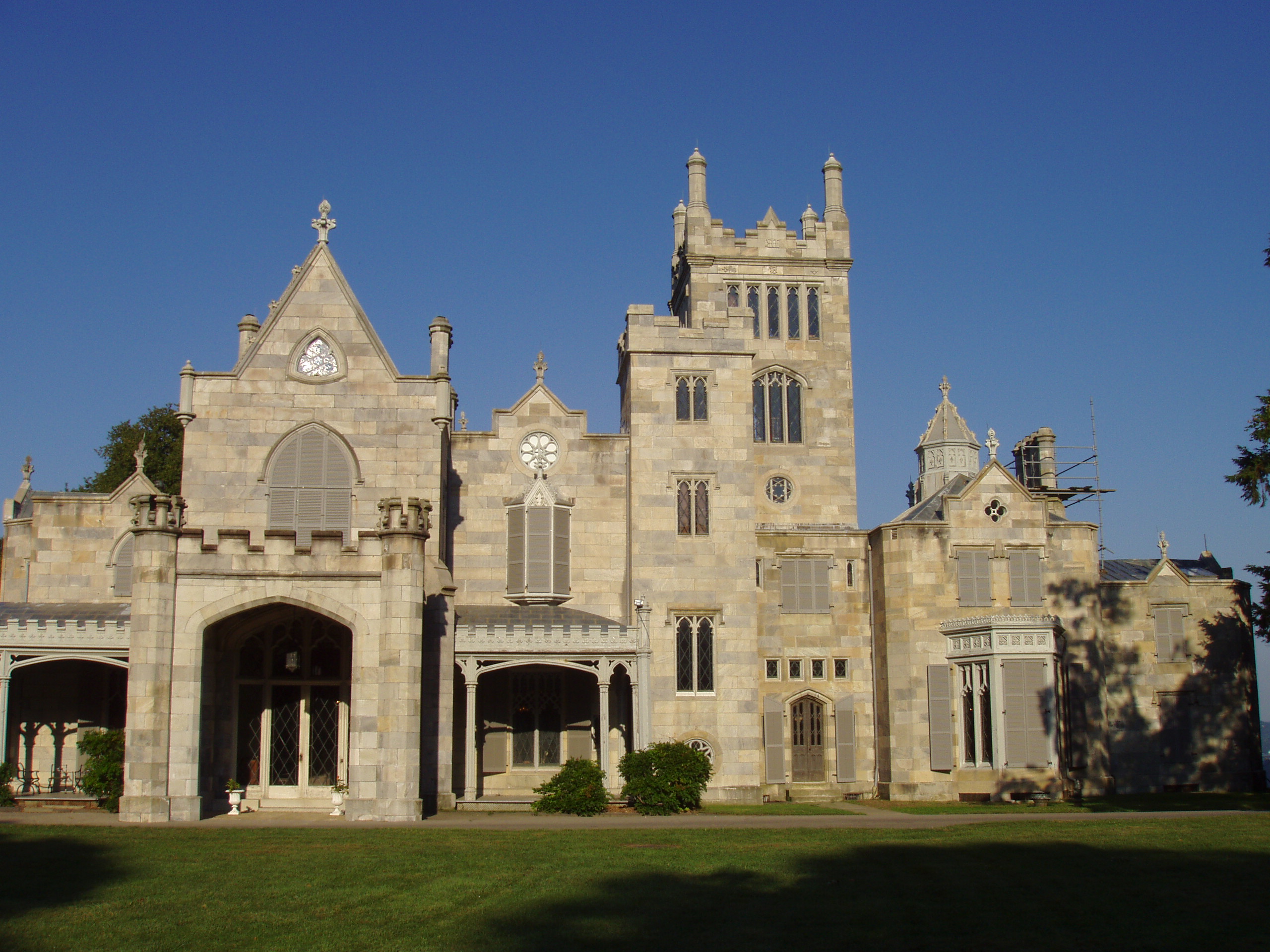
            At intervals he retired to his estate up the Hudson, a Gothic castle of white Sing Sing marble, towered and turreted, with pointed windows and vaults, pinnacled roofs.  In this massive stonework mansion, richly furnished and remote, he installed his family.  The children romped, had everything.  But his loving wife couldn’t understand why they must live in a castled palace, walled, with armed guards round the clock.  Nor why sometimes at dinner, his body gutted by fire of thought within, he sat with bowed head, exhausted, picking at his food.


File:Lyndhurst Tarrytown NY - front facade.jpg
Lyndhurst, Gould's mansion near Tarrytown.  In his time, a well-guarded castle. 
 Today, a landmark open to the public.
Urban

            Inspecting his Western railroads, he stared numbly from the observation car at the dusty track receding behind him, ignoring ríos, arroyos, gushing mountain streams, and pine-clad pinnacles.  “This trackage, these vast distances mean nothing to me,” he wrote his wife; “I miss you more than words can tell.”

            Alone, in felt slippers, he spent quiet evenings in his library, and mornings in the largest greenhouse in America, tending rhododendrons, camellias, hyacinths.  “No man,” wrote a lady writer, “can be wholly bad who is a friend of the orchid and the rose.”

            With his brain-sucked body rested, he returned again to the city, picked at flaws in contracts, reared up peaks of schemes.  Once more on Wall Street prices surged, plunged; he had made another killing.  Editorialists raged, financiers slammed on desks fists with hard gold rings.  A coward,” said some; “Unmanly,” said others; still others whispered (falsely), “A Jew.” 

            A letter came: “Gould, I will shoot you dead in a week. – A Victim.”  He sighed, gave it to the police.

            At times, scheming at his desk or reading botany, he must have thought of his old friend Jim Fisk.  Jim, who could glad-hand reporters and politicos, joke with them, drink with them, wangle from them whatever he wanted.  Genuinely liked by bellboys, chorus girls, clerks and workingmen, thugs.  A torrent of energy, a font of bonhomie, whom no one had ever bullied or wanted to.  Smarter than chain lightning, who liked to make Rome howl.  His opposite.  His best, his only friend:  “Don’t fret your gizzard, Jay.  For you, I’ll go my bottom dollar!”  Jim Fisk, murdered years before.  Jim Fisk, dead and gone.

            On Wall Street, Jay Gould was always alone.  To him, humor and warmth were denied.  No passer out of perfectos, slight and frail, in a world of bullies what could he do?  Fight them with his mind.  Lure them with spruced-up stocks and options, web them in technicalities, outscheme them with receiverships, floating debt, proxies, stun them with lightning strokes in the market.  He had a knack for it, and once he hatched a scheme, his brain ticked feverishly.  They hated him, threatened him, roared the rage of the duped and the beaten.  Puny, coughing already from TB, on Wall Street he towered.
           
            For hours in his greenhouse the most hated man in America breathed, caressed Orchidaceae imported from every nook of the world, marveled at their curved, lipped petals – streaked, tufted, crimped – like taloned green birds, like gaping jaws of pink-spotted snakes, blood-tinted moths, spiders: so intricate.          

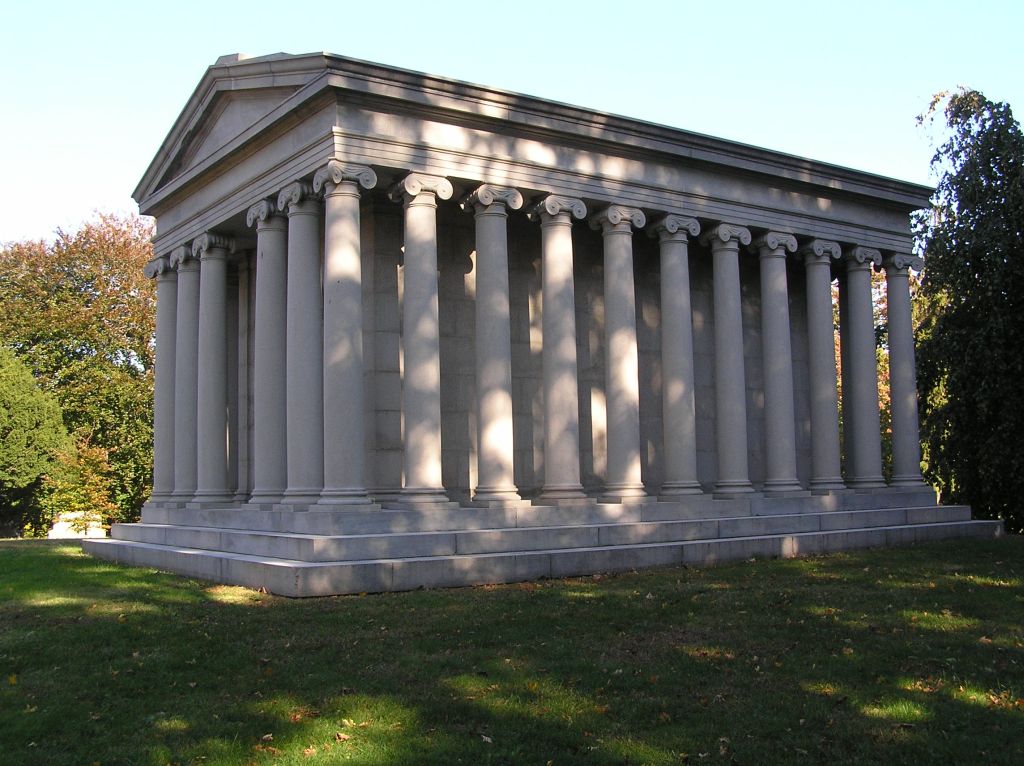
File:Jay Gould Mausoleum 1024.jpg
The Jay Gould Mausoleum in Woodlawn Cemetery, the Bronx.
Anthony 22
         The slap heard round the world (a small world):  Local elections are coming up soon in New York City and, being local, there will probably be a small voter turnout.  Still, I have been following them with some interest, partly because I've met several candidates at the Abingdon Square Greenmarket on Saturday mornings; the all-important primary is next Tuesday, September 10.  So let me share my take on a recent incident.  In the latest issue of the WestView News, a monthly neighborhood newspaper giving news of the West Village, George Capsis, the publisher, gives his version of a recent incident that has attracted much media attention.  He explains that recently he lost his wife of 55 years to cancer and feels that, had St. Vincent's Hospital still been functioning in the West Village, he could have spent more time with her in her last days; instead, he had to spend an hour and a half commuting each way to a hospital in the distant Bronx.  As a result, he has very strong feelings about those who, in his opinion, didn't do enough to save the hospital, the only hospital in the Lower West Side of Manhattan.  One of those he holds responsible is Christine Quinn, the former City Council member from this district now running for mayor.  Hearing of a Quinn rally in front of the now half-demolished hospital on West 12th Street (not far from my apartment), he went to it.  Quinn was not on hand, but he saw two of her supporters, former State Senators Tom Duane and Brad Hoylman, whom he also deemed at fault.  Incensed, he shouted at Duane.  Then, seeing Hoylman staring at the ground, he reached out to pull his head up, whereupon Hoylman, thinking it a slap, pulled back and announced, "You need to be escorted out of here."  Turning, Capsis saw a young man who seemed  ready to do the escorting, so he slapped him lightly, so he says, on both cheeks; to Capsis's astonishment, the young man "began crying like a girl and ran off."  This incident was immediately reported widely in the media; in the New York Times's version, he slapped both Hoylman and the young man.  Other versions added a slap to Duane, which Capsis emphatically denies.  This story could well be dismissed as a tempest in a teapot, but my sympathy goes out to the unnamed young man, who had nothing to do with St. Vincent's closing.  The sudden, unforeseen slap may have triggered some painful childhood memory, some humiliation of long ago that caused him to react instantly as he did; to say that he was crying "like a girl" is judgmental and insensitive.  In my opinion, Capsis owes his victim an apology, and I intend to tell him as much.  There is a simmering resentment in the West Village over the loss of our only hospital, and I share in it, but nothing excuses the assault on an innocent bystander.  So much for politics on the local scale in New York.

          Coming soon:  Next Sunday, Walter Winchell, a New Kind of Terrorist, plus a glance at the Stork Club and the ex-bootlegger who ran it, luring the rich and famous to its privileged confines, guarded at the entrance by a uniformed doorman with a solid 14-karat gold chain.  In the works: Fifth Avenue, from Goats to Greatness, with a look at those whose mansions came to line it, including the infamous Madame Restell and the Mrs. Astor and the annual Astor Ball.

©  2013  Clifford Browder