Sunday, August 18, 2013

80. Famous New York Streets: Broadway


     Broadway, the most famous street in New York City, running fifteen miles through Manhattan and the Bronx, was once an Indian trail and then, with the coming of the Dutch, the main thoroughfare in the settlement of New Amsterdam.  The Dutch named it the Heere Straat (the Gentlemen's Street or High Street) or Breede Weg, and when the English took over, they translated the latter as "Broadway."  It still runs the length of Manhattan crazily at an angle, defying the gridlock pattern of the city's streets decreed by the city fathers in 1811.

     In New Amsterdam the Heere Straat went from the fort that gives the Battery its name up to a gate in the wall that gives Wall Street its name.  Right from the first, it teemed with a mix of peoples: Dutch, English (including refugees from the rigors of Puritan New England), Norwegians, Swedes, Danes, Frenchmen, Bavarians, Poles, Italians, Walloons, Bohemians, Jews, Africans both slave and free, and Munsees, Montauks, and Mohawks, most of them coming in hopes of a freer, fuller life.  One visitor reported eighteen different languages in the settlement, and they would all have been heard on Broadway.
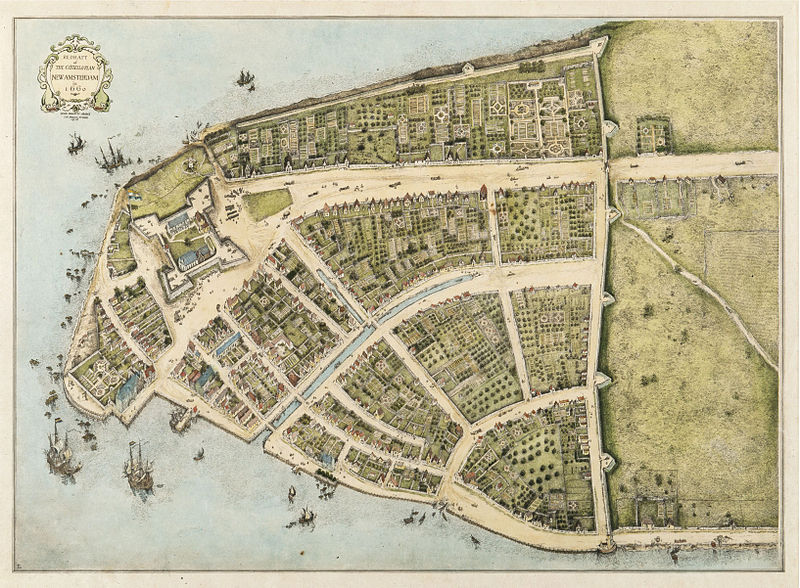
File:Castelloplan.jpg
New Amsterdam in 1660.  The Heere Straat is clearly shown, as is the fort at the Battery.

      In the eighteenth century Broadway witnessed one of the most significant events in our history: Washington's triumphal entry into the city on November 25, 1783, following the evacuation of the last British troops and, with them, some 28,000 Loyalist refugees and many former slaves whom the British  had liberated.  The city was the scene of Washington's worst defeat in 1776, following which it had been occupied by the British.  Washington and his officers entered from the north and proceeded down Broadway to the Battery, to the cheers and applause and waving hats and handkerchiefs of onlookers.  Though ticker tape was absent, it could be considered the first of many parades of heroes on Broadway.  For years afterward, November 25 was celebrated as Evacuation Day.
File:Evacuation Day and Washington's Triumphal Entry.jpg
An 1879 lithograph of Washington's entry.

      Now we'll fast-forward to the nineteenth century, the period I know best.  The city of circa 1830 was still small enough that the gentry knew, or knew of, almost everyone who mattered; for all its  ongoing changes, their world was ordered and safe.  Few people kept carriages, and those who did were known to everyone.  One of these was Dandy Marx, a dashing young blade whose clothing  defied the somber colors of the day as he drove four handsome chestnuts down Broadway, bearing with perfect nonchalance the sneers and jealousies of others.  Another familiar sight was Dandy Cox, a mulatto driving a spirited horse to a light wagon where he sat perched high on his seat, his well-brushed beaver cocked at an angle, his green jockey coat displaying polished brass buttons, his leather gloves spotless, imitating -- if not mocking -- the fashionables of the day.

     But in those days almost all the men worked, so that the fashionable promenade of Broadway, which went from the Battery to Canal Street, was mostly given over to belles and their mamas for shopping.  One of the few male interlopers was Gentleman George, a neat, trim, tastefully dressed young man who drove a stately gray with aplomb.  Where does his money come from? the men of the town wondered, while mothers eyed him with suspicion, well aware that their daughters were casting furtive glances his way, intrigued by this timid but respectful young man whom they so often met on their morning strolls.  Gossip about him saved many a tea party from dullness.  George was seen and puzzled over for years, until at last he disappeared into the city's rapid growth and expansion, a mystery to the end.

File:New York Broadway Canal Street 1834.jpg
Broadway and Canal Street, 1834.  Busy, but not jammed.

     The sidewalks of Broadway also offered a few eccentrics who stood out and occasioned comment.  The mad poet McDonald Clarke was seen there in a tattered cloak, his unbuttoned "Byronic" shirt collar a sharp contrast to the primly buttoned shirts of most males, his melancholy gaze always fixed on the pavement, another mystery figure whom women found strangely appealing.  Also familiar was the Gingerbread Man, a harmless lunatic in a swallowtail coat who jog-trotted up and down the avenue as if on a pressing errand, his only sustenance a seemingly endless supply of gingerbread stuffed in his pockets that he was constantly consuming.  One day he failed to appear, was never seen again.  Another regular on Broadway was the Lime-Kiln Man, a tall, gaunt figure, his unkempt hair and thin face smeared with lime, who took no notice of the looks of pity he garnered, another mystery man about whom nothing was known.  In time  he was found dead in a lime kiln where he had slept at night for years.

     The society of those days, though quite conformist, tolerated a number of oddballs because they were familiar and posed no threat.  What people were leery of was the blatant display of wealth, which was deemed vulgar.  Elegance was allowed, and the women of New York were famous for dressing in the height of fashion, and even the black underclass could be surprisingly chic, but the elegance had to be quiet and discreet.  All this was visible on Broadway.

File:NewYorkCity1860.jpg
Broadway, 1860.
     Now we'll fast-forward again to the 1860s, by which time everything had changed.  Irish and German immigrants had flooded in since the 1840s, the city had become a metropolis, Wall Street was now the money center of the nation, the Civil War had permitted gold speculators and war contractors to amass a fortune, and New Money was blatantly in evidence everywhere.  Ever since Central Park had opened in 1859, its Drive had become the preferred promenade of the affluent, who drove there in elegant equipages, so that Broadway was now essentially commercial.

     And what did one see on Broadway?  Red and yellow and blue-painted stages, open and closed carriages with liveried footmen, drays, wheelbarrows, hacks, milk carts with clattering cans, horsemen, lager beer wagons, express trucks stacked high with boxes labeled ASTOR HOUSE or ST. NICHOLAS HOTEL, and a wagon hauled by six straining horses conveying the towering bulk of a safe as big as a house.  And all this traffic emitted a deafening roar, as it sliced through the mud of the street, until it jammed up amid shouts, curses, and whinnyings, and maybe the shriek of a coachman being beaten by a truckman for not giving way.  With no stoplights or stop signs, how was a pedestrian to get from one side of Broadway to the other?  Without the help of a policeman, you were risking your life.  Furthermore, in wet weather the thoroughfare was ankle-deep in mire, while in dry weather it was caked with teeth-gritting, breath-choking dust.  And always, in whatever weather, being embellished with garbage and manure, it stank.

      What enterprises did this tumultuous thoroughfare offer?  Barbershops, liquor stores, lottery offices, daguerreotype galleries, artificial teeth manufacturers, sewing machine and piano forte showrooms, plain and fancy jewelers, oyster cellars, clam chowder shops, bookstores, boots and shoes, billiard table stores, ice cream parlors, gambling dens.  But there were also princely hair-dressing establishments for gentlemen, emitting whiffs of menthol, musk, and cologne; fancy dry-goods stores with uniformed doormen; palatial marble-fronted hotels; and, guaranteed to astonish visitors from the provinces, sidewalk displays of patent sarcophagi in rosewood, mahogany, and iron, satin-lined with silver mountings, featuring glass-paneled lids to display the face of the deceased.  Then as now, in New York one could obtain anything and everything.

     Pigs rooting in garbage on the side streets sometimes joined the throngs along Broadway where, in the morning rush to work, purposeful top-hatted merchants in starched collars rubbed elbows with dusty sideburned laborers, pallid clerks, and ginghamed working girls, while ragged newsboys hawked their papers, and workmen loaded or unloaded carts and toted boxes.  Later, hordes of elegant lady shoppers would appear, as well as gangs of barefoot boys and girls mouthing obscenities, and sandwich men flaunting fore and aft in bold lettering RADICAL CURE TRUSSES, POCAHONTAS BITTERS, or PHILIPOT'S INFALLIBLE EXTRACT.  For everyone went to Broadway, rich and poor, respectable and otherwise; it was the principle thoroughfare, the main artery, the commercial hub of New York.

     On Broadway the kings of the road were the whip-cracking stage drivers who, mounted high on the box of their stages, drove as fast as traffic permitted, shaving lampposts and shrieking oaths at anyone or anything in the way.  Their patrons grumbled about the ill-ventilated interiors with twin unpadded benches, where up to a dozen passengers sat facing one another amid smells of onion, sweat, and tobacco, as the stages lurched ungently ahead over cobblestones.  Passengers were expected to drop the exact fare in a box with a slit in the top, which the driver, glancing down from his seat, could verify, and God help anyone who failed to pay, since the resulting comments from the driver would be, to put it mildly, scathing.  A champion of the drivers was Walt Whitman, who, seated beside them,  often rode the whole length of Broadway listening to their yarns.  He described them as "largely animal -- eating, drinking, women," but esteemed their comradeship, good will, and honor, and credited Broadway Jack, Balky Bill, Pop Rice, Patsy Dee, and a host of others with influencing the gestation of Leaves of Grass.

     But what did the old timers think of all this?  Remembering the tranquil days of their childhood, they were dazed.  The jam of people and vehicles on Broadway overwhelmed them, and if they stood at an entrance to Central Park and watched the showy equipages heading for the Drive, they had no idea who these promenaders were or where their money came from.  Gone was the discretion of an earlier time; New Money paraded its wealth brazenly.  Engulfed by this mass of strangers, these relics of a simpler age felt small, mere atoms lost in the city's never-ending flux.

     Change, often radical, was the rule in the Never-Finished City.  By the mid-1870s buildings were rising to eight, ten, and eleven stories high, provoking mixed reviews: a new dimension to space, said some; top-heavy horrors and "Towers of Babel," said others.  Broadway had been the first New York City thoroughfare to get gaslight in the mid-1820s, and now it was the first to be lit with electricity.  On December 20, 1880, the whole stretch of it from 14th Street to 26th Street was suddenly bathed in brilliant light; observers gaped and raved.  And in 1879 the first telephone exchange opened, with the first phone directory listing all of 252 names.  Businesses rushed to adopt the new gadget, but at first it was much too costly for use in private homes.

File:Broadway-1885-APL.jpeg
Broadway in 1885, looking north from Cortlandt and Maiden Lane,
with wires crisscrossing overhead.

     Telephone and telegraph wires now crossed and recrossed each other from the tops of buildings, darkening the sky over Broadway with what seemed like meshes of a net.  Worse still, overburdened  wires had a way of snapping and falling to the street, with potential peril to anyone in the vicinity.  Then in 1889 a lineman working overhead was electrocuted on a wire gridiron in the heart of the business district; thousands watched as the body dangled for nearly an hour, its mouth spitting blue flame.  The enraged public now demanded that the wires be put underground, and the corporations involved finally, after long delays, complied.

     The advent of the automobile in the 1890s marked another major change for Broadway. The first recorded motor vehicle fatality in the United States, and indeed in all the Americas, occurred in New York, though not on Broadway.  On September 13, 1899, Henry H. Bliss, a New York real estate salesman, was getting off a streetcar at West 74th Street and Central Park West, when an electric-powered taxi struck him and inflicted fatal injuries; he died the next day.  A plaque commemorating the incident was placed at the site on the centennial of his death, a mortality that can be seen as ushering in the twentieth century.  The first traffic light was not installed in New York but in London in 1868, but in 1916 New York installed the first three-color stoplight at its busiest intersection, Fifth Avenue and 42nd Street.  That the location chosen was not Broadway shows that by now Broadway was not the single most significant thoroughfare in the city.

     By the early twentieth century it was electricity that gave the midtown section of Broadway, the section from 42nd to 53rd Street also known as the Theater District, the name "The Great White Way."  The streetlights alone justified it, but the advent of neon signs in Times Square confirmed it.  This is still the Theater District, though most of the theaters are on side streets nearby, and Times Square today, especially at night, is more astonishing than ever.  (Forty-second Street, by the way, merits its own history; once a tawdry porn center frequented by drag queens and hustlers, it has been scrubbed up and Disneyfied, a change that is praised by some and lamented by others.)


File:Times Square,New York CC-BY-SA.jpg
Jorge Láscar

     Broadway today on the Upper West Side is a wide avenue with a thin strip of park down the middle.  Back in my student days I loved walking down from Columbia to some restaurant or movie theater on Broadway, and traipsing it at night always lifted my spirits.  This stretch of Broadway was not constricted by tall buildings as it was downtown; it was big, open, and free  -- New York at its best.

     I have omitted many sections of Broadway -- Madison and Herald Square, Columbus Circle, Lincoln Center -- but if I include them, this post will become a history of the city.  So I'll sign off now, acknowledging that Broadway, no longer the single jammed artery of the city, is still a vital part of it, a symbol of it, busy, colorful, exciting.

     Coming soon:  Next Wednesday, the first of a series on colorful New Yorkers: Battling Bella and the Queen of Mean.  Older New Yorkers may pick up on these designations; younger ones and out-of-towners may not.  But they are very New York, very colorful, and well worth a look.  Next Sunday, Who makes money when America goes to war? (1861-65, with a glance at today, including a delicious photo of Dick Cheney).  Also: the Mad Poet of Broadway and the Mephistopheles of Wall Street; Diamond Jim (who owned a mere 12,000 diamonds), and his pal Lillian ("Luscious Lillian") Russell.  Why "luscious?  Wait till you see her posing on her bicycle!  Also: Texas ("Hiya, suckers!") Guinan, who after a night in the slammer remarked, "I like your cute little jail, and I don't know when my jewels have seemed so safe."  Also the Broadway gossip columnist who imposed a reign of terror (can you guess?).  And maybe I'll set foot -- just a little way -- into the hallowed precincts of the Stork Club.  New York is inexhaustible.


©  2013  Clifford Browder


Wednesday, August 14, 2013

79. Tweed at the End: "I have tried to do some good."

File:Tweed-Boss-LOC.jpg     At the elections of November 1871 the enraged reformers triumphed over Tammany, with one exception: William Marcy Tweed was reelected state senator.

     The Boss had already been arrested in a civil suit to recover stolen money, but had provided bail at once, with one million coming from Jay Gould, and so avoided jail.  The Committee of Seventy, strengthened by its victory at the polls, then sought indictments of all those implicated in the courthouse and other graft, prompting an impromptu flight of Tammany stalwarts and cronies in all directions out of the city of New York.  James Ingersoll, the millionaire furniture maker, and James Sweeny, the brother of the Squire, were reported to be refugees in Paris.  Andrew Garvey, Grand Marshal of Tammany Hall now also known as the prince of plasterers, was spotted on a ship bound for Germany, where the prince mistook a pilot coming on board for a policeman and, like a true son of Tammany, tried to bribe him, whereupon the indignant pilot threw the money overboard to the laughter and applause of onlookers.

     Other targets of investigation announced a sudden and intense need of vacation and vanished.  State Senator Henry Genet, known to many as Prince Hal, was so indiscreet as to remain within reach of the law, and was tried and convicted of fraud.  But old friendships survive the vicissitudes of politics.  Sheriff Matt Brennan delayed turning him over to the Tombs, and one Sunday Prince Hal and his custodian, a deputy sheriff, observed the Sabbath by roaming the city's bars and getting drunk.  Ordered to appear in court the next day with his prisoner, Brennan came alone, explaining that he had allowed Genet time to go home and arrange his affairs, which evidently required extensive traveling.  The result: Brennan got thirty days in jail and Genet a protracted vacation in Europe.  Peter Barr Sweeny, the Squire, left for the wintry clime of Canada to seek his health, later joining his brother in Paris, and the well-named Slippery Dick Connolly was tried and convicted, albeit in absentia, since he had fled abroad with six million dollars to finance his international wanderings.

     Two prime targets of the reformers remained.  Mayor A. Oakey Hall ("O. K. Haul" in the Nast cartoons) stayed to face charges, and in the three ensuing trials the supposed popinjay, rendered ridiculous in the Nast cartoons with his beribboned pince-nez perched on his nose, proved to be an effective defense attorney for himself, gay, witty, and charming, then caustic or tearfully melancholy, and always the soul of innocence.  Yes, he had signed some 39,257 vouchers as mayor, but, having "an ineradicable aversion to details," had had neither time nor inclination to read them all and was unaware of any impropriety.  One trial ended with the death of a juror, another with a hung jury, and the third and last with an acquittal.  But the Elegant Oakey was not done yet; triumphant, he wrote a play about a man accused of stealing that was done on Broadway with none other than the ex-mayor himself in the lead.

     Also on hand, standing his ground "like a Roman," as his lawyer asserted, was William Marcy Tweed, who had aged considerably.  At his first trial in January 1873 he was defended by a brilliant team of lawyers, and the jury disagreed.  Friends advised him to decamp, but he refused to, confident that he would be acquitted.  At his second trial in November 1873 the jury did indeed find him guilty of no less than 204 counts in the indictment.  Sentenced to twelve years in prison and a fine of $12,750, he was sent to the county penitentiary on Blackwell's Island, but the court of appeals reduced the sentence to a year and a fine of $250.  Released in January 1875, he was immediately arrested on a civil action brought by the state to recover $6 million of the Ring's alleged theft, with bail at the unheard-of amount of $3 million, and when he failed to provide this amount, he was sent again to prison.  The reformers, led by the ambitious Samuel J. Tilden, the state's newly elected governor, were determined to make an example of him.

     But Tweed still had friends in high places.  Confined to Ludlow Street Jail, most of whose inmates were debtors imprisoned by their creditors, he took frequent afternoon rides in a carriage accompanied by two turnkeys, and on the way back stopped off at his home for dinner.  On December 4, 1875, while the two turnkeys sat in the parlor, he snuck out the back door of his home and disappeared.  Immediately a reward of $10,000 was offered for his capture, and over the next few weeks he was reported to be in Savannah, Dallas, Havana, London, and elsewhere.  Just who helped him escape and where he lay in hiding he never disclosed; he was probably hiding nearby in New Jersey.  Soon, shorn of his beard and wearing a wig, he made his way by boat to Santiago, Cuba, and from there to Vigo, Spain, where the former state senator and Grand Sachem of Tammany arrived disguised as a common sailor busy scrubbing a deck.  Alerted to be on the watch for him, the Spanish authorities identified him with the aid of a Nast cartoon and, unable to read English and thinking him a kidnapper, arrested him and with great pomp handed him over to the crew of an American frigate dispatched specially to take him into custody.

     A broken man in failing health, the ex-boss wanted only to die peacefully at home, and hoping to obtain this offered the authorities the only thing still his to give: an elaborate confession, backed up by  canceled checks.  But Governor Tilden had no interest in prosecuting the many others involved in Tammany fraud, some of them judges, legislators, and upstate mayors; he wanted only to scapegoat Tweed.  Attorney General Charles S. Fairchild interviewed Tweed in his Ludlow Street Jail quarters and promised him his freedom in exchange for testimony against Peter Sweeny, who had returned from France in hopes of avoiding prison by arranging a settlement with the authorities.

     Months passed with no further word from the authorities; in time it became clear that Fairchild would not approve his release.  Tweed suffered several heart attacks, and Luke Grant, his black servant, never left his side at night, sleeping on the floor by his bed.  Sometimes, unaware that the Boss was reading his Bible, Luke would burst into song and provoke from Tweed an outburst of profanity.  But then Tweed quickly made amends.  Learning that Luke was in love, he dictated Luke's letters to the girl, using the fanciest words he could think of; the girl was mightily impressed.  

     Visitors came daily, found Tweed comfortably lodged in a two-room suite with blooming plants on the window sills, and a table with several books, including an open Bible, but the windows had steel bars.  Tweed's memory for faces was unimpaired; staring out a window at people passing in the street, he could name almost all of them, state their occupation, and say something about their family.

     Slowly he declined, complaining of more pain in his heart; obviously the end was near.  When his heart pained him, Luke pillowed his master on his own breast and massaged his heart to relieve the pain.  A married daughter and her husband, the deputy warden, and a few loyal friends came; other family members were abroad.  Luke was in tears.  "I have tried to do some good," said the dying man, "if I have not had good luck.  I am not afraid to die."  When his breathing became labored, with great effort he gasped, "Tilden and Fairchild -- they will be satisfied now."  He closed his eyes, the room was oppressively silent.  Suddenly the great bell in the nearby Essex Market tower pealed high noon like a thunderclap, and he was gone.  Luke was on his knees, clasping his master's lifeless hands and sobbing.

      The funeral was held at his daughter's house; only one politician of note attended.  But a throng of  poor people gathered outside in the street, remembering his generosity, a job of some sort, a fiver when they were in desperate need, a load of coal to see them through the winter.  After the service they were invited in to view the coffin: men in rough clothing, women in calico with market baskets, several blacks, several men with dogs; they were quiet, respectful, orderly, as they took a last look at the Boss, his hair and whiskers snow-white, his face like chiseled marble.  Many accompanied the cortege all the way to Greenwood in Brooklyn, where he was buried beside his mother.  Though he looked much older, he was only fifty-five.

      For a fair appraisal of Tweed and Hall, one has to shake off the image of the Nast cartoons, which is easier said than done.   Some of the reformers in later years decided that Hall may well have been guilty only of negligence, nothing more.  As for Tweed, whatever his faults were, his ending can only inspire sympathy.  He was being used by the powers that be for their own purposes, and in so doing they failed to honor their promise to him.  (He himself had always kept his word.)  Whether his confession was reliable, or perhaps exaggerated so as to curry favor with them, can be debated.  Whether there even was a tight-knit "Ring" of four -- Tweed, Hall, Sweeny, and Connolly -- has been questioned, though the fact of colossal graft seems undeniable.  Tweed had been a superb politician; it is a shame that he didn't use his talents more constructively.  But Samuel Tilden played his hand well, becoming first governor and then, in 1876, the Democratic candidate for the presidency, winning the majority of the popular vote but finally losing to Rutherford B. Hayes in the electoral college (a mysterious institution that most citizens don't understand, and that some are even sublimely unaware of).

File:Thomasnastselfportrait.jpg
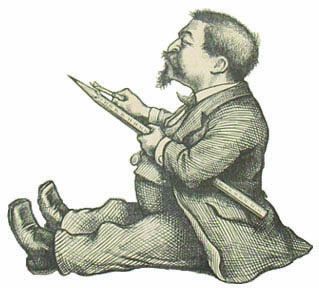
A self-caricature of Nast, sharpening his pencil to
draw a cartoon.

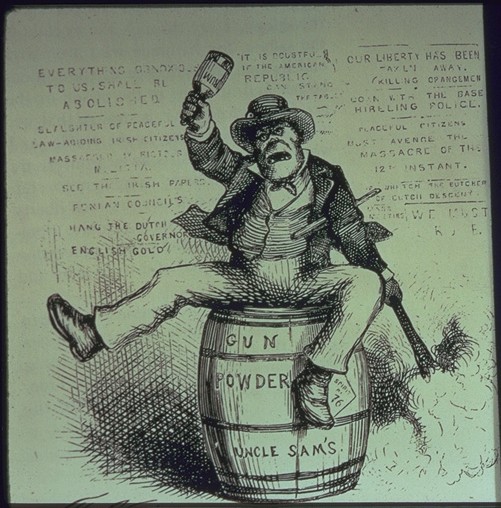
     Thomas Nast has been hailed as the most successful political cartoonist in our history.  Besides helping the Times bring down Tweed and his cronies, he is credited with popularizing the Democratic donkey and Republican elephant, and Santa Claus as the jolly, plump, red-faced figure that we conceive of today.  A German-born immigrant, he had all the virtues and vices of the WASP, portrayed the Irish as monkey-faced animals or drunken thugs, and  Roman Catholicism as a dangerous subversive force trying to gain control of our youth.  But contrary to some accounts, the word "nasty" does not derive from his name; "nasty" was around long before he was.

File:TheUsualIrishWayofDoingThings.jpg
"The usual Irish way of doing things," a Harper's 
Weekly cartoon of 1871 by Nast.


File:Ganges1876.jpg
"The American River Ganges," a Harper's Weekly cartoon of 1875 by Nast, showing Catholic
bishops as crocodiles.  In the distant background, Saint Peter's basilica topped by a cross, and
closer, in the center, a public school with the U.S. flag flying upside down, a signal of distress.
     One Tammany figure who did succumb to the reformers was Justice George G. Barnard, whose propensity for diamonds, cards, brandy, frilled shirts, and profanity was proverbial, and who presided over his courtroom with his boots propped up on the desk before him, while whittling away at pine sticks that the attendants kept him supplied with.  In 1872 he was impeached by the New York State Assembly on charges of unjudicial conduct, including fraud and corruption, and was removed from the bench and barred from holding any public office in the state.  After that he was rarely seen in public, but to friends in private he expressed his bitter grief.  He died in 1879 at the age of forty-nine.

     It would be encouraging to say that the reformers, having destroyed Tweed and his alleged "Ring," put an end to corruption in New York, but such was not the case.  In the words of George Washington Plunkitt, a Tammany stalwart of a later date, reformers were "mornin' glories -- looked lovely in the mornin' and withered up in a short time, while the regular machines went on flourishin' forever, like fine old oaks."  Tammany Hall withstood many onslaughts by reformers, always survived, and dominated New York City politics well into the twentieth century.

File:George Washington Plunkitt.jpg
Plunkitt, in a shiny top hat, seated at his preferred rostrum,
the bootblack stand outside the County Courthouse.  (Yes,
that courthouse, known today as the Tweed Courthouse.)

     And who was George Washington Plunkitt (1842-1924)? you may well ask.  He was a veteran Tammany politician who served at various times in both houses of the state legislature, but who today is best remembered for his impromptu talks on politics delivered from the bootblack stand of the New York County Courthouse, expressing candidly the views of a machine politician who thought the civil service system heralded the downfall of the U.S. government.  Needless to say, he believed in patronage and spoils, saw no need for reform.

     Some of his sayings are memorable:

  • Everybody is talkin' these days about Tammany men growin' rich on graft, but nobody thinks of drawin' the distinction between honest graft and dishonest graft.  There's all the difference in the world between the two.
  • There's an honest graft, and I'm an example of how it works.  I might sum up the whole thing by sayin', "I seen my opportunities and I took 'em."
  • This city is ruled entirely by the hayseed legislators at Albany.
  • There's only one way to hold a district; you must study human nature and act accordin'.
  • The Irish was born to rule, and they're the honestest people in the world.
  • You hear a lot of talk about the Tammany district leaders bein' illiterate men.  If illiterate means havin' common sense, we plead guilty.
  • Make the poorest man in your district feel that he is your equal, or even a bit superior to you.  Above all, avoid a dress-suit.
  • Tammany's the most patriotic organization on earth, not withstandin' the fact that the civil service law is sappin' the foundations of patriotism all over the country.  Nobody pays any attention to the Fourth any longer except Tammany and the small boy.

    As an "honest" grafter, he made a fortune by buying up land that he knew would be needed for public projects.  His world was small -- even Brooklyn was terra incognita for him -- but he did know the world of Manhattan politics and is a must-read for anyone interested in Tammany and its ways.  His talks were recorded in William L. Riordon's Plunkitt of Tammany Hall, first published in 1905 but available in more recent editions.


     Today the Tweed courthouse, the focus of so much graft, serves as the headquarters of the Department of Education.  Once disparaged as a colossal boondoggle costing more than the purchase of Alaska, it has been carefully restored and is now recognized as a landmark of note.  A striking example of Victorian neoclassical style, to my eye it is downright handsome.


File:Tweed Courthouse north main facade 118443pv.jpg
The Tweed Courthouse on Chambers Street today.  The rotunda is not visible in this photo.  The huge building in the left background is the Municipal Building.

File:Tweed Courthouse rotunda interior 118457pv.jpg
Interior of the octagonal rotunda.


File:Tweed Courthouse staircase 118451pv.jpg
Staircase, west wing.


     Note on WBAI:  It's not quite as bad as I thought.  The national and international news, coming from a different source, continues, and they have brought back the English-language news of Al Jazeera.  But the city-based local news is gone, and that's serious enough.

     Coming soon:  Next Sunday, Famous New York Streets: Broadway.  The first of a series of posts on streets; other possibilities being Wall Street, Fifth Avenue (and its poor cousin, Sixth), and the Bowery.  And more posts on colorful New Yorkers: Texas Guinan, the Queen of Mean, the Mad Poet of Broadway, the King of Gossip (can you guess?), and others.  And war profiteering, then and now.

©  2013  Clifford Browder


Sunday, August 11, 2013

78. The Hercules of Parks


     The Verrazano Bridge, its graceful span linking Brooklyn and Staten Island ...

File:New York - Verrazano-Narrows Bridge from Air.jpg
                                                                                                    Roger Wollstadt


... Lincoln Center, that amazing complex of cultural institutions, its structures and fountain coming magically alive at night ...


File:Lincoln Center Twilight.jpg
                                                                                                            Nils Olander


... the United Nations Headquarters, looming dramatically close by the East River ...

File:United Nations Building NY.jpg
                                                               Ad Meskens


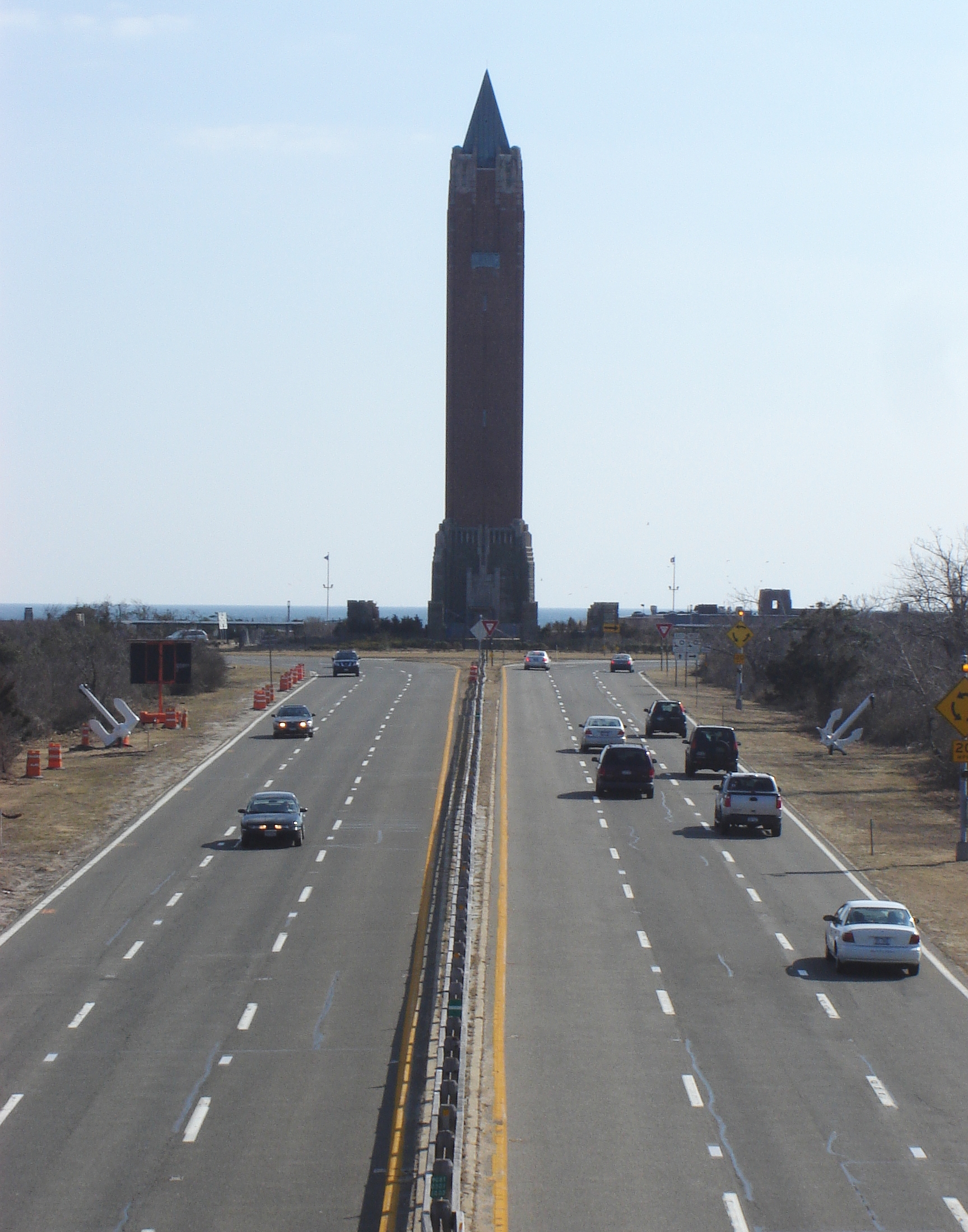
File:Jones Beach WantaghPkwy Approach.jpg
                                                                                 R.Sullivan


... Jones Beach on the south shore of Long Island, with its broad expanse of sand and elegant bathhouses, accessed by a landscaped six-lane parkway with the Jones Beach water tower soaring in the distance ...


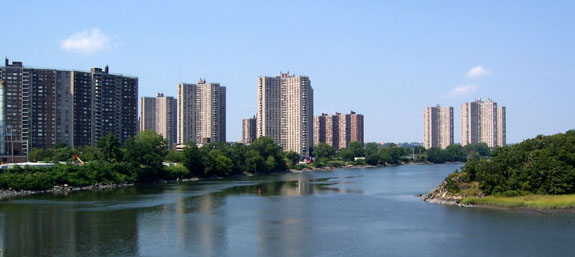
... the massive looming structures of Co-op City, the vast housing complex beside the Hutchinson River in the Bronx ...


File:Co-op City Hutch River.jpg
                                                                                                                                                                                 Sacme


... and countless other parks, beaches, throughways, housing projects, and playgrounds in and about the city -- all this and more, much more, is the work of one man, said to be the world's greatest builder since the pyramid-building pharaohs of ancient Egypt.  And many of his works bear his name.


File:Robert Moses State Pkwy Shield.svg


File:Robert Moses Cswy Shield.svg


File:Robert Moses with Battery Bridge model.jpg
Moses with a model of his proposed
Brooklyn-Battery Bridge.
     Robert Moses was just a name to me, until I read his biography (see below).  Then I realized that his works are all around us, that New York City's character and history are inseparable from the story of Robert Moses, a man whom I have never had any contact with and whom I wouldn't have wanted to know, but a giant in the history of this city.

     I have said that all these achievements were the work of one man.  This reminds me how Bertolt Brecht, when he encountered a statement like "Caesar conquered Gaul," would comment, "Really?  All alone?"  Of course Moses had assistants -- a whole army of them -- and allies.  But he was the initiator, the innovator, the guiding spirit of these projects, and without him, few of them would ever have been realized.

     Robert Moses (1888-1981) pursued his public works projects under six New York State governors and five New York City mayors, all of whom found in him an invaluable ally and a formidable opponent, but one that they could not do without.  He more than anyone shaped the city of New York; his achievements are everywhere in the city today, as well as throughout Long Island and in upstate New York.  Ambitious, impatient, and arrogant, he gave his life to public works projects, was always burning up with new ideas that he was determined to realize.  And early on he learned that dreams, no matter how vast and dazzling, were not enough; one must have power to make them happen.  So he learned to acquire power and use it.

     Consider a few of his achievements:
  • In the 1920s, when state parks were unknown throughout most of the country, with Governor Al Smith solidly behind him he created 40,000 acres of state parks on Long Island, linking them by landscaped parkways to the city, thus setting an example for other states to follow.
  • In a mere two years he transformed a desolate sandbar on the south shore of Long Island into the vast sandy expanse of Jones Beach, with elegant bathhouses, a boardwalk, a restaurant, and parking lots accommodating tens of thousands of cars.
  • As Park Commissioner under Mayor La Guardia, using thousands of laborers in one year he refurbished every park in the city, removing litter, painting structures, planting trees -- an accomplishment that astonished the press and the public.
  • In Pelham Bay Park in the Bronx he used landfill to join Hunters Island and Twin Islands to the mainland and transformed skimpy little Orchard Beach into a mile-long crescent with gleaming white ocean sand dredged up off the Rockaway beaches and brought in by barge.
  • He completed the Triborough Bridge, a huge project comprising four separate bridges linking three boroughs and two islands, thus creating the first direct link between the Bronx and Queens, and making Long Island and its parks accessible from the city.
  • As part of his West Side Improvement plan he transformed Riverside Park in Manhattan from a mass of mud and dirt into a lush green park free at last of the New York Central tracks and their smoke-belching engines, which he covered over and so made disappear.
  • As part of that same grandiose plan, he created the West Side Highway, built the Henry Hudson Bridge to carried it over the Harlem River into the Bronx, and continued it north to the city line, linking it up with the Saw Mill River Parkway and so at last giving the city a convenient outlet to the north.
  • He was also responsible for the creation of Lincoln Center, the United Nations Headquarters, Co-op City, Stuyvesant Town and Peter Cooper Village, and the New York Coliseum, as well as 416 miles of parkways radiating out from the city into the suburbs, and a massive power dam across the Saint Lawrence River.

     Is it any wonder that for forty years the press and public idolized him as the Hercules of Parks, a zealous and fearless achiever who sought only the public good, free from any political considerations?  And that he himself, immune to modesty, was sure that he would be blessed by future generations, that his works would make him immortal.

     How did he do it?  How did he cope with governors and mayors and bosses, and even at times with presidents?  How could he do anything in a city whose bureaucracy, second in size only to the federal government's, has been described as a huge spongy mass into which good intentions and noble projects sink, never to be seen again?

     The answer is: through power, sometimes blunt and naked, sometimes veiled and discreet, but always and unmistakably power.  He functioned for years as Park Commissioner, Construction Coordinator, and member of the City Planning Commission.  But his greatest power lay in the Triborough Bridge and Tunnel Authority, whose board he dominated.  An authority is a strange creature not fully understood by the public (myself included).  It has powers akin to those of a large private corporation and even, to some extent, the powers of a sovereign state.  Unlike a public agency, it needn't show its books to the public, and Moses never did, so no one knew what the authority's revenues were (and they were vast), or how Moses used them.  

     Essential to Moses' power was the praise of press and public, a mighty weapon to wield against critics and reformers who challenged him; throughout his career he cozied up to newspaper owners, editors, and reporters.  But if press and public adored him, it was because he delivered.  He drove his architects and engineers hard, pounded his fist on his desk, demanded quick results.  Those who couldn't take it quit, but those who remained were fiercely loyal, convinced that this was more than a job, that their work really mattered and would greatly benefit the public.  The result: fourteen-hour work days, and when plans for a project were urgently needed, all-night sessions with short naps at intervals on cots that Moses thoughtfully provided.  The only one who could drag him home was his wife; if she showed up, he surrendered instantly and ended the day's work.  But politicians were soon telling one another, "That Moses fellow, he gets things done!"  And nothing so pleases politicians at election time as some new park or highway or bridge that voters can make use of and enjoy.

     Discretion was not his thing; in dealing with public officials he was ruthless.  Unknown to the public, to get his way he used not only charm, bribes, and legal loopholes and technicalities, but also threats, insults, lies, even character assassination.  He once shouted over the phone at Governor Thomas E. Dewey that he was a stupid son of a bitch and hung up.  But his greatest weapon of all was the threat to resign; so necessary was he to mayors and governors, they surrendered instantly.  

     But this was not enough.  When the law empowering the Triborough Authority was amended in 1938, Moses snuck into the text hidden clauses that gave him still more power and made it practically impossible for him to be removed.  He could now issue bonds, acquire land, retain tolls, and hire and fire unrestricted by civil service regulations.  No one realized at first how the amendment had made him practically invincible, but when challenged, he could refer critics to such-and-such a clause, rendering them powerless.  Moses was henceforth independent of mayor and governor, city council and legislature alike.

     The Triborough Bridge and Tunnel Authority was now his fiefdom and private empire with its own flag and great seal; its own laws and regulations; a self-contained communications network; a fleet of yachts, cars, and trucks; a uniformed army of bridge and tunnel officers responsible only to him; a steady source of revenue from bridge and tunnel toll booths -- as high as $213 million a year, far more than what was needed to maintain its operations; and hundreds of skilled architects, engineers, contractors, and developers -- "Moses men" -- whom he often made millionaires.  Favored secretaries had bigger cars and higher salaries than city commissioners, and round-the-clock chauffeurs so they could be on call twenty-four hours a day.

     The monarch presiding over this private empire had no less than four offices, one on Randall's Island in the East River, one in the old August Belmont mansion on Long Island, and two in downtown office buildings.  Adjacent to each office was a luxurious dining room where Moses could wine and dine visiting dignitaries lavishly.  At Randall's Island invited guests would be ushered into an anteroom whose walls featured photographs of Moses with various presidents; at the Belmont mansion the anteroom's walls were covered with plaques and trophies honoring the host.  White-coated waiters served drinks, and a Moses aide would appear to regale the guests with stories of his boss's triumphs.  Finally Moses himself would appear, followed by a suite of eight or ten aides.  The doors to the dining room would then be thrown open and Moses would lead the guests inside, where the aides would be seated on his right in seats prearranged in order of rank and favor in his eyes. (From week to week, observers could tell who was up, who was down.)  As for the quality of the food served, guests spoke of it afterward in tones of awe.

     In the Moses empire these lunches were almost routine.  But whenever a new dam or park was opened upstate, chartered planes flew hundreds of guests to a whole weekend of lavish celebrations well covered by the press.  Such affairs won Moses more praise and respect, but he was taking no chances.  He also hired investigators ("bloodhounds") to create files on local officials so as to keep them in line; if lavish entertaining didn't do the trick, blackmail would, and he didn't hesitate to use it.  All of which reminds one of J. Edgar Hoover and the FBI; Hoover too presided over a private empire through many administrations, kept files on public officials, and used blackmail to get his way.  Hoover's operation was more far-reaching, involving national affairs as it did, but in the domain of public works Moses had just as much power and used it just as ruthlessly.  But even the Hoover comparison falls short.  How about Louis XIV at Versailles?

File:AlSmithWaves.jpg
Al Smith greeting crowds during his ill-fated
1928 campaign for the presidency.  The face --

hearty, coarse, open -- shows him to be Moses'
opposite.  Al Smith was too wet, too Irish, too 
Tammany -- in short, too New York -- to win
a national election.
     The governor he most admired and felt closest to was Al Smith, his polar opposite.  Born in New Haven, Moses grew up in comfortable circumstances, a secular Jew who later converted to Christianity.  He was well bred and well educated, a graduate of Yale who did postgraduate work at Oxford.  Al Smith was a Tammany man from the streets of New York, an Irish Catholic with little education, harsh-voiced, blunt, uncouth.  But both were fighters, and both wanted to accomplish things that would benefit the citizens of New York.  So Smith backed Moses completely in his battles with local municipalities and robber baron landowners as he created a vast system of parks and parkways on Long Island in the 1920s.  To settle one ongoing dispute about a proposed appropriation by Moses on the south shore, Smith summoned Moses and several landowners to a conference, so he could hear both sides.  When one of the landowners explained that they didn't want to be "overrun by rabble from the city," Smith looked at him coldly and replied, "Rabble?  That's me you're talking about," and signed the appropriation form on the spot.

     The next governor, Franklin D. Roosevelt, differed vastly from Smith.  A patrician and upstate landowner with an old and honored name, he was smooth, educated, urbane, WASP to the core, subtle, devious, and vindictive.  He and Moses disliked each other intensely, but he couldn't remove Moses from his park posts and soon realized that he needed Moses, a man who got things done.  So they developed a working relationship that continued when Roosevelt became president.

File:Fiorello LaGuardia.jpg
La Guardia addresses the citizens on the radio.

     Another prima donna that Moses had to deal with was Fiorello La Guardia, mayor of New York (1934-45) through the bleak Depression years and beyond.  Cocky, truculent, impulsive, and ambitious as well, the mayor was not the easiest man to get along with, but he was a champion of the have-nots and of public works, and like Smith and Roosevelt could see that Moses got things done.  In private Moses referred to the Little Flower as "Rigoletto," and La Guardia called him "His Grace."  Strong-willed and hot-tempered, they tangled often, but they also admired each other and shared the dream of making New York City beautiful.  But in time the mayor came to realize -- too late -- that the man he had made Park Commissioner had acquired too much power by far.


     Slowly, over time, Moses' accomplishments began to be appraised more critically.  He built new parkways on Long Island to relieve congestion on the old ones, but the result was congestion on the new and old parkways alike.  The Triborough Bridge was soon clogged with traffic, but the old East River bridges remained congested as well; Moses' proposed solution: build another bridge.  But the city planners gradually came to realize that the more facilities you provided for vehicular traffic, the more traffic there would be.

     Increasingly, Moses ran rough-shod over the mounting protests of reformers and preservationists.  In building the West Side Highway he put it right through Inwood Hill Park, destroying much of the last virgin forest in Manhattan, instead of putting the highway along the edge of it, as the park's defenders urged.  In the Bronx his highway destroyed as well a once tranquil residential neighborhood in Riverdale, and cut right through Van Cortlandt Park.  I have hiked in both those parks and can testify that it is hard to find a spot in their leafy expanses free of traffic sounds, where one can experience silence with only the faint sounds of nature. 

     Moses' projects were in fact not meant to benefit all the citizens, but only the affluent middle class with cars.  (Which is why many of his achievements are beyond my carless reach.)  All the Long Island parks had huge parking lots, but could not be accessed by people without cars, because Moses vetoed a proposed Long Island Railroad spur to Jones Beach, and made sure that the parkway overpasses were just low enough to block passage of city buses.  He had no interest in small parks for the slums, and of all the hundreds of playgrounds he built, only one was in Harlem, where playgrounds were most needed.  Clearly, he didn't share Al Smith's affection for the "rabble," whom he saw as dirty and unruly.  In the name of "slum clearance" he was quite willing to drive thousands out of their homes into overcrowded slums elsewhere or into areas that would soon become slums.  He destroyed neighborhoods and flooded the city with cars by building highway after highway, while starving the city's subways and suburban commuter railroads.  For every improvement he made, there was a high price to be paid, though that price was often hidden from the public.

     Rarely, Hercules was stymied.  In 1941 he proposed a Brooklyn-Battery Bridge that would have ravaged Battery Park, one of the few spots in Manhattan affording a fine glimpse of the harbor.  Many forces combined to resist the plan, preferring a tunnel, but he would not compromise.  Finally his opponents appealed to the Roosevelts, and the President got the War Department to declared a bridge vulnerable to air attack in wartime, which settled the matter; the tunnel was built, and not with him in charge.

     This rare defeat enraged him.  The Roosevelts were beyond his reach, but he could and did attack the preservationists by suddenly announcing that old Fort Clinton (formerly Castle Garden), a circular sandstone fort at the Battery completed in 1811, and the city Aquarium it housed, were structurally unsound (a dubious assertion) and therefore slated for demolition.  Generations of New Yorkers had been taken to the Aquarium as children, and had in turn taken their children there, so the place was enshrined in their memory.  The fort was preserved by transferring it to the federal government, but the Aquarium was indeed demolished: an act of pure spite.  Only in 1957 would the city get another Aquarium, a fine installation that my partner Bob and I have visited many times, but located in distant Coney Island, so that those without cars could only reach it by a long subway ride through Brooklyn.  I mean no disparagement of Brooklyn, but it's quite a journey -- the main sight I recall being the stellar beauty of the Gowanus Canal -- in order to witness walruses and seals.

 Fort Clinton and, within its walls, the old Aquarium.
On the right, a fire boat.
   
     Another fight developed in April of 1956, when a mother sitting on a bench in a tranquil glen just inside Central Park between West 67th and 68th Streets noticed some men nearby with surveying equipment and blueprints.  Leaving for lunch, the men left their blueprints spread out on the ground, and the mother, stooping to look at them, saw their title: "Detail Map of Parking Lot."  So it was discovered that Park Commissioner Moses was planning secretly to destroy the glen -- a quiet, shady spot where little children loved to play -- so as to build another parking lot for the Tavern on the Green, the pricey nearby restaurant he had created in 1934 as a part of his Central Park renovation.  Local opposition immediately materialized, with a petition signed by 23 mothers sent to Moses, with a copy to Mayor Robert Wagner.  Having just completed the Coliseum, Moses, then at the height of his power, saw this fuss over a small parking lot as trivial.  He determined to proceed as usual in such situations by starting the work of demolition at once, thus rendering any opposition futile.

     Early one morning another mother looked out her window and saw a bulldozer starting to tear out the roots of trees in the glen.  Within minutes 30 to 40 mothers were rushing to the park with pets, kids, and baby carriages in tow.  The bulldozer operator, finding his path blocked, halted the demolition.  A policeman came, then patrol cars, then five newspapers, and seven radio and five TV stations.  Momentarily stymied, Moses sent the bulldozer back twice, but was always blocked by the mothers.  MOMS  VS.  MOSES  and  FIGHTING  PARK  MOMS  blazoned the press.  For the first time in thirty years, Moses' ruthless tactics were evident to all, and in a battle against mothers with young children who wanted to save a slice of the city's beloved Central Park.  Moses was now more Goliath than Hercules.  Nothing daunted, Goliath sent uniformed park employees by night to erect a fence around the glen, then brought in the bulldozer, guarded by police who held the mothers off, when they discovered what was happening.  The press went wild, calling Moses a bully and sneak, while flaunting photos of weeping mothers and falling trees.  Moses was now seen as a destroyer, not a defender, of parks.  Yet when Mayor Wagner got nearly 4,000 letters of protest in a single day, he declined to intervene.

     For the first time ever, Moses was facing opponents who were sophisticated and media-savvy, well heeled and well lawyered, opponents who knew how to play the game of protest.  A court injunction soon stopped the demolition, and stories appeared in the press about the Tavern's high prices, its customers arriving in chauffeur-driven Cadillacs, and Moses' cozy arrangement with the restaurant's owner, who quite legally paid the city a pittance for his lucrative concession.  Faced with an ongoing barrage of criticism, Moses retreated as gracefully as an autocrat can, agreeing to build a playground instead of a parking lot in the ravaged glen.  MOSES  YIELDS,  MOTHERS  WIN  screamed the press.  Moses' legend as the Man Who Gets Things Done was still intact, but with flaws: he obviously reveled in power, was neither infallible nor incorruptible.  From then on, his name was linked to the bulldozer.

File:Nelson A. Rockefeller - National Security Council Meeting 1975.jpg
Moses' nemesis.  That firm jaw says 
it all: stubborn, determined, ruthless.
     Moses' rule was further threatened by a growing movement for neighborhood preservation, as opposed to massive projects causing thousands to be displaced, and by an increased awareness of the importance of public transportation, subways and buses as opposed to highways.  But his nemesis proved to be Nelson Rockefeller, governor of New York (1959-73), who, planning the Empire State Plaza in Albany (see post #18, July 2012), fancied himself a builder on the scale of Moses himself, and who, for all his surface charm, was just as arrogant, stubborn, and ruthless.  State employees were required by law to retire at age 65, but could get extensions from the governor, and over the years Moses got many.  In 1962 Rockefeller suggested to Moses, then almost 74, that he resign from one of his many posts so the governor's brother Laurence could have it.  True to character, Moses threatened to resign from all of them -- a ploy he had used for decades -- and stormed out of the meeting.  When Rockefeller phoned him, Moses, confident that he had won, refused to take the call, then sent the governor a letter repeating his threat of resignation.  To Moses' surprise, Rockefeller, professing regret, accepted all the resignations, stripping Moses of most of his power.  This time no public outcry resulted; the man was, after all, in his seventies.  Concealing his chagrin, when Moses saw the governor at a bridge dedication two weeks later, he threw his arms around his enemy, who hugged him back in turn.

     Moses was still chairman of the board of the Triborough Bridge and Tunnel Authority, but in 1968 Rockefeller proposed to merge that authority with the newly created Metropolitan Transportation Authority (MTA), which would place greater emphasis on mass transportation.  Since the governor promised to make Moses the head of it, Moses didn't oppose the merger, as he might have with a good chance of success.  But once the merger had been completed, the governor offered him only a post as consultant, which would let him keep his limousine, chauffeurs, and secretaries, but without any exercise of power.  Humiliated, Moses, now 79, accepted what was really just a face-saving gesture.  After 44 years of power, he was shorn of it.  

     Moses had trouble adjusting to his new situation.  He still had his Triborough office, but his memos to the MTA chairman were answered by underlings or ignored, and promised jobs never materialized.  He was a consultant whom no one consulted.  His mind was still active, but he watched in dismay as his beloved parks deteriorated, and little housing and no highways were built.  In time, speaking invitations and mail dried up.  His former lieutenants reported now to other superiors, were allowed little contact with him.  His pride kept him from showing his bitterness in public, but bitterness there was.  Robert Caro's lengthy biography, The Power Broker, published in 1974, did further damage to his reputation, showing his ruthlessness and scheming.  By now Moses knew that Rockefeller and the MTA were waiting for him to grow too feeble to pester them, were waiting for him to die.  In 1981 he did.

     Moses' legacy is debated to this day, the dazzling accomplishments versus the price the city and state had to pay.  He was an autocrat, but history suggests that great achievements are the work primarily of autocrats.  The Pyramids of Egypt, the Great Wall of China, the network of roads binding the Roman Empire together, the palace and gardens of Versailles -- all were the work of autocrats.  It seems unlikely that New York City and State will ever again see an autocrat of Robert Moses' stature, and just as unlikely that any one builder will ever achieve what he did.  He dreamed big and got things done -- a myriad of things all around us that we can see and use and enjoy.  The lengthy proceedings involved in the reconstruction of the World Trade Center site -- proceedings that have dragged on for years -- he would never have tolerated.  Democracy has many fine things about it, but getting big things done quickly and efficiently seems not to be among them.  I mourn the loss of woodlands and tranquility in Inwood Hill and Van Cortlandt Parks, which his throughways have sliced up savagely, but I am dazzled by Lincoln Center at night.  Should I hate Robert Moses or love him?  Maybe a bit of both.

File:Robert moses niagara power plant 01.jpg
 Robert Moses Niagara Hydroelectric Power
Station, Lewiston, N.Y.
Busfahrer
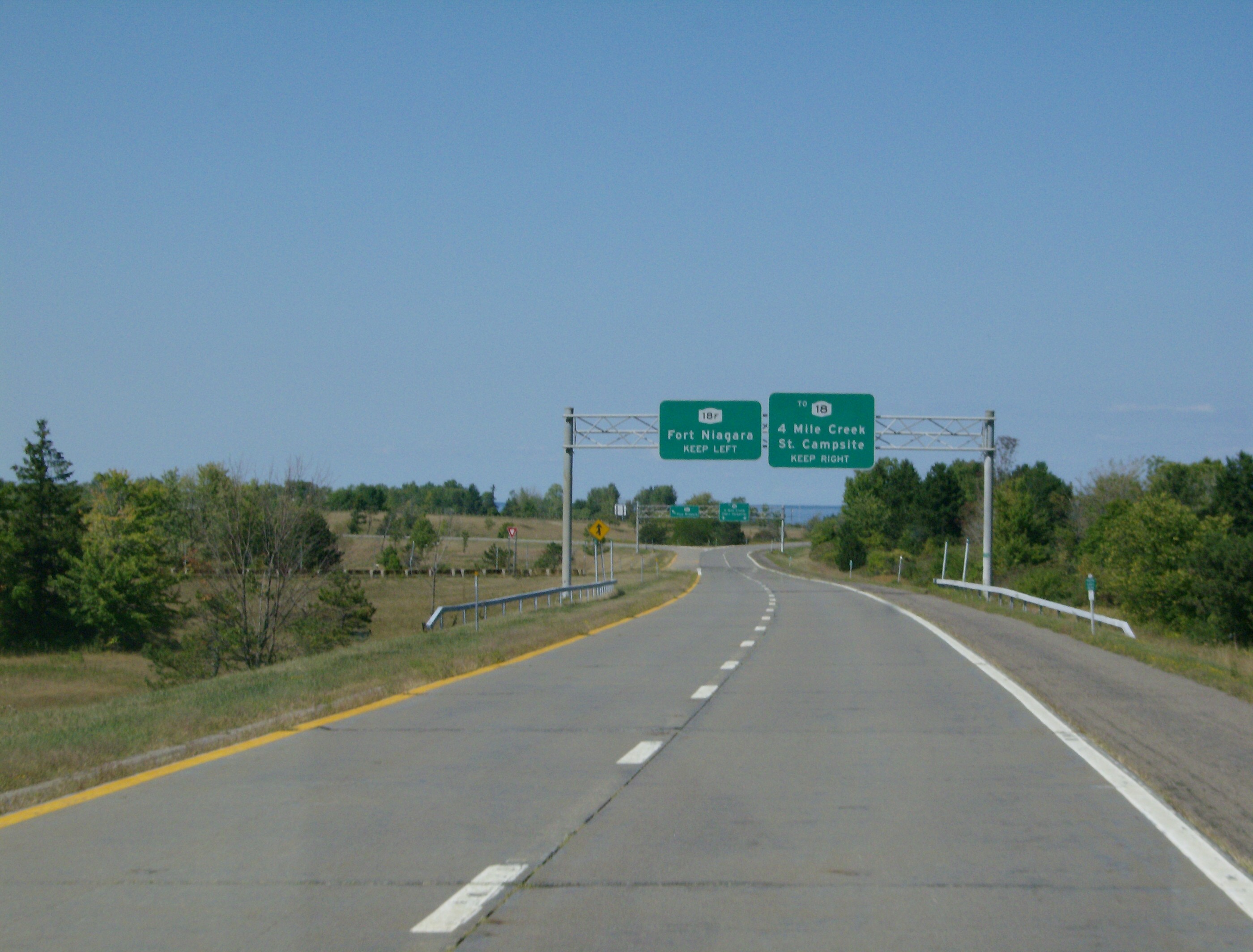
File:Robert Moses Pkwy near NY 18F.jpg
Robert Moses State Parkway.
TwinsMetsFan


File:Picnic tables along the Saint Lawrence River in Robert Moses State Park - Thousand Islands in northern New York.jpg
Robert Moses State Park, along the Saint Lawrence 
River.  Another park named for him is on Fire Island.
Matthew Trump


      Source note:  For much of this post I am indebted to Robert Caro's Pulitzer Prize-winning biography, The Power Broker: Robert Moses and the Fall of New York, an interminable but fascinating opus that treats its subject exhaustively and exhaustingly, but fairly.  The author, having done an amazing amount of research, commits the fatal sin of biographers by not leaving enough of it out.  The book should have been cut by a third; even the paperback edition is ponderous.  But for all that, it is a rich and informative read, showing not just Moses and his ways, but how things get done -- or not done -- in this city, how men of power use one another and the public, how this crazy city sort of works.

     Wienie update:  It's amazing the attention that mayoral hopeful Anthony Weiner continues to get, even after collapsing in the polls.  Last Sunday's Review Section in the Times had no less than two substantial articles about him, and he is often mentioned on the radio.  And a more recent Times article noted his and fellow sinner Eliot Spitzer's continued popularity among black voters, attributing it to two things: black churches' emphasis on forgiveness, and the frequency with which black leaders have been accused of similar indiscretions.  And why do I persist in publishing these wienie updates?  First, my waggish sense of humor can't resist.  Second, it's an ongoing New York story, and that's what this blog is all about.  And third, morbid curiosity.

     WBAI terminal?  WBAI is in such dire financial straits that it has terminated its award-winning evening news program and the whole news staff, the last program having been last Friday.  This amazes me, for I thought that time-honored program would be the last to go.  Now I have no reason to listen to the station in the evening, since most of what they're now doing is pleading for donations.  Their news program made me aware of issues neglected or ignored by the mainstream press.  When I mention ALEC and the Transpacific Partnership to friends, or tell them Monsanto is the company I love to hate, they don't know what I'm talking about.  Where now will I get such information?  WBAI professes to being optimistic about continuing, but in the light of this cancellation I have to wonder.  If you jettison one of your most significant and listened-to programs, does that mean the station is terminal?  I hope not, but I can't help but wonder.

     Coming soon:  Next Wednesday, Tweed at the End: "I have tried to do some good."  Next Sunday, Famous New York Streets: Broadway.  In the works: Colorful New Yorkers (the Queen of Mean, Texas Guinan, the Mad Poet of Broadway, and others), and a look at who made money in New York in the Civil War (three kinds of profiteers), plus a search for their equivalents today.

©  2013  Clifford Browder


Wednesday, August 7, 2013

77. Thomas Nast and the Power of the Pen


     When the New York Times accused Boss Tweed and Tammany of “monstrous abuses” and called them “reckless plunderers,” the Boss scratched an ear, shrugged: they had no proof; besides, his constituents couldn’t read. But some were hungry; asked for a donation for the Seventh Ward poor at Christmas, he wrote a check for five thousand dollars. “Oh Boss,” said an alderman half in jest, “add another naught.” He did, making it fifty thousand.

     When he first heard that some artist in Harper’s Weekly was drawing pictures of him and his pals and had labeled them a Ring (“true as steal”), he didn’t give the scribblings a glance. But when friends thrust at him a drawing by Thomas Nast that was now the talk of the town, he looked, winced:

A workman in a garret receiving a notice of eviction, while in a garden Tweed and his cronies sprawl on a bed of roses and swill champagne, Connolly and Sweeny looking crafty and sinister, Mayor Hall a prancing little fop with pince-nez, and the Boss flaunting a paunch swollen to immense proportions and adorned with a sparkling diamond. “The rich grow richer.”

     The Tammany leaders had been made to look contemptible and ridiculous, yet shrewd and sinister: the brilliant renderings of an artist sparked by rage.

     A week later a lawyer called on Nast at his home. Since the gentleman had talent as an artist, some unnamed patrons would stake him to a study tour of Europe to the tune of a hundred thousand dollars. Asked Nast, a short, stocky man with a trim mustache and goatee, pointed nose, and quick, keen eyes, 

Thomas Nast
     “Can I get two hundred thousand?”

     “Certainly.”

     “A half million?”

     “For sure. Take the money, go.”

     Nast wiggled his nose, grinned. “I think I’ll stick around.”


"Let us prey."

      Dismissing the lawyer, he went back to his board, picked up his pointed pencil and steel pen:

Tweed as a bloated vulture, diamond stickpin intact, with taloned cronies, perched on the bones of the city. “Let us prey.” 


      In July, while the slums baked and festered, a select hundred of the Tammany stalwarts retired for long weekends to the Americus Club and its wooded shoreline estate in Connecticut, where the Boss hoped to initiate the boys into clean-cuffed wining and dining and gentlemanly disport. Rising from sheets of blue silk and white lace, they donned the club uniform of blue navy pantaloons with a gold cord running down the side, a blue navy coat, and a white vest and white navy cap – the whole outfit further enhanced by a membership badge of a gold tiger’s head on a relief of blue enamel, with (for those who could afford it) eyes of blazing rubies. All talk of politics was banned. At the members’ disposal was a magnificent well-staffed clubhouse (dubbed the “Hotel de Tweed”) with billiard rooms, pool rooms, card rooms, a dining hall and kitchen, a barbershop, a well-stocked bar, and a library with plush armchairs and shelves of finely bound books that betrayed few signs of wear. The boys lingered through a ritual of meals, played pool and billiards under gaudy frescoes in rooms with mantels of Italian black marble adorned with imported bronzes, and eyed lazily a fleet of twenty rowboats in the harbor and the steam yacht William M. Tweed.

      Some of the members actually went rowing or sailing; all yearned for a rare invitation to visit the palatial yacht, where the Boss hosted a chosen few amid oriental rugs, tables set with sterling silver, and for large parties even an orchestra. Everyone was welcome at the annual clambake held on Tweed Island, a rocky bit of land a hundred yards from shore, where guests slurped a savory chowder accompanied by claret and champagne. The chowder had never been tastier, the drinks more sparkling, the Boss more chipper and blithe, his whole three-hundred-pound frame pulsing with laughter when someone told a joke. This was living!

      One morning while the Boss was reclining in the club barbershop, having his beard clipped and his scant locks slicked with oil, they brought him a New York Times that blazoned from stolen secret ledgers the expenses of the new county courthouse on Chambers Street: “Thermometers,” seven thousand dollars; “Brooms, etc.,” forty-one thousand; “Plastering,” close to three million; “Carpentry,” well over four.  "TAMMANY ROGUES" proclaimed the Times, while heaping scorn on the contractors: G.S. Miller was "the luckiest carpenter in the world," and Andrew J. Garvey "the prince of plasterers."  Given in telling detail, the figures were so outrageous that the shock and wrath of citizens exploded as far as Connecticut.

      Half cropped, half scented, Tweed rushed back to the city to be met by reporters at the station. “Is it true?” they demanded, goading him until his nostrils stung, and he glared out of deepset eyes:

      “Well, what are you goin’ to do about it?”

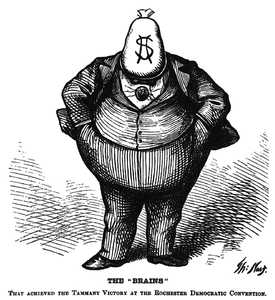
      These words (instantly regretted) were quoted all over town. At his drawing board at home, Nast, in shirtsleeves, eyeing a photograph of Tweed, whom he hated for his bullying bulk, his lips’ smug curve, and the sly look in his eye, dipped his pen in ink:

File:Boss Tweed, Thomas Nast.jpgTweed’s vast frame spreading boldly, hands in pockets, with a dollar sign for a head: The "Brains."


      Solid citizens flocked to Cooper Union. Republicans and Democrats alike, they denounced the Tammany frauds, and to cries of “Hang them!” formed a Committee of Seventy to wrest the city from the Ring. Cheers; talk of vigilantes.

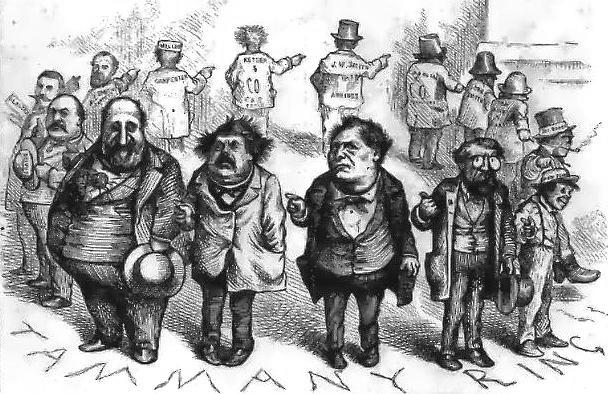
      The Boss had never shown fear; at a meeting once, when an enemy jabbed his gut with a pistol, he had faced him down unblinking. But this was different: morality, scattered in droplets for years, had suddenly congealed in a mass. When he glanced at the latest cartoon – Tweed and his pals in a circle, each one pointing to the next: “Who stole the people’s money? ’Twas him” – his ruddy tint paled, his stomach clenched. But could these puny moralists in tight collars really yank him down – he who was muscled and blooded like an ox, and more than anyone, knew and loved the city, from its spired and porticoed monuments to the ankle-deep gore of its slaughter pens, the stink and shit of its sewers?

File:Tammany Ring, Nast crop.jpg
Front row from left to right: Tweed, Peter "Brains" Sweeny,
Slippery Dick Connolly, Mayor A. Oakey Hall.  These four

constituted the alleged Ring, "true as steal."

      The Committee of Seventy petitioned the courts for an injunction to prevent the city government from raising or paying out funds. The petition was put to Justice George G. Barnard, Tweed’s chum, the white-toppered, whittling dandy of Gotham. Money was the blood of the tiger; without it, no henchman could be soothed or flattered, no voter coaxed. With a solemn air Barnard banged his gavel, granted the injunction: astonishment.

      In his Duane Street office Tweed took his goldheaded cane topped by a Tammany tiger and beat his desk five times. How could that brandy-reeking clown, that insect whom he had plucked from the mire to a pinnacle, do this to him? Rumors flitted: he had been promised the governorship. Barnard governor? Preposterous! But Barnard didn’t think so.

      Elections were approaching. On the street where Nast lived, thugs were seen watching his house. Quickly, Nast sent his family to friends in New Jersey. Then, rising in the middle of the night, his brain hot, his ink-stained fingers nimble, he sketched feverishly:

Tweed feasting, Tweed smiling, Tweed towering, Tweed gloating; the whole city squashed under Tweed’s huge thumb.

      In shops and newsstands citizens clutched for the Weekly, whose circulation had tripled. The Boss they saw pictured there was fat, sly, evil, gross.

      “Them damned pictures … ” Alone in his office, William Marcy Tweed leafed through his file of cartoons, pounded them, hurled them, yearned to shout that Bill Tweed, big and loose as the city, was a friend to all, meaty, juicy, warm. But twist and wiggle as he might, he knew that others viewed him locked in the mold of the Boss.

      “Bill,” said his friend Jim Fisk, “don’t let them galoots of reformers rattle your old tin oven!" But when he dined out the duckling had lost its savor, the ale its tang. Feeling clumsy and crude, he started burning records in his office, transferred real estate to one of his sons.

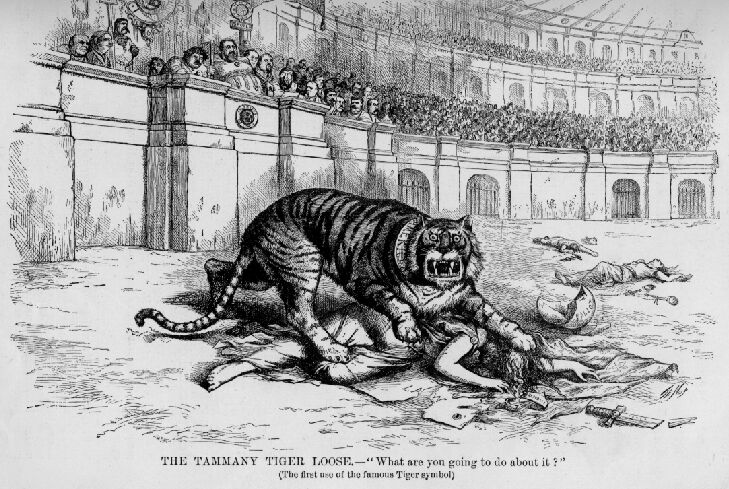
      One week to the election. Sleepless, gaunt, obsessed, Nast chewed his pencils, drew:

From his box in an arena, Tweed as a Roman emperor, smug, monstrous, watching the bleeding Republic, a prostrate virgin, ripped by a snarling tiger.  "What are you going to do about it?"

File:Nast-Tammany.jpg


      Having always loved his country, the Boss raged, almost wept. “They need me!” he bellowed. “I make this city work!”

      Even before the election they arrested him.


     Source note: This post, like the earlier one on Tweed, draws on both primary and secondary sources. Some of the dialog is fictional, but the characters and events depicted are all true to historical fact.

     Coming soon:  Next Sunday, The Hercules of Parks.  (Never heard of him?  If you live in the city, his works are all around you.)  Wednesday, August 14:  Tweed at the End: "I have tried to do some good."  (Who did him in, and who was loyal.)  Newly in the works:  Who makes money in wartime?  New York, 1861-1865.  (Contractors, speculators, bounty brokers.  And a glance at today.)

©   2013   Clifford Browder