Sunday, July 21, 2013

73. Secrets of New York (Browder version).


     Like any old city of a certain size, New York has its secrets: hidden or neglected places, often in plain sight but a bit off the common path and ignored by or unknown to many.  The Emmy-winning TV documentary series Secrets of New York, with a host in a black vinyl overcoat and spiked stilettos, has revealed and explained many of these secrets of the present or past, as do various websites as well.  Having no TV, I have never seen the TV series, though I applaud it.  I myself have neither a black vinyl overcoat nor spiked stilettos, but even so I will present my own New York secrets, thus rendering them -- for better or worse -- just a bit less secret, less mysterious.  So here goes.

The little house at 121 Charles Street

     At the northeast corner of Charles and Greenwich streets, only a few blocks from my apartment building, there is a little two-story wooden house, white with blue trim, that seems strangely planted there, dwarfed by the six-floor apartment building next to it that it stands smack against.  That such a free-standing house exists at all in the West Village, a high-rent district crowded with old or not-so-old row houses, is amazing.  The house and its small adjoining yard are surrounded by a high wall covered with thick vines, but one can get a glimpse of the house and yard through the grilled iron gate of the  driveway.  Whenever I pass the house I stop for a quick glimpse, noting in the yard a bird bath, what looks like a sundial but may be something else, and a small gazebo with a bench.  The house is definitely lived in, but I have never seen anyone on the property, though at times a car sits on the short cobblestone driveway just inside the gate.  I have always wondered who lived there, and why they would prefer to inhabit this small house and pay a hefty real estate tax, rather than put up an apartment building that over the years would bring in a handsome income.  Now, thanks to the wonders of the Internet, I have learned a lot about the mysterious little house.

                                                                                                Greenwich Village Society for Historic Preservation

     The house was originally a farmhouse situated on a rear lot at East 71st Street and York Avenue, some 200 years old but the exact date of its construction unknown.  In 1967 the Catholic Archdiocese of New York, the owner of the lot, wanted to demolish it and build a home there for the aged, but the house's owners, a Mr. and Mrs. Sven Bernhard, arranged instead to move the entire house five miles down to a vacant lot that they had purchased in the West Village, its present location.  They planted Concord grapes, a sour cherry tree, a dogwood, a magnolia, two fig trees, and an expanse of lawn.  The current owners bought it in 1988.  They are used to weekend crowds peering in through the gate, but other visitors are less welcome: a young runaway who slept there once, and a woman who asked if she could use the lawn as a dog run.  The visitors make all kinds of comments about the house, say the owners, but none of them are true.  Still a mystery house, in spite of all that can be found on the Internet.

The Christmas wreath house on Grove Street

      Another mystery house in the West Village is a three-story frame house with red shutters at 17 Grove Street, on the corner of Grove and Bedford.   Since the construction of new frame houses, seen as a fire hazard, was banned in the city in 1866, they are rare in the Village, but this one, handsome and well kept up, has survived in near-pristine condition.  At Christmastime all fourteen of its windows facing the street are adorned with wreaths with red sashes, and a peek through the ground floor windows reveals one or more Tiffany lamps, suggesting a sumptuous interior.  Over the years Bob and I have often gone out of our way to see this house with the wreaths, and we have always wondered how old it was and who lived there.  Again, the Internet has given us some answers.

                                                                                                 Greenwich Village Society for Historic Preservation

     The house was built in 1822 with only two stories, but a third was added in 1870, and at the same time, no doubt, its Italianate-style cornice, so typical of Greek Revival and brownstone houses.  It was built for William Hyde, a window sash maker whose shop was located just across a yard in a separate two-story structure at 100 Bedford Street, another old building that I had always been curious about.  Given the city's rapid expansion, Mr. Hyde's business probably did well, since new buildings required double-hung windows with sash weights.  Over time, the building went through many ups and downs; a 1936 photograph shows an unsightly fire escape, and bedding hanging out the top windows to air -- a somewhat shabby appearance.  The little shop building nearby once housed a tea room, but since then, like the house itself, it has been restored as a private residence.  Mr. Hyde would probably be amazed to learn that today his little shop building -- not the house but the shop -- has been appraised at over two million dollars, and that its annual tax bill is $14,503.32.


The old Jewish cemetery on West 11th Street


File:Second Shearith Israel Cemetery interior 4.jpg
                                                               Beyond My Ken
    A site that few people are aware of is an old Jewish cemetery on West 11th Street, just east of Sixth Avenue.  Today it is only a sliver of land with some twenty headstones, wedged in among much taller residential buildings, walled off from the sidewalk but visible from the gate.  Originally it was part of a larger cemetery established in 1805, but threatened by the city's extension of West 11th Street in 1826.  The Jewish residents petitioned the city to spare the land not needed for the street extension, and so this corner of the cemetery was preserved and is still cared for to this day.


The Meadow in Pelham Bay Park

     In summer Pelham Bay Park in the Bronx is crowded with sunbathers and swimmers at Orchard Beach, and picnickers at the picnic tables in the open grassy area just back of the south end of the beach.  But these crowds seem completely oblivious of another attraction there, the Meadow, an open space with bayberry shrubs and grasses indicated in all the maps and park guidebooks, but not easily accessed, since paths leading into it from the picnic area are often overgrown and hard to find.  After many misses I finally found access by noting a path entrance near three trees, two of them sycamores, with a bus station visible through some trees in one direction and a big beach facility visible in another.  Going in by this path I would leave the noise of picnickers and distant beachgoers behind and find myself alone in the Meadow, except for an occasional nude male sunbather stretched out on some flat rock.  In the Meadow I would also find wildflowers: cinquefoils and common St. Johnswort, purple loosestrife, narrow-leaved mountain mint, a towering sunflower, and early goldenrod, but also the red fruit of the sumac and, with luck, the first blackberries.  But what I savored most, sitting on my favorite smooth outcropping of rock, was the silence, the vast, deep silence, while puffy white clouds drifted across a clean blue sky.  It was the only spot in that huge, busy park where I could find such calm.

Staten Island:  The Groin of Summer


File:Vernonia noveboracensis 1.JPG
New York ironweed.
SB Johnny
    I have often hiked in the Staten Island Greenbelt, a broad expanse of green in the very center of Staten Island.  Leaving Forest Hill Road on the Yellow Trail, I would take the Red Trail down to a low, wet area that I call the Groin of Summer because, on a hot, muggy day, it seems the very essence of summer, rich, fertile, and secret, a spot that I alone seem to know.  I have never encountered another hiker there, and if I did, I'm sure that hiker would simply tramp on through.  In the Groin's moist soil I have seen thirsty flowers like boneset and Pennsylvania smartweed, and a thick, rich stand of New York ironweed towering to seven feet, its bold purple flowers visited by bumblebees and spotted skippers, cabbage butterflies, and spicebush and tiger swallowtails.  The soil is moist, but there is no standing water and therefore no mosquitoes.  I have always lingered there in the muggy depth of summer, reluctant to leave this magical spot that I might not visit again for a year.  (Yes, here I am penetrating Big Mama yet again and being enveloped by her; see post #59 on earth goddesses.)

Staten Island:  Heyerdahl Hill

     Going on from the Groin on the Red Trail, I would ascend Heyerdahl Hill, whose 241-foot elevation makes it one of the highest points on the eastern seaboard.  There I would encounter entirely different species of wildflowers, ones that prefer a high, dry habitat.  Veering off the trail on an unmarked path downhill, halfway down I would come to a spot known as Buck's Hollow and find the ruins of the Heyerdahl farmhouse, said to have been built about 1860 and burned circa 1910, though some date the construction of the house much earlier.  The Heyerdahl family once had a large farm here with orchards and an extensive vineyard, but Staten Island's rocky soil defeated them and they had to give it up.  Now all is overgrown, with crumbling foundations and some steps where I would sit for a few minutes in the shade.  In the distance, faintly, I might hear a barking dog, a hint of traffic.  Another quiet spot that I usually had to myself.

Staten Island:  Moses' Folly

     Hiking another trail, the Blue Trail, I would go past the three lakes of Clove Lakes Park, the most civilized segment of the trail, traverse a bit of suburbia, and then turn right off Little Clove Road to leave suburbia abruptly behind and follow a dirt path through a tangle of vegetation that by midsummer could be almost impassable.  Following the trail's blue blazes, I would hike up a fifty-foot embankment and come out on an abandoned highway ramp high above the noisy six-lane Staten Island Expressway.

Blue Trail Continuation, off of Little Clove Road near the Staten Island Expressway
Here the Blue Trail leaves Little Clove Road.
Bridge and Tunnel Club


Aborted Richmond Parkway Project, Staten Island
The Blue Trail negotiates Moses' Folly.
Bridge and Tunnel Club

The trail's blazes lead across the glass-strewn, graffiti-ridden ramp, where sumac and mugwort poke up through the cracks, and alfalfa and butter-and-eggs and round-headed bush clover grow in an adjacent field.  The trail then descends a steep wooded hillside past abandoned vehicles overgrown with weeds, crosses a trickle of a brook cluttered with more dead cars, and climbs steeply up again to another abandoned overpass that ends abruptly to the left but is marked with blue blazes leading to the right.

Staten Island Expressway, Looking West
Below the Blue Trail overpass.
Bridge and Tunnel Club

Rushing throughway traffic, deserted vehicles, ramps lunging futilely skyward, mugwort and sumac and alfalfa, broken glass and graffiti all combine to form an absolutely surreal landscape where nature and technology coexist uneasily, the like of which I've never seen elsewhere in the city, or perhaps anywhere.  This is Moses' Folly, the start of a highway planned by master builder Robert Moses that would have slashed right through the Greenbelt, a grandiose project characteristic of its ruthlessly determined planner, but canceled in the 1970s after years of protest and litigation when outraged citizens staged demonstrations and found allies in high places.  Also commemorating the frustrated builder is Moses' Mountain, an artificial rise just off the Yellow Trail near High Rock Park, created from excavations for the canceled project.  I hiked up it once but wasn't overwhelmed by the vegetation or the views; maybe I was there at the wrong time of year.  (More about Robert Moses in a future post.)


Greenwich Village courtyards
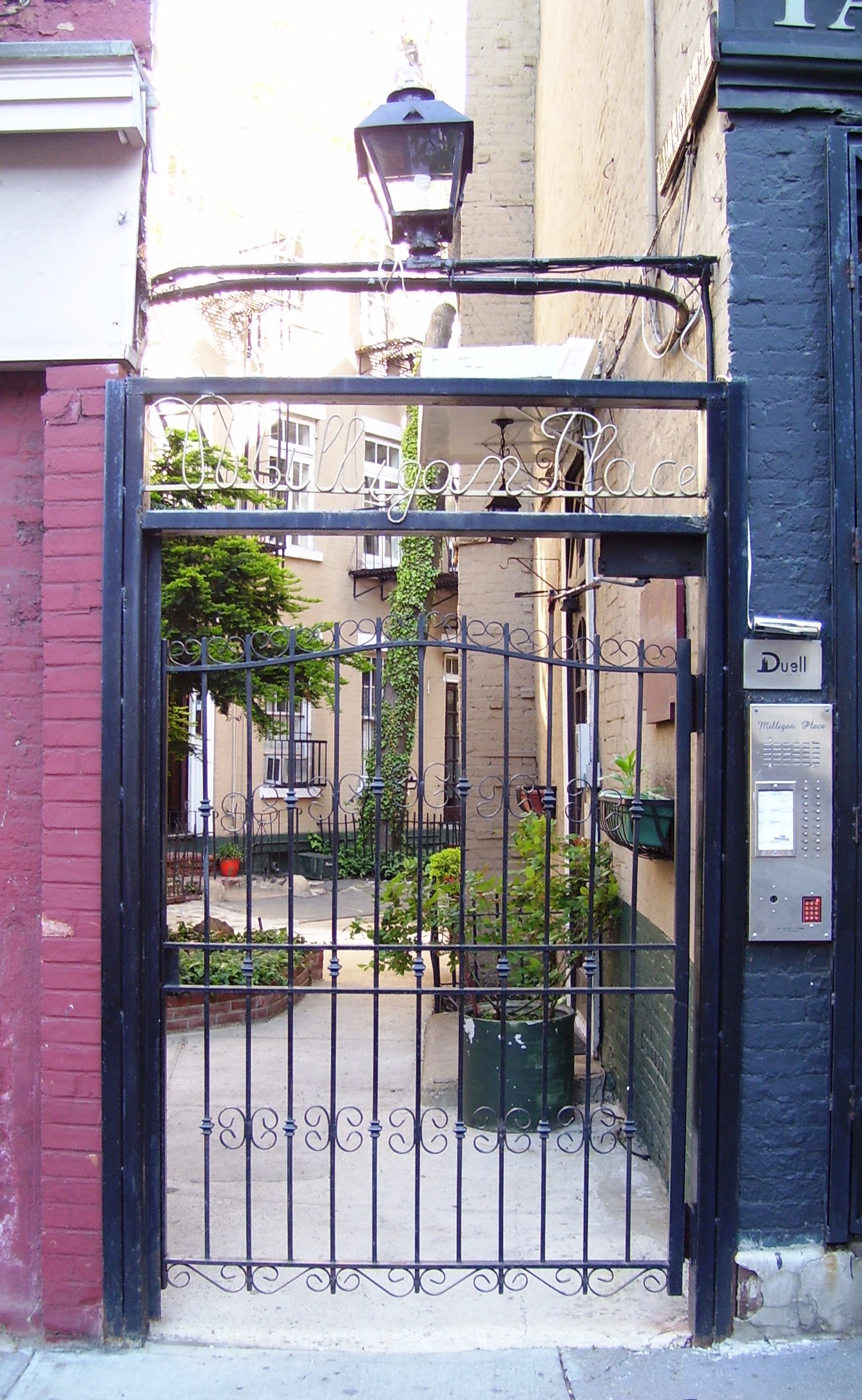

File:Milligan Place entrance.jpg
Milligan Place entrance.
Beyond My Ken


     Returning to Manhattan, let's have a look at some secret spots in the Village right near where I live: little private courtyards walled off from the street and accessed by a gate that you could easily walk past, unaware of the tiny community within.  One such is Milligan Place, located off Sixth Avenue between West 10th and West 11th streets, a private courtyard with four three-story brick houses built in 1852, and in the middle of the courtyard, a tree, a birdbath, and flowers.  When walking about in the Village, I try to keep an eye out for these sites and inspect them through the gate at the entrance, though I have never entered one since I respect their privacy.  In this case, one has no choice: the gate is securely locked, creating an oasis of tranquility in the midst of urban hurly-burly.  Who lives here and how they obtain this privilege I don't know, which adds a further touch of mystery.


File:Milligan Place.jpg
Milligan Place inside the gate, a view that I have never had.
Beyond My Ken


     Not far from Milligan Place in the West Village is another courtyard, Patchin Place, a short dead-end  lane off West 10th Street between Greenwich and Sixth Avenues, just across from the Jefferson Market Library.  Lining it are ten three-story brick row houses built in 1848; descendants of the Patchin family, who then owned the land, resided there until 1920.  Early in the twentieth century Patchin Place became popular with artists and writers who wanted a bit of privacy in the midst of bohemia, this being a time when the Village offered low, not high, rents.  In 1917 the addition of indoor plumbing, electricity, and steam heat made the rooms a bit less bohemian but more livable.  The poet e.e. cummings and the reclusive writer Djuna Barnes both lived there until their death, cummings at #4 from 1923 to 1962, and Barnes at #5 from 1941 to 1982.  They knew each other and cummings would check on her by shouting out his window, "Are you still alive, Djuna?"  But in 1963, when a developer wanted to tear down the houses on both Patchin and Milligan Places to put up a high-rise apartment building, Barnes emerged to lead a protest movement, saying she would die if she had to move.  She also said, less helpfully, that destruction of the neighborhood would leave local youths with nowhere to practice their mugging.  The courtyards were saved, and the creation of the Greenwich Village Historic District in 1969 guaranteed their survival.  Patchin Place lacks the secluded charm of Milligan Place but, given its history, it is a must-see for Greenwich Village tours, though it has now earned the name "therapy row" because many psychotherapists have moved in since the 1990s.  One thing that hasn't changed since the nineteenth century is the gas street lamp, one of only two in the city, though it is now powered by electricity.

File:Patchin Place through gate.jpg
Patchin Place in 2011.
Beyond My Ken

     Not all Village courtyards are so famous or desirable.  On a brief excursion recently I discovered one on the north side of West 12th Street just east of Eighth Avenue.  It too has the requisite grilled gate, opening to a flagstone walk lined with greenery and leading to two entrances well back from the street.  Narrow and dark, it lacks the charm of Milligan and Patchin Places.  And at 305 and 307 West 11th Street, between Hudson and Greenwich Streets, I found a grilled fence thickly screened in front with bushes, rendering almost invisible from the street the steps leading down to a basement apartment, and a small lawn with a towering sycamore, behind which, near the other entrance, is a patio with garden chairs and a tub of flowers.  This one too gets little light, but in the heat of summer maybe that's not so bad.  The Internet informs me that these are Greek revival townhouses built in 1836, with the original plank floors, fireplace mantles, and other details.

The mystery of basements

     In this city I have always been fascinated by sidewalk entrances to basements, those entrances revealing steep stairs descending into darkness, as if into some mysterious underworld, some land of the forbidden or the dead.  Always I have wondered,  What's down there?  What's going on in those dark regions below?  In the case of shops and restaurants, it's obvious: their supplies are stored down there.  But what about residential buildings?  Boilers, no doubt, and meters recording use of electricity and gas.  For the average tenant, those devices themselves are mysterious, but is there anything else?  I have never presumed to venture down those stairs disappearing into darkness, with one exception: my own apartment building.  Whenever we have lost power in our apartment, I have had to access the sidewalk entrance in front of what is now, and for long has been, the famous Magnolia Bakery, so as to flip the switches on our circuit breaker and restore power.  The circuit breakers are against the wall immediately to the left at the foot of the stairs, but usually the bakery has piled cartons or other obstacles in front of them, so getting to our circuit breaker has always been a challenge.  But there is much more down there than circuit breakers and meters, and I still don't know exactly what.  Sometimes, when I undertake one of these descents, a Magnolia employee emerges out of the shadows to help me remove the obstacles, but what he is down there for otherwise I cannot imagine.  Our basement is an unexplored hinterland, a realm of mystery.

     There is another entrance to our basement, in fact two, accessing another part of this hidden underworld that is separated from the realm of meters and circuit breakers.  With a key, you can enter through an outside door under the building's residential entrance, or, if you gain access to the building, you can go down a dark stairway in the ground floor back, near the area where garbage and recyclables are kept.  I have been down there only once, long ago, when our boiler broke down in midwinter and the building lacked heat.  In the boiler room I found a large contraption with all kinds of dials and numbers that supposedly regulated our heat, too complex and baffling a mechanism for me to flick a switch in hopes of restoring heat to the building.  Other tenants might have been tempted to try and in so doing might have made things worse, so I could understand why boiler rooms might be off limits to tenants.  But even with a nonfunctioning boiler, the room was marvelously warm and inhabited -- by flies!  So I learned where flies go in winter.  Not to Miami, but to the nearest boiler room.  We were shivering upstairs, but they were cozy and warm down there.  And once, quite recently, there was another resident, a homeless man whom the previous super had hired to take out the trash.  The homeless man decided to make a nest for himself down there and one night, drunk, he set the place on fire.  Fortunately, the fire was put out quickly.  The super stayed carefully away until the firemen left, but then, thinking the crisis over, returned and, to his surprise, was questioned by the police.  The homeless man was dismissed and his nest eradicated, and soon we had a new super.  Realms of mystery can also be realms of danger.

Flowered bikes

     In my neighborhood I have often seen a bike with its front basket richly adorned with artificial flowers -- so adorned that you can't help but notice it.  I see it locked to a street sign or some other immovable object, but never with its owner, who remains a mystery; he -- or she -- seems to want attention but is never there.  I thought there was only one such flowered bike in the area, but recently, going up Seventh Avenue on errands, I found another similarly parked near West 12th Street.  This was a woman's bike with its front basket festooned with fake flowers, and a plate like a license plate attached to the rear wheel that said  WILD  GIRL.  Wild Girl was nowhere in sight, so she too is a mystery.  Attached to the basket also was a small plastic cup, perhaps to hold a beverage or to receive donations, I don't know which.  I shall keep an eye out for both these flowered bikes and report any further information encountered.  But when I googled "flowered bike," to my surprise I found that this is no rare phenomenon; flowered bikes are in evidence both here and in Europe.  But in the West Village they are still rare enough to attract attention, mine included.

Jamaica Bay Wildlife Refuge
File:070530 4855 wiki.jpg
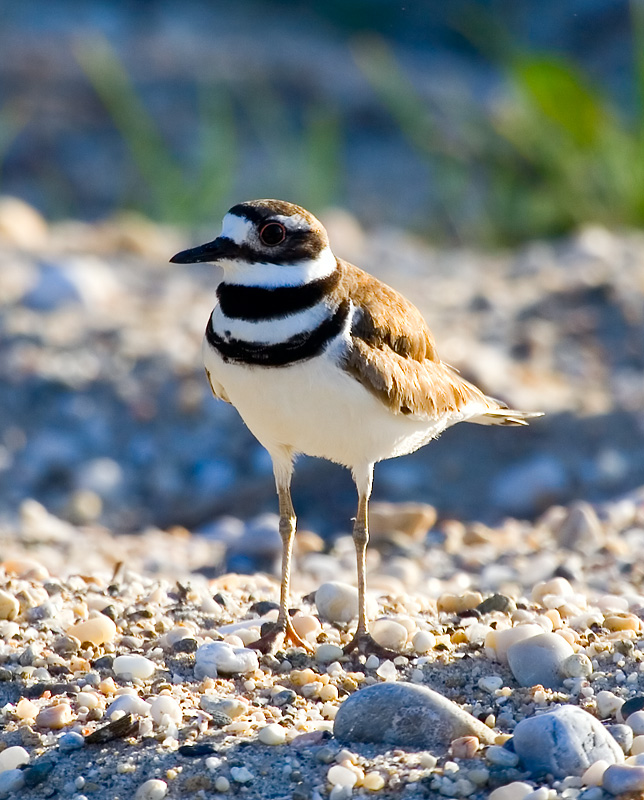
The killdeer, a strident spring visitor.
ShutterGlow.com

     Grasses bending in the breeze, tang of marsh.  Flaunting its double breast band, the killdeer shrills its name or an insistent dee-dee-dee.  Tree swallows dart and zip and perch, then dart again.  Overhead, black-headed laughing gulls shriek their laugh in a rich cacophony, while ibises with decurved beaks emit a guttural ka-onk, and osprey soar, or drop down to their nest atop a wooden platform to feed the greedy beaks of their young.  From fence posts or the tops of bushes, streaky-breasted song sparrows give forth their musical and sometimes buzzy song, while in the marsh grasses nearby, male red-winged blackbirds flaunt their red epaulets and sing a gurgled konk-la-ree.  Low over the open grasslands a white-rumped marsh hawk glides, while a score of white-feathered egrets perch in trees across the pond.  From every side, songs and calls of birds unseen or seen, trills and clicks and buzzes, bright chants and high-pitched warbles, and high in the sky the croak of a crow buzzed by a trio of redwings.  Sounds and sights, the burst and turbulence of spring.

File:Pair of Canada Geese.jpg
Canada geese are seen year round at the Refuge,
where they are welcome.  Not so welcome in 
urban parks and golf courses.


File:Snowy Egret flying 0587.jpg
A snowy egret in flight.  A beautiful bird in the 
air or on the ground.  Has a black beak and
"golden slippers."
Dori


     Late summer: four thousand tree swallows in bushes and weeds or ahead of me on the gravel path, taking flight as I slowly approach, becoming a fine dust of birds in the air, birds over me and on every side of me, flying within eight feet of me and settling back down on the path behind me as if I had never approached them, never routed them from their chosen stretch of ground.

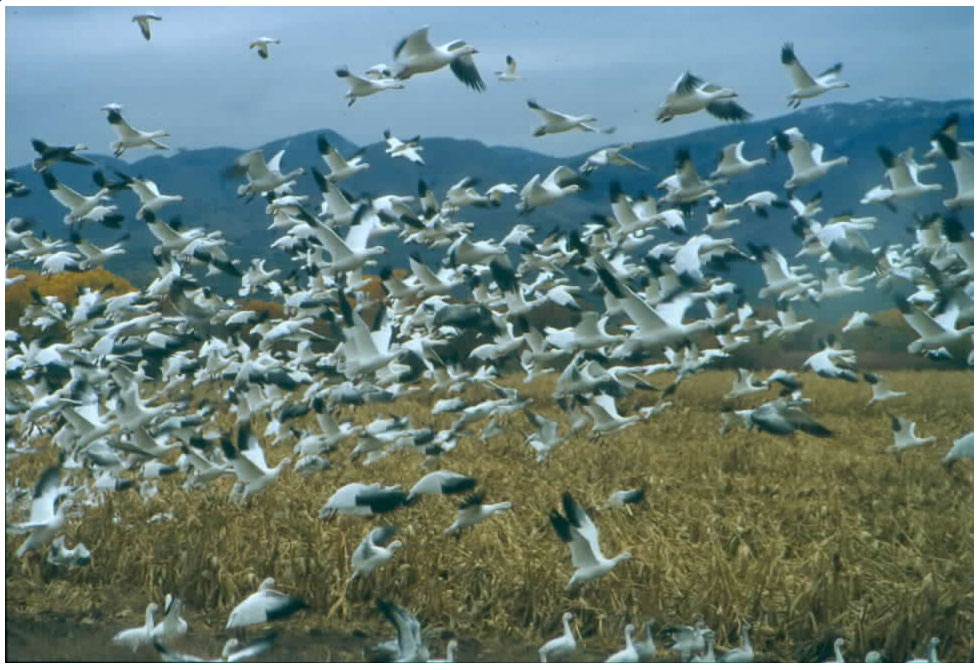
     Or autumn: at my approach, a thousand snow geese, white bodies with black-tipped wings, explode into the air, and then another thousand, rising and soaring, the air vibrant with their loud, piercing bark.
File:SnowGooseBoaqueDelApache2.jpg
Snow geese in flight.  A sight you won't soon forget. 
Einar Einarsson Kvaran

     Such is the Jamaica Bay Wildlife Refuge in Queens, which I have visited in every season of the year, a favorite haunt of birdwatchers, but otherwise too remote to attract many nature lovers simply out for a  gentle walk in the wild.  The refuge's salt marshes, fields and woods, fresh-water and brackish ponds, and wide expanse of bay draw hundreds of migrating birds, and are home to snakes and muskrats, butterflies and dragonflies, fierce-looking but harmless horseshoe crabs, and diamondback terrapin, oceangoing turtles that crawl ashore in early summer to lay their eggs in the sand.  And a habitat as well for wood ticks in late spring, and mosquitoes and pesky flies in midsummer, which is why I've avoided the refuge from late June through mid-August, by which time at least the flies have subsided.  I was there on 9/11 watching the fall migration of warblers, and saw the Twin Towers enveloped in smoke that was carried for miles over Brooklyn to the ocean.  With subway service to Manhattan suspended, that night I had to be put up by a friend in Brooklyn, before finally returning to Manhattan the following morning.  In spite of that memory, and the ticks and mosquitoes and flies, I recommend the refuge to anyone with an appetite for nature; it's impressive, it's unique.  But be in touch with it before you go, since it and the subway line approaching it were damaged by Hurricane Sandy.

A slave gallery and a boat graveyard


File:St. Augustine's Church 290 Henry Street.jpg
The hidden rooms were on either side of the tower.
Beyond My Ken


     I'll end with two secret sites that I have never visited but that are too interesting to omit.  In Saint Augustine's Episcopal Church on the Lower East Side, which was consecrated in 1828, cramped staircases lead to two concealed rooms behind the balcony where African-American worshipers could participate in services without being seen.  Edgar Allen Poe sometimes worshiped there, and Boss Tweed, indicted and hiding from the authorities, hid in  one of the rooms to attend his mother's funeral.  Neglected for decades as a part of our shameful past, when freed slaves were victims even here of segregation, the rooms were finally restored and opened to the public in 2009.


   A swampy stretch of the Arthur Kill Road waterway on Staten Island is now a graveyard for dozens of rusting, rotting, and abandoned boats of all sizes, whose sunken hulls emerge strangely from the water, listing to one side or the other.  Not easily accessed by car or bike, the sight is said to be oddly majestic and beautiful.  I know it only from photos, but it does seem to have a haunting cemetery-like atmosphere.  Another forgotten corner of the city, and a perfect one to conclude with.

Kaitlyn Tikkun


     Scam alert:  A few days ago I got an e-mail from my publisher informing me that he was on an impromptu tour in the Philippines, unannounced to anyone in advance, and was in a desperate situation.  He had lost his wallet, and his hotel was holding his passport until he settled his bill.  Please, could I send him $2500, which he would repay as soon as he returned.  This sounded phony, so I answered saying that I needed more confirmation.  Another e-mail soon came asking if I recognized the enclosed e-mail I had sent him recently.  This was the e-mail I send to friends on Sunday morning, announcing a new post in my blog.  Since anyone could access that e-mail, I was now more suspicious than ever.  So I answered by asking how we knew each other, what is our connection?  This time I got no answer.  Leery of e-mails, I phoned the publisher and learned that he was not, of course, in the Philippines and was fully aware of the attempted scam.  Someone had hacked into an account of his, but the compromised account had been closed and he had changed his password.  This is a familiar scam, often attempted by hackers pretending to be a beloved grandchild in desperate need of money from a doting grandparent.  Many of my viewers are probably familiar with the scam, but be on the alert anyway, since some hackers (unlike this one) are very informed and very clever, and can target a potential victim with the most persuasive appeal.  And of course never give any personal information to a stranger on the phone or online, and never hit a link to decline an e-mail offer, since that in itself may get you involved; instead, just delete the e-mail.  Ah, the wonders of the Internet!

     Coming soon:  Next week, Go Ahead: The Mania and Disease of Progress.  In the works: The Hercules of Parks (about the greatest builder since the pharaohs); and How America Goes to War: 1861, New York, with rallies, flags, threats (fly the flag, or else), the rush to uniforms, heroes real or   manufactured, and hanged effigies of traitors.  Plus asides about the Kaiser, Tojo, saving the Evanston waterworks, and Evanston's greatest wartime dissident, my father.


(c)  2013  Clifford Browder


Saturday, July 13, 2013

72. Liars, Cheats, and Manipulators


     We have all lied, cheated, and manipulated at least a little bit, but this post is about people who do these things habitually, weaving them into the fabric of their being.  And these offenses are linked; if one lies, one probably cheats and manipulates, and if one manipulates, one probably cheats and lies.  These are stories about real people I have known in New York, but the names are fictional.

     I met him in Nantucket.  Tall, slender, blond, with a sexy sun tan, Ralph was supple as an otter, smooth and congenial, with an engaging smile and a glib tongue, a charmer from Delaware well known to everyone on the beach and in the bars.  We connected at once, slept together at his place, cycled, took walks on the beach at night under a vast sky bright with stars.  Of course I hoped for a future of  enhanced togetherness, but noticed that maybe he knew too many people, especially young males, and greeted them all knowingly with the same warm smile he bestowed on me.  He would promise to meet me at a bar prior to dinner, but forty minutes or an hour would pass, before his bright blond charm materialized, with some vague excuse for his tardiness.  At the end of my vacation we parted, agreeing that he would visit me in New York.

     He came, took me to parties given by his friends, reveled into the distant reaches of the night till I was drooping, while assuring me that it was "only the shank of the evening."  When a friend dropped in at my place, Ralph would parade before him in his briefs, poised and nonchalant, and if we visited a friend of mine at his place, Ralph would manage to leave some small item behind, so as to have a pretext to drop by again.  By now I was downright suspicious.  Then, twice, he left me to vanish into the gloaming and its rich potential, returning the following afternoon, ever buoyant, with smiles and yet another flimsy explanation.

     By now I had had enough.

     "You're using my place as a base of operations.  Whatever you're looking for, it isn't here.  Get out!"

     Never before had I issued such an ultimatum to anyone, nor have I ever since.

     He was stunned, shocked, angry, and above all indignant at my rankest incivility.  "You're from the Midwest.  You don't know better!"

     "Get out!"

     He pleaded the most ardent pleas, argued the most passionate arguments, threatened vague dark reprisals, then sank down on the sofa in a sudden fit of vapors, languished there like a wilted lily, and when I remained unmoved, sprang up bold as beans to utter more vague dire threats, pout, plead, and argue yet again, professing to be hurt to the crux of his being.  Finally, having dented my resolve not a bit, he phoned another friend to arrange accommodations and, with a last hurt glance, departed.

     In the wake of this bravura performance I brooded for all of twenty minutes and felt a slight bit of hurt myself, then a buoyant mood of relief.  What most amazed me was not his whoredom or lies, but his dazzling repertory, revealed in that last half hour, of moods, shifts, ploys, one stratagem fading quickly into another and then another, a slick and scintillating display of virtuosity worthy of the lords of guile.


     My friend Kevin was a quintessential New Yorker, dapper, sophisticated, witty, a fervent balletomane who of necessity taught college.  He more than anyone immersed me in the New York way of life, instructed me in what clothes were acceptable, what shows I should see, and the magic of ballet.  A natty dresser, in the 1950s he favored the restrained elegance of Brooks Brothers, whose Boys Department satisfied his needs at a price well within his budget.  A decade later, when the Peacock Revolution hit, he gravitated quickly toward bell bottoms and bright-colored shirts, while his right hand glittered with a ring on every finger.  What his students thought of all this I can't imagine, but it was the age of anything-goes, so if some were put off, others must have been dazzled.

     But beneath the chic and glitter, the dark forces of his psyche picked at the structure of his ego, the edifice of his charm.  He had moments of intense insecurity, fits of depression, attacks of migraine that seemed to have no cure.  Managing money escaped him; he had a great propensity for debt.  I often told him he was the only one I knew who had made a mother of the Chemical Corn Exchange Bank, whose money (for interest) flowed to him like milk.  He was gay, but the Gay Lib movement all but passed him by, since his matings were rare and brief; maybe he asked too much.  

     One day he informed me that, during a rare foray into a bar, he had connected with a South American named Vergilio who gave off an aura of glamour -- a word that he brandished freely, and that I associated not with Latin charm, but with the publicity machine of Hollywood.  I soon met Vergilio at Kevin's, found him well-groomed, poised, and charming, with a soft voice that caressed, but enigmatic: a smile over a cocktail glass, little more.  In no time, thanks to Kevin, Vergilio was temporarily installed in the apartment of a friend of Kevin's who was going away on vacation, which I thought a bit premature, given how little Kevin knew of his newfound friend.  But Kevin was radiant, basking in the aura of glamour.

     In the weeks that followed, Kevin began evincing alarm: Vergilio's health was not all it should be.  Then he informed me that Vergilio was going to consult a doctor on the doctor's yacht, which struck me as an odd site for a consultation.  Next I got a phone call from Kevin, with anguish in his voice: "Vergilio is dying!"  His friend had informed him that he was suffering from a long-term fatal ailment, its exact nature undisclosed, that required treatment in Europe; he would be leaving soon.  So Vergilio left; Kevin moped about, waited for news, worried.  Postcards came from Paris, Monte Carlo, Nice, with only the briefest message and no news about his treatment.

     Three weeks later he was back, well-groomed and urbane as ever, the same soft voice, the same smile over a cocktail glass.  He showed Kevin and me a series of photographs from his trip, every one featuring a smiling and handsome Vergilio in a well-appointed residence, his host unidentified.  By now even Kevin sensed something amiss, but his need of glamour locked him under the spell.

     Vergilio now informed Kevin that he had to return to Europe for an operation that might or might not save his life, probably not; professing embarrassment, he confessed he needed money for the trip.  Why he had to turn to a new friend, and not to old friends and family, went unexplained.  Kevin at once gave forth of his own meager savings, then phoned any number of friends, entreating them to loan him what they could.  Some did, some didn't.  I myself, unable and unwilling to label Vergilio a liar or a fraud without convincing evidence, promised five hundred dollars but then, common sense prevailing, gently but firmly declined.  "I don't believe in it," I explained.  "I feel like I've been kicked in the teeth," said Kevin.

     Vergilio departed once again for Europe, and I heard no more of him, for Kevin and I were now estranged.  Finally I phoned a mutual friend, asking how he was.  "He's learning what he has to learn," she said, but refrained from saying more.  Months passed; other matters claimed me, but I thought often of Kevin.  Finally he phoned and invited me over.  He looked worn and wan, but got to it right away:  "If I ever see him again, I'll say to him, 'What?  You're not dead?  But that's why I gave you all that money and sent you back to Europe.  Dead -- you should be dead!'"  A hard look came over him that I had never seen before.

     To my knowledge, Vergilio never reappeared in New York; if he did, it was at a far remove from Kevin.  Kevin never mentioned his name again.  His finances habitually precarious, I doubt if he ever repaid any of his friends.  But of one thing I am sure: Vergilio is off somewhere, on this continent or another, smiling over a cocktail glass and enlisting the sympathy and generosity of friends.  New friends; to the old ones he wouldn't dare show his face.


     Warren Laforgue was a dark-haired young man with a sly and sometimes mischievous smile whom I knew at Columbia University, when he was an undergraduate in French in General Studies and I was a graduate student in French.  That year the top floor of John Jay Hall was, quite by chance, two-thirds gay, so it didn't take us long to get acquainted.  He asked if he could sleep with me, explaining that he had broken up with a longtime lover recently and had trouble sleeping alone.  Since Warren could qualify as "cute," I had no objection, but it turned out that when he said "sleep," he meant exactly that; there was a bit of togetherness, but no sex whatsoever.  I adjusted and we became friends.  There must be something in me that encourages the confidences of others, since I have been the confidant of any number of friends and family; maybe I should have been a therapist.  Warren was soon telling me all about his past and present life, minus a few gritty details of his current sexual adventures.

     Warren was a member of not one but two undergrounds at Columbia: the gay underground that I quickly discovered, and the Catholic underground headquartered in the Newman Club, whose weekly meetings drew Catholic students, both graduate and undergraduate, for faith-related discussions and fellowship in the midst of this most secular campus.  So Warren was active in gay life but, by confessing regularly and receiving the sacrament, he cleansed himself of sin and entered into a state of grace that truly uplifted his spirit ... for a while.  He even told me that, if approached by someone whom he found uninteresting, he had the perfect turn-off: "Don't touch me -- I'm in a state of grace!"  He said this jokingly, but perhaps he really resorted to it, though I came to realize that his rebuffs were few and far between.  Yet he planned to leave all this behind and one day marry and become a public school teacher in New Orleans.

     He had already lived for a time in New Orleans, where he became the lover of a young man whose mother was vice-president of a bank.  In no time he found himself a teller in the bank, making good money but under pressures professional, emotional, and spiritual.  One day he cracked up in the teller's cage, throwing money wildly about.  Soon he was in a therapist's office telling his story.  When the therapist had had time to absorb it, he gave quick, unequivocal advice: quit that job and get out of here at once.  The next day Kevin was on a plane to Michigan and his mother's home, after which he in time found his way to New York.  There he entered into another relationship, but this one was tainted from the start by his partner's constant infidelities.  Once, arriving at their apartment, he found the door locked and knew at once the situation.  To get in, he smashed a window, at which point his partner's tguest, terrified, dashed out into the courtyard stark naked, to the amazement and amusement of the neighbors. It was in the wake of this second breakup that I met him; done with relationships, he wanted only one-night stands, followed duly by confession and the sacraments.

     At the Newman Club he met Ann Richards, a graduate student in French whom I knew slightly.  Everything about her was thin, pinched, and dry: a predestined spinster.  She kept apart from the other graduate students, left classes quickly with her lips compressed, eyes down so as to avoid eye contact with anyone.  Knowing me to be a friend of Warren's, in passing she would give me a quick, tight smile, nothing more.  She had a job as monitor in a nearby women's dormitory, where her dour vigilance kept careful watch over the virtue of the residents.  (This was before the anything-goes mood of the Sixties.)  Her tight little world seemed well defended against the secular realm all around her and any hint of a broader, richer experience, until she got to know Warren, whose winsome charm had its effect.  "I have a cold heart," she told him one day, "but you have crept into it."  A guarded confession, but a confession nonetheless, and this from a devout Catholic not given to effusions of emotion.

     "Look!" Warren said to me once, wearing a pair of jeans cut off at the knees.  "New shorts.  Ann cut them off and hemmed them for me.  It didn't cost me a cent."  But she was more than his seamstress.  She helped him with his French, and occasionally I would see them together in a restaurant.  Given Warren's paucity of funds, I'm sure that she was paying.  He was using her, but with her full consent.

     In time I got a teaching job and moved off campus into an apartment of my own.  But I was still in touch with Warren, who kept me informed of his endeavors.  Though a less than brilliant student, he decided to apply for a Fulbright scholarship to Belgium or France, and to accomplish this goal marshaled all his resources.  A young woman whom he knew at the Newman Club worked in the office that processed the applications.  She explained that the applications would be put in either of two piles: pile A for those considered the most promising, and pile B for all the others.  If his landed in pile B, she would shift it to pile A.

     But Warren didn't stop at that.  Coached by Ann Richards, he set his sights on Columbia's highly esteemed Graduate Department in French, into whose hallowed precincts he had up till now never set foot.  Approaching Professor Bédé, a renowned scholar who specialized in nineteenth-century French literature, in careful French he asked the eminence for a letter of recommendation.  "But young man," said the eminence, "I hardly know you.  You've never taken any of my courses."  "But sir," said Warren, "a recommendation from you would do a lot of good."  Bédé pondered, then announced, "Very well, a supplementary recommendation."  All this in French, with emphasis on supplémentaire.  But Warren got his recommendation.

     Next, still coached by Ann Richards, he went to Jeanne Pleasants, the reigning authority in French phonetics, who also spoke no English.  "It's very rare," she remarked, "for an undergraduate to take an interest in phonetics."  "But madame," said Warren, "phonetics is the basis of the language!"  Jeanne Pleasants beamed.  "Ah, to hear this from an undergraduate!"   So Warren got a second recommendation, supplementary perhaps, but with a stellar name attached.

     Was he overreaching?  One of his friends, apprised of his campaign, blurted out, "You dumb kid, you've got more push than brains!"  This depressed Warren, but I consoled him, my support tempered by the awareness that we both knew there was a measure of truth in the rebuke.  Warren could master irregular verbs, but was at a loss when it came to Flaubert or Proust.  Adept at parroting the opinions of his professors, he couldn't evolve an opinion of his own.  His papers were a pastiche of truisms; rarely, some lived experience of his own broke through.

     Meanwhile Warren was active on other fronts.  He didn't go to bars, since there were so many cruising spots close to home, but somehow he made the acquaintance of an antique dealer who was immediately and irrevocably smitten.  As proof of his fervor the dealer showered gifts on Warren: an antique chair, precious bric-a-brac, a charming little end table, a Tiffany lamp.  Planning one day to have an apartment of his own in New Orleans, Warren shipped item after item home to his mother for storage; what she thought of it all I can't imagine.  In time the dealer's ardor subsided, common sense reclaimed him, and the bonanza stopped.  But not until Warren had feathered his future nest handsomely.

     By now Warren had a job teaching in a Catholic boys' school.  The older boys he found unmanageable, but with the younger ones he had great success.  Soon he was invited to the home of one of them, and the boy's father, the proprietor of a cruise line, offered Warren a job in the purser's office of one of his cruise ships.  So Warren departed with a duffel bag crammed with his thngs and spent a glorious summer in the Caribbean.

     In his absence I happened to have a talk with a young botany instructor, who remarked, "How he uses us all!  He had only to offer a hint to Ann Richards, and she gushed forth money.  And I gave him an A in a botany course where he never even showed his face."  He smiled, shrugged.

     This unsettled me.  I knew that Warren was using us, but didn't know to what extent.  Later that summer my buzzer rang in the middle of the night.  Jarred awake, groggy, and nursing the dimmest hunch as to who it might be, I refused to answer.  The insistent buzzing stopped, but minutes later I heard footsteps in the hall, and a key turning in my lock.  Groping my way to the door, I opened it and saw Warren with his duffel bag, and the building's night attendant, whom he had persuaded to let him in, in the event of my absence.  I grunted acquiescence, waved Warren to a sofa in the living room, and staggered back to bed.  Getting up in the morning, I found him deep in sleep on the sofa, so I breakfasted quietly and went off to teach a morning class.  But I left a note:  "Stop blood-sucking Ann Richards.  Next time you want me to put you up, tell me in advance.  Help yourself to breakfast.  We need to talk. I want you for a friend."

     When I got back to the apartment, Warren and his duffel bag were gone.  He left a note: "I haven't seen Ann Richards for weeks."  Of course not; he'd been off on the cruise.

     Warren didn't get a Fulbright, but he received a lesser scholarship that let him spend a year at a Catholic university in Belgium.  I received one glowing letter from him, telling how he had delivered a talk there to a large audience, marking a transformation of the insecure young student I had known.  I hoped it was true.  But when he came back a year later, he didn't contact me; I heard from others that he had passed through New York.  I never heard from him again.  Perhaps he didn't need me any more; perhaps my note about his blood-sucking had wounded him.  In any event, Warren had thrown me away.

     I hope that Ann Richards found a good teaching job and lived her quiet life.  I hope that Warren Laforgue got to New Orleans, taught there, and married a nice Catholic girl, not too bright, who wouldn't ask too many questions.  I still remember him with fondness.  He was a manipulator, but at least he had deftness and charm.


     I promised liars, cheats, and manipulators in the plural, but so far, confining myself to cases I have personal knowledge of, I have offered only one of each, their offenses strictly limited in scope.  But our history is rich in all three.  As proof of it, I present off the top of my head this list of Americanisms, all verbs meaning to cheat or swindle: to bamboozle, blindside, buffalo, clip, deacon, diddle, fudge, hustle, jive, noodle, pinch, pluck, ream, shave, sucker, humbug, hornswoggle.  All of which -- and I'm sure there are more -- goes to show that this nation has witnessed plenty of lying, cheating, and manipulating.  How could it not, when we had a whole continent to exploit, a nation to build, and new ideas, new religions, new inventions, and new freedoms to thrust at ourselves and the world?  We have always been, and still are, expansive, grabbing all we can, and reaching for more and better.  Boosterism -- a very American notion -- comes easily to us, and boosters are given to exaggeration and enthusiasm, which can easily shade into lying, cheating, and manipulating, with consequences often vast in scope.  I'll cite just an example or two.

     The recent resentencing of Jeffrey Skilling, former CEO of the Enron Corporation, reminds me of that colossal fraud, leading to what was then the biggest bankruptcy in the nation's history, with dire consequences for employees, shareholders, and the citizens of Houston.  Skilling was convicted of conspiracy, securities fraud, false statements to auditors, and insider trading -- a rather heavy load of offenses -- and was sentenced to 24 years and 4 months in prison and fined $45 million.  Now his sentence has been cut by ten years, making him eligible for release in 2017.  How former employees and shareholders feel about this, or for that matter the citizens of Houston, has not been reported.  My mutual fund family interviewed Enron twice as a possible investment, but couldn't understand how the company's visible operations could produce the profits reported in its glowing quarterly reports.  "You don't understand modern finance!" the Enron people huffed at them.  Indeed they didn't, and as a result their funds, unlike some, were untouched by Enron's collapse.

     The Enron fraud was based in Houston, but over the years Wall Street has seen lots of dubious promotions, usually ending in collapse.  In the nineteenth century it was canals and turnpikes, then railroads and gold mines and petroleum stocks, all of them touted wildly on Wall Street, some of the enterprises sound, but their stocks uplifted -- for a while -- into the stratosphere.  Recently it was the dot com bubble of the 1990s, and then real estate, from which we are still recovering.  Boom and bust, boom and bust -- that's what our history is all about, and in most of these pies Wall Street has had its sticky fingers deeply implanted.  A parade, often colorful, of liars, cheats, and manipulators.

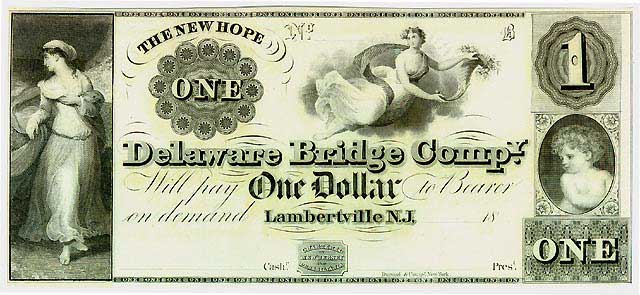
     In the nineteenth century, in the absence of any federal currency, paper money was also issued by states, cities, counties, private banks, railroads, stores, churches, and even individuals.  Ironically, the money of big New York City banks with solid assets was highly esteemed throughout the rest of the country, and rightly so.  (How times have changed!)  All this ended in the 1860s when, during the Civil War, the federal government started issuing greenbacks, a national currency that replaced all other currencies.  Were those earlier currencies the works of liars, cheats, and manipulators?  Theoretically, no.  But when the issuers went bankrupt, rendering their currency valueless, one might well think so.


File:Delaware Bridge Company Dollar.jpg
A dollar bill issued by a bridge company in New Jersey.  Would you have accepted it? 


      In a mode more comic than serious, consider the nineteenth-century theater company that toured the West advertising the "gowrow," a fabulous monster exhibited in a tent adorned with a lurid painting of an ferocious animal devouring a family of mountaineers.  Lured by such promotion, a crowd would gather outside the tent, forking over good money for tickets to what promised to be the show of shows.  Suddenly, bloodcurdling roars and shrieks would erupt inside the tent, with clanking chains, gunshots, and sounds of a struggle.  A man would stagger out, his clothes shredded, with blood running down his face: "Run for your lives!  The gowrow has broken loose!"  The back of the tent then collapsed amid more roars and sounds of rattling chains.  Needless to say, the crowd fled in panic without stopping to get their money back, at which point the theater troupe packed up quickly and took off for distant vistas where the hoax was still unknown.


File:House for sale.jpeg
Signs of the recent bust, 2008.
The truth about

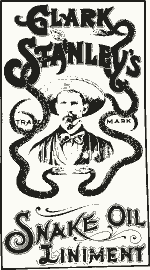
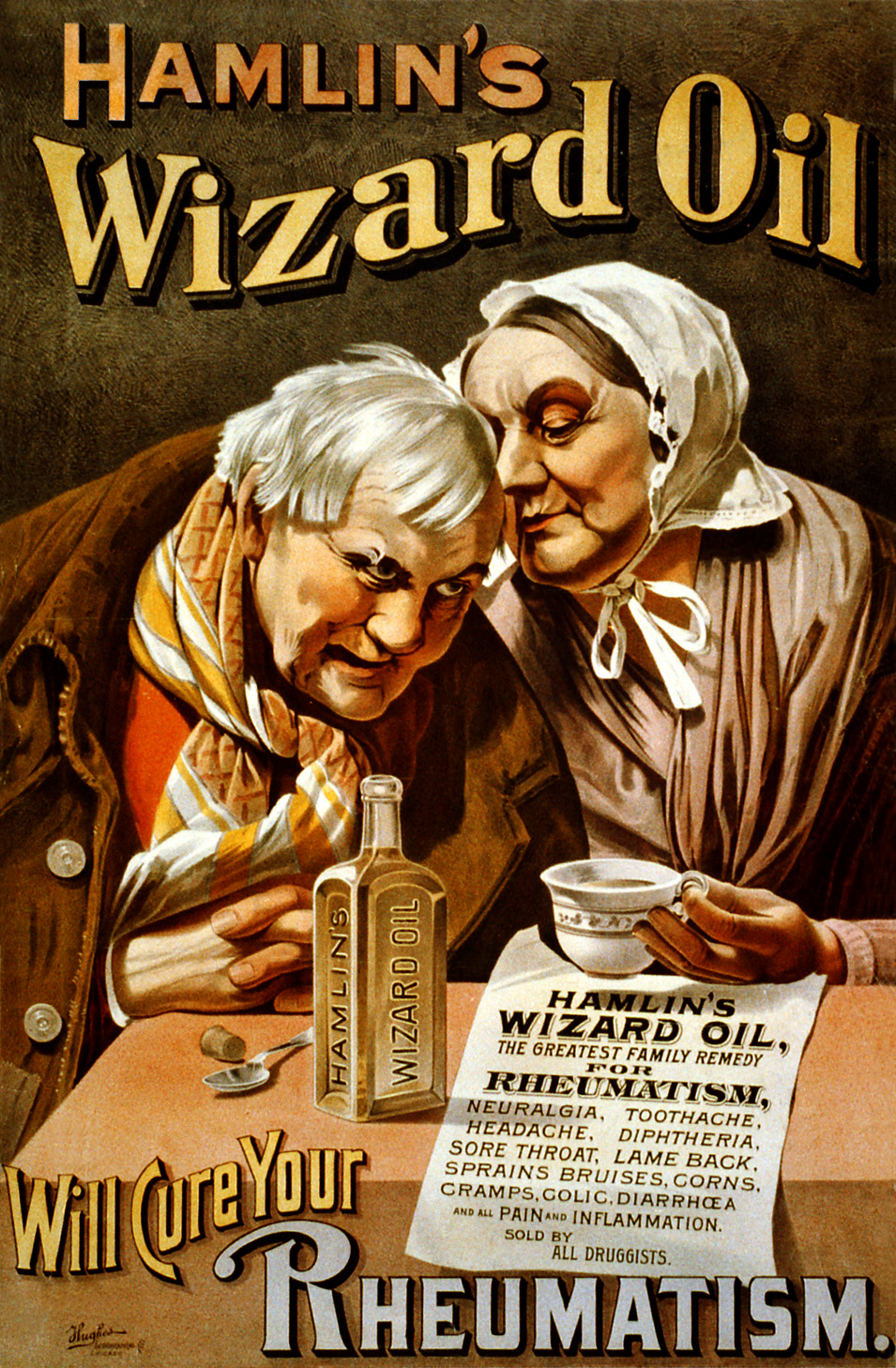
     Maybe sophisticated New Yorkers wouldn't have fallen for such a hoax, but over the years they have been suckered by subtler schemes, as for instance the Wall Street bubbles mentioned earlier.  Of course not everyone invests, but advertising reaches us all, and what does it involve if not lying, cheating, and manipulating?  Classic examples are the patent medicines of the nineteenth and early twentieth centuries, which promised cures for cancer, rheumatism, syphilis, self-abuse (aka masturbation), impotence, toothache, consumption, catarrh, dyspepsia, and anything else you care to name.
File:Alterative Juice.png
File:Snake-oil.png


File:Hamlin's Wizard Oil poster.jpg


     I've seen whole pages of those ads in old newspapers, but patent medicines were also touted in posters slapped on fences and horsecars and on asbestos curtains in theaters; on the signs of sandwichmen on crowded city streets; in handbills slipped under the entrances of residences; in outsized graffiti on the Palisades, where excursionists on steamboats couldn't help but see them; and on telegraph poles beside the Union Pacific tracks across the continent.  "Ob-scenery!" proclaimed Horace Greeley, editor of the New York Tribune, but if citizens scoffed at the ads or criticized them, they also bought.


File:Cocaine for kids.gif
Cocaine for kids: an interesting proposition.


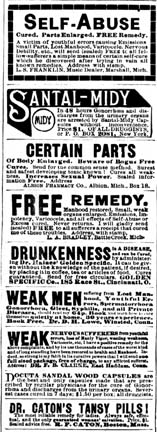
File:TansyPills.jpg


     In one column of ads, a remedy for self-abuse and another (Santal-midi) for gonorrhea; remedies to enlarge certain parts of the body and to restore manhood; a Golden Specific for drunkenness; a cure for weak men (syphilis, gonorrhea, and "all private diseases"); a cure for weak nerves caused by "youthful errors"; sandalwood capsules for gonorrhea; and tansy pills "for women's salvation."  This last, mysterious enough, is probably a discreet reference to yet another venereal disease remedy.  The fate of those who tried these remedies I cannot bring myself to contemplate.


File:Fda.jpg
Our friend and protector?
     Of course patent medicines are a thing of the distant past.  Today, the FDA protects us from such scandalous offerings, does it not?  Surely we aren't lied to, cheated, and manipulated in so gross a fashion now.  Not by Big Pharma or Big Tobacco or the food and supplement industries, or by the gun industry or anyone else offering products to satisfy our craving for money, comfort, beauty, pleasure, health.  Books could be written on this subject, and have been.  I'll simply mention the journal Nature's charge in 2005 that 70% of FDA panels writing clinical guidelines on prescription drug usage contained at least one member with financial ties to drug companies whose products were covered by those guidelines.  The FDA has since implemented new guidelines to avoid such conflicts of interest, but criticisms continue.  Caveat emptor. 


     Election note:  Speaking of liars, cheats, and manipulators, our local elections here in the Big Apple can be highly entertaining, if one has an appetite for farce.  First, Anthony Weiner, who had to resign his House seat when his pornographic e-mails to a number of women came to light, has resurfaced as a candidate for mayor, asking voters to give him a second chance, and shaking up an otherwise dull campaign.  He is now neck-and-neck with Christine Quinn, hitherto the favorite, who yearns to be the city's first woman mayor and first avowed gay mayor.  Hot on the heels of this development came the news that Eliot Spitzer, our former mayor who had to resign when his planned rendezvous with a pricey call girl was revealed (see vignette #14, July 1, 2012), is now a candidate for city comptroller, an important but lackluster post that manages the city's multibillion-dollar pension system and oversees the city's finances.  And in the latest poll he's actually the front runner!  My reaction?  Well at least things are getting more interesting.  They both have name recognition, though not the kind most candidates want.  Weiner must be a good campaigner to have gotten this far so fast.  As for Spitzer, he was a superb state attorney general, doing all the things the federal attorney general should have been doing, and -- briefly -- a lousy mayor who antagonized everyone, even his friends.  But he's provoked a massive backlash, and if he's got business, unions, Wall Street, and the Democratic establishment against him, he must be doing something right.  Not that I've decided to vote for either, but I'm watching closely with interest this resurgence of two political outcasts as they rise like the phoenix from the ashes of their earlier career.  Meanwhile the late-night comedians are having a ball.  Jay Leno, the Times informs me, has referred to them as the Peter Tweeter and the Hooker Booker.  And commenting on the possibility that a former madam might also run for comptroller, Leno remarked, "There's a tough choice for the voters.  One is involved in the most degrading profession of all time, and the other ran a whorehouse."  Yes, the election is getting to be fun!

     Coming soon: Secrets of New York (Browder version), featuring mystery houses, a secret meadow, Moses' Folly, a boat graveyard, and two thousand birds in flight.


(c)  2013  Clifford Browder


Wednesday, July 10, 2013

71. The Magnificence and Insolence of Trees


File:Ailanthus altissima drawing.png
Twigs of the tree of heaven.

     There are wonders all around us, but we don't look.

     I have always loved trees.  It began in my childhood in Evanston, where the streets were lined with arched elms that provided welcome shade in the summer.  The most unathletic of boys, I still loved to climb in the willow trees on a nearby riverbank.  (I say "riverbank," but it wasn't really a river, just a sewage canal.  Unpoetic, but at least it didn't smell.)  Right on our street, and on many other streets, was the tree of heaven, or ailanthus, which gave off no heavenly scent but a stink.  And if you stripped a twig of its leaves, you had a pliant switch.  I know because an older friend of mine, having provided himself with just such a weapon, challenged me to a duel, and when I declined, lashed my bare legs with his switch, which sent me rushing home with tears of rage.


File:Cottonwood 20090521 083459 1.jpg
This is the stuff my brother loved to set on fire.
EnLorax
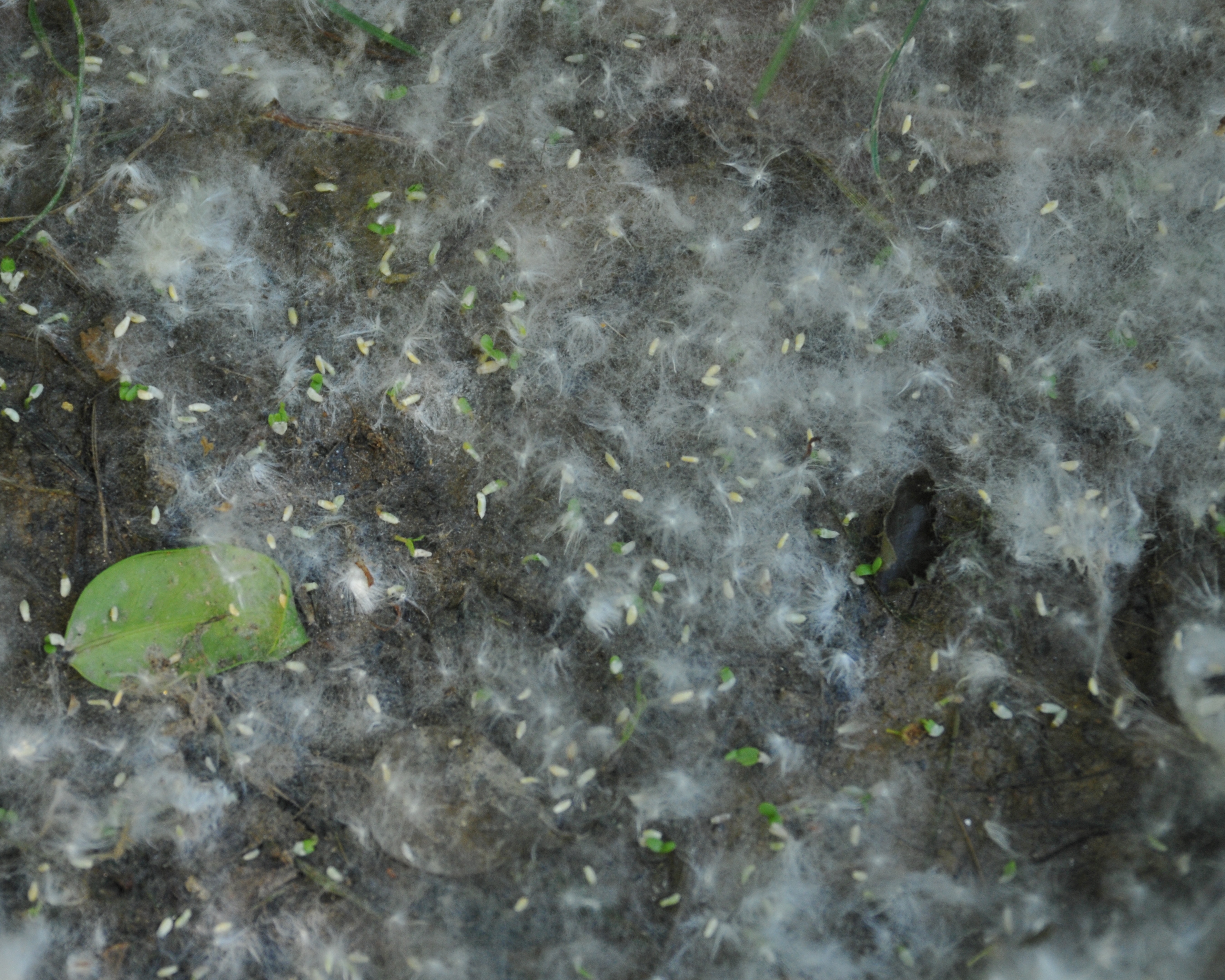
         But the great tree of my childhood was a giant cottonwood that towered in a neighbor's yard just across an alley from our own back yard, a tree so huge that it robbed our neighbor of sunlight, but so costly to remove that he simply had a few branches severed and left the rest.  In June it gave its cottony seeds to the breeze, and everyone's lawn was whitened for many days, and I went about sneezing, since I was allergic to the stuff.  My older brother took delight in setting fire to those seeds, ostensibly to spare his kid brother some sneezes, but really just to create a little havoc.  Fortunately, he never set the neighborhood on fire.  In summer I would lie on a flat roof next to our sleeping porch, hoping for a tan while watching a breeze ripple through that vibrant mass of silver-flecked green: a pulsing continent of life.


File:Myrtales - Eucalyptus dalrympleana 5.jpg
Eucalyptus leaves and fruit.  I loved to crush the
leaves and breathe in the intoxicating scent.
Emöke Dénes
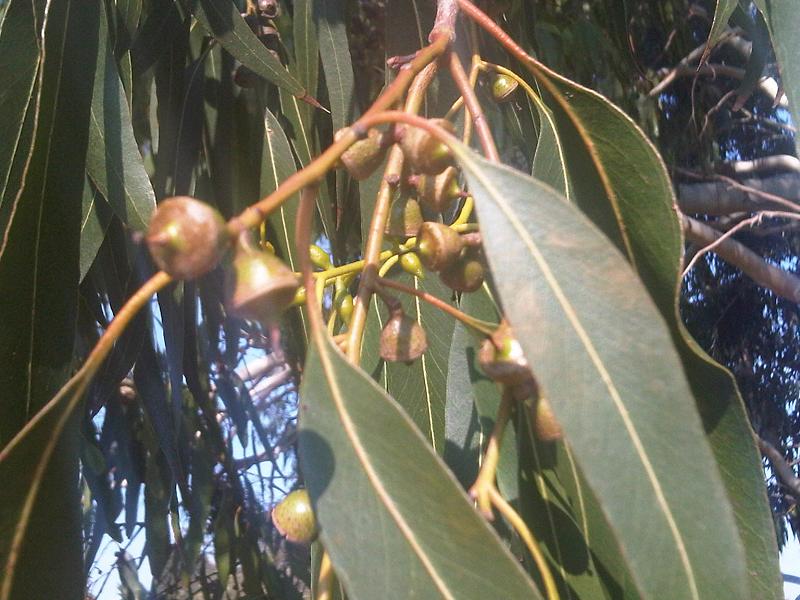
     Yes, this blog is supposed to be about New York, and I'll get there soon enough, but allow me one more digression, a side trip to Southern California, where I went to college.  There, one Easter vacation when everyone else flocked to the beaches for sun by day and erotic and boozy revels by night, I myself, stuck carless in tranquil Claremont, trekked its tidy streets studying the trees of that strange clime, most of them imports from distant places.  There were palm trees both native and from the Canary Islands, acacias from Asia, eucalyptus from Australia, and the Mexican pepper tree.  One huge pepper tree loomed in an undeveloped lot that I often crossed on my way to classes, breathing in a subtle aroma of pepper.  But the most memorable fragrance came from the crushed leaves of the eucalyptus, the headiest, most intoxicating scent that I have ever experienced from a tree.  As for majesty and sublimity, I encountered them later when I went to Muir Woods, an old-growth redwood forest near San Francisco, and had my first glimpse of redwoods, some of them 1200 years old, towering giants that made us humans seem like puny little creatures indeed.


File:Redwood trees in Muir Woods National Monument, just outside San Francisco, California.jpg
Redwoods in Muir Woods.

     So at last we come to New York.  Within two blocks of my apartment there are magnolias, cherry trees, gingkos, redbuds, and a mystery tree I was for years unable to identify.  The mystery tree is 30 to 60 feet high with white flowers of the rose family (5 petals and a cluster of protruding stamens); it's all over on the streets, blooming every April.  None of my friends could identify it, but my online query to the Parks Department finally received a response.  It is the callery pear, a name I had never heard of before, and the second most common tree on the city's streets.  (And the most common one?  They didn't tell me.  My candidates: gingko biloba, Norway maple, American basswood.)

File:Callery pear pyrus calleryana tree blossoms.jpg
My mystery tree in bloom.


File:Gingko biloba leaves.jpg
The fan-shaped leaves of the gingko.
     The gingko biloba is a strange thing with fan-shaped leaves often divided into two lobes.  A native of China, it has no close living relatives but resembles fossils from 270 million years ago.  A common cultivated tree here and elsewhere in North America, it was long thought to be extinct in the wild, but now may still grow in two small areas in eastern China.  A rarity, then, but here it is on West 11th Street, turning yellow every fall and bearing soft fruitlike yellow-brown seeds that smell like rancid butter or vomit, as I discovered one autumn when, an amateur forager (see post #23, September 2012), I investigated it.  Suburbanites complain of the smell and mess of the fallen fruit, which can render sidewalks slippery as well as stinky.  Yet at the North End of Central Park I have seen Chinese women busily gathering the fallen fruit, which is believed to have both culinary and medicinal values, and value also -- though I haven't checked it out -- as an aphrodisiac.  In any case, the smell put me off, so I gave up on foraging it.  Yes, I know it's prized by herbalists and used by Western medicine to enhance memory and treat dementia, and for other stuff as well, but my God, that smell of vomit!  But it's a tough baby, so tough that six gingko trees survived the atom bomb in Hiroshima charred but intact, and in time became healthy again.  One of the strangest trees I've ever known, growing almost on my doorstep.  It will probably survive us all.

File:Ginkgo biloba (Schönbrunn) natural monument 20081122 101 Fruit.jpg
The fruit of the gingko, beneficial but smelly.
W


File:Cercis canadensis redbud tree bloom.jpg
A redbud in full glory.
Dcrjsr
     Less mysterious and exotic is the redbud, a small tree of the pea family that bears pink flowers in the spring before the leaves appear.  My mother once came back from a spring visit to rural Brown County, Indiana, raving about the beauty of the flowering dogwoods and redbuds in the woods.  Dogwoods I have seen in every forest I have visited in the spring, but redbuds never.  So redbuds became an elusive but sought-after prey, once prompting a special expedition to Inwood Hill Park that proved fruitless.  Then, a year ago, I found one, labeled and blooming, in the little park just across the street, and this year I have seen them in that park and elsewhere in the neighborhood.  A lovely little tree bearing pea family flowers clustered on its branches, well worth my quest through the years.

     There is no way I can mention all the trees in city parks that I relate to, so I'll just mention a few.  In my post on foraging (#23 again) I told how I have harvested wild apples in Van Cortland and Pelham Bay Parks and the Staten Island Greenbelt.  If I finally gave that up it was because the yellow apples were small and afflicted with dark spots that had to be cut out, leaving not much apple, while at the same time the greenmarkets were full of large, ripe, often flawless apples with a superb taste that you get only from freshly picked apples for a month or two in the fall.

File:Black walnut tree 1.jpg
No, these aren't apples, but black walnuts still on the tree.
Sue Sweeney
File:Dried Juglans nigra fruit J1.JPG
The dried nut.
Jamain
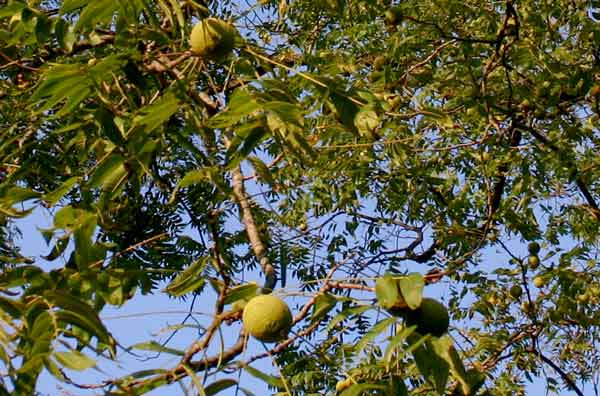
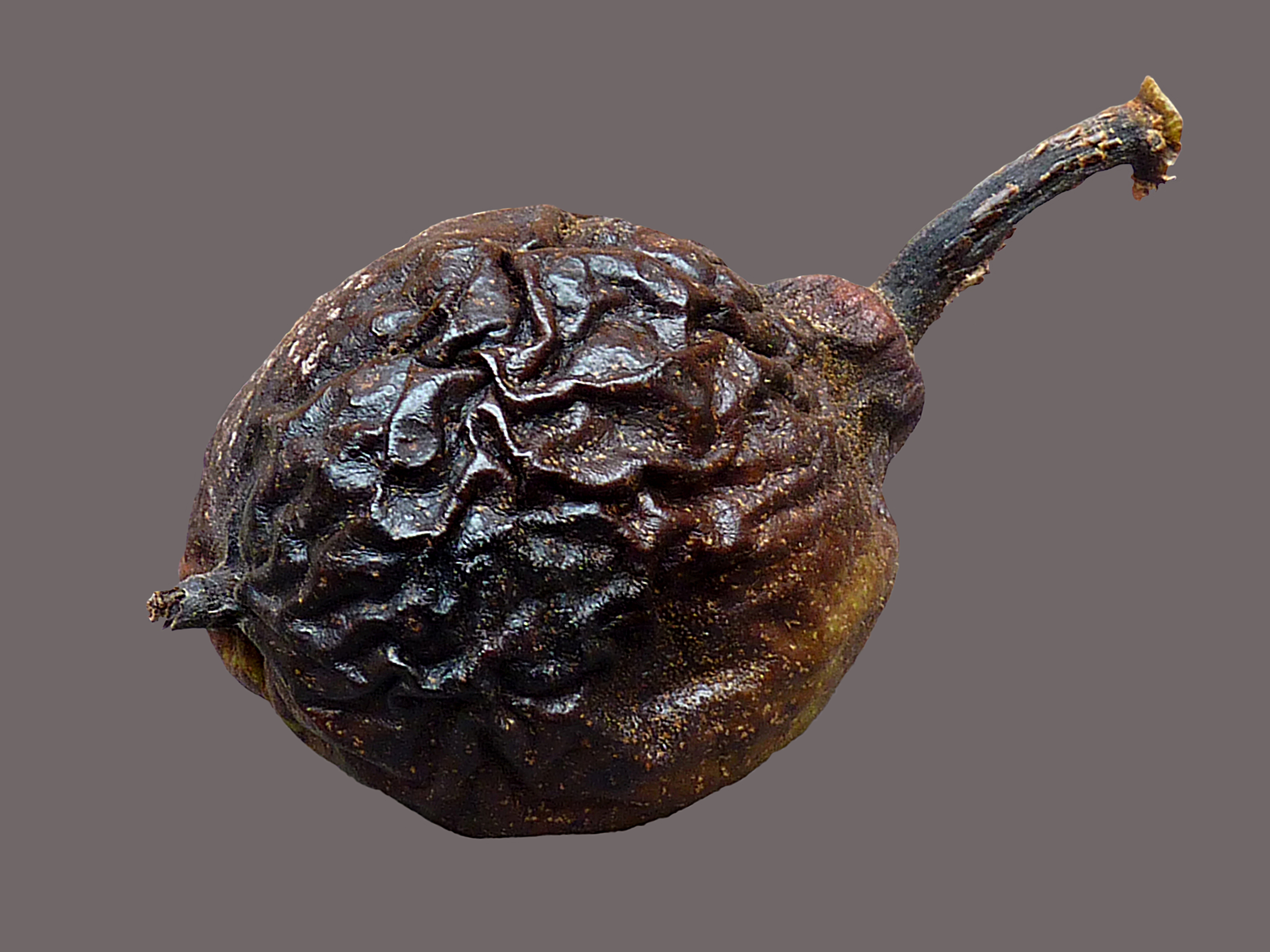
     Another attempt at foraging likewise proved a fiasco.  Black walnuts grow wild in the city parks, and I had heard that they, like their cousin the English walnut, are edible, which sounded good to me.  The nut is contained within a green, fleshy husk, rather like a shrunken tennis ball, that falls to the ground in autumn, so you might think harvesting the nuts is easy.  Well it ain't.  First of all, the husk clings to the nut, so to remove it you're advised to stamp on the fruit with old shoes to get the husk off.  What you then have is a corrugated brown nut that stains your fingers if you touch it, so rubber gloves are advised.  (If you get the stain on your fingers, don't worry, it will come off -- in a few days.)  So now you have to let the nuts dry on newspapers for a week, so as to eliminate the stain.  Even then you don't have the edible kernel, which is locked inside the nut.  But you can get at the kernel; all you need is a heavy-duty nutcracker, a vise, a heavy hammer, or a large rock.  (At this point I'm tempted to say a boulder.)  So finally you crack the nut open and there, inside, is the long-sought meat, which you remove with a pick.  I'd been told that black walnut has a strong, rich, smoky flavor with a hint of wine, and that it can be used in any recipe that calls for nuts, but it must be used sparingly, or it will overpower the other ingredients.  After all this to-do -- the gathering, the stamping, the stain, and then the long week of drying, climaxed by the bashing and cracking -- I expected something wondrous, a taste that would vault me to pinnacles of bliss.  No go: the taste impressed me as unimpressive and certainly not worth all that effort.  Since then I've been quite content to consume the commercial English walnuts readily available in stores and requiring no such lengthy preparation.  But good luck, if you want to try.

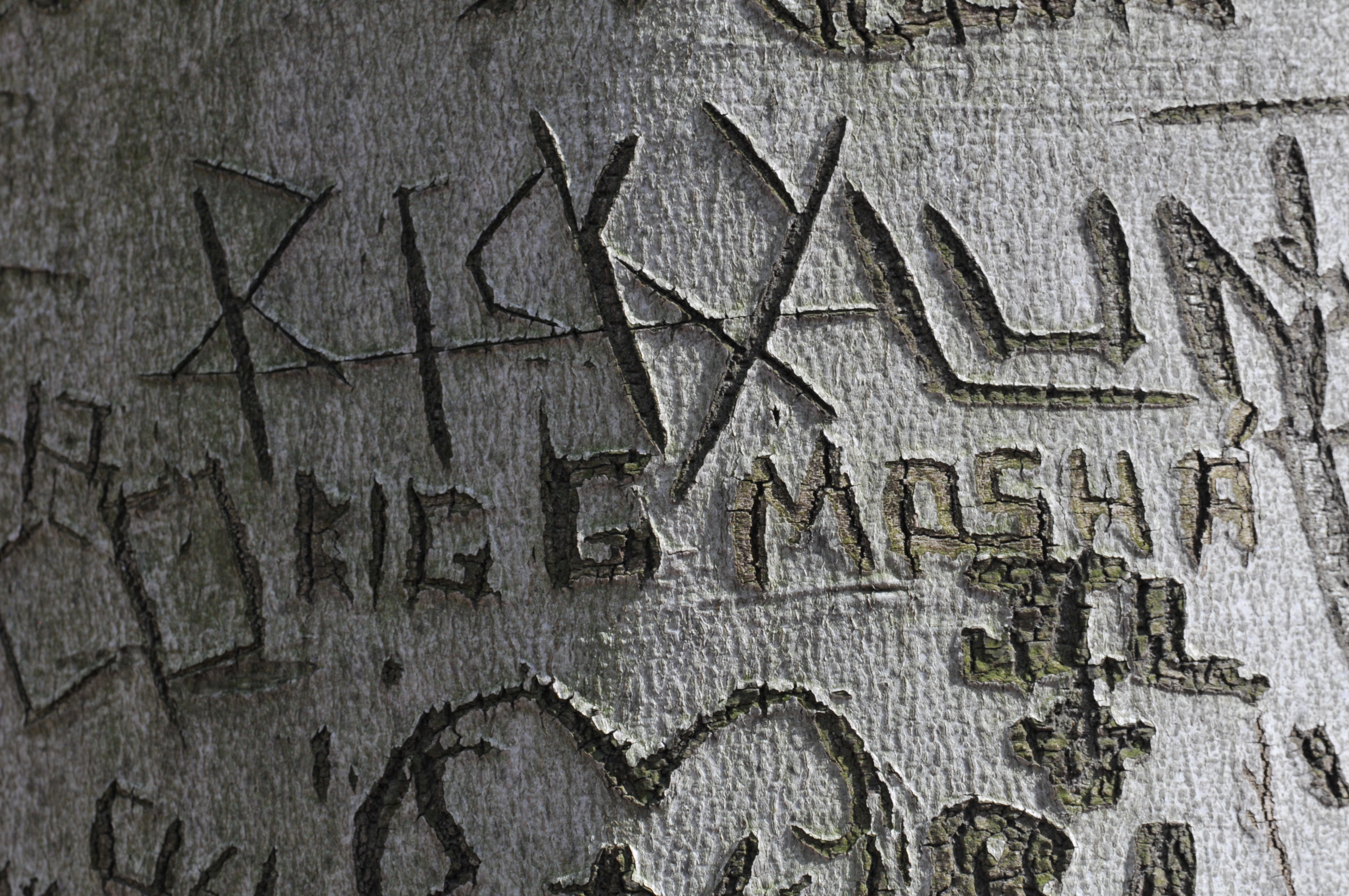
     Most mature trees have dark, ridged bark that doesn't help laymen much in identifying the tree, but three exceptions come to mind: the mottled bark of the sycamore, the papery bark of the paper birch, and the smooth bark of the beech -- all three of them to be found in city parks.  My favorite sycamore is a huge tree in Van Cortlandt Park, its trunk some four or five feet in diameter, with the typical sycamore bark showing green, gray, brown, and white patches that resemble U.S. Army camouflage, the kind you see very unmilitary-looking young men wearing on city streets.  A giant of giants, yet few park visitors stop to admire it.  (Fewer still notice the stand of poison hemlock growing nearby -- the stuff that did Socrates in -- but that's another story.)  The bark of the paper birch peels off in horizontal stripes, leaving black marks on the trunk.  As its other name "canoe birch" implies, the Native Americans of the Northeast used it to make canoes.  And the smooth gray bark of the beech invites graffiti, often the initials of lovers cut into it -- avowals that may be embarrassing in a year or two, since fervor fades, whereas beech bark endures.

File:American sycamore bark.jpg
Sycamore bark.
Jim Thomas


File:Curling bark of a paper birch.jpg
Paper birch bark.
Sue Sweeney


File:Scarred American Beech Bark.JPG
Beech bark with graffiti.
HorsePunchKid


     I won't go into the colors of foliage in autumn, since it's not the season.  Instead, I'll mention what about trees grabs me most in any season: their architecture.  Their roots plunge deep in the soil, their trunks rise nobly, and their twigs reach for the sky.  This is seen best in those that tower, when they stand singly and assume their full proportions: beech, cottonwood, sycamore, and above all oak.

File:Oak Tree - geograph.org.uk - 1360647.jpg
David Lally

     Trees figure prominently in myth and legend, where the roots are identified with the underworld, the trunk with the middle world or earth, and the soaring branches with the upper world or heaven.  Connecting all aspects of creation, they become the World Tree or Cosmic Tree, whose fruit has healing powers or confers immortality.  In my post on gardens (#57, April 2013) I mentioned the Tree of Life in Eden and the tree bearing golden apples in the Garden of the Hesperides.  Both conferred immortality, both were forbidden to mortals; to prevent Adam and Eve from eating of the fruit and becoming immortal, Yahweh drove them from Eden and placed cherubim with a flaming sword to guard the Tree of Life.  So obviously, those trees have got a lot going for them.

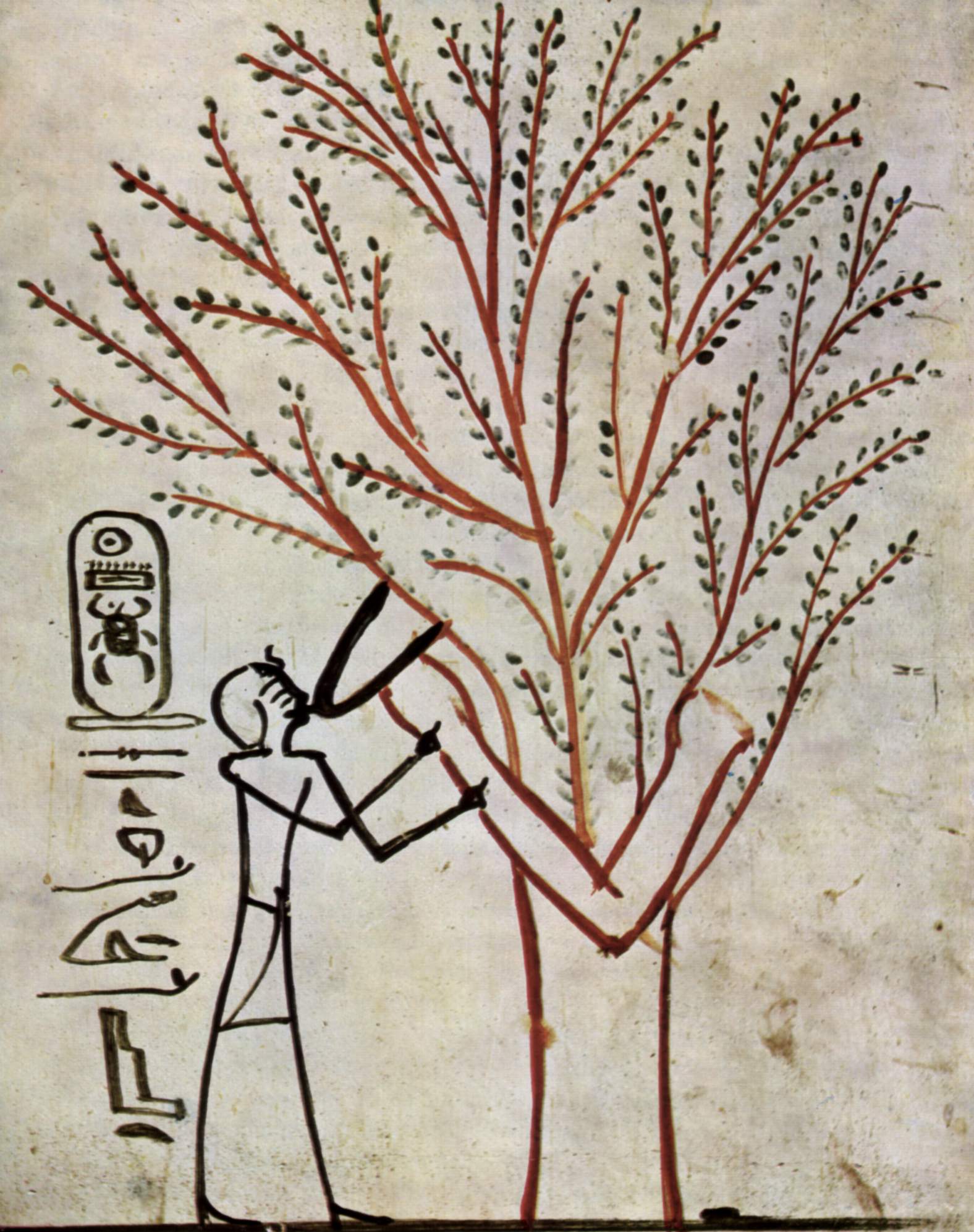
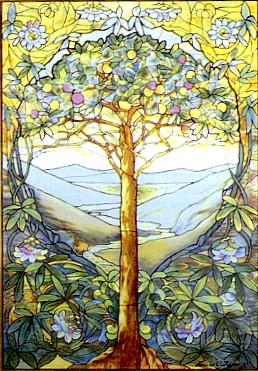
     The Tree of Life appears in the myths and religions of ancient Persia and Egypt, Assyria, China, the Baha'i faith, the Kabbalah, Mesoamerica, and elsewhere, and has inspired many artists.  In Egypt it was sometimes portrayed as a nurturing mother, another manifestation of the Goddess (aka Big Mama) discussed in another post (#59, May 2013).  Christianity has identified it with the Cross; the tree of death of the Crucifixion becomes the tree of life of the Resurrection.  It also appears in a vision in the Book of Mormon, where a path leads to a tree symbolizing salvation.

File:Tree of Life Lehi from Book of Mormon.jpg
The Tree of Life from the Book of Mormon.
File:Christinae kyrka tree of life01.jpg
A modern Tree of Life in a Swedish church.
Hakan Svensson

File:Maler der Grabkammer des Thutmosis III. 001.jpg
From the tomb of Thutmose III (1500-1450 BCE).
The Pharaoh is fed from the holy tree.
  

File:Tifftree.JPG
The Tree of Life: stained glass by Tiffany.

     In Norse mythology the world tree Yygdrasil is a holy tree where the gods assemble daily to
hold court.  Various creatures reside in it, including an eagle, a squirrel, and four stags.  The three Norns, who rule the destiny of gods and men, bring water from a holy well and pour it over the tree, so its branches won't rot away or decay.


File:AM 738 4to Yggdrasill.png
Yygdrasil and the creatures that inhabit it.
From a 17th-century Icelandic manuscript.


     By now, I hope that the magnificence of trees is apparent, and you can understand why, in passing a park, I always stop to admire the grand, leafy fullness of trees.  But why do I also mention their insolence?  Here we go into fantasy.  In a poem I have imagined a dialog between the trees and myself.  In it the trees put me down as a fruitless, rootless creature who dithers about, lacking their calm, earthed fixity.  When I protest that my daily motions and varied feelings are meaningful, they laugh contemptuously and dismiss every other claim of mine to a significant existence.  Finally, when I mention my vitamin-rich, fiber-crammed diet, pesticide-free and locally grown, they answer scornfully, "Runt, what do you eat?  We eat the sun!"  Finding no answer to this, I retreat to a more comforting communion with weedy fields and tufts of small grasses, which, despite my memories of towering sun-flecked continents of green, are reassuringly squat and sensible.  So trees in their magnificence can be seen as dwarfing us and reminding us of our puny dimensions, our insignificance.  Not a bad note to end on, but for a final touch I'll quote the ending of a poem by Joyce Kilmer (not my favorite poet, but relevant here):

          Poems are made by fools like me,
          But only God can make a tree.

To which I'll simply add: Yes, but with the help of Big Mama, who sticks her nose (and other apparatus) in everywhere.  (Again, see post #59, May 2013: Earth Goddesses: Big Mama.)

     Note:  One year ago, on July 11, 2012, this blog began.  The first post: 16. My Love/Hate Affair with WBAI.  That affair continues to this day.  Prior to that I was sending e-mails to friends; those e-mails appear as 15 vignettes in this blog.

     Coming soon:  Next Sunday, Liars, Cheats, and Manipulators.  Also, fittingly, a note on two New York politicians disgraced and ousted from office by sex scandals but now rising like the phoenix from its ashes to run for office again: Eliot Spitzer and Anthony Weiner.  Their resurgence confirms yet again the name of this blog: No Place for Normal: New York.

(c)  2013  Clifford Browder