Sunday, October 14, 2012

29. The Bejeweled Elephant and the Balding Runt, part 1


File:New York Halls of Justice.jpg
The Tombs, circa 1870
Imagine a courtroom in the Halls of Justice, known otherwise as the Tombs, in 
New York City in the 1870s.  You are a member of the jury in a criminal trial – 
say, a grisly murder trial involving dismemberment of the body.  You sit with the other jurors – a carpenter, a sexton, a retired steamboat captain, an elastic suspenders manufacturer, and others – as the defense attorney makes his final plea.  Mounting from a massive frame, his voice ranges from bass to falsetto, from pianissimo to forte, conveying doubt, shock, indignation, and rage, then the gentlest, most infinite compassion, while his hands flutter birdlike or stab and spiral in the air.  He paces, then at intervals stops abruptly and eyes the jurors one by one.  Shakespeare and Milton adorn his cadences along with psalms and proverbs, and the most hallowed words of the Gospel. 

         Then, suddenly, he gestures toward his client, reminding you that a palpitant and noble human life is at stake.  Think twice, thrice, a thousand times before you doom the defendant to the noose.  He, William Howe, has witnessed hangings but a few short steps from here, in the courtyard of the Tombs.  He gestures grandly, as if to sketch up a towering scaffold.  “I know the awful suspense beforehand, the crash of the trap, the hurtling body” (his arm shoots downward), “the quick, neat snap of the spine” (his hand cuts sideways), “the twitching, dangling corpse” (his hand jerks, goes limp).  “It is terrible.  Only felons steeped in violence and gore should suffer it, certainly not my client.”

         For two weeks you and the other jurors have witnessed the bravura performance – or should one say antics? -- of this amazing man, his massive frame sporting a wardrobe of infinite variety, changed daily or even twice a day: check trousers, velvet and doeskin waistcoats, blue-violet and crimson shirts, a coat of royal purple, and at first, clusters of diamonds.  Garish, perhaps, and in the very worst possible taste, but somehow he brings it all off, as if to say, “I’m outrageous, grandiose, compelling, the most vivid thing you’ll ever experience – superbly and marvelously me!”  Unlike the prosecutor in sedate drab gray.

         But his diamonds – what happened to his diamonds?  The lawyer’s fingers, cuffs, and vast expanse of shirtfront are lusterless, yet two weeks before, when he picked the jurors and pronounced his opening address, he twinkled with diamonded buttons and studs, sparkling fobs on his watch chain, gleaming rings, and instead of a cravat, a cloverleaf of pearls framing a dewdrop that positively glittered.  He had blazed success, but as the trial progressed, one by one the diamonds vanished.  Now, as he addresses you for the very last time, he stands before you in a dark gray suit absolutely barren of dazzle.  Yet as always, his words have force.  Is this a charlatan, an artist, or what?

         The lawyer pauses a moment, strokes the waxed tips of his handlebar mustache, then directs your attention to the defendant, a burly young man, black-haired, tense, fisted, whose eyes, unblinking, glare from an inner intensity.

         “Look at this young man, this sensitive, suffering soul, detained even now 
in durance vile – how unjustly! – for a murder he knows nothing about.  Is this a murderer?  A man who, with his alleged paramour, could shoot, stab, strangle her husband, then dismember the body and send the body parts by express in various directions?  No, I tell you, no!

         The sonorous voice has trumpeted truth to the rafters.  Then, portentously, having mopped his brow with a violet handkerchief that he flourishes like a banner, he hunches his great girth forward; you and the other jurors do the same, eager to capture whatever revelation is about to be delivered.  The lawyer’s voice is restrained and confidential.

         “This young man has friends; they have testified to his worth and honesty.  Scores of them sit now in this very courtroom, following these proceedings with care.”

         Another sweeping gesture guides your eyes toward the benches jammed with onlookers, where here and there stalwart specimens of manhood daub their teary eyes.  The judge looks on stone-faced; the prosecutor glares his scorn.

         “And his family … ”  The lawyer’s voice turns poignantly soft.  “What shall I say of his family?  An aged mother, fearful of losing her only son, her joy and sole support, who even now chokes back the scream of grief … ”

         On the front bench, tears well slowly and course the withered cheeks of a snowy-haired old lady, head bowed in stoic silence.

         “And his wife – his loving wife and child … Would you widow her and orphan their infant … ?”

         Beside the old woman you sits a young blond woman, hauntingly beautiful, who casts tender looks at the prisoner, a baby in her arms.  At intervals, a soft squeal is hushed with cooing.  Every eye in the courtroom is on her, often as not glistening with tears.  Throughout the courtroom not a whisper, not a cough can be heard.

         As the lawyer expands movingly on the motif of the family, your eyes stray to that pale young exquisite face, cradling a babe in her arms.  And then, great heaven! are your eyes deceiving you?  Right here in the courtroom, while gazing at the accused with tenderness, she is baring her bosom to perform the most maternal of functions!  You are shocked … touched …

         A gavel bangs, the judge’s voice booms:  “Mr. Howe, you have violated this court’s decorum and imposed upon the jury.  That young woman and her infant will be escorted out!”

         Murmurs from the spectators.  As bluecoats loom around her, the young woman rises with dignity, shoots a last poignant glance at the prisoner, and then, still clutching her child, is led away.  The defendant glares, the old woman sobs, several jurors gasp or weep openly, your own sight goes blurry, the lawyer blubbers till his handlebars are soggy, the exiting young mother tears nobly, and the baby wails.


         Such were the courtroom antics of William Howe, rendered fictionally here,
but with close attention to historical fact.  After such a performance, no matter what the evidence, and even with the prosecutor’s summation yet to come, could there be any doubt as to the jury’s verdict?  When Howe defended, nine times in ten it was innocent.

         In the 1870s, 1880s, and 1890s Howe and Hummel were the most celebrated – not to say notorious – defense attorneys of New York and probably the nation.  With their names blazed in huge block letters, their offices occupied the ground floor at 89 Centre Street in convenient proximity to the Tombs, that squat, massive prison in whose somber cells so many of their clients resided before, if not after, the verdict.  The two partners presiding there could not have been more different:  William Howe the flamboyant courtroom orator, lion-headed with wavy gray hair, deep-chested, massive, his colorful attire adorned with multiple diamonds, and Abraham Hummel the crafty back-office master of chicanery, with a large pear-shaped head, bald, atop a meager body characteristically clothed in black.  Howe was expansive, flamboyant, outward-going; Hummel was shrunken, contained, secretive: the bejeweled elephant and the balding runt. 

         In their flourishing practice Howe and Hummel drew on a vast array of resources; courted publicity; never took checks (having defended numerous forgers), insisting always on cash in advance; kept their office open twenty-four hours a day, with a skeleton crew on duty at night; and kept no account books so as to have no revealing records that might be subpoenaed.  Their office was a magnet for accused brothel owners, fences, pickpockets, bookmakers, counterfeiters, safecrackers, arsonists, and suspected murderers.  During a purity crusade in 1884 (yes, they did happen – rarely – even in New York), all 74 madams rounded up named Howe & Hummel as their counsel.  Also visiting the premises were prisoners who, having just escaped from the Tombs, stopped off there to shed their prison togs for less suspect attire, of which an ample supply was always on hand.

         Greatly helping the firm in its endeavors was an army of hired agents: informants collecting backstage gossip as material for breach-of-promise suits; process servers disguised as Western Union messengers, scrubwomen, and milkmen; and a host of professional witnesses always on call, ready to appear as sweet-faced ancient mothers, adoring wives, and doting children to be planted in the first row of spectators, or loyal friends to be sprinkled throughout the courtroom, ever ready with smiles or tears as needed.  Howe himself had the gift of copious tears and used it generously, though some suspected that he got an assist from an onion-scented handkerchief.  But not all his performances succeeded; on occasion he attended hangings in the Tombs courtyard garbed in funereal black. 

         But Howe’s courtroom performances were remarkable, winning a large number of the 600 murder trials he participated in over a long career.  On one occasion he dropped ponderously to his knees before the jury box and thus delivered a two-hour summation, after which he must have needed considerable help to get his 250 pounds back on his feet. 

         Howe’s most celebrated case involved a young woman who had shot and killed her sweetheart; in the course of a heated argument her trigger finger, he insisted, had accidentally slipped not once but four times.  Sensing that the jury 
was  less than convinced, he stretched his summation far into the night (yes, there were evening sessions in those days), until the courtroom atmosphere turned 
dark and eerie, and everyone was tired and restless.  Suddenly, at the end of his summation, he approached the defendant from behind, encircled her with his arms, seized her wrists and ground his fingernails deep into them, eliciting from her a scream such as no courtroom had ever heard.  That done, he instantly ended his summation.  The prosecutor was so shaken that he could barely marshal his thoughts, and the unnerved jury shuffled from the courtroom to return minutes later with an acquittal.  Why the defendant’s agonized scream should prove her innocence remains a mystery, but Howe’s perception of a jury’s moods, and his ability to manipulate them, have perhaps never been equaled. 

         So much for William Howe.  Next time we will have a closer look at his partner Abe Hummel, who put his deft, bony hand to such matters as divorce (then scandalous) and the profitable form of blackmail known as breach-of-promise suits.  A picturesque twosome, to say the least.

Thought for the day:  Poverty hardens and embitters.  Material wealth makes the nation sweeter, more Christlike.  (Bishop William Lawrence of the Episcopal Church.)

Note to the preceding:  The previous thoughts have been mine, often plucked from my poesy, though sometimes with a vague source unnamed because unremembered.  For this one, so richly significant, I am happily able to name a specific source. (Bishop Lawrence, incidentally, was a personal friend of J.P. Morgan.)  Should these thoughts be taken seriously?  I myself don't know.  We are all of us, at times, holy fools, and at other times just fools.  I am no exception.

                                             © 2012  Clifford Browder


Sunday, October 7, 2012

28. Slime Molds, Stinkhorns, and Other Friends of Mine


When I hike outdoors I have lots of friends – wildflowers, birds, trees, moths, and butterflies, and assorted beetles and other bugs – but slime molds and other fungi have a special place in my heart.  These organisms are part of the vast world of nonflowering plants – plants that don’t bear flowers or produce seeds – a world that includes fungi, mosses, ferns, lichens, and algae.  But my special affection goes out to various fungi and I shall talk about them here. 

“Slime molds” – with a name like that you sure could use a friend.  But I won’t start with them, I’ll save them till last.  So where should I begin?  How about a mushroom whose name can also put you off -- elegant stinkhorn?  Of course it has a scientific name, Mutinus elegans, but there’s something so deliciously improbable, so oxymoronic (or just moronic?) about “elegant stinkhorn,” I wouldn’t dream of calling it anything else. 

File:Elegant stinkhorn - Washingon DC - 2011.jpg
                                                                Tim 1965
So here we go.  Imagine a pink tapered finger of a thing, four to seven inches long and open at the top, poking up out of leaf litter or wood debris in woods and cultivated fields, its top third or so covered by a greenish slime that stinks, and you’ve got the essence of elegant stinkhorn.  The stinkhorn part of the name is clear enough, but what, you may ask, is elegant about it?  Darned if I know; you’ll have to ask the guy who named it, if he’s still around.  I’ve seen (and smelled) it mostly on a certain woodland path on Monhegan Island in Maine, but since it’s often found in parks and gardens in urban areas, I’m sure it’s lurking somewhere hereabouts; you have only to go looking and sniffing for it.  And that stinky green slime has a purpose, being a mass of spores that attracts insects (in nature there’s no accounting for taste) and then sticks to them, so that when they fly off, they spread the spores far and wide, thus guaranteeing the stinkhorn a rich progeny.  And if the thing strikes you as looking slightly wanton, all I can say is, that’s nothing compared to another stinkhorn that goes by the name of Phallus impudicus, which I shan’t presume to translate.  (Nature’s morals leave a lot to be desired.)

           Next, how about the puffballs?  (Please, no jokes.)  These little guys can show up from summer to late fall (assuming a fair amount of rain, to be sure) on lawns and in parks and open woods, and even in deserts and mountains.  Spherical and usually stalkless, they are sometimes the size of golf balls, though I’ve seen them even smaller, and in the case of giant puffball (Calvatia gigantea), which I’ve never seen but want to, as big as a soccer ball.  Why the “puff” in “puffball”?  Because, if you touch them when they’re mature, the spore mass escapes in a smokelike puff through a tiny hole in the top of the sphere.   Most puffballs are considered choice edibles when young, but I’ve never indulged, since my appetite for fungi is strictly visual; not having had a course in mycology, I might make a mistake, and such mistakes (as I’ll soon show) can be fatal.  I look, but I don’t taste or devour, though those who do say that mushrooms and other edible fungi are a rare delight.


File:Lycoperdon pyriforme, Stump Puffball, UK.jpg
                                                                    Stu Phillips

         There are many kinds of puffballs, but the one I’ve seen most frequently, in dense clusters on wood, decaying logs, and debris, is pear-shaped puffball (Lycoperdon pyriforme), often only an inch in diameter, pear-shaped and smooth, 
and yellow-brown to gray in color.  Widespread  throughout, it strikes me as the commoner of the tribe.  


                                                                    Jason Hollinger


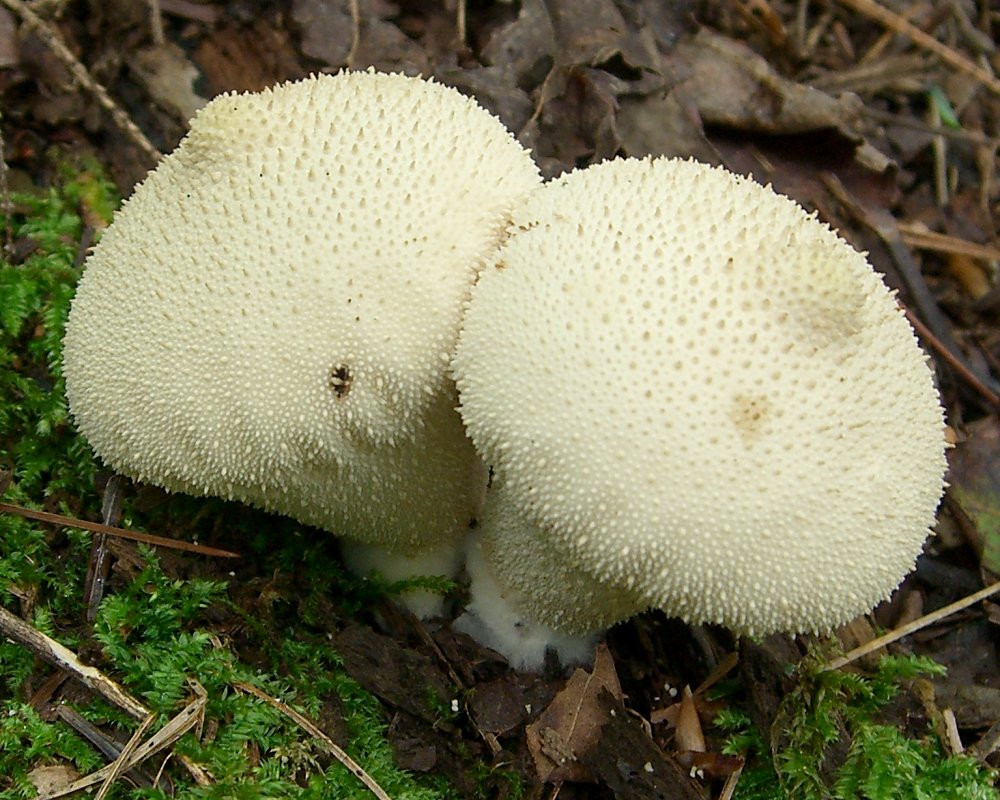
Another one, and to my mind more elegant, is gem-studded puffball (Lycoperdon perlatum), a slightly larger round to turban-shaped white mushroom with tiny conical spines that account for the “gem-studded” part of the name, though to my eye they look more like tiny warts.  Still, if pear-shaped puffball is a commoner, gem-studded puffball comes off as a prince.  


                                                                      Stan Campbell

          Finally, akin to puffballs, and sometimes classified with them, are the earthstars, puffball-like spheres atop a bunch of starlike rays, found in open woods.  Alas, I have never seen one, know them only from pictures in books. 

Perhaps the most prized edible wild mushroom in the world, chanterelle (Cantharellus cibarius) is a beautiful vaselike mushroom, bright yellow or orange, with ridges descending its stalk and a fragrance like apricots; I have often seen it around New York growing alone (it likes its space), though often with some cousins nearby, on the ground under oaks and conifers.  That something so bright and graceful should exist in the same world as slime molds and stinkhorns amazes me, but such is the crazy diversity of the universe of fungi.  Though I’ve never tried it, 

File:Chanterelle.jpg
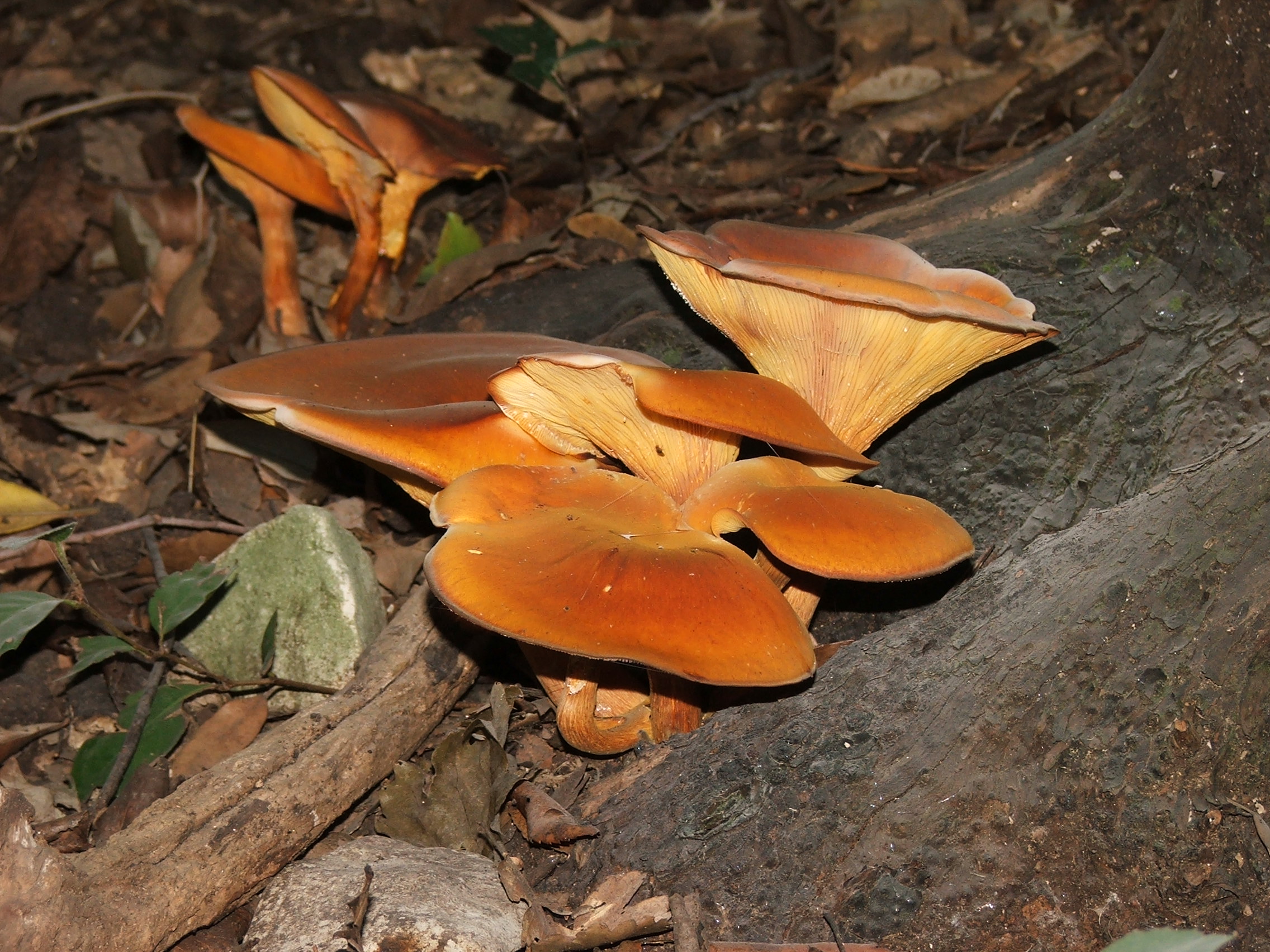
Chanterelle or Jack O'Lantern?  Can you tell the difference?
Jack O'Lantern.  The one above is chanterelle.
I’m sure it is delicious as a food, unless of course you’ve picked by mistake its orange-to-yellow look-alike, Jack O’Lantern (Omphalotus olearius), in which case you’ll be sick to your stomach for up to two days.  One more reason why I look at mushrooms but don’t pick them to eat.  As for Jack O’Lantern, it’s a groupie that grows in clusters on stumps and buried roots, and lacks the apricot-like fragrance of chanterelle.  For the name there are two explanations: its orange color suggests pumpkins; when picked fresh and placed in a dark room, its gills give off an eerie green glow.  I found it once in Pelham Bay Park and brought it back to test its bioluminescence (yes, that’s the word for it), but got nothing; maybe it wasn’t fresh enough for the gills to glow.


File:Schopftintling-Coprinus-comatus.jpg
Shaggy manes, in various stages of deliquescence
                                                                                 H. Krisp
For masochism it would be hard to surpass the inky caps, mushrooms whose gills liquefy on maturing, dissolving the cap into an inky black fluid-- a kind of fungal hari-kari unique in the universe of fungi.  I have seen one species, shaggy mane (Coprinus comatus), under oaks in Van Cortland Park, sometimes cylindrical, shaggy, and white; sometimes with the cap expanding and not at all shaggy, as the gills turn black from the edge of the cap inward; and finally, after liquefying, as a capless bare stalk that gives no hint of its prior shape and color.  It has a habit of turning up in numbers on lawns and in gardens, and can even push up through asphalt.  If picked when young, before liquefying, it is a highly prized edible used in stews and soups.  Its juice was once used as an ink for writing.

         Now we come to the dark tribe of mushrooms, the Amanitas, meriting the name not because they are dark in color – far from it – but because they harbor deadly poisons.  When I first encountered them on Monhegan Island, a friend told me how to tell them from seeming look-alikes --  useful advice, since in a rainy autumn they pop up all over the headlands and in the spruce woods of the island.  Amanitas are characterized by a universal veil that encloses the young mushroom when it first appears, but then breaks, leaving traces on the cap and base; a partial veil that shields the gills on the undersurface of the cap, which also breaks, leaving a ring or annulus on the stem; and a swollen base. 

         Armed with this knowledge, we shouldn’t have trouble recognizing these sinister characters, should we?  Ah, but what if rain washes away the ring, and the telltale patches on the cap and base?  Then the mushrooms are easily confused with other quite harmless species.  Ninety percent of fatal mushroom poisonings can be attributed to these guys, so picker, beware!  One way to identify them is to make a spore print, placing the severed cap on a sheet of paper with the undersurface facing down.  The spore print of Amanitas is white, the color of purity and innocence (no comment).  That and a few other technical details should settle the matter, at least 
for experts.  One local expert you can trust is Steve Brill, the go-to guy for foraging, mentioned in post #23 (go to www.wildmanstevebrill.com).


1. Puffball or Amanita?  Take a guess.
                                                                      Wang-Chi Poon
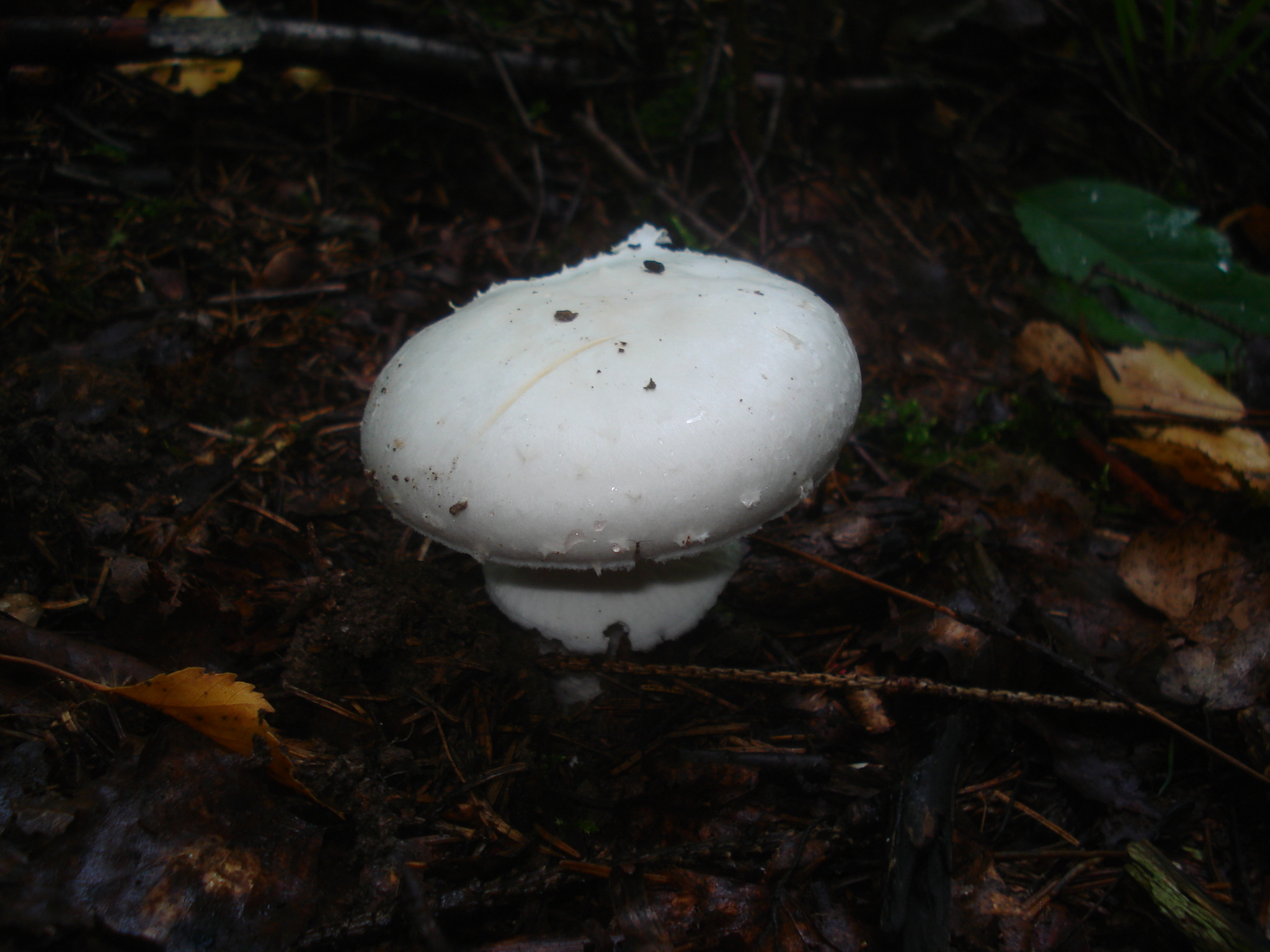
       A further complication: when Amanitas first appear, egglike in their universal veil, they resemble puffballs, those fetching little edibles mentioned earlier.  If, when gathering puffballs, you accidentally toss in an Amanita or two, your next meal may be your last.  Yet another reason for amateurs to leave well enough alone.
2. Again, puffball or Amanita?  Answer at the end of the post.
                                                                             Sanja 565658

                                                   Jason Hollinger
       I have encountered many Amanitas.  Yellow patches (Amanita  flavoconia) is a common small species with bright yellow patches on an orangeish cap; I’ve seen it both on Monhegan and in parks down here.  Fly agaric (Amanita muscaria) often appears on and near the headlands of Monhegan, its blood-red cap six inches or more in diameter and covered with pyramidal white patches – the showiest Amanita, in my experience, and easily recognized.  In an open area near the shore on Monhegan I once saw no less than twenty-five, though such conglomerations are rare.  The  name comes from the mushroom’s use in former times as a preparation to ward off flies.  (Maybe we should give it a try today.)


File:Amanita muscaria fungi in the Frame Heath Inclosure, New Forest - geograph.org.uk - 261251.jpg
                                                    Jim Champion
         My favorite Amanita is Destroying Angel (Amanita virosa), one of the deadliest of the tribe, which I’ve seen many times in the spruce woods of Monhegan, though rarely down here. “Destroying” is obvious, you may say, but why “angel”?  To understand that, you need to see it as 
I have, shining  white against a dark backdrop of spruce tree trunks, usually alone, offering  the typical mushroom form in classic simplicity.  For sheer beauty I rank it with chanterelle.  A sinister beauty, to be sure, and cunning, for its symptoms of poisoning – severe vomiting, diarrhea, and cramps -- are followed after a day or so by a remission that reassures the victim and gives hope of recovery, followed in turn (barring treatment) by kidney or liver failure and death. 
         Even though they contain both male and female organs, we think of flowers 
 as being inherently feminine; everything about them suggests it: the colors, the fragrance, the enticing vaginal depths.  Mushrooms, on the other hand, often assume phallic shapes, as for example the Phallus impudicus mentioned earlier, and another Amanita named Amanita phalloides, not to mentioned the puffballs and stinkhorns.  So of course they strike us as being inherently masculine, poking up brazenly all over the place when conditions are ripe.
         But wildflowers are always present from early spring through the end of fall, whereas mushrooms are mostly found in late summer and autumn, up until the first deep frost.  And in a dry season you will find few or none, since it takes a heavy rain, and ideally several days of it, to provoke these penile insurgencies.  One very rainy August years ago I encountered thick growths of mushrooms in and around the city in places where I’d never seen them before, though when I stopped to examine them, I was immediately beset with swarms of mosquitoes.  Which is why soggy autumns, especially late autumns, are the best time for mushroom hunting.

For the hardy few:  My poem "Blond Brain, White Tongue," first published in The Chattahoochee Review, tries to convey the mystery of mushrooms.  See the post "Poesy 2."
         And finally, the slime molds: not mushrooms, but blobs and smears and tiny balls and curlicues and crusts – molds that undergo such changes in their brief life cycle that you can know one stage and not recognize another that develops a few hours later.  On a stump in the spruce woods of Monhegan I have seen scrambled-egg slime (Fuligo septica), a fluffy yellowish mass that does indeed, at this stage, look like scrambled eggs, though it later becomes crusty and black.


                                                                        Jason Hollinger
         Also on a dead log in the spruce woods of Monhegan I have found wolf’s-milk slime (Lycogala epidendrum), little puffball-like pink-to-gray balls or cushions exuding a pink paste that resembles toothpaste.  More than one hiker, on first encountering the stuff, has taken it for someone’s old bubblegum deposited on a bit of rotting wood.  But what the connection with wolf’s milk is, I haven’t been able to discover.  
Coral slime
                                                                       Jason Hollinger
         These two slime molds are a worthy and transforming experience, but what really haunts me are the names and color photos in the Audubon field guide to mushrooms of the slime molds I have never seen.  Just listen to these names: carnival candy slime, coral slime, red raspberry slime, Japanese lantern slime, yellow-fuzz cone slime, pretzel slime, tapioca slime, white-footed slime, chocolate tube slime – what a feast for the imagination, what evocations of color and texture and shape!  They induce in me fantasies of candy and pretzels and weird underwater formations and ripe berries and cottony masses and strange globs of protoplasm creeping silently over dead things – fantasies that aren’t so wide of the mark, when you see their color photos, which have added to my repertory white icicles and brown cigars. You may think that my imaginings far surpass reality, but no, having glimpsed a few of these mysterious organisms, I can assure you that seeing them in their gooey, sticky flesh transcends even the most vivid imagining.
         In closing I’ll add this salient fact: transient as they are, and parasitic, sucking nutrients from rotting leaves and wood, slime molds are agents of decay, doing their part in the endless cycle of death and life and death and life again that encompasses all nature, ourselves included.  They are part of us and we are part of them, like it or not: a cycle that is simultaneously awesome, fascinating, relentless, and terrifying.  
I think of all these forms of life – slime molds and mushrooms and puffballs and stinkhorns and the rest – as friends, because to do otherwise would acknowledge them as enemies, and workers of our destruction and dissolution, which indeed they are, or will be.  But if we all work together in this fantastic pageant of life, and see each other as partners and sharers and collaborators, the beauty and mystery for me outweigh the dread and horror.  All these varied life forms are indeed beautiful and mysterious, and worthy of our attention, our respect, and even, I hope, our love. 
A hopefully relevant aside:  My world of lovable creatures includes not just fungi but also snakes (mostly harmless) and spiders (good guys who eat flies and mosquitoes), and yes, even poison ivy and stinging nettle.  But I’ll admit that I draw the line, when it comes to flies and mosquitoes and roaches.  I want to believe William Blake’s luminous assertion, “Everything that lives is holy,” but the holiness of a few pesky life forms does, as of this writing, escape me.  But then, I never said I was perfect.  Not yet, at least.

Answer, puffball or Amanita?  1. Puffball.  2. Amanita -- in fact, the deadly Amanita virosa or Destroying Angel.

Thought for the day:  Slime fungus is your cousin; mold, your blood brother.

                                         © 2012  Clifford Browder