Sunday, February 17, 2019

396. Beauties, Dancers, Whores


 The Eye That Never Sleeps 


     Pre-order my new novel,The Eye That Never Sleeps, from the publisher, Black Rose Writing, at a 15% discount from the retail price of $18.95; it will ship on the release date, May 2. E-book available soon after that.  Author's copies available now at $20.00 + postage.


 The Eye That Never Sleeps eimage.jpg

Summary: The fourth title in my Metropolis series of historical novels set in nineteenth-century New York, The Eye That Never Sleeps tells the story of the strangest friendship that ever was. Hired by the city’s bankers to apprehend the thief who is plundering their banks, private detective Sheldon Minick develops a friendship with his chief suspect, Nicholas Hale, an elegant young man-about-town who is in every way the sober Methodist detective’s opposite. They agree to a truce and undertake each to show the other the city that he knows and values.  Further adventures follow, including a cancan, a gore-splattered slaughterhouse, and a brothel with leap-frogging whores.  But when the truce ends, the inevitable finale comes in the dark midnight vaults of a bank.

Not a standard detective story.  Sheldon Minick is scared of women, wears elevator heels, and loves to belt out Methodist hymns at church.  He is fascinated by Nicholas Hale, who is young, dapper, free-spending -- a risk-taker, deft with women, bisexual.


                     Beauties, Dancers, Whores


         This post was inspired by three beauties at the Met, the scandalous Madame X, and a celestial dancer.

         I am fascinated by the works of the Spanish master Francisco de Goya y Lucientes (let’s just call him Goya), who painted portraits, genre paintings, heroic historical scenes, and grotesque works conveying the horrors of war.  Trouble is, you don’t find much of his work outside Spain.  So when, some years ago, the Met announced two Goya works on temporary loan from the museum of Lille in northern France, I rushed to see them.  (Lille?  Yes, Lille.  Because Napoleon encouraged provincial museums to expand their collections, and Lille managed to snag two Goyas).

         The two Goyas, though acquired by Lille separately, were a perfect pair, for they were about the same size and displayed elegantly dresses majas.  At the time I took maja to mean a belle or beauty, which seemed to fit the subjects of these paintings.  One shows two gauzily dressed young women sitting in a box at a bullfight, with two shadowy, mysterious gentlemen behind them.  


File:Goya (attr.), majas al balcon, 1800-10 ca. 01.JPG
Another version, with a balcony, at the Met.
Sailko

The other painting shows a well-dressed young woman reading a letter, while her maid holds a parasol over her.  (A love letter, the museum notes suggested.)  On the ground near her, presenting a stark contrast, are several working-class women doing their laundry on a river bank.  Clearly, she is a lady, or a good imitation of one, and they are not.

         The two paintings made a great impression on me, and I wondered what kind of a reputation the majas might have.  This was, after all, Goya’s Spain of the early nineteenth century, far more conservative than post-revolutionary France.  And when, recently, I found an online definition of maja as “a Spanish belle of the lower class,” I was even more curious.  If these majas are of the working class, who paid for their finery?  The mysterious gentlemen escorts of the bullfight/balcony scene, one suspects. So are majas simply glorified whores?

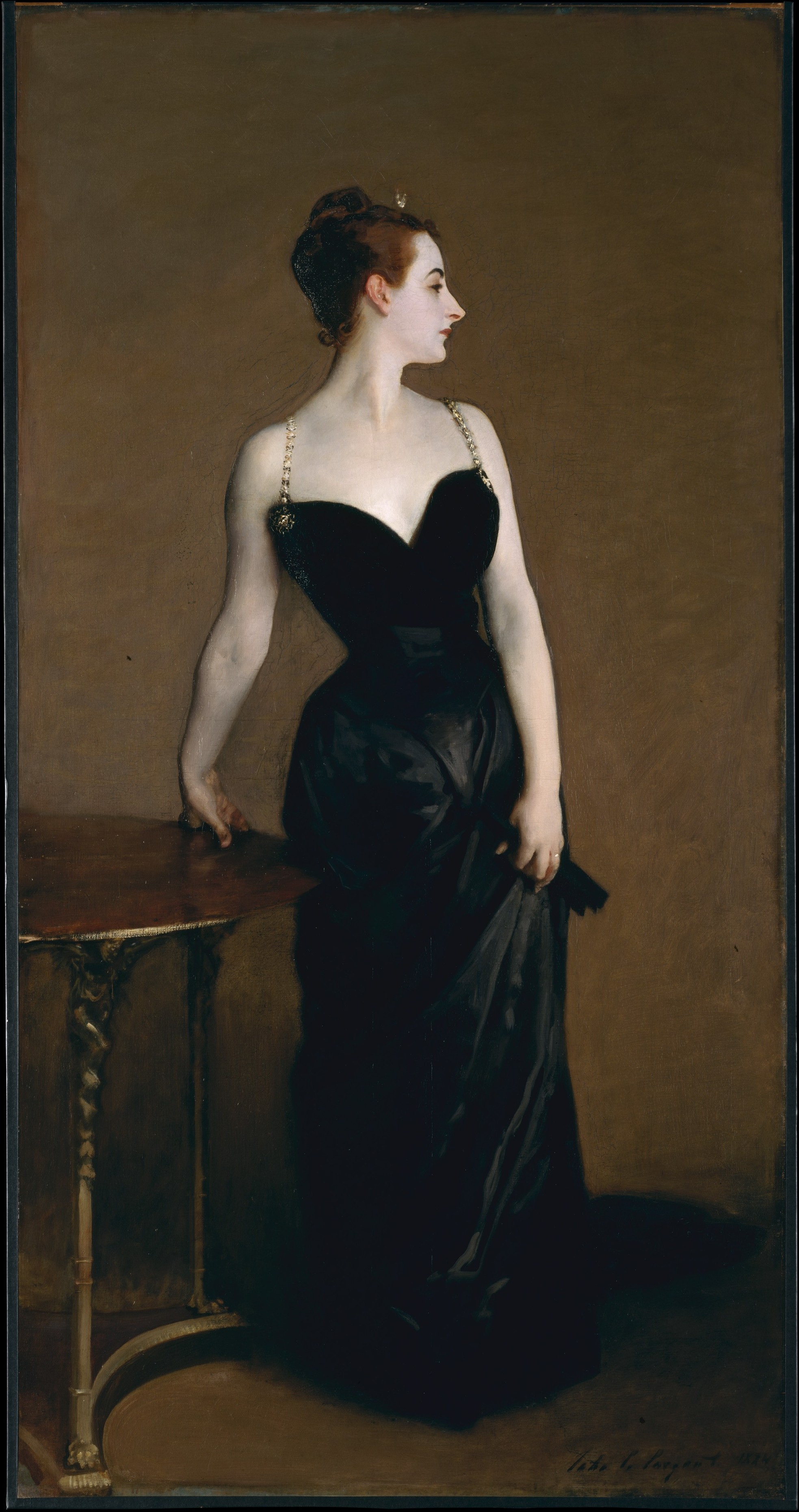
         In the nineteenth-century U.S. it was risky for a respectable woman to draw undue attention to herself.  Middle-class wives didn’t want their names in the newspapers, and if they had their portrait painted, it was meant for display only in the home.  This was true even in sophisticated Paris, where the American artist John Singer Sargent shocked the public when he exhibited, in the 1884 Paris Salon, his Portrait of Madame X.  
File:Sargent MadameX.jpeg
Here she is, with both shoulder straps intact.

The work showed a handsome woman in black satin, her head in profile, with one strap of her low-cut gown unfastened.  The subject of the dramatic painting, the world soon learned, was the American wife of the French banker Pierre Gautreau, noted for her beauty and her rumored infidelities.  The work was not painted on commission, but at a request from the artist.  The reaction to it was so negative that Mme Gautreau, who at first thought it a masterpiece, felt humiliated, and the chagrinned young artist left Paris for London and remained there for the rest of his lengthy career.  As for the painting itself, Singer kept it, later displayed it at international exhibitions, and sold it to the Met in 1916, convinced that it was the best work he had ever done.  Another version is in the Tate in London.

         If respectable women were not supposed to put themselves on display, what about actresses?  The public might applaud an actress’s brilliant performance in the theater, but respectable women wouldn’t think of inviting her into their home, and dreaded the thought that one of their sons might fall in love with a thespian (the meaning of which they weren’t quite sure).  So actresses were both acclaimed and excluded -- the same ambiguous position that burdened Molière and his troupe, men and women alike, in seventeenth-century France.  

         A woman’s respectability is the subject of Henry James’s delightful story “The Siege of London” (1883).  It opens with two Americans at the Paris opera, a newcomer,and a seasoned widower wise in the ways of the world.  The newcomer confesses that he doesn’t understand how his friend can tell at a glance if a woman is respectable.  Eyeing a box with his opera glasses, he asks the old hand if the woman there is respectable or not.  His friend takes a look and immediately says she isn’t, but adds that the young man with her is.  Then he realizes that he once knew the woman and decides to say hello to her at the intermission.  So begins a story that hinges on whether or not a much-married American woman can in any way be called respectable.

         The women mentioned so far – Goya’s majas, Sargent’s Mme Gautreau, and James’s protagonist – risked society’s rejection, but they were not performers.  If in the nineteenth century respectable women were not supposed to put themselves on display, what about actresses?  Respectable women and their husbands might applaud an actress’s brilliant performance in the theater, but they wouldn’t think of inviting her into their home, and dreaded the thought that one of their sons might fall in love with a thespian (the meaning of which they weren’t quite sure).  This applied even to Sarah Bernhardt, the acclaimed French actress whose first tour of America in 1880 garnered attention, rave reviews, and money (which, being debt-prone, she could use), but not respectability.  Not that she needed it, preferring freedom and a series of male lovers.  “Have you seen my latest?” she would ask an old acquaintance, usually referring to some fledgling actor discovered in the provinces, whom she had annexed and, to the annoyance of her troupe, given roles he was unequipped to handle.  (The annexed young man lasted a season or two.)  So society’s wariness of actresses was not without foundation. 

File:Joseph Karl Stieler-Lola Montez1847.jpg
Lola Montez in Munich, 1847.

         So how about dancers?  Worse still.  A dancer’s ability to wreak societal havoc was demonstrated by the career of the Irish dancer who took the name Lola Montez. After engaging in numerous dalliances and provoking a duel between two admirers with fatal results in Paris, in 1846 she performed in Munich.  There she became the mistress of the smitten king, Ludwig I, who created her Countess of Landsfeld and gave her an annuity. She then meddled in politics, and when the 1848 revolution erupted, Ludwig no. 1 had to abdicate, and she too fled the country.  Coming in time to the U.S., she shocked and titillated audiences, especially the gold miners in California, with her wiggly Spider Dance.  In and out of marriages, she began wasting away, spent her last days doing rescue work among fallen women, and died in Brooklyn in 1861, at age 39, of syphilis.  She is buried in Green-Wood cemetery, a repository of celebrities that also harbors Boss Tweed, assorted minor Roosevelts, and mobster Albert Anastasia.  Good company, indeed.

         Mention of the notorious Lola brings to mind – at least to my mind – the life-size sandstone statue of a contorted Hindu dancer in the South Asia hall of the Met.  


File:India semi-devine attendant Dancing Celestial.jpg
Rosemania
Though she lacks arms and legs, she looks wonderfully supple and sensual.  Identified as a celestial dancer of the mid-eleventh century, she must be performing in honor of the gods, who are thought to inhabit temples and consider them their home.  Presumably the real-life celestial dancer would be performing in a temple, but I can't help wondering about the status of her secular equivalent, perhaps a dancer at court.  Would she hope to captivate a monarch, as Lola did, or to advance her position in society otherwise? 

         Such matters will be considered in the next post; see below.


                             BROWDERBOOKS


For my other books, go here.


Coming soon:  Artists or Whores?  Nautch Girls, Geishas, and the Dancing Girls of Lahore.


©   Clifford Browder   2019


Sunday, February 10, 2019

395. Gay Slang of the 1950s, plus Thoughts on Camp


                   The Eye That Never Sleeps 


     If you want my new novel, The Eye That Never Sleeps, and can wait until the release date, May 2, pre-order it now from the publisher, Black Rose Writing, at a 15% discount from the retail price of $18.95; it will ship on May 2.  The e-book will be available soon after that date.  The more sales I have online, the better.  I will sign copies later on request.  If you can't wait, buy a signed author's copy from me now at $20.00 + postage.


 The Eye That Never Sleeps eimage.jpg


Did you ever have a friend who at times acted like your enemy, or an enemy who at times became your friend?  The Eye That Never Sleeps tells the story of just such a friendship.  To be released May 2, this is fourth title in my Metropolis series of historical novels set in nineteenth-century New York.  Detective Sheldon Minick, one of the two main characters, is already known to readers of my novel Bill Hope, for characters in the series turn up in more than one novel.

Summary: Hired by the city’s bankers to track down and apprehend the thief who is plundering their banks, private detective Sheldon Minick develops a friendship with his chief suspect, Nicholas Hale, an elegant young man-about-town who is in every way the sober Methodist detective’s opposite. They agree to a truce and undertake each to show the other the city that he knows and values.  Further adventures follow, including a cancan, a gore-splattered slaughterhouse, and a brothel with leap-frogging whores.  But when the truce ends, the inevitable finale comes in the dark midnight vaults of a bank.

This is not a standard detective story.  Sheldon Minick is a bit scared of women, wears elevator heels to add to his height, and loves to belt out Methodist hymns at church (though he leaves the praying to his wife).  He is fascinated by Nicholas Hale, who is young, dapper, free-spending -- a risk-taker, deft with women, bisexual.


                 Gay Slang of the 1950s, 
                plus Thoughts on Camp


         Self-conscious subgroups have always had a lingo of their own, and that has certainly been true of gay people, especially when they constituted an underground society, hidden from the majority straight world but known to the knowing few.  Gay men needed their own society and slang, for the straight world – with exceptions – viewed them with scorn and distaste.  Or worse still, with pity.  Here are some of the straight world’s terms for gay males back in the 1950s, ranging from the least to the most offensive.

1.    Homo
2.    Queer
3.    Faggot, fag
4.    Fairy
5.    Pervert
6.    Degenerate

To which I might add "fruit" and the adjective "fruity," except that today I wouldn't add it at all.  Instead, I can imagine a gay kid saying, "Fruit?  What's wrong with being soft, ripe, sweet, and good to eat?  I'll buy into that, you bet!"

         When I first entered the gay world in New York in the 1950s, I learned its lingo effortlessly, picking it up from gay friends and from the talk in gay bars.  Using it made you feel special and in the know; it stamped you as a member of your tribe.  So here are some of the terms I learned.  I suspect that some are still current today, and others forgotten or remembered fondly as “quaint.”

butch / nelly:  a masculine / feminine gay person  (also used as adjectives)

queen:  feminine gay guy  (often used loosely for gay men generally)

fluff:  nelly  (used by the macho leather jacket crowd for non-leather gays)

trick:  a gay guy you’ve had (or hope to have) sex with (as in “to pick up tricks”)

an ex:  a gay guy you once had sex with  (“one of my exes”)

trade:  hetero males willing to have sex with gay guys (often with a suggestion that they are latently gay, as in the saying “Today’s trade is tomorrow’s competition”)

rough trade: violence-prone trade

S and M: sado-masochism (a kind of cult among some gay men)

hustler: a male prostitute

chicken: a young gay guy new to the game, innocent

swish: an effeminate gay man (also used as a verb and adjective)

auntie: an older gay guy (pejorative)

sea food: sailors

jail bait:  a gay kid below the age of consent

fish: a woman (pejorative)

fag hag: a hetero woman who hangs out with gay guys (not pejorative)

blow job: oral sex

69: simultaneous oral sex of two male partners (a verb and adjective)

tea room: rest room, john

to cruise: to go looking for a partner for sex

to camp: to talk or behave in an ostentatiously gay manner

         The term “camp,” whether a verb, an adjective, or a noun, is of unknown origin, though many origins have been proposed.  Be that as it may, it has quite a history.  I first knew it in the 1950s as a gay verb, as just noted.  By the 1960s it was used more broadly in the meaning of “excessive” or “over the top,” and as such was akin to “theatrical” and “artificial.”  It might or might not be pejorative, but often suggested a trendy and “with it” pattern of behavior.  Very influential was Susan Sontag’s 1964 article “Notes on Camp” in the Partisan Review.  She defined “camp” as “one way of seeing the world as an aesthetic phenomenon,” but went on to call it “failed seriousness,” which some have labeled not “camp” but “campiness,” meaning frivolous and “so bad it’s good.”  For some, it was identified not only with artifice and ostentation, but also with naïve middle-class pretentiousness, in which case the trendy became teasingly pejorative. 

File:Carmen Miranda in The Gang's All Here trailer cropped.jpg
Carmen in all her glory, in
The Gang's All Here, 1950.

         One example of “camp” cited by Sontag was singer and movie star Carmen Miranda, "The Brazilian Bombshell," whom I recall appearing in old musicals wearing tropical fruits that came off as outrageously and implausibly funny.  In time, “camp” came to include drag queens and other performers like Dame Edna, Divine, Boy George, and Liberace.  And if some of those names don’t register with you, it shows how the concept has morphed over time.  

File:Dame Edna (7105780145).jpg
Dame Edna in 2012.
Dame Edna

File:Liberace Colour Allan Warren.jpg
Liberace in 1974.
Allan warren
          “Camp” is ambiguous, elusive.  One may well ask if it is frivolous or serious, or a combination of both.  Is it a gay term or has it lost that connotation?  Is it trendy or hopelessly dated?  Ask a dozen historians, and you’ll get a dozen answers.  So I’ll leave it to younger generations to use the term as they wish, or to bury it in oblivion.  But let’s face it, “camp” has always been fun.


                           BROWDERBOOKS

For my other books, go here.


Coming soon:  No idea, but something will happen.


©   Clifford Browder   2019


Friday, February 8, 2019

395. BROWDERBOOKS


                               BROWDERBOOKS


For the latest BROWDERBOOKS, go here. 

Sunday, February 3, 2019

394. Must Gay Sons Hate Their Mothers?


File:Tennieldumdee crop.jpg
Who are these characters?  To find out, and to meet
Mr. G. Whiz, a recipe for amorous attachments, and
"Silly," click here.
          The Eye That Never Sleeps Hustle


     If you want my new novel, The Eye That Never Sleeps, and can wait until the release date, May 2, pre-order it now from the publisher, Black Rose Writing, at a 15% discount from the retail price of $18.95; it will ship on May 2.  The e-book will be available soon after that date.  The more sales I have online, the better.  I will sign copies later on request.  If you can't wait, buy a signed author's copy from me now at $20.00 + postage.


 The Eye That Never Sleeps eimage.jpg


Did you ever have a friend who at times acted like your enemy, or an enemy who at times became your friend?  The Eye That Never Sleeps tells the story of just such a friendship.  To be released May 2, this is fourth title in my Metropolis series of historical novels set in nineteenth-century New York.  Detective Sheldon Minick, one of the two main characters, is already known to readers of my novel Bill Hope, for characters in the series turn up in more than one novel.

Summary: Hired by the city’s bankers to track down and apprehend the thief who is plundering their banks, private detective Sheldon Minick develops a friendship with his chief suspect, Nicholas Hale, an elegant young man-about-town who is in every way the sober Methodist detective’s opposite. They agree to a truce and undertake each to show the other the city that he knows and values.  Further adventures follow, including a cancan, a gore-splattered slaughterhouse, and a brothel with leap-frogging whores.  But when the truce ends, the inevitable finale comes in the dark midnight vaults of a bank.

This is not a standard detective story.  Sheldon Minick is a bit scared of women, wears elevator heels to add to his height, and loves to belt out Methodist hymns at church (though he leaves the praying to his wife).  He is fascinated by Nicholas Hale, who is young, dapper, free-spending -- a risk-taker, deft with women, bisexual.


Must Gay Sons Hate Their Mothers?

         “You old fuck!” he screamed into the phone and slammed down the receiver.   Well, we all have bad days charged with tension.  True enough, but he was talking to his mother. 

         This incident my late partner Bob recorded in a journal entry dated September 2, 1988.  (For more on Bob and his journals, see post #391.)  Bob was not given to grossness or profanity.  In a moment of anger or frustration I would yell “Shit!” but he would murmur “Sugar!”  And like many a gay son, he had always been close to his mother, going to the opera with her, lunching with her, and giving her memorable gifts.  Hearing Parsifal at Easter at the Met, the two of them would sit in silence, holding hands, entranced by Wagner’s music.  More than once, when they were lunching together in Jersey City, the mother’s friends would stop by their table and congratulate her on having such a dutiful and attentive son. 

         Bob often joined his parents during their summer vacation on Nantucket, and when his father had to return to Jersey City and his job, Bob and his mother would stay on a few more days.  Recorded in photographs, those days with his mother were special.  In the father’s absence he would encourage her to smoke, which in his father’s house was strictly forbidden.  Alone together, they indulged in forbidden pleasures, they were free.  It was almost a honeymoon, and photos of him on those occasions have, to my mind, a distinctly sensual look.  Shades of Oedipus!

         So what happened?  Bob and his mother lost his father in 1982 and she grieved intensely.  Bob then came out to her, and after she had had time to absorb this, she phoned me and said, “Welcome to the family.”  All was fine here in the city, but when they went to Nantucket, where she had vacationed so often with Bob’s father, Bob had to be spouse as well as son.  As a result, if I joined them for a few days,she was jealous.  By my mere presence, I disrupted their intimacy and, for a few short hours daily, stole her son away.  
        
         Over the next few years Bob’s mother, now living alone in her Jersey City apartment, deteriorated physically and mentally at an alarming rate.  His journals of the late 1980s tell a grim story.  He came regularly to buy her a week’s worth of groceries; to take her to her doctors’ appointments and the outfit that made her hearing aid; to escort her to a beauty parlor; and on her good days, to accompany her to a restaurant where they lunched together and sometimes were joined by me.

         By 1987 the situation was serious.  She fell repeatedly in her apartment or on the street, began forgetting or losing things, and relied on him more and more.  On Christmas Eve of that year, when the two of them were drinking beer together, she had a few too many and slid off her chair to the floor.  Unable to lift her up, Bob phoned the police, but they were slow in coming.  So at his mother’s suggestion he grabbed her legs and, with her lying on her stomach, pulled her across the floor to her bedroom, an experience that he deemed worthy of a Samuel Beckett novel, Beckett being one of his favorite authors.  But if the whole scene was grotesque, he also saw in it a certain dignity stemming from the honesty existing between a mother and her grown son.  The police finally arrived, lifted her off the floor, put her to bed, and departed.  But since she failed to realize that, at her age, she couldn’t drink beer as she once did -- meaning several beers at a time -- Bob phoned the liquor store supplying it and stopped their deliveries.  This she resented, seeing in him the father who had tyrannized her childhood in Germany, and the American husband who had forbidden her to use makeup or smoke.

         The journal entries of 1988 record the worsening situation.  On May 12 he insists that his mother “is integral to my daily breathing.”  He is embarked on an odyssey, perhaps the most important of his life.  What his mother means to him is at stake.  That morning she was a tearful child, totally relying on him, and he didn’t fail her.  His heart is drawn to her.  Or is he deluding himself?  There have been some frightening times of late, when his inner resources seemed nonexistent.  To say that his current relationship with her is of positive value “smacks of a vague insanity.”

         June 17, 1988.  His mother seems to be aging significantly week by week as he watches helplessly.  “An incredible sense of mortality is invading my sensibility.  For Mom, there is a ponderous despair.  She never speaks of the fucking religion she at one time espoused so wholeheartedly…. There is, for her, quite nothing.  A vacuum of awesome contours.  In a way she is waiting – waiting – for the end.  My own mother, wasting physically, devoid of interests, excruciatingly bored.  And I, each week, observe and my sadness deepens.  If this is to be one of the profound periods of my life, I scorn the wisdom I may eventually acquire from this extended pain.”

         For me, reading this now, his words have a chilling authenticity.  The contrast with the AARP Bulletin, whose contents address seniors, is striking.  In Bob’s journals, no photos of smiling oldsters mixed in with ads for stair-lifts, wheelchairs, and easy-to-use cellphones with zippy names.  No triumphant articles on how I overcame bipolar, or tips on how to add healthy years to your life.  Bob is now in the world of Samuel Beckett, the chronicler of despair, decay, and death.

         The entries show a progressive hardening in his tone.  His respect for her has vanished; he tells her pointedly that he feels pity for her, but little else.  Her lack of resources – an interest in literature, art, dance, and music – troubles and depresses him, for it leaves her at the mercy of her mood of the moment.  He, on the other hand, is attending concerts and ballet, and lunching or dining with friends, even while seeing to her needs.  Exasperated by her ceaseless demands, at one time or another he calls her – sometimes to her face – a child, an actress, a nuisance, a liar, a Frankenstein, a grotesque.  “My abuse toward my defenseless mother continues unabashed,” he confesses on August 26, “and I’m growing increasingly afraid of myself.”  She has drained him to the point of exhaustion. 

         And now we come to the incident of September 2 mentioned earlier.  “Ten minutes ago I called my mother an ‘old fuck’ and slammed down the phone.  I’m trembling.  This was appallingly dreadful of me, and yet the words leaped spontaneously.  No need to detail the motivation.  Worthless.  All related to her increasing lack of mind.”  Then, having stocked her up with provisions for his absence, he escapes for a few days to Nantucket.

         September 27, 1988.  “I do not wish my mother dead.  I refer rather to when she dies -- then release for me.  I wish finality for no human being despite moments of fitful anger when I may utter profanities of this ilk.  My heart, in its most honest, enduring contours, is a kind, concerned heart….   Yet I know I am capable of heartlessness, cruelty, indifference, and vengeance.  Inescapable.  Getting worse, with respect to Mom.  What, what, what can I do?  (Later.)  The final stages of everything I now share with my mother are at hand.  Quite frankly I believe I’m moving into the finality of a life.”  Even as he writes this, the memory of the famous jockey with whom he had his first sex experience 31 years before flits into his mind. 

         Anyone who has been a longtime caregiver will recognize these feelings: the intertwining of resentment, explosive anger, and regret, the dismay at moments of indifference and cruelty, and even intrusive memories of sex.  I was aware at the time of Bob’s difficulties with his mother, but only now, while reading the contents of his journals, do I appreciate the depth and intensity of his feelings.  He too -- in spite of concerts, friends, and hours-long meals in restaurants -- was desperate and alone in his suffering.  And finality would be a long time in coming.

         November 29, 1988.  “Mom looked extraordinarily frail in her thin, faded nightgown.  The strong bones of her face contrast strangely to the bird-like frame that is now her physical abode.  I was again reminded of the limitations of human existence as I helplessly surveyed the ruins of what was once a strong, healthy body – and of course I reflected on my own demise somewhere down that not-so-long road of life.”

         December 7, 1988.  “Tonight, I entered the apartment and heard her talking to herself, stating over and over again, ‘I’m all alone.  Nobody wants me anymore.’  I listened in utter sadness before I made my presence known.”  But he then went on to rant against religion, asking why didn’t J.C., an alleged miracle worker, converse with and console his mother.

         “Nobody wants me anymore.”  When I first encountered them, those words went straight to my heart.  But it’s also true that Hedwig Lagerstrom always harbored a streak of self-pity.  Even when she and her husband were both alive and in the best of health, she was capable of “down” moments when she would say dejectedly of older people, “Heart attack, they say.  But it isn’t heart attack, it’s heartbreak, and nobody cares.”  Implication: such is the fate of the elderly at the hands of an uncaring world.  And this when she was having Bob and me over for a turkey dinner, maybe in a living room cluttered up with a decorated Christmas tree, miniature illuminated houses on a mantel, a jolly little plastic Santa and Mrs. Santa, and sumptuously wrapped presents for everyone – what Bob, in his unsparing journal entries, refers to as “Christmas shit.”

         February 12, 1989.  “These recent years have destroyed any illusions regarding Mom.  I view her in a clear light.  She offends me, and often disgusts me….  I am incapable of admiring or loving someone who is ignorant and shallow.  I say this in full knowledge of her sacrifice in helping to raise me.”  In his journal he is determined to be honest, and brutally honest he is.

         Especially maddening was his mother’s habit of losing things: her keys, her glasses, an important check or bill, her $800 hearing aid.  She would then “rave and flail,” while her son stayed calm.  Sometimes an item disappeared for days, then mysteriously reappeared, retrieved by her from what hiding place he would never know.  And sometimes, delusional, she would accuse her home-care aid, or even Bob, of stealing the missing item.  Once when she was missing her keys, he didn’t raise his voice but said quite calmly to her, “Maybe you stuck them up your ass.”  Whether she absorbed this and other remarks isn’t clear, since at times she was lost to reality and immersed in a world of her own.

         A journal entry for April 11, 1989, tells how, just when he had dressed her up for a Sunday dinner in an elegant restaurant, she couldn’t find her costly hearing aid.  After a half-hour search he recovered it, but now she couldn’t find her glasses.  “I started to erupt.  For a minute, I raged.  Yelled out 'Bastard!' and realized, on the instant, that my profanity was aimed at the outrage of aging and not specifically at Mom.  I cooled down.”  They then left, but fearing “indelicate” table manners, he steered her to a less elegant restaurant.

         Her life now was joyless.  The apartment that had once hosted splendid turkey dinners with all the trimmings now harbored a “Samuel Beckett atmosphere.  The furniture, the wallpaper, all is dying.  Strange, sometimes dank odors come and go.  The rooms are in twilight, dim illumination.”  

         Mother’s Day brings out the worst in him.  His anger erupts “like a tornado,” and he takes the lovely yellow carnations that he brought her, crushes them, and throws them on the floor.  In his journal the next day (May 15, 1989) he deplores “such a rotten, dastardly thing.” 

         The mother maintains what he calls her end-of-the-world act, but she is not always a passive sufferer; on one occasion she throws a pocketbook at him.  But an entry of September 25, 1989, reports that “I found her sleeping in a fetal position on her bed, blankets drawn close around her aging, shrinking body, her head resting on a tissue-thin pillow.  I saw a sleeping child.  I was deeply stunned.”  No matter how depressing the sight, his descriptive powers are unimpaired. 

         She pursues him even into his dreams.  On September 17, 1989,  while vacationing in Maine, he records one.  In it she meets him in front of a Baptist Church.  Diminished physically and barely able to speak, she seems to have no bones or blood.  She pleads to be taken to a hospital, but he slaps her to bring her back to “herself,” then drags her to a bus stop.  When she collapses on a bench, he tries again to snap her back to the person she once was.  He wants her to wear her bright pink dress for church, but she escapes him and tries to enter another church across the street.  When he picks her up and carries her back to the bus stop, she weighs nothing, seems to be air, her face a piece of pink tissue.  He scolds her for not trying to look her best, but then realizes he must get her to a hospital; his attempts to revive her are futile, even immoral.  People gather around them and someone phones for an ambulance; end of dream.  Deep in his psyche, he concludes, he still doesn’t believe she is declining.  This is his dilemma, “the thistle that burns through the night and which I’m unable to grasp and dispose of.”

         In time he will get her into a nursing home, thus relieving him of some of his responsibilities, but phone calls will come all too often from the home reporting yet another fall, or some other cause for alarm.  But at least she won’t be alone.  I visited her there with Bob.  Though she lived in reduced circumstances, being allowed only a few personal items in her room, on that occasion she seemed fairly content, and with the other residents feasted on TV.   For better or for worse, finality was still in the offing.

         Mother/son relationships have been much studied, often with differing conclusions.  I offer Bob’s story, told with brutal honesty, as yet another account of these entangled emotions, rarely soothing or heartening, mostly painful, even shocking.  Personally, I feel deeply sorry for both of them.  They were locked into a situation that neither one wanted.

          Bob's journals, correspondence files, and photo albums are a rich archive of gay life and cultural history in New York from the 1950s on.  So rich a collection that I am looking for a home for them after I too depart this luscious earth.  (Not imminent --   I'm a tough old bird.)  At the moment I have three possibilities.  If necessary, I shall query them each in turn.

                             BROWDERBOOKS

For my other books, go here and scroll down to BROWDERBOOKS.


Coming soon:  Gay slang of the 1950s, plus thoughts on camp.

©   Clifford Browder   2019