Sunday, March 9, 2014

116. Fires and Firemen

     This post is about New York City fires and firemen, past and present.  I’ll start with fires I have experienced personally, then have a look at fires and firemen of the past.  I have been through 2½ fires in the city.

Fire no. 1

     My partner Bob and I heard a commotion downstairs, poked our noses out the apartment door, saw a haze of smoke coming up the staircase, and a fireman knocking on doors one flight down.

     “Do you want us out of the building?” I yelled.

     “Yes,” came the fireman’s answer, “and fast!”

     That said, he darted down the stairs into the hazy smoke.  So Bob and I tossed on our light jackets and followed him down the stairs into the smoke.  Ahead of us we saw Mrs. T., the landlady, who was housebound with arthritis, being carried down the last flight of stairs.  Only when we were safe outside, joining the crowd watching the firemen at work, did we realize that we had done exactly what you’re told not to do in a fire: to go in the direction of the smoke. 

      The fire was in the basement.  We later learned that Mrs. T. had once had a perfume business and stored some chemicals there.  Another no-no: don’t store inflammables in the basement, and above all, don’t leave them there, forgotten, for years.  The chemicals had been a fire just waiting to happen.

     The fire was quickly put out, and after the firemen had aired the building to get rid of the smoke, we were allowed back in.  No damage except in the basement, so it ended well.  Being a bit shook up, Bob and I and our downstairs neighbor Hans joined another neighbor in her room for an after-crisis drink.  A real Village scene, we thought: four survivors tippling together in a tastefully shabby apartment.

     “Like in La Bohème,” said Hans, a great opera buff. 

     “Or Götterdämmerung,” I quipped, mindful of Wagner’s fiery finale.

     So ended my first fire in the city.  No word of it in the newspapers, since such non-events occur all the time, too numerous and routine to merit a mention.  But I had learned to be leery of accumulating inflammables.  Once, when our trash area was piled high with boxes and newspapers that the super hadn’t bothered to put out for collection, I informed the Fire Department, and they were on the spot inspecting the place within 24 hours.  And every time I walk past the Magnolia Bakery, our celebrated ground-floor neighbor, and the Bleecker Street entrance to our basement is open, I peer down the steep stairs, wondering if that shadowy underworld is piled high with the bakery’s empty cartons, as it once was, when I went down to have access to our circuit breaker.

Fire no. 2

     One summer many years later there came a sudden knock on the door.  Bob was away, so I was in the apartment alone.  At the door was our young next-door neighbor, and behind her, once again, smoke pouring up the staircase, this time much thicker and more threatening.

     “Get out of the building!” I said, before she could say a word.  “Don’t go down the stairs.  Use the fire escape.  I’ll see you down on the street.”

     So she went down the front fire escape to West 11th Street, and after phoning Hans to alert him, I went down the other fire escape to Bleecker Street.  It was a mild summer afternoon, so all the tenants joined the inevitable throng watching the fire from the street.  Hans told me that another of our neighbors, who was watching the scene with visible anguish, had apologized to him: the fire had started in his kitchen.  Long out of work, he watched television day and night and had probably been watching it when he had something on the stove.  A quiet, harmless guy, but sad.  Another neighbor had told us once of helping him get an ambulance on Christmas Eve.  “I’m the loneliest man in the city,” he had confessed, before being whisked off in the ambulance to an emergency room – not a cheerful prospect on Christmas Eve.  And now, a fire in his apartment, and all of us routed out to the street.

     Again, the firemen had come quickly and soon the fire was out, with damage only to his kitchen.  For several days afterward, going up or down the stairs, through his open door I could see workmen working in his kitchen, and him, seemingly oblivious of them, watching television.  In time he moved out; I have no idea what has become of him.  And that is the story of my second fire in the city.

      As fires go, not much, you might say.  No roaring infernos, no charred bodies, no tangled, blackened wreckage.  Agreed.  But I have one more fire to offer.

Fire no. 2½

     Why 2½?  Because this fire wasn’t in my building, so I wasn’t routed out to the street.  One summer night, long past midnight, I heard a commotion on the roof next to mine.  Going to a window, I looked out and saw firemen on the roof next door, training hoses on a fire on the next roof over, where the residents had partied quietly the night before.  The flames were leaping skyward: a real conflagration devouring everything in its path.  I hadn’t even heard the sirens, but there were the firemen, dousing the fire with torrents of water until the flames finally faltered, shrank down, flickered, went out.  It was all over in a matter of minutes, but I’ll never forget the sight of that great mass of flames leaping high.  The excitement over, I went back to bed.

     The next morning I looked out and saw two of the residents poking about in the charred ruins of what had once been a charming roof garden.  Among the wreckage were glasses from the partying of the night before.  They saw me, gestured, shrugged.  I shrugged too and told them of the spectacle I had witnessed well past midnight.  And that was the end of the rooftop partying.  One cigarette, not quite out, had probably been left behind, when the revelers quit the roof and went downstairs; that’s all it took to kindle a blaze.

New Yorkers and fires

     New Yorkers tend to shrug off fires.  Not in their own building, of course, or in a building nearby, but otherwise they don’t pay much attention.  Fire engines race down the streets every day, their sirens wailing, and they’re just a part of the usual hullabaloo, along with police and ambulance sirens, rumbling trucks with screeching brakes, horn blasts of irate drivers, and altercations – often shrill – of motorists.  But New Yorkers don’t resent those sirens, annoying as they can be, since they are rushing aid to someone who needs it, and fast.  Here the city’s congestion is actually advantageous, since firemen, once an alarm is sounded, can be at the scene of the fire within minutes.  Congested cities don’t harbor the worst risk of fires; it’s those handsome dwellings out in the country, in idyllic settings, that risk burning to the ground before fire engines from some distant location can arrive.  There are fires in the city, but they tend to be put out fast.

     An exception to my statement that New Yorkers shrug off sirens: my partner Bob.  Once, when he was fourteen, he and his family were routed out of the floor they rented in a three-story tenement in Jersey City when, in the wee hours of the morning, a fire raged next door.  They were soon allowed back in, with no damage to their building, but the experience marked him for life.  Whenever he heard a fire engine’s siren in the street below our West Village apartment, he would listen intently, nervously, until the engine raced on past our building.  And if the siren stopped near us, he would peer out the window to see if our building was involved.  It never was, and he always breathed a sigh of relief.  Overly cautious, needlessly fearful?  Maybe.  But he was the best fire detector our apartment could have had.

     New York City firemen are generally admired.  Yes, their union long resisted admitting minority applicants and had to be coerced by the courts, and yes, occasionally a few of them get into off-duty brawls and scrapes, but our firemen emerged as the heroes of 9/11, when so many of them died in the collapsing Twin Towers.  We need the police too, but they have been tainted by corruption in the past, and the recent stop-and-frisk practice offended the minority youths who were arbitrarily harassed, and alienated the general public as well.  Luckily, the firemen have escaped such controversy.  When our friend Barbara visited from Maine, she watched in admiration and awe as firemen performed some routine task in public.  And another woman, a passerby and total stranger, joined her, professing the same admiration of these burly stalwarts going about their business, totally unaware of two admiring females watching discreetly from a distance. 

Great fires of the past

     Thanks to the city’s frequently updated Fire Code, regulating fire prevention, the storage and handling of combustibles, and related matters, and its regulation of building materials, the chance of a great fire today is vastly reduced.  And New York has never been devastated by a city-wide conflagration like the ones that leveled Chicago and San Francisco.  But in earlier times, when building materials were inflammable and regulations minimal, there were not one but two great fires in the city.

     The evening of December 16, 1835, was unusually cold, with high winds hammering the city.  Toward 9 p.m. a watchman smelled smoke and, joined by other watchmen, traced the smoke to a large warehouse on Merchant (now Beaver) Street.  Forcing the door open, they found the interior ablaze and watched helplessly as flames burst through the roof and, whipped by the wind, spread quickly throughout the downtown commercial district.  Bell towers and church bells clanged the alarm, and the city’s firemen, exhausted from fighting two fires the night before, turned out to haul their engines to the scene of the blaze.  But by midnight the freezing wind had lashed the flames into an inferno so bright that the glow could be seen in Poughkeepsie, New Haven, and Philadelphia, where firemen also went into action, thinking their suburbs were on fire. 

File:The Great Fire of the City of New York Dec 16 1835.jpg
The burning of the Merchants' Exchange, 1835.

     Firemen arriving on the scene found the wells, cisterns, and hydrants frozen solid, and when the firemen, chopping holes in the frozen East River, tried to pump up water, the water froze in the hose.  Meanwhile merchants dragged goods out of warehouses to supposedly safe locations, only to see them consumed in the spreading conflagration.  Racing north, the flames engulfed the supposedly fireproof Merchants’ Exchange, a handsome cupola-topped, marble-faced structure on Wall Street that was the pride of the city and a tribute to its commercial success.  Rescuers managed to save records of current stock transactions, but barely got out in time before the great cupola came crashing down.  Scraping together supplies of gunpowder wherever they could be found, fire fighters blew up buildings along Wall Street and succeeded in blocking the fire’s progress and thus saved the northern half of the city from destruction.  By morning thirteen acres of the downtown commercial district were still aflame, and rivers of burning turpentine rolled out across the frozen East River to set several vessels on fire.  When the fire finally subsided, the ruins were littered with scorched silks and satins and laces, bottles of wine and champagne, and a mountain of coffee on South Street.  Looters were prowling about, getting drunk on scavenged liquor and gloating at the misfortune of the affluent, until state militia and U.S. Marines were brought in to put a stop to the looting.
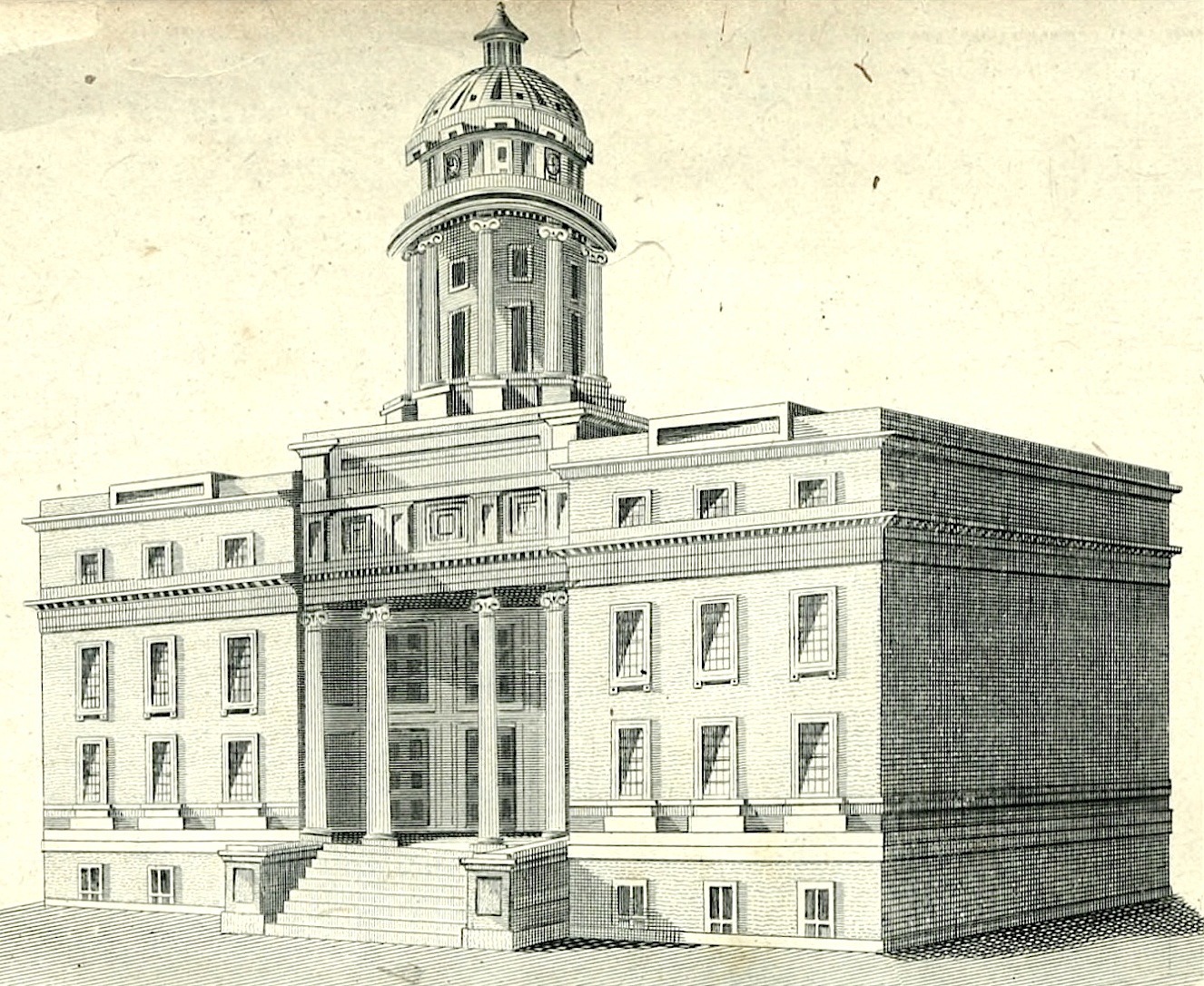
File:New York Merchants' Exchange.jpeg
The Merchants' Exchange, where merchants met to buy and sell
commodities, real estate, stocks, steamboats, whatever.  Before the telephone, 

merchants made themselves available to one another by going "on 'Change."

     What was the toll of this, the city’s worst fire ever?  Some 674 buildings had been destroyed, with losses estimated at from $18 to $26 million – for that time, a huge amount more than triple the cost of the Erie Canal.  Yet only two people died, since the commercial district was almost devoid of residential buildings.  And the Go Ahead spirit of the city was such that reconstruction began at once, with the ground still hot from smoking embers.   Within a year some 500 new buildings had gone up, and the whole ravaged area was completely restored.

     Ten years later the city suffered another great conflagration in the same downtown commercial area.  It began about 2:30 a.m. on July 19, 1845, on the third story of a whale-oil and candle manufacturer on New Street, a block south of Wall Street, and spread quickly to adjoining buildings.  When the fire reached a large warehouse on Broad Street where quantities of combustible saltpeter were stored, firemen rushed into the building to drag a hose up to the fourth floor to direct water onto the blaze.  When heavy black smoke began coming up the stairway, the firemen were ordered out of the building; five minutes later there was a huge explosion that demolished not just the warehouse but many nearby structures, while hurling bricks and flaming debris through the air, tossing people in the area to the ground, and setting the whole neighborhood ablaze.  But on this occasion the firemen were aided by water flowing from the recently completed Croton aqueduct, so that the fire was under control by 1 p.m. that afternoon. 
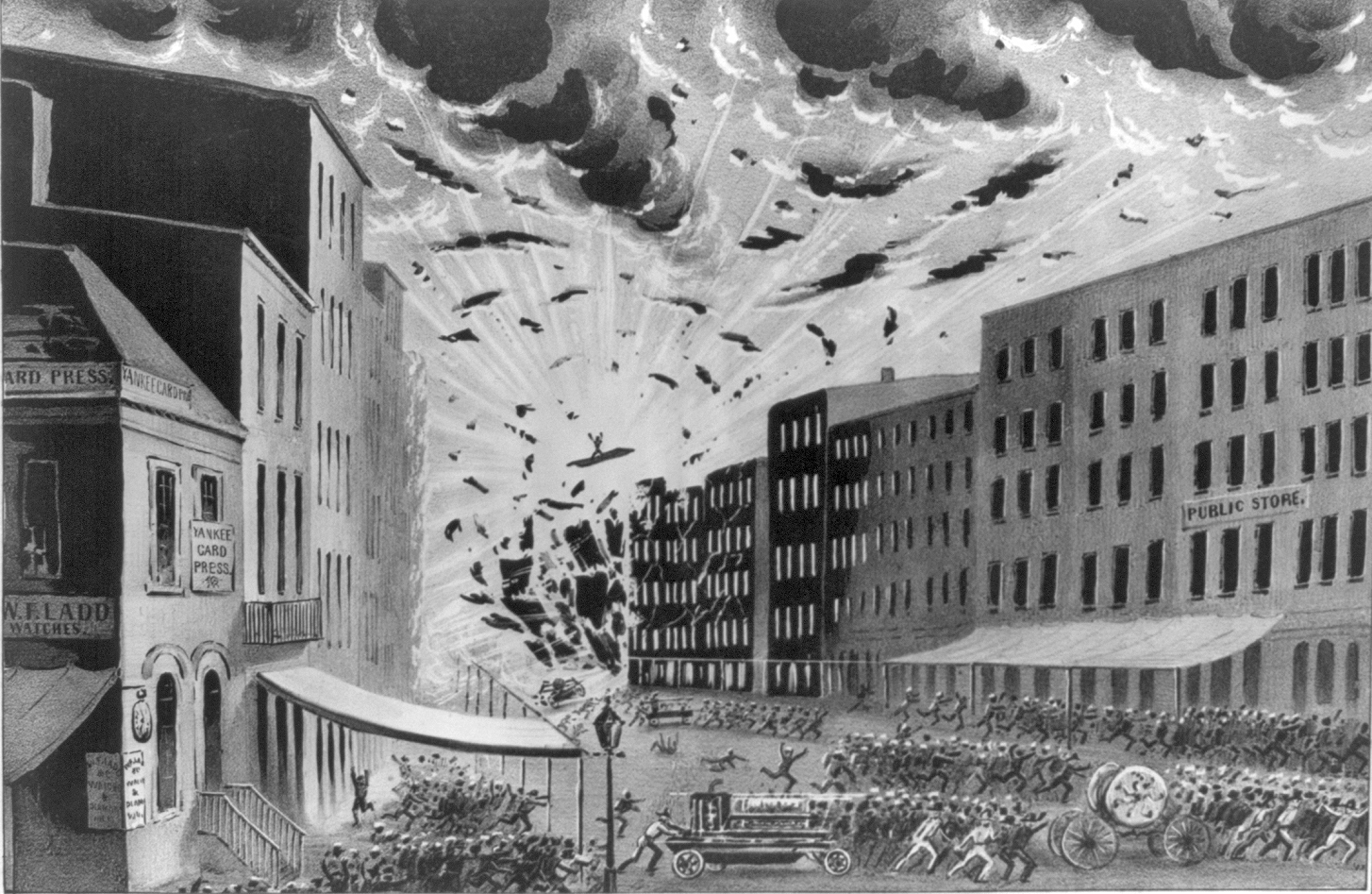
File:NYC Fire 1845 explosion loc.jpg
The warehouse explosion, 1845.

     The destruction caused by the 1845 fire was vast  -- 345 buildings destroyed and property damage appraised at from $5 to $10 million -- yet it confirmed the efficacy of building codes adopted in 1815 that banned the construction of new wood-frame structures in the densest parts of the city.  When the fire spread eastward toward areas rebuilt after the 1835 fire with stone, masonry, and iron roofs and shutters, it had been checked. 

File:Image of Triangle Shirtwaist Factory fire on March 25 - 1911.jpg
The Triangle fire.  The firemen's hoses could
reach the upper floors, but their ladders couldn't.
     Still, a lot remained to be done.  It was not until two tenement fires in 1860 blocked stairways and trapped residents on the upper floors, with consequent loss of life, that public pressure forced the state legislature to pass laws requiring fire escapes on tenements and other structures.  Further reforms came only after the horrific Triangle Shirtwaist Factory fire of March 25, 1911, when fire broke out on the eighth, ninth, and tenth floors of a ten-story building at the corner of Greene Street and Washington Place, just east of Washington Square Park in Greenwich Village.  Flames soon blocked one stairway, and the doors to other exits were locked to prevent theft.  Terrified employees crowded onto the single fire escape, a flimsy structure that collapsed under their weight, flinging twenty employees to their death on the pavement below.  The firemen’s ladders couldn’t reach beyond the sixth floor, and their nets couldn’t withstand the force of bodies falling from such a great height.  Crowds below watched in horror as other employees – mostly young Jewish and Italian immigrant women – jumped from the flaming upper floor windows to their death, landing on the pavement with a thud that would haunt bystanders for months to come.  In all, 146 garment workers died as a result of the fire. 

     When the company’s two owners were tried on first- and second-degree manslaughter charges, a skillful defense led the jury to acquit them.  But reformers pressured the state legislature to modernize the state’s labor laws, mandating better access and exits, improved fireproofing, the installation of alarms and automatic sprinklers, and better working conditions for employees.  Further measures were subsequently adopted as skyscrapers lunged higher and higher into the sky, and still more after the collapse of the Twin Towers on 9/11.  Fire prevention is a never-ending enterprise requiring constant revision and improvement. 

Volunteer fire companies of the past

     Long before the city had a professional fire department, there were volunteer companies composed of young men who hauled their engines through the streets, ostensibly because horses would panic at the sight of a fire, but really because they liked the glory and to-do of hauling their prized engines themselves.  In the nineteenth century their typical uniform included a wide-brimmed leather helmet with the number of the fire company blazoned on the front, a red flannel shirt, and black pants.  The companies were known by such nicknames as Honey Bee, Short Boys, Red Rover, Big Six, Old Turk, and Yellow Birds.  Each company had an engine house in a certain neighborhood, and if an alarm sounded, they would rush the engine from there to the site of the fire, while their foreman shouted orders and gave encouragement through a brass trumpet.  Rivalry among the companies was intense, and if two of them arrived at the scene of a fire, and only one hydrant was available, fierce fights resulted with fists, pipes, and the blunt ends of axes, while the building continued to blaze.  On one such occasion in July 1846 engine companies 1, 5, 6, 23, 31, and 36 engaged in a donnybrook of epic proportions, and on a Sabbath morning, no less, until a superior managed to calm things down; fortunately, no building was burning at the time.  Every so often a company was disbanded for brawling, but the brawling somehow persisted.

image description


     When not so engaged, the firemen performed valorous deeds in rescuing residents from burning buildings, and in calmer moments took great pleasure in marching in parades.  The fire companies, like the militias of the day, were an integral part of  working-class society.  And they often exerted political influence as well.  Nine New York mayors were elected as active firemen or as candidates sponsored by fire companies.  To launch a political career, what could be better than having a whole fire company solidly behind you?  Which was why Big Bill (not yet “Boss”) Tweed tried repeatedly to get himself elected foreman of a fire company and finally succeeded in 1850, when he became foreman of Engine Company 6, whose tiger emblem later became associated with Tammany Hall.  Reformers deplored Tammany's influence on the fire companies, not to mention outright theft; money appropriated for equipment often ended up in the pockets of Tammany politicians and foremen.

File:Frank Chanfrau as Mose.jpg
Chanfrau as Mose.
     New fame and glory came to the volunteer firemen on the evening of February 15, 1848, at the Olympic Theatre, when the actor Frank Chanfrau first appeared in the sketch “A Glance at New York” as Mose the Fireboy, conveying with great accuracy the speech and mannerisms of a contemporary Bowery boy “dat ran wid der mersheen” (English translation: “who ran with the machine”).  In the audience were Bowery Boys, fire laddies, and their friends, who recognized the character at once and cheered.  An instant success, the play ran for seventy nights, which for the time was extraordinary.  More plays featuring Chanfrau as Mose followed, and Mose became a staple character, much beloved, of the New York stage.

     But reality was something else again.  In time, the volunteer firemen’s propensity for brawling, combined with the city’s rapid growth, brought a realization that New York City needed a full-time professional force of fire fighters, resulting in an act by the state legislature in 1865 creating a Metropolitan Fire Department.  The era of the fist-swinging volunteer fireman, colorful and rampageous, was over, and it was no doubt all to the good.


File:Metropolitan Fire Department.jpg
Harper's Weekly celebrates the formation of the New York City Fire Department in 1865.  As the
pictures show, horse-drawn engines were now increasingly in service.

     Voluntary or professional – preferably professional -- we need firefighters; we  couldn’t survive without them.  Risking their own lives, they keep us and our cities safe.

File:Bombers fallers.jpg
                                                                                                                                                                                Pere Qintana Seguí
  

     And now, a new feature to end on: a photo that expresses some essential aspect of New York – its energy, diversity, congestion, craziness, or whatever.


This is New York

File:Haredim new-york shabbat.jpg
                                                                                                                                                                   Seamus Murray


     Coming next Wednesday:  Prophets vs. Profits of Doom.  Or: WBAI vs. Wall Street.  Gary Null and Thom Hartmann pronounce.  Is another Great Crash coming?  Should we hoard gold and silver?  Will there be another fearful war?  DON’T BUY STOCKS, or should we?  Am I a greed creep?  Our many, many selves: I have at least nine; how many do you have?

     ©  2014  Clifford Browder


Sunday, March 2, 2014

115. Greenwich Village, Bohemians, Walt Whitman and how gay was he?


      I have just begun reading John Strausbaugh’s comprehensive and well-researched book The Village: 400 Years of Beats and Bohemians, Radicals and Rogues; A History of Greenwich Village (HarperCollins, 2013), which I highly recommend to anyone interested in the Village and its colorful past.  It will be a long read (553 pages + end matter!).  I’ve only reached the mid-nineteenth century, but it has inspired this post, and I hope it will inspire many others.  Much of what follows I owe to this source.

Greenwich Village

     I always assumed that the name was somehow related to Greenwich in England, a district of southeast London where the Royal Observatory is located, and the modern prime meridian was first established in 1851, creating zero degrees longitude, by which mariners calculate their east-west position at sea.  (Confused?  So am I.)  All of which is mercifully irrelevant.  According to Strausbaugh, a Dutchman named Yellis de Mandeville, who lived near the village of Greenwijck on Long Island, bought some land in what is now Greenwich Village and named it Greenwijck.  This was of course too much for the English, who by the 1720s had Anglicized it as “Greenwich.”  And since all settlements outside the city were called villages, the area came to be known as Greenwich Village.

     In the eighteenth century the Village was still wild countryside where hunters went to shoot woodcock, snipe, and rabbits.  Wealthy New Yorkers bought estates there and lived comfortably until the 1820s, when the city’s relentless march northward overtook the area.  In 1822 an especially virulent summer epidemic of yellow fever drove many city residents, businesses, and government offices from the crowded, filthy, ill-drained city at the southern tip of Manhattan up to the healthier, well-drained soil of Greenwich Village.   A boom in building followed, and when the epidemic ended, many residents chose to stay, commuting daily by stage to the business district far to the south.  But the new buildings went up along the Village’s existing paths and lanes, thus perpetuating the area’s haphazard street plan where, one short block from where I live, West 4th Street intersects West 11th in defiance of all logic, reason, and common sense.  When the grid plan of the city fathers, forcing all of Manhattan into rigid rectangular lots, reached the Village, it had to accept and tolerate the neighborhood’s crazy labyrinth of streets, which baffles and infuriates newcomers to this day.  So already the Village was an exception to the rule, a law unto itself, a curious backwater destined to become a bedroom community free of industry, a charming neighborhood, quiet and – to use that trite and dreadful word – quaint.

Bohemians

     The term “bohemian” was apparently first applied to impoverished young writers, artists, and intellectuals in Paris’s Latin Quarter by a journalist named Felix Pyat in 1834.  Prior to the French Revolution of 1789 writers and artists had for the most part depended on patronage from the nobility and the Church, which obviously imposed severe limits on their works and the ideas behind them; individualism and revolt were out, deference and conformity were in.  Yes, there were a few free spirits like Caravaggio and François Villon, the first an accused murderer and the second a thief, but these were rare exceptions.  Mozart and Haydn and Bach, Racine and Molière and Shakespeare, all had to tow the line. 

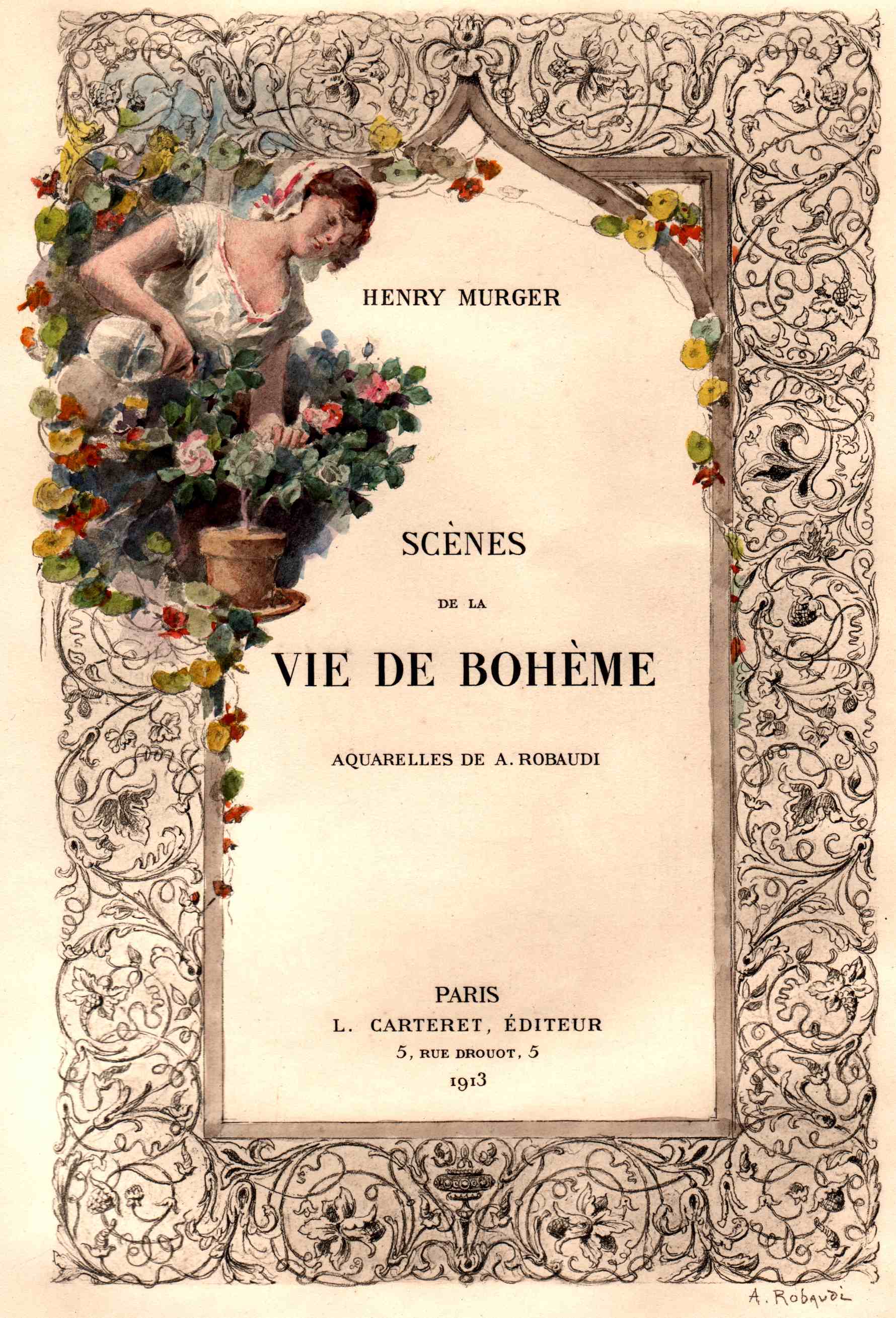
File:Murger Boheme couverture light.jpeg    But by the nineteenth century, when the rising middle class finally got there (they had been “rising” for centuries), writers and artists experienced a new freedom, but with it the need to please these arrivistes or enjoy the charms of poverty and near starvation.  This was the Romantic age, which glorified the artist as a tortured genius, finer and braver than the triumphant but often ill-informed and insensitive bourgeoisie.  These hungry and often antisocial rebels clustered together on the Left Bank and formed a nonconformist society of their own, a society that was portrayed in Henry Murger’s play Scènes de la vie de Bohème, which, when first produced in Paris in 1849, was an enormous success. 

     All the Western world became fascinated by these new young bohemians, and Murger’s 1851 book of the same title became an international best seller.  Puccini’s La Bohème, first  performed in Italy in 1896, was based on Murger’s book and perpetuated its idealized sketch of bohemian life.  In the first act, when the quartet of free-living young men are confronted by the landlord who wants his rent, and avoid coughing it up by getting the landlord drunk, I have always had issues with the story.  No Paris or New York landlord worthy of the name would have let himself be stymied so easily; within minutes he would have the minions of the Law there, and the non-rent-paying tenants would have found themselves duly dumped on the street.  But then, why let a touch of reality spoil a charming and much-acclaimed opera?

Pfaff’s and the Queen of Bohemia

File:Pfaffs.jpg
Pfaff's, with Whitman seated in the foreground.
Presumably as imagined later by an artist.
     Bohemia came to these fair shores in the 1850s, and settled down – or let’s say surfaced and congregated – right here in the Village in a basement restaurant-saloon called Pfaff’s, under a delicatessen and shoe store at 645-647 Broadway, near Bleecker Street.  Broadway by then was the city’s main artery, its chief shopping district and entertainment zone and, after dark, its most notorious red-light district.  Just the place, then, for a hangout for a clutch of impoverished poets, journalists, artists, and a few actresses of dubious repute.  Presided over by a German Swiss named Charles Pfaff, it offered fine beers and wines, and real silver and chinaware, to the regular customers who sat at small tables in front, while a long table in back was reserved for the city’s first bohemian crowd.  The genial host welcomed them all, and no doubt realized that the free-living bunch in back would attract the curious eager to get a glimpse of bohemians.  And the ill-paid journalists and illustrators of the time appreciated the host’s letting them linger over their beers and run up substantial tabs. 

     Another opinion was voiced by the New York Times, a staunch upholder of integrity in a city that often had little of it.  A “Bohemian,” it opined in January 1858, was not quite, but close to, a loafer.  He has either written a flop of a play, painted a picture that didn’t sell, published an unreadable book, or composed an unsung opera.  Bohemians despised anything low or mean or inelegant, it granted, but they were not useful members of society.  There spoke the work-ethic of America, which would last as long as bohemia existed, each in a sense feeding off the other in a curious state of  symbiosis.  A work-ethic needs loafers it can despise and feel superior to; bohemia needs diligent, rent-paying, nose-to-the-grindstone types to rebel against.  No one can rebel against a vacuum.

File:Ada Clare.jpg
Ada Clare
     And who were these bohemians?  From 1859 on, a self-published, little-known poet who was also a self-proclaimed loafer, Walt Whitman.  But more of him anon.  The queen of the roost was Ada Clare, born Jane McElhenny into a well-to-do Charleston family in 1836.  Losing both parents as a child, she was raised by a grandfather who brought her to the North.  Breaking free from Southern gentility, she changed her name and went on the stage in New York and got her first poems published there.  (One explanation of the new name: a take-off of the Southern lady’s frequent utterance, “I declare,” as in, “Ah declare, General Beauregard, it’s time to open fire on Fort Sumtah.”)  She also fell in love with a famous pianist and composer named Louis Gottschalk, a notorious seducer by whom she had a son out of wedlock.  Far from hiding the fact in shame, as was considered appropriate in that Victorian age, she proclaimed it in calling cards announcing, “Miss Ada Clare and Son,” thus no doubt becoming the city’s first liberated woman, years before the celebrated shenanigans of Victoria Woodhull (see posts #39 and #40), who was christened Mrs. Satan.   

     In 1858, after travels with her son (and the calling card) abroad, including a look at bohemian Paris, Ada Clare returned to New York and was welcomed by the Pfaff regulars as the Queen of Bohemia.  Her complexion was pale, her eyes blue, and her hair short, blond, and wavy, and parted on the side like a boy’s.  Whitman called her “a perfect beauty” and credited her with intellect and cultivation.  Certainly her presence, plus that of several other single, unchaperoned women, gave Pfaff’s the requisite risqué atmosphere, so necessary to any authentic bohemian hangout.  (In those days any unchaperoned women seen in public were assumed to be prostitutes.)  In France Ada Clare might have been the hostess of a salon frequented by intellectuals and statesmen (albeit minus their wives, if such they had), but in New York the one immediate opportunity was Pfaff’s.

     A personal note:  I know how special and liberating such an atmosphere can be, having sampled it here in the Village at the famous San Remo, on the corner of Bleecker and MacDougal, circa 1959 and 1961-65, and again at the Co-Existence Bagel Shop in North Beach, San Francisco, in 1960-61, when I was hovering on the fringe of bohemia and observing with fascination and wariness its mix of beatniks, hustlers, drunks, and leeches, plus a few real artists and poets and liberated women – a group I loved to rub easy elbows with, up to a point, but that I was too square, too bourgeois, too concerned with my financial well-being, to embrace wholeheartedly.  But, as I once heard author Jean Houston say, “Groups are juicy.”  Yes they are, some of them, though others can be stultifying.  The ones at the Sam Remo and the Co-Existence Bagel Shop were fun, and gave you the feeling that you were in just the right place at just the right time, though I wouldn’t quite call them creative.  A human amusement park would be more to the point, a scene not to be missed, but not to be lingered in too long.  Knowing when to quit is half of successful living.  (And the other half?  At the moment, I haven’t a clue.)

     Ada Clare gave acting a try, but excelled mostly in sharp-tongued literary and theater criticism, dismissing works she deemed inferior with scorn.  At her home in the uptown wilds of West 42nd Street, she is said to have held Sunday evening soirées for men who had distinguished themselves in the arts, war, and philanthropy, and for women who were beautiful and brilliant.  If so, she came close after all to emulating the grandes horizontales of France, the cocottes who offered charm and intelligence as well as delights  of the flesh.

Walt Whitman, and how gay was he?
   
File:Walt Whitman, steel engraving, July 1854.jpg
One of the roughs.
    In 1855 Whitman had published the first edition of Leaves of Grass, unsigned, but with an engraving of himself, bearded, in a loose open shirt and what look like dungarees, head tilted under a wide-brimmed hat, with one hand on his hip and the other in his pocket, the whole pose loose, casual, relaxed.  This was not at all the image of the poet of that time. 

     If Americans had an image of the poet – and most of them were too busy to bother with such nonsense – it was probably a Byronic look such as McDonald Clarke (see post #85) had effected: clean-shaven with an open collar, tousled hair, hatless, rather handsome features, preferably with a hint of elegance and sensitivity.  This was the Romantic poet, well-groomed or not (one was, after all, a rebel), not dainty but not rough.  And a bit of inner torment was requisite, as seen in that quintessential Romantic, the poet Hoffmann, the protagonist of Offenbach’s opera Tales of Hoffmann: a tormented genius plagued by an evil nemesis and doomed repeatedly in love, foundering at last in drink.  Whatever the variation, the Romantic was a man apart, out of the mainstream, a visionary misunderstood by others, a rebel, an outcast. 

File:McDonald Clarke - Appleton's cyclopaedia.jpg
McDonald Clarke, definitely not
one of the roughs.

     But Whitman presents himself differently.  The engraving in the unsigned first edition suggests a man of the people, very working class, and in the opening poem of the volume, now called “A Song of Myself,” he reveals  himself as “Walt Whitman, an American, one of the roughs, a kosmos, disorderly, fleshly, and sensual.”  And the poetry itself is healthy, robust, expansive, all-embracing.  This is a poet speaking for America who hopes that America will listen.  No inner torment here, no broodings of an outcast. 

     Of course Walt Whitman was homosexual; no one doubts that today.  But was he in his own time “out”?  That is a question not so easily answered.  I am annoyed by current gay biographers who simply assume that every contact Whitman had with younger men was sexual; it strikes me as a projection of modern attitudes onto an earlier age when homosexuality (the word had yet to be invented) was universally condemned as a crime against nature.  For many years I inclined to the opinion of an earlier biographer whose name escapes me, but who suggested that Whitman may not have had sexual experience: “For his work to be complete, maybe his life had to be incomplete.”  This made sense to me, since many an author has recounted experiences that he (or she) can have known only in fantasy.  Stendhal comes at once to mind, but the supreme example surely is Shakespeare.  So why not Whitman?

     Certainly what we know of him poses contradictions.  The Calamus section of Leaves of Grass, which first  appeared in the 1860 edition, celebrates “manly attachment,” “the need of comrades,” “athletic love,” and declares that he will unbare his broad breast, having long enough “stifled and choked.”  Here now is a hint of inner torment.  And he goes further:

    Here to put your lips upon mine I permit you,
    With the comrade’s long-dwelling kiss or the new husband’s kiss,
    For I am the new husband and the comrade.

Which, for mid-nineteenth-century America, was pretty daring.  Let’s face it, whether fantasy or not, the Calamus poems are “hot.”  In fact, they’re torrid.

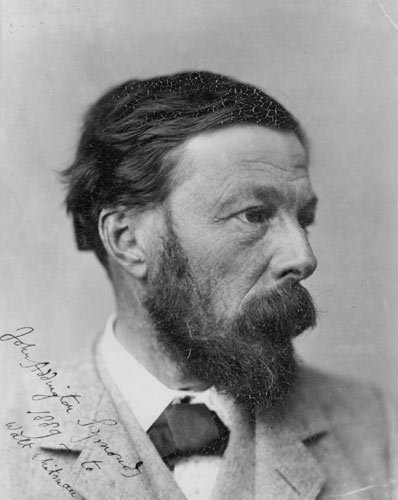
File:Symonds, John Addington.jpg
John Addington Symonds.  An 1889
photo autographed to Walt Whitman.
     What complicates things is the correspondence between Whitman and the English man of letters John Addington Symonds, a married homosexual who had fathered four daughters.  Symonds discovered Whitman’s poetry in 1865, was overwhelmed by the Calamus poems, and wrote Whitman an admiring letter in 1871, thus initiating an intermittent correspondence that would last many years.  In subsequent letters he addressed Whitman as “My dear Master,” yet skirted around the subject of his own homosexuality while pressing Whitman to say more about the male bonding of Calamus.  After years of beating around the sexual bush, in August 1890 Symonds wrote Whitman asking pointedly about the homosexual content of the Calamus poems.  Whitman’s response was an angry and defensive denial, spiced up with the preposterous claim that he had fathered six illegitimate children, confirming evidence of which, needless to say, has never come to light.  Whitman’s heated reply has provided fuel and fodder to all those determined to establish the poet’s heterosexuality or, failing that, his bisexuality, and has certainly added greatly to the enigma of his sex life.

     Here is where I find John Strausbaugh’s account convincing.  Whitman began frequenting Pfaff’s in 1859, eager to get attention for himself and a forthcoming third edition – the one with the Calamus poems – of Leaves of Grass.  The first edition, generally ignored, had garnered a few reviews that dismissed it as “stupid filth,” “twaddle,” and “a muck of abomination,” and one that, long before the Calamus poems had appeared, denounced the poet for “the horrible sin not to be named among Christians,” which the critic discreetly phrased in Latin.  The second edition of 1856 had been received with silence.  At Pfaff’s the poet, then forty, enjoyed the high spirits of the younger crowd, who, as Strausbaugh tells it, accepted him and were no more bothered by his homosexuality than they were by Ada Clare’s status as an unwed mother.  In other words, at least to a small circle of fellow bohemians, Walt Whitman was definitely “out.”

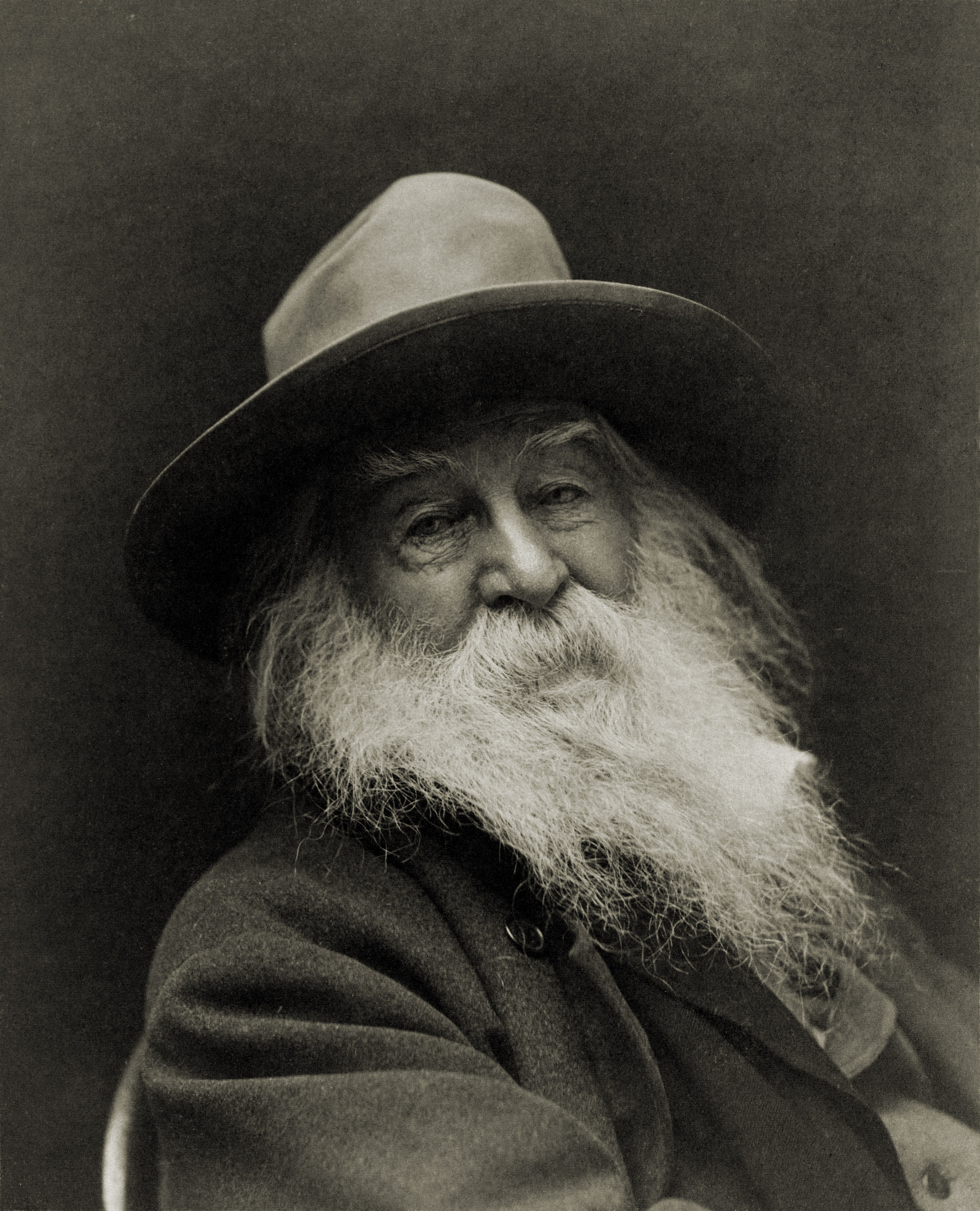
File:Walt Whitman edit 2.jpg
The good gray poet, albeit closeted, in 1887.  A favorite
 photo of his, a copy of which he sent to Tennyson in England.

     And what about the famous 1890 letter of denial that Whitman sent to Symonds?  By that time Whitman had achieved a modest amount of recognition and was surrounded by a coterie of younger admirers.  Given the attitudes of the age, he chose to protect his reputation as the “good gray poet” by denying his homosexuality flat out.  It’s too easy today to criticize this surrender, so in contrast with the boldness of the Calamus poems, but Whitman was living in another time.  Having been discreetly, to a small circle, “out,” he went back “in.”  And Symonds’s hesitation over time to deal with homosexuality directly and in a personal way should likewise be viewed with understanding.  Only five years later, in 1895, Oscar Wilde would be arrested and tried for “gross indecency,” convicted, and sentenced to two years in prison, the judge lamenting that this, the maximum sentence allowed, was totally inadequate for such a case. 

Epilogue

     The outbreak of the Civil War broke up the bohemian crowd at Pfaff’s.  Some of them joined the Army, and Whitman went to Washington to do volunteer work with the wounded in the hospitals. 

     Ada Clare’s years at Pfaff’s may well have been her best.  Subsequently she traveled, wrote, and acted, but her novel Only a Woman’s Heart (1866), relating her affair with Gottschalk, garnered harsh reviews, some of them from vengeful writers whom she had once savaged in reviews of her own.  After that she gave up writing and devoted herself to acting in a provincial stock company.  In 1874 she was bitten by a rabid dog, collapsed on a stage in Rochester, was brought back to New York by friends and installed on Bleecker Street in the Village, where she died a horrible death of rabies.  Informed, Whitman mourned the loss of a “gay, easy, sunny, free, loose, but not ungood life.”

     After the war Pfaff and others tried to revive the bohemian scene in the rathskeller, but it never quite came off.  Instead, the place became a respectable lager beer saloon, just one of many in the city.  Pfaff closed it, then in 1870 opened another uptown on 24th Street near Broadway.  In the mid-1870s Whitman visited him there and they reminisced over brim-full wine glasses about the old times and friends now mostly deceased.  Pfaff closed the new place in 1887 and died a few years later.


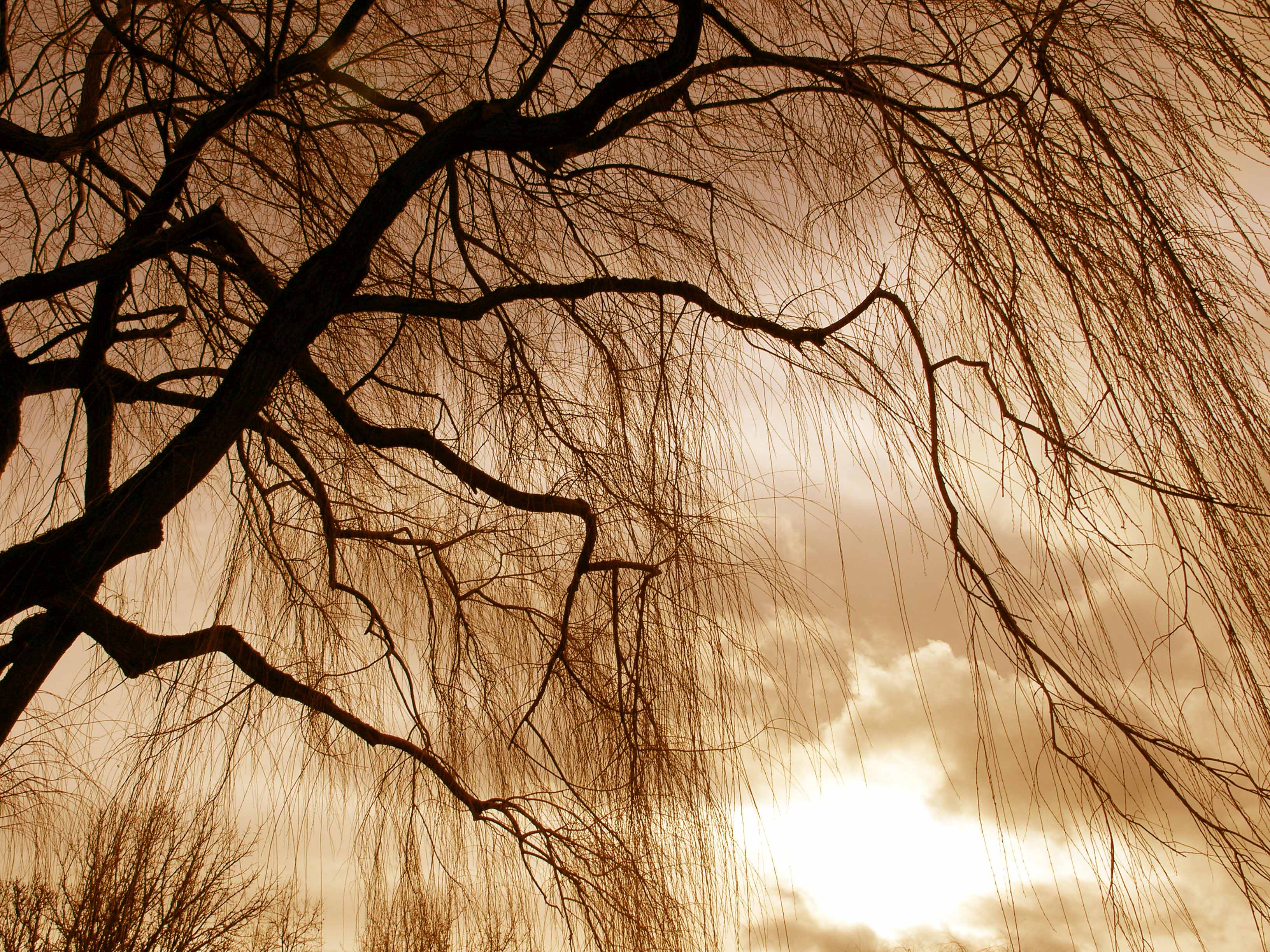
     Trees:  An article in the Times a week ago celebrated the wintry beauty of elm trees in Central Park, each branch and twig delicately lined with snow.  “A tabernacle in the air,” it proclaimed.  Yes, the bare skeletons of trees in winter, with or without snow, are a marvel to behold, and most of us don’t bother to behold.  I have already celebrated the beauty and wonder of trees in post #71, “The Magnificence and Insolence of Trees,” and urge all residents of the winter-besieged North to look about themselves in awe at the wonder of trees. 

File:Bare Tree 2.jpg


     Coming soon:  Fires and firemen in the city (my 2½ fires, why New Yorkers shrug off fire alarms, and the volunteer fire companies of yore).  After that:  How New Yorkers have fun (the options are endless and sometimes crazy).

     ©  2014  Clifford Browder