Sunday, January 12, 2014

108. Andy Warhol: Genius or Fraud?


     In an auction last November 13 at Sotheby’s here in New York, a grisly Andy Warhol painting, “Silver Car Crash (Double Disaster),” showing a body amid the wreckage of a car crash, was sold for $104.5 million, the highest price paid to date for one of the artist’s works.  The sale provoked much comment, some of it harshly negative, and rekindled the perennial debate as to the importance of Warhol as an artist, some seeing him as a genius and some as a fraud. 

     Recently I queried several friends, all knowledgeable New Yorkers, and got a consistently mixed reaction.  “So-so,” said one, adding that he could do without the repetitions, meaning the reduplications of celebrity portraits and other subjects.  My friend John felt that certain works, but not all, merited serious attention, citing in particular a silkscreen painting – just one, not fifty – of Marilyn Monroe, that the artist painted in 1962, soon after her suicide, and then reproduced many times; John found her expression and the vivid background coloring captivating. 

     A third friend, an artist who does landscapes and city views, saw early Warhol as defining a moment in art history but viewed the later work, always witty and entertaining, as lacking the depth of the earlier work.  When I questioned him about the “moment in art history,” he said that early Warhol in a small way recognized and visualized a decade in which American decadence had a defining influence on the course of civilization; by “decadence” he meant a materialistic view of the world, with instant gratification and idol worship (Marilyn, Elvis, Liz Taylor) thrown in.  My partner Bob, who loves abstract expressionism, is frankly scornful of Warhol, whose work he deems simplistic, commercial, and lacking in depth; “I’ve never seen a work of his that I liked,” he explains.  As for me, less knowledgeable about modern American art than any of them, I am inclined to share Bob’s reaction, opining that Warhol was indeed a genius … of self-promotion.  But maybe I’ll be moved to – just a little – change my mind.
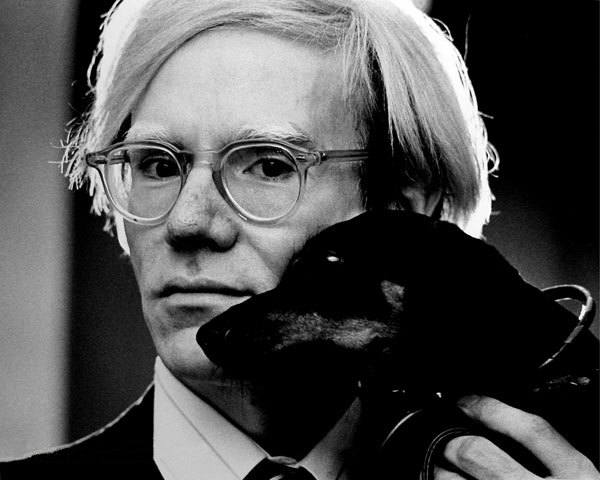
File:Andy Warhol by Jack Mitchell.jpg
Andy with a friend.
Jack Mitchell
File:Warhol-Campbell Soup-1-screenprint-1968.jpg     No one would deny that Warhol, the Prince of Pop, probably alone of twentieth-century American artists, made his name a household word for his generation and  beyond; people who know little or nothing about art have heard of him and sometimes have opinions.  He surfaced in New York in the 1950s as a successful and very well paid commercial artist and an innovator in silkscreen painting.  In the 1960s his Pop art was widely displayed in exhibitions featuring such attention-getting creations as Campbell’s Soup Cans, 100 Coke Bottles, and 100 Dollar Bills, plus renderings of vacuum cleaners and hamburgers, and garish portraits of celebrities like Marilyn Monroe, Elvis Presley, Marlon Brando, and Mohammad Ali.  He himself became a celebrity, his youthful features, with long blond hair and  glasses, becoming known to the public through photos and self-portraits. 

File:Exploding Plastic Inevitable.png
Poster for Exploding Plastic
Inevitable, a 1966 multimedia
spectacle by Warhol that featured
The Velvet Undergound.
     Warhol’s studio at 231 East 47th Street, dubbed the Factory (it was in fact an abandoned hat factory), proved a magnet for avant-garde artists, writers, musicians, and assorted drug addicts, weirdos, and crazies, all of them Warhol devotees over whom, even with his gentle demeanor, he is said to have reigned tyrannically.  Out of the Factory came quantities of Pop art, avant-garde films, multimedia happenings, and the music of The Velvet Underground, a rock band managed by him, which enjoyed phenomenal success.  At Factory parties celebrities and socialites rubbed shins with drag queens and hustlers in a unique setting where everything, from the floor to toilet handles, was painted silver, and there were drugs galore.

     Then, in June of the pivotal year 1968, just after Warhol moved to a new studio on the sixth floor of 33 Union Square West, the radical feminist Valerie Solanas, author of a tract advocating the elimination of men, shot him, inflicting a wound that was almost fatal.  I remember how this was big news, until Robert Kennedy’s assassination three days later relegated the Warhol story to the back pages.  Solanas later pleaded guilty to reckless assault, was sentenced to three years in prison and released in 1971, phoned Warhol and threatened him again, then was rearrested and subsequently institutionalized several times before fading into obscurity.  That Solanas, hating men, should pick Warhol as her victim is curious, since he never claimed to be, or wanted to be, a sterling specimen of manhood.  My take on the two of them is simple: she’s a bore; he’s interesting.  In her photos she looks like she's been force-fed on hate.  But she has been hailed – by a few – as a “girl Nietzsche,” Medusa, an anti-patriarchal avant-garde militant, and a feminist/lesbian revolutionary ahead of her time.  For that fifteen minutes of fame that Warhol says we all get, it seems that all you have to do is shoot someone.

     Following the shooting Warhol was out of commission for weeks.  He was released from the hospital in July, and on his first sortie out of his house he went to 42nd Street to see a porno movie and bought, according to a friend who went with him, the dirtiest magazines he could find.  But the Factory, now much more tightly controlled, was never the same again.  It is said that Warhol was so afraid of further attacks by Solanas that he would jump if even a good friend touched him.  He was less scandal-prone and likewise less successful in the 1970s, when critics began criticizing his celebrity portraits as superficial and overtly commercial, but reaped more critical and financial success in the 1980s.  By then his long graying hair, over a gaunt face, looked at times like a fright wig; aging was not kind.  In 1987 he died following gallbladder surgery at 58. 

     I probably first heard of Andy Warhol when his Campbell’s soup cans caused a splash in 1962, but I never met him.  We were exact contemporaries but moved in different worlds; toiling then in the glades of Academe, I would have found his entourage too bizarre, and the drug scene of the Factory repellent.  Besides, the idea of 32 Campbell’s soup cans as art, especially when exhibited in a single line like products on a shelf, turned me off, old fogey that I am, so that right from the start I was suspicious of his antics and his art.  The same goes for 100 Coke bottles, or 100 dollar bills, or however many images of captivating Marilyn Monroe he produced. 

     But my friend John has a different take on both the artist and his art.  John knew him in his early years in the 1950s and has shared his impressions with me.  An editor at Interiors magazine (see post #47), he got to know Andy Warhol when Warhol did cover art for the publication.  John remembers commissioning him for cover art and some drawings to be used inside the magazine for the princely sum of $25.00.  John’s personal impression: the artist was a gentle soul, otherworldly and precious; he describes him as “featherly.”  Easygoing and friendly, Warhol was accessible; one could readily address him as “Andy.”  Though he was beginning to show his serious art, he was not impressed with himself, not at all the ego-driven artist; above all, he was accommodating.  For a feature article by John on music, Warhol did a semiabstract cover showing a speaker with sound waves.  When the publisher saw it, he asked John to have Warhol add a small picture of an interior.  John was fearful that the artist would resent this interference with his creation, but Andy replied, in his soft fey voice, “Oh that’s okay, John.  That’s okay.”  Yes, accommodating in the extreme.

     His sexuality was enigmatic.  Certainly he was gay and on the femme side; blond and “featherly,” he may have had a rough time in high school, though to my knowledge this has not been commented on.  When he first hit the New York art scene, he says that the other gay artists kept him at a distance, deeming him too “swish.”  Homoeroticism permeates much of his work, yet when interviewed in 1980 he claimed he was still a virgin, which confirms the impression that I always had of him.  His doctor has stated that on his scrotum Warhol had prominent blood vessels like a cluster of little rubies, a condition that made him self-conscious and ashamed.  That may well explain why he seems to have preferred voyeurism to full participation.  His interest in porn, and the male nudity exhibited in some of his films, would seem to confirm this.  “Fantasy love,” he once said, “is much better than reality love.  Never doing it is very exciting.”  Furthermore, John has told me how a friend of his attended a gay party where Andy Warhol was present.  During some sort of sadomasochistic exhibition Warhol, standing next to him, kept uttering an emphatic “Wow!” 

     Whitman’s sexuality, like Warhol’s, was enigmatic; some gay lib advocates of today have assumed that every young man he befriended was a lover, but there is no hard evidence of this.  Certainly his Calamus poems are suffused with eroticism.  But a biographer once said of him, “Perhaps for his work to be complete, his life had to be incomplete.”  The same could well have been true of Warhol.

     Well reported on as Andy Warhol is, there are facts about him that many people probably don’t know.  Here are some, culled from the Internet:

·      He was born Andrej Varhola, Jr., in Pittsburgh in 1928, the son of working-class immigrants from Slovakia.  His father worked in a coal mine or did construction work, depending on the source.
·      In third grade he had St. Vitus’ Dance (Sydenham’s chorea), a nervous system disease causing involuntary movements of the limbs, and became a hypochondriac, fearing doctors and hospitals.  As a result, he probably delayed having his gallbladder problems treated, leading to his death in 1987.
·      A self-proclaimed mama’s boy, he lived with his mother in New York from 1952 to 1971; she died in 1972.
·      He praised Coca-Cola as a distinctly American and democratic phenomenon: all Cokes are the same, and everyone drinks them -- the President, Liz Taylor, and the bum on the street.
·      He is said to have phoned his press agent every morning.
·      He said that, contrary to popular opinion, movies make things look real, whereas real life is like watching television.  When he was shot, he knew that he was watching television; it was unreal.
·      He once said: “I love Los Angeles.  I love Hollywood.  They’re so beautiful.  Everything’s plastic, but I love plastic.  I want to be plastic.”
·      Another quote: “I am a deeply superficial person.”
·      Boys who came to lunch and drank too much wine were amused or even flattered, when he asked them to help him “paint” by emptying their bladder on canvases primed with copper-based paint.
·      He was a practicing Ruthenian Catholic and regularly attended Mass at the Roman Catholic church of St. Vincent Ferrer, at Lexington and East 66th Street in Manhattan.
·      The IRS audited him every year from 1972 until his death in 1987.
·      One critic called him "the Nothingness Himself."  Warhol’s comment: “I’m still obsessed with the idea of looking into the mirror and seeing no one, nothing.”
·      He and his friends are said to have bought 2,000 bottles of Dom PĂ©rignon to be consumed at the millennium.  After his death, and long before the millennium,  the bottles disappeared. 
·      When he was buried in a suburb of Pittsburg in 1987, a copy of Interview, a gossip magazine founded by him, was dropped into the grave, along with an Interview T-shirt and a bottle of Estee Lauder perfume.
·      When Sotheby’s auctioned his estate, it took nine days and grossed more than twenty million dollars.
·      The Andy Warhol Museum in Pittsburgh, with seven floors and 17 galleries harboring his art, films, and archives, is the biggest museum in the country devoted to a single artist.
        
     There remains my original question: Andy Warhol, genius or fraud?  So where do I come out?  Certainly, as I said earlier, he was a genius at self-promotion.  I find him, perhaps not a great artist, but a fascinating phenomenon.  Indeed, I’m much less drawn to Andy Warhol the artist than to Andy Warhol the person, whose contradictions intrigue me: a virginal voyeur who needed people around him yet seems never to have revealed himself fully to others.   And the very things so many of us deplore in American culture – crass commercialism, the cult of celebrities, the commodification of art, Hollywood, money, Coca-Cola, plastic – he embraced and glorified.  But to label him either genius or fraud is too simplistic; he may have had a bit of both in him but can’t be described so easily.  Somehow he evolved from the gentle, accommodating person my friend John knew in the 1950s into the reigning monarch of the Factory in the 1960s, ruling his court like an autocrat and reveling in the fawning admiration of his courtiers.  Obviously, they needed him, but he needed them as well.  And from the beginning to the end of his career, I think he can be fairly described in his own words: “I am a deeply superficial person.”

     Curiously, the Sizzling Sixties, that era of liberation – gay lib, women’s lib, and campus rebellions nationwide – was also characterized by autocrats: Rudolph Bing at the Met (post #84), Lee Strasberg at the Actors Studio (post #41), Robert Moses at the Triborough Bridge and Tunnel Authority (post #78, though by then he was on his way out), and Andy Warhol at the Factory.  But all these figures, autocrats or not, were immensely creative and produced results.

     When all is said and done, I still am amazed that some anonymous buyer forked over $104.5 million for a Warhol painting.  After all, he was buying the work not of an Old Master but a Young Phenomenon.  But who knows how Andy Warhol’s reputation as an artist will fare in the future?  These things are unpredictable.  As an example I cite the French painter Puvis de Chavannes (1824-1898).  What, you never heard of him?  Or his name only rings a faint tinkle in the cave of memory?  Well, his murals and oil paintings were hot stuff back in the Third Republic, when the Impressionists were first getting known.  And today, he rates close to zero or, as my friend John has remarked, as “nineteenth-century kitsch.”   So it goes in the art world, as one taste yields to another, and that one to still another.  Will this be Andy Warhol’s fate?  I wouldn’t presume to say.  But there will be more reminiscences and biographies of him – scores, hundreds – for he is an enigmatic and fascinating subject.

File:Puvis de Chavannes - L'Esperance.jpg
Puvis de Chavannes, L'Espérance (Hope).

     If Andy Warhol still exists in some higher mode of being and is aware that a work of his sold for $104.5 million, I’m sure he’s smiling.  Unless, of course, he’s too busy silkscreening God.
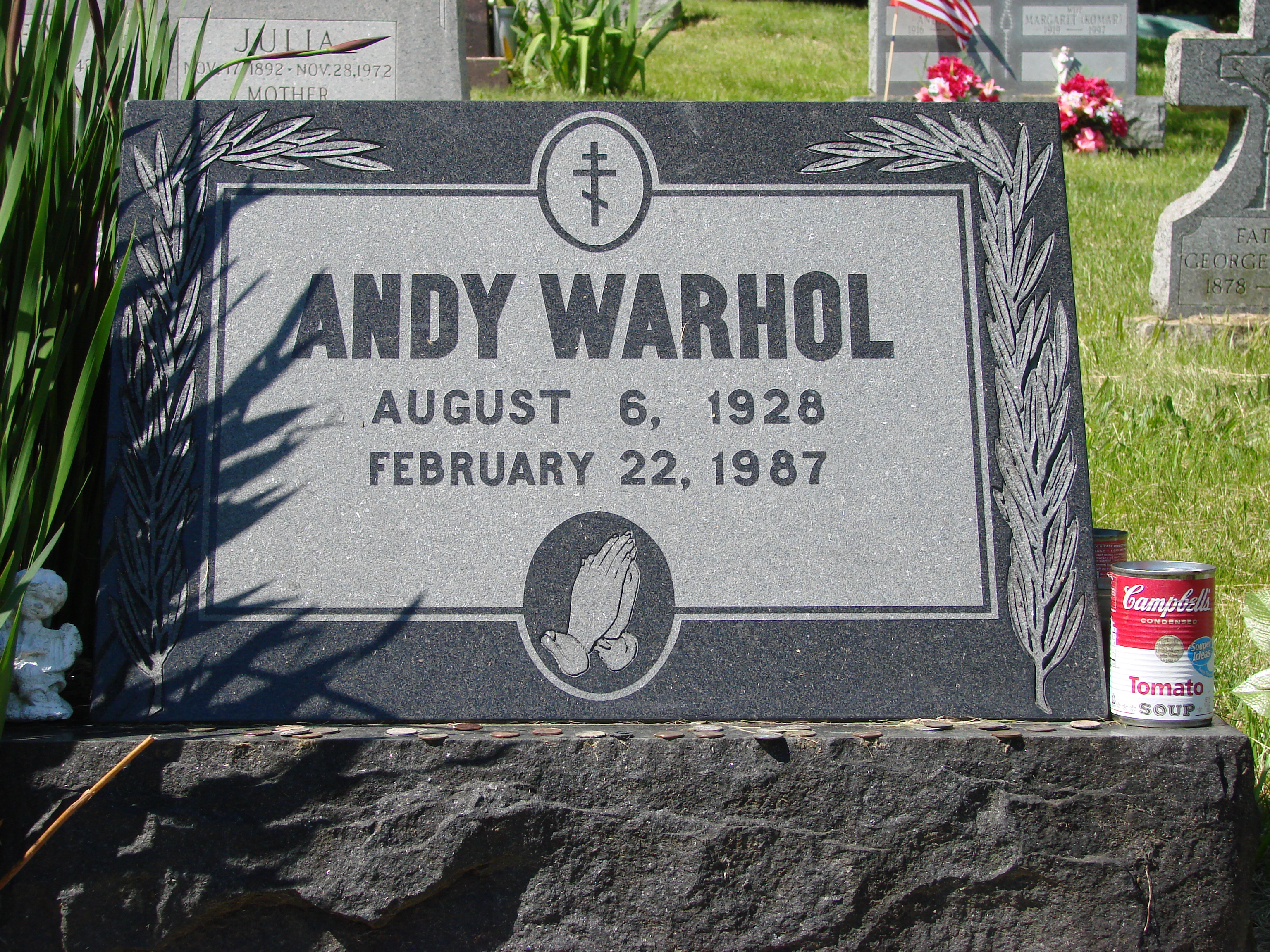
File:Warhol's grave.jpg
                                                                                                        Allie Caulfield
    
     A sobering thought:  Bourgeois that I am, I can’t help but ask who, at the Factory in its heyday, did the floors and the bathroom.  A maid?  Volunteers?  His mother?  Andy himself??  And who cleaned up after those legendary parties?  Maybe his archives have the answer.

     A note on Judith Malina:  In post #94 I discussed the Living Theater, its propensity for nudity, and why I kept my clothes on.  From a recent article in the New York Times I have now learned that its cofounder and artistic director, Judith Malina, afflicted with emphysema and confined to a wheelchair, is still going strong at age 87.  A year ago she lost the Lower East Side home of the Living, and the commercial space above it where she had lived for six years, because she couldn’t pay the rent.  She has had vast experience in losing leases, but this was different.  “I was crying, screaming,” she says.  “They had to carry me to the car.”  She now lives in an assisted-living residence for theater people in Englewood, New Jersey, where she is writing and making plans to direct new works.  She likes her neighbors and the serenity of the grounds there, but yearns for the creativity of the Lower East Side, her home of many years.  “If there’s going to be a beautiful, nonviolent revolution,” she insists, “it’s going to start there.”  Living Theater actors visit her almost daily, and she gets into Manhattan once a week.  “I feel very exiled, abandoned,” she admits, but she continues to write in her diary, some of which has been published, and next spring hopes to direct a new play of hers in Manhattan.  Though she seems to keep her clothes on now, this woman is unchanged, unreconstructed.  Bravo, Judith!  Keep at it as long as you can.

     Congressional millionaires:  According to the nonprofit Center for Responsive Politics, at least 268 of the 534 members of Congress had a net worth of over $1 million in 2012.  At the top of the list is Representative Darrell Issa, Republican of California, with $330 million or more.  At the bottom, poor David Valadao, another Republican of California, with debts of about $12.1 million from loans on a family dairy farm.  I confess that I'm surprised, since I thought that all our Congress folk, without exception, were millionaires.  How else to explain their letting unemployment benefits expire for over a million Americans?  Well, if they aren't all millionaires yet, they will be, if they play their cards right.  

     Coming soon:  Four Forgotten New York Murders (the Girl in Green, a society dentist, Old Shakespeare, and Ah Hoon); Maritime New York: the Slave Trade and the China Trade (horrors, then hong merchants, white devils, and the Son of Heaven).

     ©  2014  Clifford Browder


Sunday, January 5, 2014

107. Two Famous New York Murders


     New York City is not the murder capital of the nation or the world, an honor that other municipalities here and abroad can contend for; currently its homicide rate is in fact declining and has reached a 45-year low.  But given its large population and abundance of newspapers, it has witnessed and recorded a fair number of murders over the years, famous and well reported in their time, if often forgotten today.  This post will recount two of them, starting with a spectacular one involving many witnesses and therefore recorded in detail, unlike so many murders that occur clandestinely, obliging us to only conjecture about what happened.  So let’s go back to the early 1900s and the Gilded Age, when crusty old J.P. Morgan ruled financially, the scandal-hungry tabloid press was rampant, and Teddy Roosevelt, who had reaped glory by charging up San Juan Hill, was president. 

Stanford White, 1906

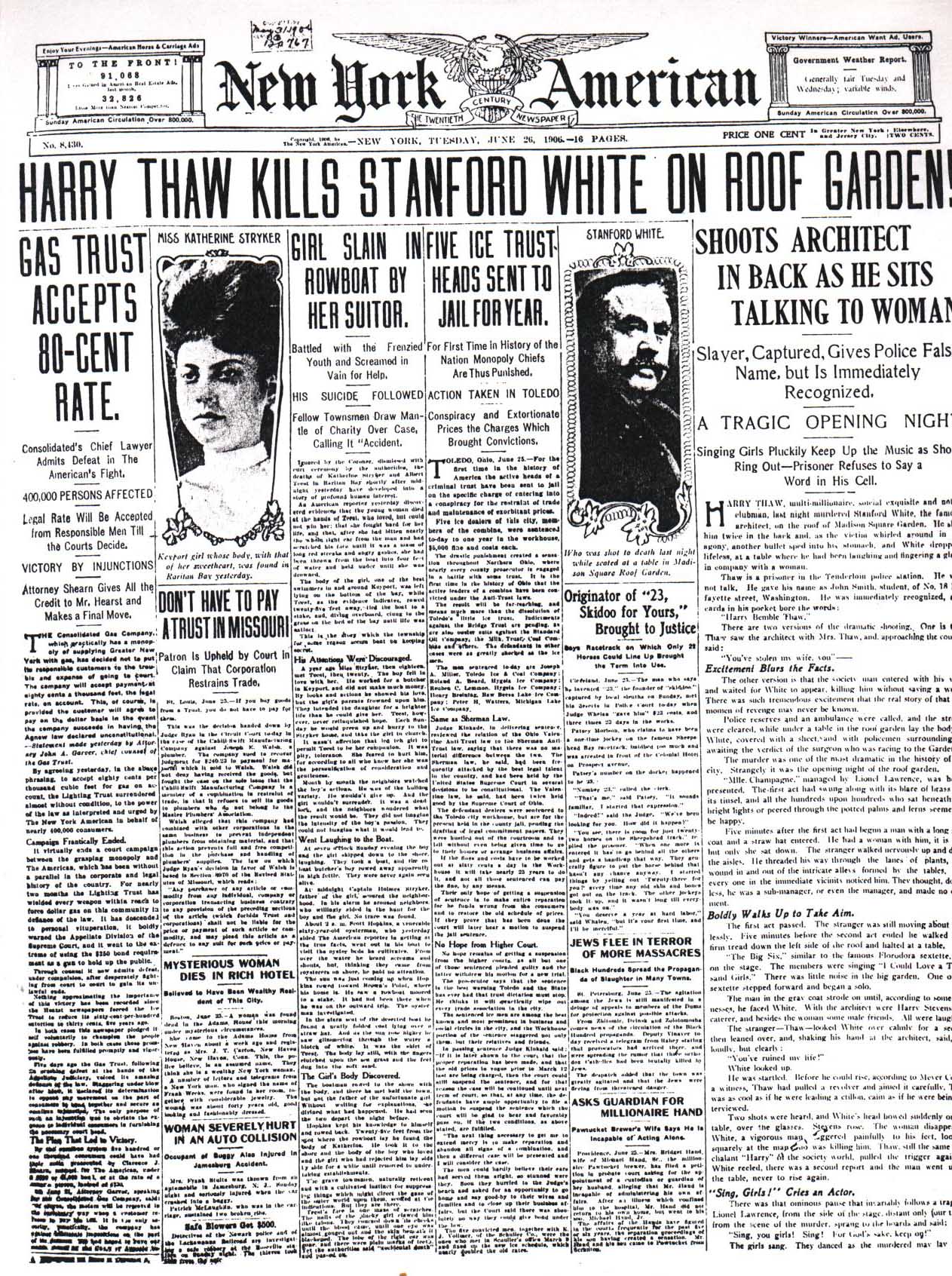
     On the evening of June 25, 1906, a fashionable audience was assembled on the rooftop of Madison Square Garden, a vast Beaux-Arts structure with a soaring minaret-like tower at 26th Street and Madison Avenue, for the premiere of the frothy musical comedy Mamzelle Champagne.  At 10:55 p.m., while the performance was nearing its conclusion, a burly redheaded gentleman of fifty with an abundant red mustache entered alone and sat at the table customarily reserved for him, five rows from the stage.  Resting his chin in his right hand, he seemed lost in thought, perhaps eyeing the young female performers onstage, as was his custom, since he was a practiced connoisseur of teen-age girls. 

File:Stanford white 11.jpg
Stanford White.  The cleanshaven look
was coming in with the new century,
but the older set remained hirsute.
     The redheaded gentleman was none other than Stanford White, the most renowned architect in the nation, whose firm had designed the very structure  he was then in, as well as countless others, including the Judson Memorial Church on Washington Square and the Washington Square Arch, located in that square at the foot of Fifth Avenue.  Unknown to his wife and family, his separate apartment on 24th Street, supposedly a place where he could work uninterrupted, provided a sumptuous setting for his numerous teen-age conquests, including one room with a red-velvet swing suspended from the ceiling with ivy-twined ropes, where his young mistresses often disported.  White’s presence at the rooftop garden theater resulted from a last-minute decision when he postponed a planned trip to Philadelphia because his nineteen-year-old son had arrived unexpectedly in the city for a visit; they had dined together, and White had come on to the Garden alone.

     Some ten minutes after White’s arrival a handsome younger man left his own table, walked about nervously while muttering to himself, then approached White’s table.  As a performer onstage began the song “I Could Love a Million Girls,” the younger man took out a revolver from beneath his coat and fired three shots at point-blank range into White, one bullet hitting his left eye and killing him, while the other two grazed his shoulder.  White’s lifeless body fell to the floor, and the table overturned with a clatter.

     A stunned silence gripped performers and audience alike.  Spectators thought at first that this was part of the performance or another of the party tricks common in fashionable circles at the time.  But then, grasping what had happened, people screamed, leaped to their feet, and began a panicky flight toward the exits.  At the theater manager’s insistence, the orchestra made a feeble attempt to go on playing, but the performers were frozen in horror and the panic continued.  Someone put a  tablecloth over the body and, when blood soaked through it, added a second one as well.

File:Harry Kendall Thaw circa 1905.jpg
Harry Thaw.  Baby-faced?
Yes, just a bit.
     The murderer had left holding his weapon aloft to indicate that he was done shooting.  When he reached the elevators, a bystander took the revolver away from him, and a policeman arrested him.  “That man ruined my wife,” said the murderer.  Just before the policeman took his prisoner down in an elevator, a woman rushed up and embraced him; witnesses said they believed it was the murderer’s wife.   The policeman then escorted the man out of the building on the way to a police station in the Tenderloin; the man did not resist, seemed dazed.  Garden employees recognized him as Harry Thaw, a Pittsburgh millionaire and man about town whose wife was Evelyn Nesbit, a beauty with a bit of a past.

     The story that came out in Thaw’s subsequent trial for murder has different versions, depending on who told it and why.  It is clear that Evelyn Nesbit came to Stanford White’s attention when, at age sixteen and already a successful model, she performed in the musical Floradora, an import from London that had opened on Broadway in 1900 and proved an astonishing success.  Prominent in the show was a luscious sextet of young women, dubbed the Floradora girls, who attracted scores of admirers; all of the original six, it is said, ended up marrying millionaires.   

File:Florodora sextet.jpg
The luscious sextet.  With male escorts, but who noticed them?

     The eyes are the scouts of the heart.  It was as a Floradora girl with long, dark hair that hauntingly beautiful young Evelyn caught the eye of Stanford White, who impressed her with his wealth and winning ways.  (Does “hauntingly beautiful” sound overdone?  Just look at the photos of her at that time.)  According to one version told by her, he drugged her with champagne and deflowered her, following which she professed to hate him.  But in another version she described herself, a young innocent from Pittsburgh, as dazzled by his attentions and a somewhat willing victim.  In any event, she became his mistress for a while, swinging on the red velvet swing, until, as she matured, he lost interest in her and moved on to other conquests, though not without maintaining a rather fatherly interest in her and on occasion providing her with funds.

File:Evelyn Nesbit by Sarony Studio, 1901.jpg
Evelyn at sweet sixteen.  If this one
doesn't grab you...
 
File:NesbitKasebier.jpg
... how about this one?  Beauty that men would
die for, and at least one did.

     But Evelyn had another admirer, Harry Thaw, a mentally unstable playboy (the word first appeared about now, possibly in reference to him) who also plied her with gifts and attention, slowly overcoming her resistance with his declared ardor and repeated proposals of marriage, which she finally accepted.  Even before they married, he had pressed her repeatedly for details of her relationship with White, exhibiting a jealousy that amounted to an obsession.

     White was aware of Thaw, though perhaps not of Thaw’s mounting hatred of his wife’s onetime seducer.  For the New York upper crust the term “Pittsburgh millionaire” suggested nouveau riche, unmannerly, brash, and this was certainly White’s opinion of Thaw, whom he dismissed as a clown,  calling the baby-faced younger man the “Pennsylvania pug.”  For his part Thaw hated White and blamed him for his exclusion from the city’s elite men’s clubs and other perceived slights, but envied White’s social position and freewheeling life style.  All of which led up to the events of June 25, 1906.

File:Stanford White 33.jpg

File:Thaw in jail.tiff
Harry Thaw in the Tombs, dining on food catered
by Delmonico's.

     The news of the murder was blazoned in the press, and especially in the sensationalist tabloids of the day, who branded White a “sybarite of debauchery” and worse, while friends of his defended him and praised his accomplishments as an architect.  Meanwhile, lodged in the Tombs pending what promised to be “the trial of the century,” Thaw wore his usual custom-tailored clothes, dined on meals catered by Delmonico’s, and enjoyed a daily ration of wine and champagne.  He expected the jury to see him as a chivalrous man defending innocent womanhood against a villainous predator.

     The prosecution tried Thaw in 1907 for premeditated murder, and Thaw’s lawyers mounted a defense of temporary insanity; the result was a hung jury.  His second trial in 1908 found him not guilty by reason of insanity and sentenced him to incarceration for life in a state hospital for the criminally insane.  There he lived comfortably, but when a legal attempt to free him failed, he escaped to Canada in 1913, only to be brought back to the U.S.  But he then obtained a new trial in which the jury found him not guilty and no longer insane and therefore set him free.  In later years he wrote a memoir defending his murder of White.  After further misadventures he died in 1947 at the age of 76, leaving Evelyn Nesbit a bequest of ten thousand dollars out of an estate valued at over one million.

File:Evelyn Nesbit and son, 1913.jpg
Evelyn with her son, 1913.
     Harry Thaw, irrational, wrath-prone, and a user of cocaine and morphine, was hardly the ideal husband, and Evelyn Nesbit wanted to divorce him.  Subsidized by Thaw’s family, she agreed to testify on his behalf as a loyal wife and did so, reinforcing the defense’s portrayal of White as a sexual predator.  In 1910 she gave birth to a son whom she claimed was Thaw’s, conceived during a conjugal visit to Thaw in the state prison, but all his life he vigorously denied paternity.  She divorced Thaw in 1915. 

     For ears afterward Evelyn Nesbit was plagued by her reputation as “the lethal beauty.”  In 1916 she married an actor, but his wife’s notoriety caused him to leave her, and she finally divorced him in 1933.  She seems to have run a speakeasy in Manhattan during the 1920s, and struggled with alcoholism and morphine addiction well into the 1930s.  She in turn published not one but two memoirs, and later taught ceramics and sculpture in Los Angeles in the 1940s and 1950s.  She died in a nursing home in California in 1967 at age 82.

     As a grade-school history buff in Evanston, a suburb of Chicago, from an early age I was well aware of two famous murders in distant New York City: Stanford White and Jim Fisk.  Fisk’s death and its aftermath I have recounted in post #69, “Jim Fisk, part 5: Such a Good Boy,” so it requires no repetition here.  As for White’s, I recall the 1955 film The Girl in the Red Velvet Swing, telling Evelyn Nesbit’s story, but had no idea that she was still alive at the time.  Indeed, she was hired by the studio as an adviser, though her advice seems not to have been taken since, in true Hollywood fashion,  the film’s version of her story is highly fictionalized. 

     Now, in researching this post online, I came across a 1954 interview with her in her small Los Angeles studio, where she was teaching sculpture and ceramics.  An accompanying photo showed her, tools in hand, beside an unfinished piece of sculpture: a woman of 69 in slacks with looks appropriate for her age but, inevitably, lacking the haunting beauty responsible for her earlier adventures and misadventures.  Her younger students were totally unaware of her past, but their grandmothers, she said, sometimes chatted with her about it.  Ah, once again the wonders of the Internet!  There she was, years later, a modest teacher in distant Los Angeles.  That this woman who years before, through no fault of her own, caused a famous murder should still be alive, however modestly, seemed inappropriate. 

     This is the same feeling I experienced on learning that Josie Mansfield, Jim Fisk’s inamorata and the cause of his murder in 1872, died in Boston forty years later, in 1912.  I almost want to shout at these aged survivors, “How dare you live on so many years after the peak experience of your life?  What meaning can all those surplus later years have, overshadowed as they must be by the turbulent events of your youth?  Don’t you know when to bow out?” 

     But that’s not how these things work; like it or not, there are usually survivors, shorn of beauty, drama, and glamour.  History, alas, is messy and leaves lots of loose ends dangling.

     The story of Stanford White’s murder, and the murderer and the woman involved, have taken up so much space that there is room for only one more homicide, if homicide it was.  So now let’s go back even further to 1841, when the eminently forgettable John Tyler was president, and the city was still recovering from the Panic of 1837, but importing tea and cutlery and textiles and fancy lace, and exporting grain and cotton.  And smoking.  Just the men, of course, not the ladies – perish the thought!  (You’ve come a long way, baby.)  And not cigarettes (those spindly things had yet to appear) – but big, fat, thick cigars.  And the men – some of them, at least, since others knew better – chewed.  Yes, in spite of Mrs. Trollope’s diatribes (see post #24).  Which is why the pothouses of the day (known later as saloons) had sawdust on the floor.  Enough said.

Mary Rogers, 1841

     She was known as the Beautiful Cigar Girl, the young woman working at John Anderson’s tobacco shop at 319 Broadway.  Her unusual good looks drew multitudes of males to the shop, some of whom lingered to exchange teasing glances with her, and one to feel such inspiration as to write a poem, later published in the New York Herald, extolling her heavenlike smile and starlike eyes.   Among the customers were such literary figures of the day as James Fenimore Cooper, Washington Irving, and the poet Fitz-Greene Halleck.  No wonder Anderson paid her well; his business was thriving.

     On the afternoon of Sunday, July 25, 1841, Mary, then twenty-one, told her fiancĂ©, Daniel Payne, that she would be visiting relatives.  She lived at her mother’s boardinghouse on Nassau Street, and when a severe thunderstorm developed and Mary didn’t return, the mother assumed that she was staying over with relatives.  But Mary did not return the following Monday; she had disappeared. 


     The news shocked the city, and it was shocked even more when, three days later, her body was found floating in the Hudson near Hoboken.  The coroner found finger marks on her throat, suggesting strangulation.  Now the press sensationalized the case even more, proposing suspects – Payne among them – and speculating as to what had happened.  The street gangs of the day were also accused, as well as the abortionist Madame Restell, who might have dumped her body in the river after a fatal abortion.  Then, weeks later, some articles of women’s clothing, including a handkerchief with the initials “M.R.,” were found near where the body had been discovered.  Frederica Loss, who ran a nearby tavern, recalled seeing a young woman there with a man on July 25; they dined in the tavern and left.  Later that evening she heard a scream outside.

     Daniel Payne had an alibi proving his innocence, but was suspected nonetheless.  He began drinking heavily and claimed to have seen Mary’s ghost.  On October 7, 1841, he took a ferry to Hoboken, drank heavily at Mrs. Loss’s tavern, then went outside and drank a fatal dose of laudanum.  Dying on the spot where Mary may have died, he left a note: “To the World – here I am on the very spot.  May God forgive me for my misspent life.”  Some took this as an admission of guilt, but most believed that despair at her death had led him to suicide.

     In November 1842 Frederica Loss, shot accidentally by her son, made a deathbed statement that Mary had come to her tavern on the fatal night with a doctor who performed an abortion.  Mary, she said, had died of complications, and Mrs. Loss’s son had dumped her body in the river.  This contradicted the coroner’s report of marks of strangulation, and his assertion that she had been a person of chastity, but the story was widely accepted.  The police evinced skepticism, however, and no arrest was ever made.

     Some sources assert that the newspapers, soon preoccupied with other crimes, lost interest in the Mary Rogers mystery, but this is not altogether the case.  In the November 8, 1845, issue of the fledgling National Police Gazette, a sensationalist publication whose coverage of crime and scandal soon brought it a large circulation nationwide, an anonymous letter to the editors suggested that Mary Rogers had indeed died a victim of abortion, and decried the three abortionists then known to be practicing in New York City, among them Madame Restell.  (For Restell, see post #32.)  And when a mob, worked up by a street agitator, marched on Madame Restell’s residence at 148 Greenwich Street on February 23, 1846, among their shouts was the cry, “Who murdered Mary Rogers?”  Only a police presence kept them from storming the house.

     In addition, the story of the Beautiful Cigar Girl had been enshrined in literature, for in 1842 Edgar Allen Poe published “The Mystery of Marie RogĂŞt,” based closely on the Mary Rogers story but set in Paris, a city he had never visited.  In Poe’s story the body is found in the Seine, and C. Auguste Dupin, a forerunner of Sherlock Holmes, unravels the mystery of the young woman’s death by studying accounts of her story in the press.  Dupin’s conclusion, reached by careful logical analysis: Marie was murdered by a naval officer with whom she had arranged a secret rendezvous; following this fatal lovers’ quarrel the guilt-ridden murderer dumped her body in the river and disappeared.  Frederica Loss’s deathbed statement regarding a botched abortion does not appear in Poe’s account.  That account leaves something to be desired.  One critic has called it “an able if tedious exercise in reasoning.”  Yes, lacking the blood and sinews of vividly described characters, it might strike many readers as tedious.

     At the end of his story Poe insists that his fictional solution of Marie RogĂŞt’s murder was not meant to solve the problem of Mary Rogers’s death.  That death, whether resulting from strangulation or abortion, remains one of New York City’s most noteworthy unsolved mysteries.  In the annals of the city’s homicides, there are  too many such mysteries, and no literary sequel to preserve them in our memory.

     For auld lang syne:  Many of us sing it on New Year’s Eve, as midnight approaches – often loudly and boozily – but few of us know what it means.  It’s a Scottish-dialect poem by Robert Burns set to music, and the repeated phrase “for auld lang syne” can be rendered as “for days long gone” or something similar; substitute this and it will all make sense.  The song is a reaffirmation of a friendship of long standing.  There are many verses, but few of us can manage more than the first, followed by the chorus:

For auld lang syne, my dear,
For auld lang syne,
We’ll take a cup o’ kindness yet
For auld lang syne.

It must be known internationally, for when I sang it to myself ineptly – as only I can do – on New Year’s Eve, our Haitian home care aide surprised Bob and me by announcing that he knew the song and could sing it in either French or Creole.

     Here now is an e-mail I received on New Year’s Day from a friend who once served in the State Department:

Happy New Year

It is strange the things you remember as time goes by.  
Thinking about the 88 New Year’s Eves that I remember, one in particular returns to me year after year.   It was the late Fifties and I was living in Antwerp.   I was duty officer and so confined to quarters next to the telephone with the radio for company.  I sat in the silence in front of a log fire in my living room,  And then, at the stroke of midnight came a wonderful sound.  All the many, many ships in Europe’s largest port began to sound their steam whistles.  And then on the BBC, a deep -voiced Scot., with his lovely accent,  quoted the last verse of Robbie Burns’ poem “For A’That”; it was a warm emotional and lovely moment.  And I pass the lines of the poem on to you with my fervent hope that Burns’ wish will be granted.

“Then let us pray that come it may,
(As come it will for a”that,)
That Sense and Worth, o’er a’;
The earth,
Shall bear the gree, an’a’that.
For a’that, an’a’that,
Its coming yet for a’that
That Man to Man, the world
O’er,
Shall brothers be for a’that.”


And I, Cliff Browder, summoning all the Scots' blood in me, wish the same to everyone.

     Coming soon:  Andy Warhol: Genius or Fraud?  And after that: Four Forgotten New York Murders.


     ©  2014  Clifford Browder