Wednesday, October 9, 2013

92. Rediscovering New York: West 12th Street and Columbus Circle


     New York City is inexhaustible; I am constantly discovering or rediscovering things in it.  This post is about West 12th Street and Columbus Circle, places I have visited innumerable times but that I have recently rediscovered.

West 12th Street

     It’s only two blocks from 11th Street, where I live, and I go there almost daily, so you’d think I knew it pretty well.  But there are aspects of it I never noticed until recently.  For instance, a hand-lettered sign, about 3 by 5 feet, posted conspicuously in front of 254 West 12th.  It says, in printed letters of diverse colors:

IF  WE  ALL  DO  ONE  RANDOM  ACT  OF  KINDNESS  DAILY  WE  JUST  MIGHT  SET  THE  WORLD  IN  THE  RIGHT  DIRECTION.    MARTIN  KORNFELD                                                                                              

     Who Martin Kornfeld is I don’t know, but presumably a young person, with all the glowing idealism of youth, who lives at this address.  I have passed his sign many times, but only this time did I linger long enough to absorb his message and write it down.  With that message who can argue?

     Just across the street and a few doors down is an old row house fronted by a stoop that I have passed many times but never been in.  Until last week, that is, when an alumni gathering from my high school in was held there, and I attended.  Our host, who welcomed us at the door, must own the whole building, but he managed to host some eighty of us on the parlor floor, where we stood around like penguins, chatting and gobbling the lavish feast he provided.  But this isn’t about alumni, it’s about the apartment, or what I could see of it, in spite of the thronging guests.  It was old, well furnished, spacious.  In back there was a balcony overlooking a ground-floor garden, but what most caught my eye was the ornate marble fireplace in the dining room, a reminder of the tasteful splendor that these old row houses, often drab and undistinguished on the outside, can harbor within.  I regret that I was unable to absorb more of the furnishings, well concealed by the crowd of guests. 

     Where West 12th Street crosses Greenwich Avenue, but a short distance farther on, there looms the hulking monstrosity of what was once the National Maritime Union headquarters, and now is, or at least has been, the Edward and Theresa O’Toole Building of St. Vincent’s Hospital.  Barriers and scaffolding now surround it along both West 12th Street and Seventh Avenue, raising my hopes of its utter demolition.  It should be obvious by now that I, who treasure both old buildings and Modernist monuments like Rockefeller Center and the Empire State Building, am not too fond of this structure.  It needs its own space, shouldn’t be here in the West Village.  Here, I loathe, hate, detest it, long to see it disappear.

File:NMU Building from south.jpg
In all its glory, before the current renovations.
Beyond My Ken

     But first, a word about it.  The west side of Seventh Avenue between Greenwich Avenue and West 14th Street has always struck me as a jumble of clashing architectural styles, a blatant example of our American inability to plan harmonious wholes, our willingness to let things occur haphazardly, even if eyesores result.  (Lincoln Center and Rockefeller Center are of course brilliant exceptions.)  Here, in the triangle formed by West 12th Street, Greenwich Avenue, and Seventh Avenue, there was once the looming hulk of an old Loew’s movie palace fronted by a huge marquee.  Next to the Loew’s was I don’t recall what, and next to that a Gothic-style Methodist church, and next to that a soaring modern apartment building, and next to that a commercial building hosting various shops and stores. A more displeasing juxtaposition of edifices I can barely imagine. 

     The movie palace is long since gone, as are the buildings next to it.  In place of those buildings, in the early 1960s, rose the National Maritime Union building.  Since the union was then doing well, it launched an aggressive building program, the first project being its headquarters, the Joseph Curran Building, on Seventh Avenue between West 12th and 13th Streets.  They hired New Orleans-based architect Albert C. Ledner to design some unique buildings for them, and unique is what he gave them.  Completed in 1964, the Curran Building consisted of two ground-floor glass block cylinders topped by four floors whose white walls were rendered as two half-circle scalloped overhangs suggesting portholes or waves, though to many ground-level viewers staring up they looked like gears, or rows of menacing teeth. 
    
     The ground floor housed the hiring halls, while on the floors above were offices and committee rooms, and on the roof, high above the hurly-burly of the avenue and almost invisible from the street, the executive offices.  The structure clashed violently with all the buildings around it, which is exactly what the architect intended.  The interior, which I never saw, was said to be impressive, but my concern was the exterior, which I took to be a sort of post-Modernist concoction, garish, tasteless, brash.  The structure was hailed by some as a clean break with the stale conformity of Modernism, a daring leap into something new.  Some leap!  From the street, to my untutored eye it looks like an unwieldy ocean liner lumbering ahead on a misguided cruise.

     Perhaps its construction was an act of hubris.  In any event, with the decline of the Port of New York the union’s fortunes waned, and in 1973 it was obliged to sell the building to St. Vincent’s Hospital, which was expanding from its base on the other side of Seventh Avenue.  Not that the hospital tore the building down; no such luck.  Instead, they renamed it the Edward and Theresa O’Toole Building and incorporated it, incongruous as it was, into their complex of buildings, moving their faculty practice offices and out-patient clinics into it.  So the eyesore – icon to some – remained.

     Is the site jinxed?  St. Vincent’s seemed to be expanding vigorously, but financial problems developed and in 2005 it shocked the West Village by filing for bankruptcy, then emerged from bankruptcy only to file for bankruptcy again in 2010 and shut down all its services.  In 2011 it sold its property to Rudin Management Company, a real estate developer that got approval from the city’s Landmarks Preservation Commission to gut the O’Toole Building so as to create a full-service emergency care center on the site.  The reconstruction is currently underway, while Rudin is demolishing the other St. Vincent’s buildings to make room for – alas! -- luxury condos.

     I share the outrage of Villagers at the loss of St. Vincent’s Hospital, the only full-service hospital in the area, but I thought that, by way of compensation, the O’Toole Building might vanish from this earth.  My rediscovery in this case is simply an updating on the status of the building.  Alas, only the interior will be demolished; the exterior, in all it garish glory, will be preserved, and the unwieldy ocean liner will continue to lumber on.  Those who see the building as an icon of post-Modernism can cheer; I do not.

Columbus Circle

     Going to my dentist’s office on Central Park South, I emerge from the subway at 59th Street and Broadway to negotiate several lanes of onrushing traffic.  Some hardy souls jaywalk here, but I do not, denying myself this time-honored privilege of New Yorkers because the Circle is a roaring surge of vehicles swirling about, entering and leaving the Circle when you least expect it.  I do not plan to exit this world a traffic casualty in the midst of this savage maelstrom of traffic.

File:ColumbusCirclefromTimeWarnerCenterNYC20050807.jpg
Columbus Circle, seen from the west.  Columbus towers atop his column in the center.
To the left, in front of the Park, is the Maine monument.

Choster

     This wild scene is surveyed from on high by the marble statue of Christopher Columbus that gives the Circle its name, perched atop a granite column in the center of the Circle.  The statue was erected in 1892 as part of the commemoration of the 400th anniversary of that doughty mariner’s “discovery” of the Americas, a landfall celebrated by everyone except the “discovered” native peoples, whose woes date from that event.  I don’t suppose I’ve ever seen anyone staring up at that statue; even the pedestrians here are in too great a hurry, too preoccupied with getting to the dentist or some other worthy destination.

     Following my last visit to my dentist I decided to catch a bus up Broadway to the Fairway supermarket at 74th Street to buy extra virgin olive oil at a bargain price, and so embarked upon a short journey of rediscovery.  What I above all rediscovered – having passed it countless times before without paying it much attention – was a massive monument at the southwest corner of Central Park, facing Columbus Circle.  There are always surging crowds here, but no one seems interested in the monument, a solid block of limestone with a gaggle of statues at its base and, crowning the top, another gaggle, gilded, of the same. 

File:USS Maine Mounment (1913), New York, NY (P1010836).JPG
The Maine monument, rarely noticed by passersby, except as a place to sit and catch your breath.
Becksguy

     On this occasion I took a moment to survey the monument and try to decipher what it was all about.  At its base is a diaper-clad youth, quite charming, with arms outstretched, atop what looks like the prow of a ship, with three other figures behind him, one of them serenely erect, and still others on the right and left sides of the monument.  Pegging the whole shebang as a Beaux Arts endeavor, I decided the diaper boy, on whom pigeons sometimes perch, was probably a Cupid, though there was no bow in sight, and the other figures assorted pagan gods.  As for the gilded figures at the top, they seemed to be a chariot with horses, and so, being on a classical kick, I opted for Apollo driving the chariot of the sun.  But this was all just a guess; I hadn’t a clue as to what the work really signified.

     And so, when I got home, I consulted that modern repository of knowledge, the Internet, and found what I needed to know.  Yes, it’s a Beaux Arts monument installed in 1913, but it has little to do with the gods of antiquity, since it commemorates the loss of American lives when the battleship Maine was blown up in Havana Harbor in 1898, precipitating the Spanish-American War, the “splendid little war” that Teddy Roosevelt yearned for … and got.  “Remember the Maine!” was the battle cry of that era, though I suspect that few passersby today, at the southwest corner of Central Park, have the slightest idea what that affair was all about.  At the time we blamed the Spaniards, who ruled Cuba, for the disaster, though today it seems likely that the explosion was internal, an accident and not the work of foreign agents, whether Spaniards or rebelling Cubans. 

File:USS Maine National Monument - DSC05929.JPG
Victory (topped by a pigeon), backed up by Peace (standing), a muscular nude Courage (to the left),
and a well-garbed Fortitude consoling a victim (to the right).

File:USS Maine National Monument - DSC05927.JPG
A very triumphant Columbia.
     The figures at the base of the monument are said to represent Victory, Peace, Courage, Fortitude, and Justice, though which of these worthies is which I couldn’t at first begin to say, least of all which one the charming diaper boy at the prow of the ship represents.  Finally, after diligent research, I can report that the diapered youth is Victory, the standing female behind him Peace, the male to the left Courage, and the female to the right Fortitude, while the figures on the side of the monument represent the Atlantic and Pacific Oceans (on the left and right respectively).  (As so often in life, Justice seems to have gotten lost.)  As for the gilded bronze figures perched on top, they represent Columbia Triumphant in a seashell chariot pulled by three hippocampi, signifying our dominance of the seas; they are said to be cast from metal recovered from the guns of the Maine itself.  Yes, we had demolished two antiquated Spanish fleets, one off Cuba and the other in Manila Bay, but as for our dominating the seas, the British Navy of the time might have had a word to say. 

     The façade of the Metropolitan Museum of Art, Grand Central Station, and the Public Library at 42nd Street are all Beaux Arts manifestations, but I don’t find them pretentious, whereas this monument, to my eyes, smacks of pretension.  Well, it reflects the jingoism of the time, when Teddy Roosevelt charged up San Juan Hill and right into the White House, where as V.P. he succeeded President William McKinley when that eminence was assassinated.

File:Trump International Hotel and Tower (New York).jpg     Continuing on my journey of rediscovery (remember my journey of rediscovery?), I passed the Trump International Hotel and Tower, an imposing high-rise situated on Columbus Circle between Central Park West and Broadway.  This soaring edifice is a reincarnation of the Gulf and Western building, which was stripped to its skeleton and given a new façade in 1995-1997.  I once worked on the Harper Collins World Anthology in that earlier incarnation and remember it as the building that swayed in the wind.  Hopefully, after Mr. Trump’s intervention, it stays still.  Outside the tower is a huge steel globe that I had never looked at closely, a tangle of wires in the form of a sphere representing the globe that Columbus navigated.  Like anything coming from the hand of Mr. Trump, it is grandiose; personally, I prefer globes that are solid, not skeletal, but perhaps that’s too old fogey for today.

     Pressing ahead on this journey of rediscovery, I reached my bus stop, and there, right across the sidewalk, smack against an embankment fronting the Trump Tower, was Occupy Wall Street.  I thought they had more or less vanished, but no, there they were, a dozen or so, reclining on sleeping bags and looking rather unwashed and bedraggled.  Announcing their presence in bold print were their signs:

OCCUPY  GOLDMAN  SACHS

THE  GOVERNMENT  SHUT  DOWN
BUT  THEY’RE  STILL  RECRUITING

IF  YOU  AREN’T  PISSED  OFF
YOU  AREN’T  PAYING  ATTENTION
 
            The signs were bold, but they themselves looked to be off duty and just a bit tired.  I thought that they had all but vanished, but no, they’re still around … sort of.

     So ended my little journey of rediscovery; my bus came and I took it.

     Yes, New York is inexhaustible.  A diaper-clad Victory, and Columbia triumphant among sea shells, dolphins, and sea horses; Mr. Trump’s super modern globe; and the remnants of Occupy Wall Street: not bad for a casual fifteen-minute walk.  Of course there is more to Columbus Circle than what I mention here, but I’m covering only what my short walk rediscovered.  I encourage all residents and visitors to undertake a similar journey, to discover or rediscover the unconcealed secrets of the city, those things in plain sight that we all breeze by without really noticing.  Even if our rediscoveries include an eyesore like the Maritime Union Building that I so love to hate.  It’s all a part of the grandiose jumble, the dazzling conglomeration of buildings, statues, people, and events that make up the challenging, exciting, and ever changing city of New York.

     A passing thought:  Now that all the federal museums are closed, and the national parks are shut down tight, I wonder if Congress is denying itself any of its perks.  Hmmm...  Let's look into it.

     Coming soon:  Next Sunday, Brooke Astor, Aristocrat of the People – a woman who could host President Elect Ronald Reagan (and have him on his hands and knees, looking for her lost diamond earring) one day, and visit a school in the slums of Harlem, or get a hug from a museum janitor, the next.  After that: the Living Theatre, Quentin Crisp, and maybe the last of my posts on famous streets, Wall Street.

     ©  2013  Clifford Browder


Sunday, October 6, 2013

91. Taylor Mead, Icon and Almost Innocent


      Way back in 1959, when I left my spacious Morningside Heights apartment and moved into a shabby little room on West 14th Street, so I could be near the Beatnik scene on McDougal Street, I first encountered him, a thirtyish poet name Taylor Mead who could be seen roaming about the streets clutching a shaggy manuscript to his chest.  He was skinny, cleanshaven, and dark-haired, with a long, narrow face and a high forehead, but what most caught my eye was the depraved look he had about him.  What do I mean by “depraved”?  Over the hill, past the point of no return, lost, lost, lost.  When I heard him read at the Gaslight Café, his stuff was mostly unmemorable, but he was not.  If he was heckled or interrupted or otherwise annoyed, he screamed at the offender, which settled the matter, since Taylor Mead could outscream anyone. Which encouraged me to keep my distance.

Taylor Mead (right) with Andy Warhol. 

     Fast forward a few months to 1960, when I had followed the Beatnik scene and my own restlessness out to San Francisco and settled into a small room in an SRO on Broadway, conveniently near to Chinatown for cheap meals, and to North Beach and the Beatniks.  Attending a poetry reading with my newfound friend Floyd at the Mission, a welcoming place on Grant Street run by a young minister who served a free meal once a week and otherwise catered to the Beats, I saw Taylor Mead again, the same lost look, the same shaggy manuscript pressed tight to his chest. 

     “I know that guy,” I told Floyd, meaning of course that I knew of him.  “I heard him read in New York.”

     When Taylor Mead plunked himself down on a chair right behind us, Floyd, with a sly grin, turned to him and said,  “Hi there!  My friend here heard you read in New York.  He loves your stuff.”

     Taylor Mead flashed instantly the warmest smile.  “Why, thank you.  My poetry isn’t just surface.  It has real meaning, it has depth.”

     To date, I hadn’t sensed much depth in his poems, just a lot of ragged surface.  But this was a different Taylor Mead: relaxed, not defensive, even charming. 

     I don’t recall if Taylor Mead read at that reading, but soon afterward I heard him read at the Co-existence Bagel Shop, the chief Beatnik hangout of the time, where Beats and tourists mingled cheerily, or not so cheerily.  Taylor’s first line was memorable: “I was a cocksucker in Arcady…”  What followed I barely recall; that first line was hard to top.  Mostly I remember a passing reference to his wealthy father, against whom he was obviously in vehement revolt.  But I also recall the comments of those around me.

     Two well-dressed men of middle years, obviously out of their element.  “He’s not that good,” one said, softly.  “I’ve heard homosexuals of real talent read.”  His friend concurred.

     “Give him a chance,” said a black man.  “He’s doing his best.”

     Overhearing them, a woman remarked, “In this place I keep my opinions to myself.”

     The next I knew of Taylor Mead was once again at the Mission, where a fragment of a film in progress was shown, with pleas for contributions so the fund-strapped project could be finished.  It was an amateurish effort in black and white, though not without charm, featuring Taylor wandering haphazardly through the city.  The high point came when, at one point, his pants dropped, exposing his bare bottom; the audience roared.  I don’t recall if I was inspired to donate; I rather doubt it.

     That summer I went to Mexico and, returning to San Francisco, I found that most of the Beats had decamped.  By then I had tasted of their scene sufficiently to know that it wasn’t for me; I’m too neat, too practical, too work-oriented.  But from them I had learned both positive and negative lessons, one being, in the words of a knowledgeable friend who had also tasted of bohemia, “Get to know these people a little, learn from them, but don’t let them into your life.  They can destroy you!”

     The unexpected offer of a teaching job brought me back to New York and I saw Taylor Mead no more.  So what was my final impression of him at that time?  An aging adolescent given to temper tantrums but also capable of charm.  He needed attention, craved it, was irate if he didn’t get it.  A lost soul, almost an innocent, but a calculating innocent, if such a thing can be.  And certainly a free spirit, but paying a price for it.  I assumed he was on some kind of drug, didn’t think he’d last to enjoy a ripe old age.

     Fast forward fifty-three years to today.  Imagine my surprise when, researching my recent post on the Bowery, I went to the website of the Bowery Poetry Club and encountered the name of Taylor Mead, who had often read his poetry there.  Clicking on a link, I learned that, a longtime resident of the Lower East Side, at age 88 he had died in May of this year during a visit to a niece in Denver and had received obits in the New York Times and Los Angeles Times and numerous blogs that hailed him as a poet, actor, exuberant bohemian, and star of underground films.  “An elfin figure with kewpie-doll eyes,” said the L.A. Times.  (Elfin perhaps, but I never noticed the kewpie-doll eyes.)  Imagine too my shock on seeing recent photos of him: the skinny young poet with a depraved look had turned into a little old man, wrinkled and bent, who walked with a cane, an old man capable of smiles but who, far from exposing his anatomy, was well bundled up even in mild weather.  So he had survived into old age and was even older than me!  I then went on to learn more about him so as to update and correct my earlier impression; what I learned follows here.

     Taylor Mead was born in Grosse Pointe, Michigan, a Detroit suburb that, as a Midwesterner, I know to be an enclave of the rich and privileged.  His father was a wealthy businessman and influential figure in the Democratic Party in Michigan, and his mother a socialite; they divorced before he was born.  He endured a private high school (“brainwashing for the bourgeoisie,” he later termed it), and, through his father’s influence, got a job with Merrill Lynch in Detroit, but soon found that he had no inclination for finance.  Taylor Mead at Merrill Lynch -- the very idea boggles the mind!  He soon left, and left Detroit as well, needing to put space – a lot of it – between himself and his family.  Knowing from the age of 12 that he was gay probably had a lot to do with it.

      I won’t recount every phase and detail of his life; that can be left to a future biographer.  Having read Jack Kerouac’s On the Road and, inspired by it, hitchhiked across the country more than once, he came to New York to be anonymous, to have a private life.  By this, I think he meant to live freely, as he could not do back in Michigan.  Which reminds me how Quentin Crisp, author of The Naked Civil Servant, came here decades later to live more freely than he felt he could in his native England.  (A future post will “do” Quentin Crisp.)  But Taylor Mead wanted only a degree of anonymity.  His whole life and career were fueled by a desperate desire for attention; he took to notoriety as a wasp takes to jam.

     When I first encountered him in New York in 1959, he was reading his poetry in bars and coffee houses, but he had yet to achieve real fame.  When I encountered him again in North Beach, San Francisco, in 1960, his career as an underground film performer was beginning.  The fragment of film I saw him in was obviously the first segment of The Flower Thief, an experimental low-budget black-and-white film using war surplus film stock and a hand-held camera, and directed by Ron Rice.  Taylor says of Rice that he was stealing his girlfriends’ support checks, running off with theater receipts, and chasing people down the street trying to film them, but that everybody loved him.  In the film Taylor, a bedraggled Chaplinesque innocent, wanders  around the city with three precious possessions: a stolen gardenia, an American flag, and a teddy bear.  Hardly acting, he is playing himself.  Film historian P. Adams Sitney called the film “the purest expression of the Beat sensibility in cinema.”  According to Taylor, he and Rice were to split the proceeds of the film 50/50, but Rice eloped with all the money.

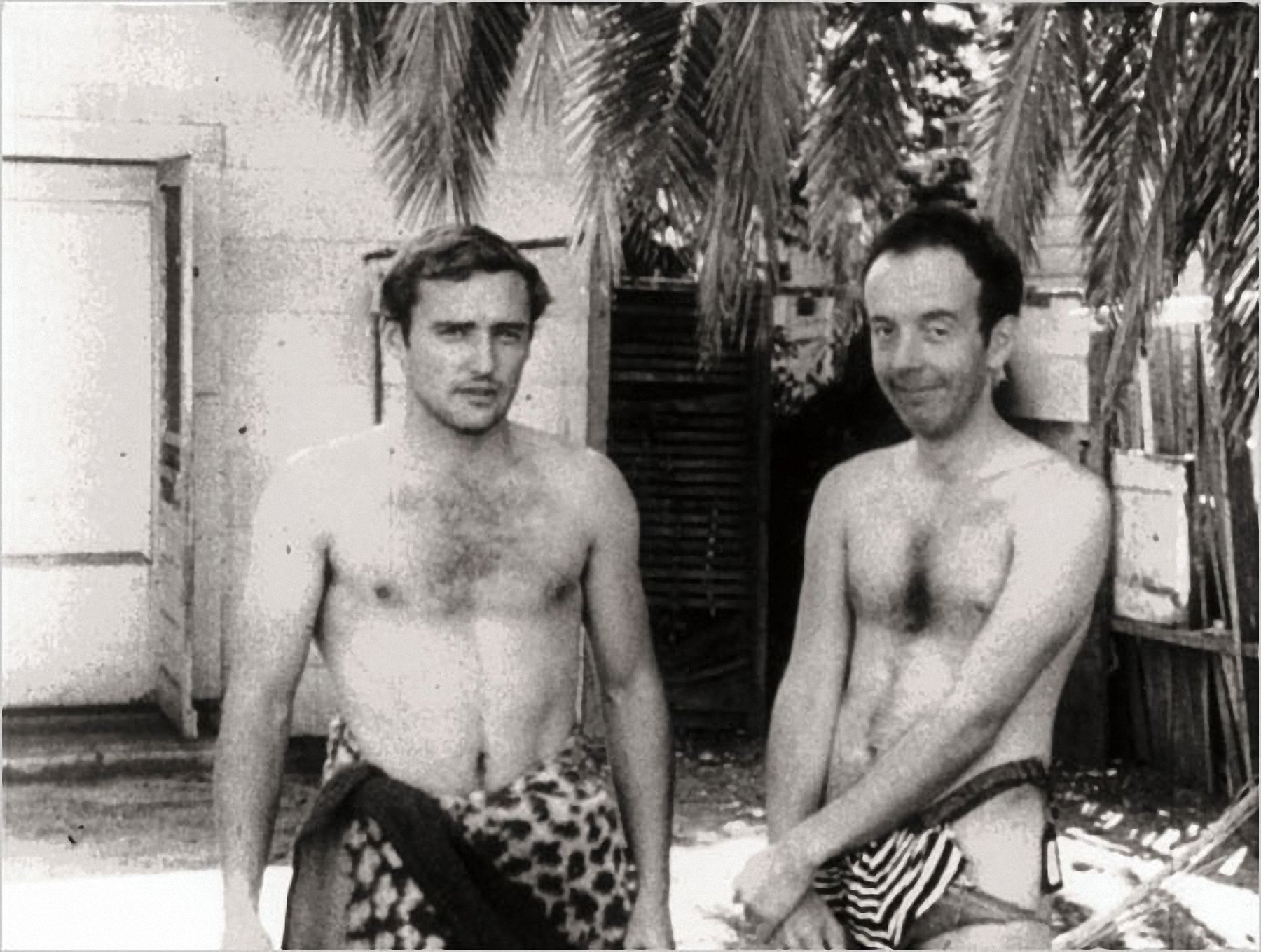
     After that Andy Warhol “discovered” him and, back in New York, he began starring in Warhol’s underground films.  In the first one, Tarzan and Jane Regained … Sort Of (1964), Taylor played – unbelievably – the heroic Tarzan, whose sarong kept falling off as Tarzan was climbing trees, prompting one critic to state that he did not care to see any more two-hour films of Taylor Mead’s behind.  The star and Warhol then searched the Warhol archives and, finding no such film, decided to rectify the matter.  The result was Taylor Mead’s Ass (1964), an hour-long silent epic of the star performing just with that part of his anatomy.  I haven’t seen it, but it should now be obvious why underground films stay underground.  (Taylor himself later remarked, “Only a sicko would watch the whole thing.”)  During the 1960s he made eleven films with Warhol, their collaboration ending in 1968, when a radical feminist writer who had grievances against Warhol shot and seriously wounded him.   

1963 Tarzan and Jane Regained (Dennis Hopper and Taylor Mead) 01
Taylor on the Tarzan set with Dennis Hopper.  Taylor was a very winsome Tarzan.

     In 1966, while living in Europe (how financed? one wonders), Taylor heckled a Living Theatre performance in Southern France that he found “communal to the point of sameness.”  Irritated by actor and cofounder Julian Beck’s repetition of “End the war in Vietnam,” Taylor began shouting “A bas les intellectuels!” and “Vive la guerre de Vietnam!”  (A future post will “do” the Living Theatre as well.)

     Subsequently Taylor made numerous other underground films, some of them so spontaneous that they involved only one take.  Always he was playing himself, since his art was his life, and his life was his art.

     Note on me and Andy:  I saw several Warhol films back in the 1960s, though none with Taylor Mead.  They were unstructured, haphazard, a series of improvisations.  There were some charming and humorous moments, but in general they violated the Supreme Commandment of Performing Arts:  Thou shalt not bore.

     The obits and online sources are curiously silent about the next thirty years, so that a big middle chunk is missing from the arc of Taylor’s life.  In addition, one wonders about how he supported himself (even a legend has to pay rent), and about his sex life.  Fame was what Warhol offered him, not cash.  He evidently got a little income from his father’s estate – just enough to survive on -- and as for sex, he probably reaped it haphazardly, being too much in love with himself to sustain a long-term relationship.  In the 1970s Gary Weiss made some short films of him talking to his cat in the kitchen of his Ludlow Street apartment; one of the films, in which he expatiated on the virtues of constant television watching, was later aired on Saturday Night Live. 

     Certainly Taylor Mead became a beloved icon of the Lower East Side, where he lived for years in a rent-stabilized fifth-floor apartment at 163 Ludlow Street.  He read his poetry in various venues, took up painting and got his work shown in various galleries, and fed stray cats in a Second Avenue cemetery and elsewhere during his nocturnal prowls.  The snippets of his poetry that I’ve seen online are prosy and rambling, and rich in non sequiturs and four-letter words – in other words, just what you’d expect.  As for his paintings, they seem to have been bold and splotchy.

     Though a nonsmoker and vegetarian, he did drugs like the opiate Vicodin, but seems to have kept free of the heavy stuff so prevalent in the Warhol entourage.  Having a great propensity for booze, he hung out in bars where he sometimes got free drinks.  His block was full of drug dealers, but the dealers in and around his building looked out for him when he came home drunk at 4 a.m., or when he went out in the early morning hours to feed the cats.  Some minor strokes finally limited his walking, so he had to give up feeding felines, turning the task over to an elderly lady.  But he loved his neighborhood, drugs and all; when he went out, people always recognized him and said hello, and young people helped him out of cabs and up the stairs.  When the Bowery Poetry Club opened in 2002, he read there regularly, amusing audiences with his vivid comments on sex, death, genius, and himself.


     He was also, it would seem, a clutterbug.  William Kirkley’s 2005 documentary Excavating Taylor Mead shows him trying to clean up his apartment, crammed with the ephemera of his colorful life, including thousands of loose manuscript pages and his vivid paintings, so as to avoid eviction by the city authorities, who had probably condemned it as a firetrap.  In the same year his volume of poetry A Simple Country Girl was published, with the memorable line, “I am a national treasure / If there were such a thing.” 

     Not everyone who encountered him hailed him as a beloved icon or a treasure.  When someone pointed him out to a friend of mine at a gathering circa 1970, my friend’s reaction was, What is that?  And novelist and poet Eamon Loingsigh has told of entering a dark Lower East Side bar one afternoon a few years ago and finding “an old, creepy looking man leaning on the bar, crouching like a frail spider among a few smarmy-dressed women.”  The spider screeched at times, sipped his beer, flirted with the newcomer, and called for champagne, but the bartender merely smiled.  The spider was obviously the center of attention, his wit and spontaneity eliciting cackles from the fiftyish ladies.  The visitor thought the old man’s face looked familiar, but he couldn’t quite place him.  Loingsigh left the bar after an hour and only later, seeing some Warhol films, did he recognize the screeching spider as a young man and realize that he was Taylor Mead.

Photos by Clayton Patterson Taylor Mead has returned to his Ludlow St. top-floor apartment after a hospital visit, but he has difficulty going up and down the stairs.
Taylor in his Ludlow Street apartment, March 2013, minus heat.
Clayton Patterson

     Taylor’s last months in New York were consumed by a battle with his new landlord, who was converting all the other apartments in the building to market-rate rentals.  Taylor clung to his home of thirty-four years, where he paid only $380 a month, while workers hammered outside his door from 7 a.m. until evening, and plaster fell from the walls, roaches crawled up his legs, and the kitchen sink didn’t work.  Finally, no longer able to navigate the stairs, he agreed to move out in return for a financial settlement.  He then went to stay with a niece in Denver, but was planning a trip to New Orleans and ultimately a return to New York when he succumbed to a stroke.

     So where do I end up?  I don’t think my initial take on Taylor was wrong, except for doubt that he would make it to a ripe old age.  He was an exhibitionist and narcissist for sure, a free spirit and perhaps a lost soul, but in the losing he found himself, he became Taylor Mead.  An almost innocent of considerable charm who both took himself very seriously and chuckled at his own quirks and pretensions.  Said Susan Sontag in Partisan Review, “The source of his art is the deepest and purest of all: he just gives himself, wholly and without reserve, to some bizarre autistic fantasy.  Nothing is more attractive in a person, but it is extremely rare after the age of 4.”  Yes, Taylor Mead gave himself and in so doing became the one and only thing that mattered to him, his chief object in life and supreme accomplishment: Taylor Mead.  I too mourn his loss.

     Unless, of course, a biographer comes along, peels away the legend, and reveals some raw, hard truths.

     Coming soon:  Rediscovering New York: West 12th Street and Columbus Circle; and Brooke Astor, Aristocrat of the People.  In the works: Quentin Crisp, the Living Theatre; personal anecdotes or impressions concerning either are welcome.

     ©  2013  Clifford Browder


Wednesday, October 2, 2013

90. The Bowery: From B'hoys to Bums to Condos


     The street known as the Bowery runs north from Chatham Square at Park Row in Lower Manhattan to Cooper Square at East 4th Street, though it once was considered to end at Union Square, where it met Broadway.  It has a long history with many phases, more really than Broadway or Wall Street.

File:Denkmal Peter Stuyvesant.jpg
Peter Stuyvesant, a statue by
Gertrude Vanderbilt Whitney,
1941, in Stuyvesant Square.
                 Originally it was a Native American path spanning the entire length of the island of Manhattan.  When the Dutch came and founded New Amsterdam, they named it the Bouwerij, an old Dutch word for “farm,” because it connected farms and estates outside the city wall to the settlement at the southern tip of Manhattan.  In 1651 Peter Stuyvesant, the last governor of the Dutch colony, bought a large farm that, supplemented by additional purchases, came to 300 acres bounded by what is now 17th Street on the north, the East River on the east, 5th Street on the south, and Fourth Avenue on the west.  When, over his objections, the colony surrendered to the British in 1664, he retired to this estate, died there in 1672, and was buried in the floor of his private chapel. 


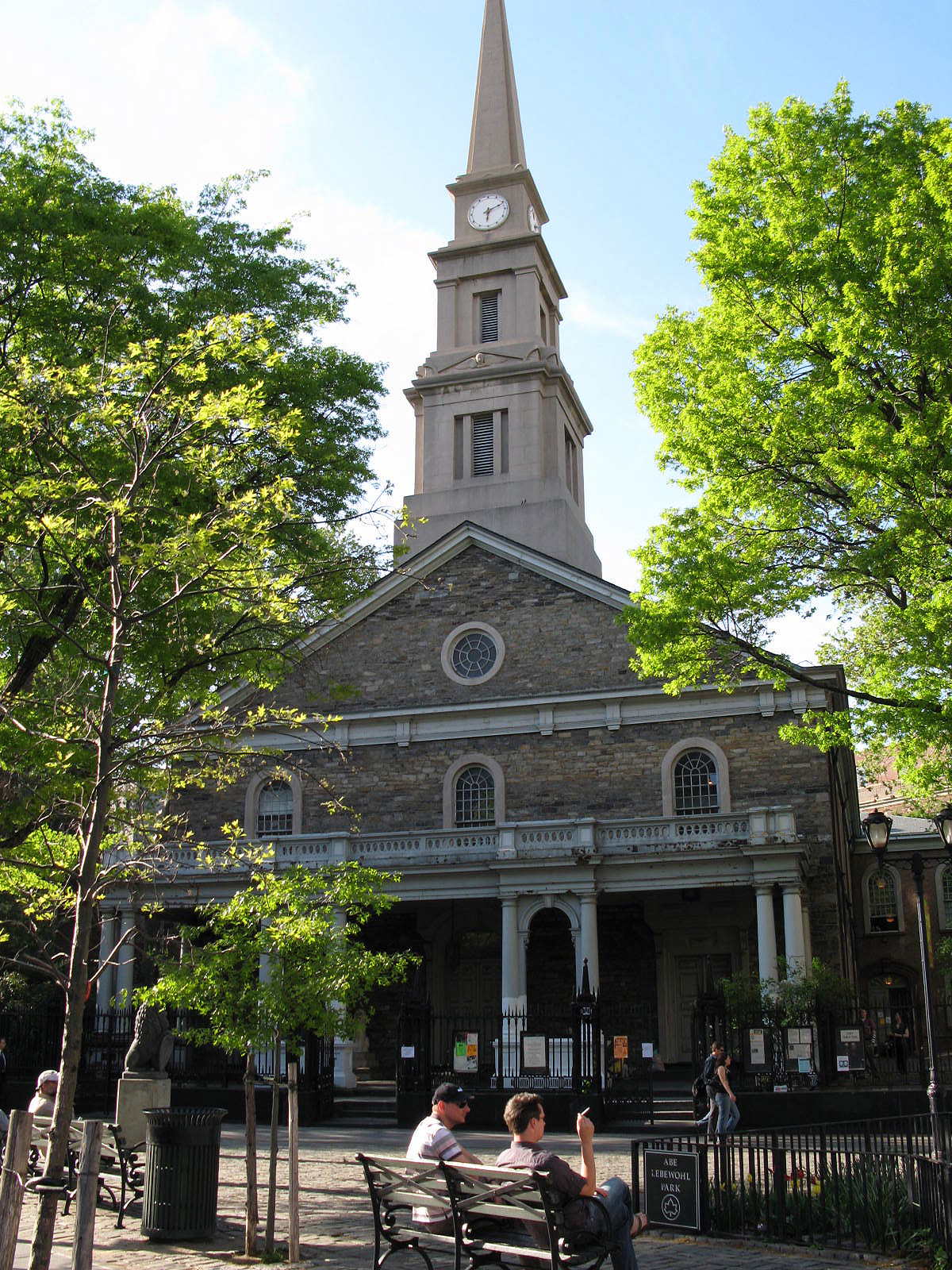
File:St Mark's Church - New York City.jpg
Momos
     But that’s not the end of Old Silver Leg, as he was sometimes called because he wrapped his wooden leg in silver bands to strengthen it.  His descendants lived on in the area, and in 1778 his great-grandson sold the crumbling chapel and graveyard to the Episcopal Church.  On this site, in 1799, the church of St. Mark’s Church-in-the-Bowery was built, with the family vault holding the governor’s remains under its east wall.  From then on there were reports of a one-legged ghost stalking about, its peg leg going clop clop clop on the floor, and of the church bell being rung by unseen hands.  The old governor was evidently still angry about the colony’s surrender and resented as well the disturbance of his remains.  These reports continued into the twentieth century and beyond; in 2002 the clop clop clop of his wooden leg was once again allegedly heard in the church. 

      In the eighteenth century the dusty road known as Bowery Lane ran past farms, several owned by Stuyvesants, and past gentlemen’s estates.  A small community named Bowery Village sprang up with a few houses, a blacksmith, a wagon shop, a general store, and a tavern.  By the early 1800s, as the city expanded steadily northward, the village attracted more wagon stands, shops, groggeries, an oyster house where post riders could leave mail, and a brothel, in spite of which respectable residences were also built.  Clearly, change was coming, as evidenced in 1812, when Third Avenue was cut through Stuyvesant property, and old roads were closed and the houses on them removed or demolished.  The Stuyvesants resisted bitterly and managed to save a few homes, but the neighborhood, no longer rural, was subjected to the Commissioners’ rigid grid plan designed for all of the island of Manhattan.

File:New York Broadway and the Bowery 1831.jpg
The junction of Broadway and the Bowery at 14th Street, 1831.  What is now Union Square.

     As the years passed, the Bowery, sometimes paved with cobblestones and sometimes with gravel, became a broad avenue paralleling and rivaling Broadway.  But in spite of a few fine residences, the street soon became a commercial and entertainment center for the working classes, in effect a poor man’s Broadway.  In 1836 the Bowery Savings Bank was established at 130 Bowery to serve the workers in the area, where there was no other bank.  Lining the avenue by the 1840s were saddleries, stove shops, druggists, jewelers, candy and peanut vendors, pawnshops, junk shops, oyster stands, taverns, livery stables, and clothiers who spread their wares out on the sidewalk.  Thronging that sidewalk were pleasure-seeking sailors, sleek-haired young butchers, flashy girls, bullies from the slums, and, peddling to the lot of them, black women offering baked pears, or hot yams cooked over charcoal fires, or hot corn ladled out of cedar pails filled with steaming water.  Already the street was being hailed by some as the most democratic scene in the city, and even the most Christian.  If a fellow who had seen better days showed up there in a torn coat and battered hat, no one thought the worse of him, since they or their friends had all been there as well, and might be there again. 


     Prominent among the Bowery denizens was the Bowery B’hoy, known at a glance by his loud clothes, often the red flannel of his volunteer fire company, and by his soap-greased sidelocks topped by a stovepipe hat set at a rakish angle, with a cigar or chaw in his mouth, a black silk tie, and high-heeled calfskin boots.  A butcher or mechanic by day, or a shipbuilder or carpenter or unskilled laborer, at night and on holidays he swaggered down the Bowery as if he owned it, which in a sense he did, or leaned against a lamppost with the same unmistakable air of possession.  Everything about him proclaimed his rowdy independence, his hate of pretense, his disdain for  bourgeois sobriety.  Good-humored, loyal to his friends, and fiercely protective of his girl, he believed in fair play and a boisterous brand of chivalry, wasn’t a thug or a bully, but was always ready for a fire, a fight, or a frolic.  For entertainment he was partial to prize fights and dog and cock fighting, but nothing delighted him more than a fire alarm.  Hearing one, he rushed to join his volunteer fire company and help haul their engine to the scene of the fire, clashing with any rival company that got in the way, but often performing rescues of great courage and daring.

     Matching him in independence was the Bowery Gal, a working girl who in her off hours sashayed along the Bowery with a swinging gait.  Her gaudy bonnet trimmed with an exuberance of flowers, feathers, outsized bows, and ribbons, plus the clashing colors of her clothing, and her short skit revealing a well-turned ankle, proclaimed her the very opposite of the well-mannered young middle-class lady, who was schooled to be proper, modest, tasteful, and demure.  One journalist of the time discerned in the Bowery Gal and her male counterpart the most original and interesting phase of human nature yet developed by American society.

     Catering to the rowdy working-class denizens of the Bowery was the Bowery Theatre, which opened at the corner of Canal Street and the Bowery in 1826 and survived numerous fires, being rebuilt each time and lasting well into the twentieth century.  Women and children and the less hardy patrons took refuge in the gallery, leaving the pit to the boisterous males who, when the doors opened, rushed in like a horde of unchained demons.  If any stranger was so misguided as to claim the seat of a regular, the B’hoys lifted the offender bodily over the heads of the crowd and passed him to the rear of the theater. 

File:Bowery Theatre, 46 Bowery, New York City.png
The Bowery Theatre in 1846.

     The fare offered at the Bowery was primarily melodrama, with heroes rescuing damsels in distress from the clutches of villains who died wretchedly and deservedly, with jerks, spasms, and groans, to the appropriate cheers and hisses of the audience.  If the curtain failed to go up on time, whistles and stomps erupted, and shouts of “H’ist dat rag!”  But if the play ended satisfactorily, no audience ever produced such thunderous applause.  That applause reached a new level of enthusiasm in 1848, when the actor Frank Chanfrau introduced the character of Mose, the Bowery Boy incarnate, whom the audience at once recognized and cheered obstreperously.  Mose soon became a legendary theatrical figure, assuming the prowess and proportions of a Paul Bunyan in his ever greater and more fantastic exploits.

File:Bowery-Theatre-Leslie-1856.jpeg
A performance at the Bowery Theatre, 1856.

     By the 1850s a great influx of Irish and German immigrants added new colors to the Bowery scene, with half the signs in German, since Germans  settled in large numbers on the Lower East Side.  On Sundays whole German families flocked into the beer gardens for a day of entertainments, singing, dancing, and feasting: a total contrast with the Irish saloons and their strictly male clientele who met there for conviviality before trudging homeward to the realities of spousedom.

Saturday night on the Bowery, 1871.
     But to really know the Bowery one had to see it on Saturday night, when it was ablaze with gaslight from red and blue and green glass globes, while horsecars passed with colored lights and jingling bells, and working-class men surged along the sidewalks looking for fun and entertainment.  Music and laughter issued from the dance halls, and the crackle of rifle fire from shooting galleries, while on the sidewalk small German bands played waltzes, organ grinders presented their gaudily clad monkeys, and black quartets sang spirituals.  Vendors hawked hot corn and oysters, theaters offered melodramas and musical extravaganzas and French opera bouffé, and dime museums enticed passers-by with mechanical contrivances, flea circuses, and wax figures representing famous events and lurid crimes.  Whatever distractions a young working man might desire on his night off were available there, and cheap.  Yes, there were abundant drunks and whores, and gang fights on occasion, and even a riot now and then, but the Bowery had a life all its own, unmatched by any other scene in the city.  It was raw, undisciplined, and free, it was  rambunctiously alive.

     Nineteenth-century New York was perennially in flux, and the Bowery was no exception.  In 1878 the Third Avenue El began operation, running from Chatham Square north over the Bowery and then over Third Avenue all the way to 129th Street.  Nighttime riders could glance into second- and third-floor interiors, where they might see a family at a late meal, a woman sewing by a lamp, or a girl and her boyfriend leaning over a windowsill, but anyone on the street below had a less magical experience.  Not only did the El line darken the street, but it also made a screeching noise and showered pedestrians with oil drippings, soot, and hot cinders. 

File:The Bowery, New York Times, 1896.JPG
The Bowery, 1896.

      Equally significant was the founding in 1879 of the Bowery Mission at 14 Bowery, seeking to provide food and shelter to the homeless men of the neighborhood.  The Mission, still in operation today, continued at various addresses on the Bowery, which was becoming more and more the haunt of down-and-outers, with flophouses and cheap restaurants and clothing stores catering to them, as well as cheap saloons.  By the 1890s prostitutes abounded, as well as bars and dance halls for “degenerates” and “fairies,” who found a working-class neighborhood more tolerant than middle-class neighborhoods elsewhere.  But if they fled middle-class gentility, that gentility began pursuing them as respectable citizens went “slumming,” making daring forays into this realm of outcasts and the damned.

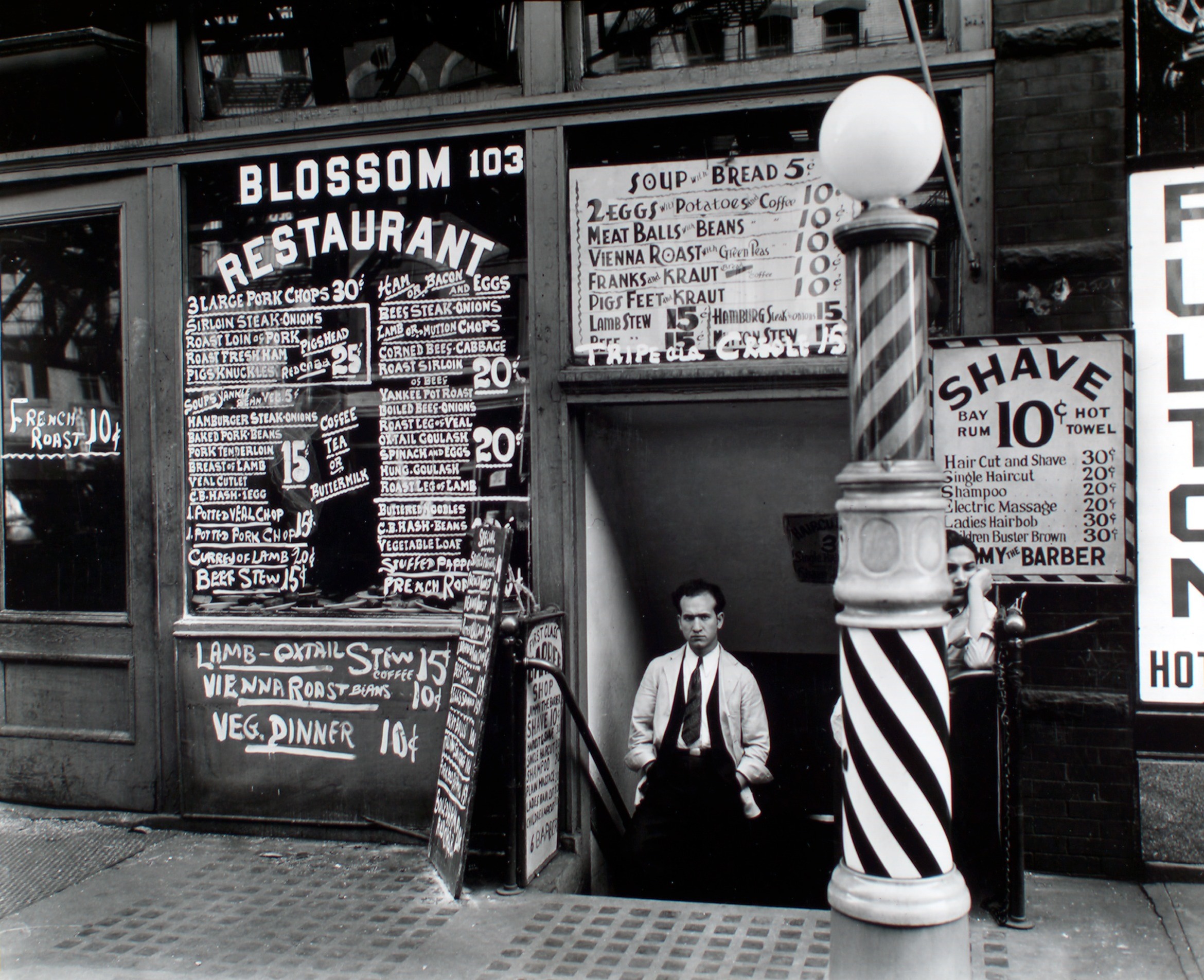
File:Blossom Restaurant; 103 Bowery by Berenice Abbott in 1935.jpg
Blossom Restaurant at 103 Bowery, 1935.  Notice the Depression prices: 3 pork chops, 30¢;
beefsteak onions, 20¢; veg. dinner, 10¢; shave, 10¢.  Ah, the good old days!


     In the early twentieth century the Bowery became notorious as the Skid Row of New York, and the most famous one in the nation; in 1907 the population of its flop houses, missions, and cheap hotels was estimated at twenty-five thousand.  The Depression of the 1930s only made matters worse.  And yet, by way of contrast, the Bowery from Houston to Delancey Street became the city’s chief market for lighting fixtures and lamps, and from Delancey to Grand Street its chief market for bar and restaurant equipment, markets that are still there today.

File:Gerhard vormwald-bowery-new york city-1977.jpg
On the Bowery, 1977. 
Gerhard Vormwald
     When I came to New York in the 1950s, mention of the Bowery meant only one thing: hopeless drunks and down-and-outers, bums.  But even then there was more to the street than that.  In the late 1960s my newfound partner Bob took me to Sammy’s Bowery Follies, a unique joint at 267 Bowery that was part dive, part tourist trap.  What I chiefly remember is feisty women in garish outfits singing feisty songs; it was fun. 


     Sammy’s was past its prime by then, having been founded in 1934 by Sammy Fuchs first as a run-of-the-mill saloon, but then, in a spurt of inspiration, as a cabaret that he proclaimed “the Stork Club of the Bowery.”  In its heyday Sammy’s, with its packed sawdust floor and Gay Nineties pictures and photos of prize fighters on the walls, drew drunks and celebrities alike, skylarking sailors and local down-and-outs, the rich and the forgotten, all of them rubbing elbows in a Gay Nineties-style bar while reborn vaudeville has-beens belted out songs.  It got so famous that tour buses rolled up and sent their occupants thronging in for a brief taste of how the other half lives.  But in time its glory faded, and in 1970, a year after Sammy Fuchs died, it closed its doors.  Sitting at the bar on that last night were Prune Juice Jenny, Box Car Gussie, Juke Box Katie, and Tug Boat Ethel, all mourning the loss of a beloved hangout. 

Ethel, the Bowery Queen, at Sammy's.
Courtesy of the Museum of the City of New York.


     Another sign of change was the demise of the Third Avenue El.  The Depression had brought decreased ridership for all the elevated lines, and Mayor La Guardia decided to eliminate them so as to raise property values.  The Third Avenue El ceased service on May 12, 1955.  My partner Bob was a longtime fan of the line, which he rode sometimes to get somewhere and sometimes for the sheer fun of it.  With many likeminded veterans of the El, most of them casting mournful looks and some of them swigging champagne, he rode on the very last train from Chatham Square to 34th Street, where he got off because of the crowds now jamming the train.  Property values may well have soared, but a bit of old New York was gone, never to return.

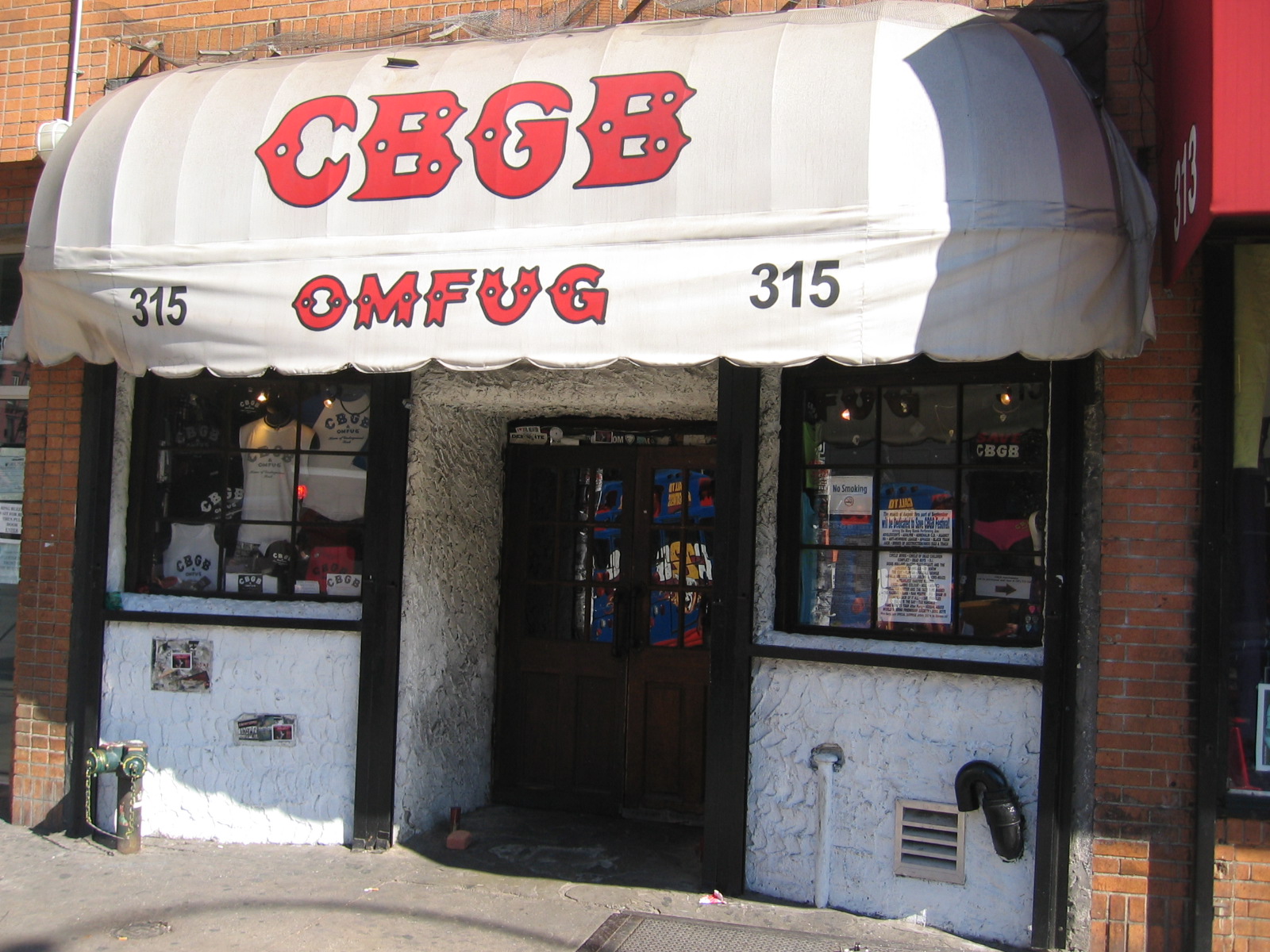
     But the Bowery never quite dies and always resuscitates.  In 1964 Anthony Amato established his Amato Opera at 319 Bowery, near 4th Street, where it flourished for thirty-five years, presenting mostly French and Italian operas on a postage-stamp stage; in recent years Bob and I attended many.  And in 1973 the music club CBGB moved into 315 Bowery, just a few doors away, to offer hard core punk, then rock, folk, and jazz to enthusiastic audiences.  Meanwhile the Bowery’s vagrant population was declining, partly because of the city’s effort to disperse it.  Decidedly, the Bowery was on an upswing, leaving its Skid Row image behind. 

File:CBGB club facade.jpg
Adam Di Carlo

File:Bowery Hotel full.jpg
The Bowery Hotel
Beyond My Ken

     Today the Bowery is definitely undergoing gentrification, as high-rise condominiums appear, plus an upscale food market and the New Museum of Contemporary Art, as well as curio shops, art galleries, a poetry club, celebrity lounges, and the luxurious Bowery Hotel, offering 24-hour room service, valet parking, a fitness room, spa services, and many other amenities.  (But does Manhattan really need another luxury hotel?)  So the elite no longer come on quickie slumming tours; they come to visit and to stay.  What would the Bowery B’hoy of yore think of spa services and a fitness room?  His comment would be unprintable.  There are still some flophouses and the Bowery Mission, so the street’s reputation for a mixed population endures.  But gentrification winning out with a vengeance.


     Bank note:  The founding of the Bowery Savings Bank to service the workers of the Lower East Side, recounted earlier, is a reminder that banks once served the public and not just themselves.  Many nineteenth-century New York banks had names indicating the specific clientele they meant to serve: the Butchers’ and Drovers’ Bank, the Importers’ and Traders’ Bank, the Merchants’ and Clerks’ Bank, the Seaman’s Bank for Savings.  Quite a contrast with the big banks of today, as for instance my beloved J.P. Morgan Chase, now under siege from regulators for various peccadillos, among them a whale of a trading loss in London.  So far the CEO, Mr. Jamie Dimon – a handsome and distinguished gentleman, to judge by photos in the papers – has survived, his bonuses intact.  But for the sins of the higher echelons I do not blame the employees at my branch, cordial and friendly minions dispensing the warmest greetings and an abundance of candy.  The candy I eschew (there’s that word again, resounding like a sneeze), but I could use a few more pens; alas, they are nowhere in sight.

     Coming soon:  Next Sunday, Taylor Mead, Icon and Almost Innocent (a free spirit whom I experienced long ago and rediscovered recently).  In the works: Brooke Astor, an aristocrat of the people ("Money is like manure; it's not worth a thing unless it's spread around"); Quentin Crisp (another free spirit who realized himself most fully here in New York); and the Living Theatre (I endured and survived their freewheeling productions and indecent exposure).


©  2013  Clifford Browder