Wednesday, September 4, 2013

85. Colorful New Yorkers: The Mad Poet of Broadway, Fernandy, and the Mephistopheles of Wall Street


The Mad Poet of Broadway:  McDonald Clarke (1798-1842)


File:McDonald Clarke - Appleton's cyclopaedia.jpg
In his younger days, most definitely
effecting a Byronic look.
Strollers on Broadway in the 1830s often saw a tall form lounging past with a shredded blue cloak and a red handkerchief, a melancholy gazer at the pavement whose soul-deep sighs seemed to make of him, in this city of bustling doers, a singed angel or gentle demon.  “Who is he?” asked passing ladies, touched.  McDonald Clarke, they were told: the Mad Poet of Broadway, a moonbeam-weaver whose head, by his own admission, turned on the pivot of his heart. 

An orphan, he had always hoped to find in a woman the love he had missed as a child.  Years before, in a spurt of youthful ardor, he had eloped with an actress of seventeen on the very night when she was to open in the role of Ophelia.  Past midnight the couple were routed from their wedding bed by the bride’s angry mother and even angrier manager.  While the mother threw clothes on the girl and yanked her homeward, the burly manager, out of pocket from a refund of ticket sales, beat the poet several shades of purple.

A week later they eloped again.  For two months they passed balmy nights in parks, wrapped in the poet’s great blue cloak, or if it rained, took refuge under the roof of a market.  One cold, stormy night, homeless, penniless, they knocked at the mother’s door: no answer.  Spying a rain barrel, they put a board across it, climbed up, and were reaching toward a second-floor window when the board split, dumping them in the barrel below.  Suddenly, while they splashed and sputtered, the mother dashed out, grabbed her daughter’s hair, ducked her, ducked her again, then snatched her out and hauled her in the house.  As the door banged shut, the poet was left shuddering in the barrel.  Her marriage annulled, the girl soon returned to the stage.  Clarke’s friends denounced her, but he himself defended with zeal “she who in tender folly dared mingle the moonlight of her own destiny with the midnight of mine.”

For years afterward he haunted the pavements of Broadway in a blue cloak and red neckerchief,  effecting a Byronic look and role as the doomed outsider, his reason slightly zigzag.  He penned odes to gravestones and Melancholy, or in brighter moments to chestnut vendors, organ grinders, and a host of Fair Unknowns.  In the taverns at night he was welcomed by actors and writers who plied him with hot rum punch that kindled his fantasy, fuzzed his speech, and sent him lurching homeward.  But where was home?  Evicted from his lodgings, he had slept for months in a hearse, and when expelled from there, on tufts of grass among the tombstones of Trinity Churchyard.  Meanwhile poems of his somehow crept into print: rhymes clanked, meters limped; a soft soul shone.

Smitten by a banker’s daughter glimpsed at a window, he mooned for two years, his passion the joke of the town.  Finally, urged on by friends, decked out in a freshly laundered cloak and with a borrowed walking stick, he had knocked at the father’s door, announced himself as a suitor.  Enraged, the citizen had spun him about and kicked him down the stoop.  Bruised and mocked again, he had endured, his brain more zigzag than ever, writing poems to winding sheets.  

Yet at times in the bustle of Broadway he and he alone might notice a young girl, smirched and barefoot, selling baked pears or peddling cakes on the street.  He would drop to his knees, greet her, and pry out her story.  Often learning that she was an orphan like himself without a decent home, he would announce that her woes were at an end.  Taking her by the hand, he would lead her on a trek uptown to Bond, the most elegant of streets, where merchants and bankers resided in handsome red-brick houses with marble street-front trim.  Climbing the steps of one of them, he would pound on the shiny brass knocker, and when a maid answered, ask to see the lady of the house.  The maid might give a look but would fetch her.  When the lady rustled her satins to the door, the poet would bow deep and declare, “Madam, God has pleased to make you a trustee of his wealth.  It is His, not yours.  Take this poor orphaned child, wash her, feed her, clothe her, comfort her in God’s name.”

Then, with a flourish of his tattered blue cloak, he would turn and depart, leaving the little girl puzzled, the lady stunned and perplexed.

The penniless poet frayed on through the years, erratically kind, mothlike, a host to fleas and angels.  Jotting poems to maidens on handkerchiefs, he proclaimed critics, landladies, and kings of cash pimples on the forehead of Creation.  Doom-laden, he groped toward seeds of light.  One evening in Trinity Churchyard, shivering in the wind, he informed a querying watchman: “McDonald Clarke is dead.  Three nights ago on this very tombstone, he dashed his brains out.  The storm that night was the tears Heaven shed for him.  His body was revivified by God.  Before you behold Afara, archangel of the Almighty!”

They lodged him in a cell in the Tombs, pending transfer to Bloomingdale Asylum.  By morning he was dead – of brain fever, the prison doctor reported.  Rumor had it that having turned on a faucet in his cell and flooded it, smiling, he drowned.


Fernandy:  Fernando Wood (1812-1881)


File:Fernando Wood - Brady-Handy.jpg

      To Gotham, in the fifty-fifth year of the century in the Age of Go Ahead, came word that the solons of Albany, replete with rural wisdom, had passed an Act for the Prevention of Pauperism, Crime, and Intemperance whereby, as of July Fourth next (a date the city hailed with whiskey- and rum-soaked orgies), liquor should be banned throughout the state and public drunkenness forbidden.

       Temperance: in Gotham the word had a grit-and-dust feel, a chalk taste.  At the thought of it, the Irish in their grog shops, downing tumblers of cheap liquor, muttered dark oaths.  At the hint of it, the Germans in their beer gardens, clinking steins, scowled under frothy noses, while behind the façades of brownstones (certain brownstones), genteel profanity glanced off the rims of stemware over delicate wines.

       All eyes turned to the mayor.  Tall, lithe, erect, dapper in a trim black frock coat with a brushed hat, tight gloves, and a walking stick, Fernando (“Fernandy” to his friends) Wood was a blue-eyed, soft-voiced master of the glib smile, a man of principle (and interest).  Though hatched by Tammany, an I-rose-from-nothing-you-can-do-it-too rabble pleaser, he had astonished the respectables when he put the police in uniform, chased the whores off Broadway (into decent side streets), closed saloons on the Sabbath (unlicensed ones stayed open), and enjoined the aldermen, who were known as the Forty Thieves, to be leery of franchises, go easy on the vouchers.  For this display of mayoral energy without precedent, he had been christened the Municipal Hercules.

       But at the first word from Albany of temperance, the mayor was sore vexed.  Long ago his first enterprise had been a grog and grocery shop near the waterfront, catering to thirsty stevedores and the desperate classes, whose votes he later reaped.  Since then, in spacious tile-floored barrooms, before gilt mirrors backing bars adorned with cupid-crowned clocks and nippled Venuses, over the years His Honor, through the ins and outs of politics, had quipped and glittered in his cups.  Would Hercules enforce the law – he whose proclaimed credo was to spurn “I cannot” and say “I would”?  Consulting a lawyer, then more lawyers, then more, he finally announced that as mayor he would enforce this act, however needless and impolitic, but would give full attention to exceptions, technicalities, and the rights of citizens, violating which, officers would be called to strict account.

       At this announcement, Gotham winked, nor did the city’s tippling notably decrease.  Within a year the law was voided in the courts, whereupon Gotham cheered, and the Sabbath quiet was tainted more than ever by the din of groggeries that spilled out reeling drunks on the street.

        Soon thereafter the mayor was up for reelection.  “Anyone but Wood,” said the temperance men.  “Anyone but Wood,” said the Know Nothings, despising the foreign hordes the mayor favored.  “Anyone but Wood,” said the shiny new Republicans, who schemed his prompt retirement.  “Anyone but Wood,” said Mr. Greeley of the Tribune, decrying the city’s infestation with thief, ruffian, and harlot, to cope with whom, he charged, the decent faced a cruel dilemma: buy a sword cane or move to Connecticut.
           
       Meanwhile the mayor promised cleaner streets, better housing, bigger parks, while offering free eats with liquor to the multitude, who esteemed in his sleek countenance no mirror of their own shabby selves, but a paragon of affluence and power.  Into his campaign chest dropped the sudsy coins of barkeeps, bank notes from brothel owners, winnings of gambling den proprietors, and crisp bills from the deft fingers of abortionists.  Ever pliant to the public mood, he kept his own dark counsel, but daily in saloons, on docks, and in the street smiled into grubby handshakes and boozy greetings, then went home to an adoring wife, scrubbed, cologned himself, and changed his clothes.        

      Against him on election day stood a Know Nothing, a Republican, a Reformist whose bowels ached for change, and a disgruntled Tammanyite, no two of whom agreed.  Trooping to the polls, along with high-minded, dry-tongued critics, were merry hosts of Sabbath smashers plus bone boilers and horse skinners from the slums, and Tammany stalwarts shepherding pollward flocks of newly minted citizens, almshouse decrepits, and furloughed denizens of the county jail.  All day the mayor’s whisper squads spread smear and slander, aided at the polls by Dead Rabbits whose fists and scowls discouraged opposition voters.  In the Fourth Ward, ballot boxes were smashed; in the First, a citizen had his nose shot off (“Yer looks better widout it,” said a Rabbit), while citywide, wherever knives and brickbats reigned, the understrength police (the mayor had furloughed half of them) kept prudently aloof.

      Result: despite temperance and Mr. Greeley’s dreams of honest government, he whom enemies now labeled King of the Dead Rabbits and Father of Dock Rats was reelected.  In decorous brownstones decent citizens cried fraud, while holders of horsecar franchises, tipplers and gamblers, cartmen, stevedores, and hot corn girls made jubilee.

      Thereafter in this tear-down, build-up city where traffic screeched, maiming pedestrians, and streets stank with cholera-breeding filth – this city where garment makers stitched by candlelight, while speculators in California gold dust thrived, and moralists inveighed against grime, grog, and riot, as the veiled wives and daughters of the privileged sought out Madame Restell, the lady of solutions – presiding over all, glad-handed, waving jauntily to festering and feisty multitudes, the mayor, soft-stepping in his trim black frock coat, silver stickpin, and tight gloves, smiled.


The Mephistopheles of Wall Street:  Jay Gould (1836-1892)

File:Jay Gould.jpg
His puny frame well clothed.
            From across the street Selover, a brawny six-footer, rushed over and confronted him.  “Liar!” he shrieked, grabbed his lapels, shook him, pushed him against a railing by the sidewalk, hoisted him over it, held him above the eight-foot drop.

            “Liar!  Liar!  Liar!”

            With each shout an iron fist bashed his head.  Dangling, the small man fended off the blows weakly, wailed piteously.

            “Goddam bastard liar!”

            As the blows rained, a crowd gathered, protested.  Selover let go; his victim dropped into the basement area and collapsed.  The towering Westerner glared, stalked off.  A barber rushed out of a basement barbershop, helped the battered man to his feet and up the steps, recovered his hat and pen.  Stunned, trembling, the victim staggered off.

            Boasting of frontier justice over drinks, Selover announced to the press: “Jay Gould is a liar, a cheat, and a scoundrel deserving of public disgrace!”

            Rumors flew of Wall Street pools and quarrels; no hard facts emerged.  Gould said nothing, pressed no charges.  Offended in the physical, that gross, alien world where he was not at ease, never again would he venture on the street without a bodyguard.


            Pale as the light of December, Jay Gould, puny-limbed, dark-hatted, with a masking black thicket of beard, walked soft, talked soft, clean and neat as a wasp.  Hatching schemes, he sat at his desk by the hour, his gaze vacant, his only movement the tapping of a pen.  When the schemes burst, prices on Wall Street leaped or dropped, markets cracked, fortunes broke.  If, in the hurlyburly, men cursed or threatened him, he vanished up the Hudson on a yacht. 

            To oust him from Erie, shareholders and U.S. marshals had used a crowbar to force the locked door of his presidential office, pursued him with a notice of his removal as he dodged behind tables and chairs, and when he took refuge behind a locked door in another office, served the notice through a transom; finally he left and resigned.  No matter; within a few years he was lord of ten thousand miles of railroad, worth ten, thirty, fifty million dollars, and was said to control newspapers and banks.

            Many a Wall Street mystery could be explained, it was thought, by entries in the books of his old brokerage firm.  After a wrangle and a rift between them, his partner had snatched the books away and stored them on his farm in New Jersey.  One day, in the partner’s absence, a party of rough men appeared at the farm, intimidated the hired man on the premises, seized the books, and left.  The books were never seen again.

            To some his beard looked devilish; they called him the Mephistopheles of Wall Street.  In a rare interview he said: "I am credited for things I have never done, and abused for them.  I have the disadvantage of not being sociable.  Wall Street men are fond of company and sport.  When business hours are over I go home and spend the remainder of the day with my wife, my children, and books of my library.  My inclinations are domestic.  They are not calculated to make me particularly popular on Wall Street."

            At intervals he retired to his estate up the Hudson, a Gothic castle of white Sing Sing marble, towered and turreted, with pointed windows and vaults, pinnacled roofs.  In this massive stonework mansion, richly furnished and remote, he installed his family.  The children romped, had everything.  But his loving wife couldn’t understand why they must live in a castled palace, walled, with armed guards round the clock.  Nor why sometimes at dinner, his body gutted by fire of thought within, he sat with bowed head, exhausted, picking at his food.


File:Lyndhurst Tarrytown NY - front facade.jpg
Lyndhurst, Gould's mansion near Tarrytown.  In his time, a well-guarded castle. 
 Today, a landmark open to the public.
Urban

            Inspecting his Western railroads, he stared numbly from the observation car at the dusty track receding behind him, ignoring ríos, arroyos, gushing mountain streams, and pine-clad pinnacles.  “This trackage, these vast distances mean nothing to me,” he wrote his wife; “I miss you more than words can tell.”

            Alone, in felt slippers, he spent quiet evenings in his library, and mornings in the largest greenhouse in America, tending rhododendrons, camellias, hyacinths.  “No man,” wrote a lady writer, “can be wholly bad who is a friend of the orchid and the rose.”

            With his brain-sucked body rested, he returned again to the city, picked at flaws in contracts, reared up peaks of schemes.  Once more on Wall Street prices surged, plunged; he had made another killing.  Editorialists raged, financiers slammed on desks fists with hard gold rings.  A coward,” said some; “Unmanly,” said others; still others whispered (falsely), “A Jew.” 

            A letter came: “Gould, I will shoot you dead in a week. – A Victim.”  He sighed, gave it to the police.

            At times, scheming at his desk or reading botany, he must have thought of his old friend Jim Fisk.  Jim, who could glad-hand reporters and politicos, joke with them, drink with them, wangle from them whatever he wanted.  Genuinely liked by bellboys, chorus girls, clerks and workingmen, thugs.  A torrent of energy, a font of bonhomie, whom no one had ever bullied or wanted to.  Smarter than chain lightning, who liked to make Rome howl.  His opposite.  His best, his only friend:  “Don’t fret your gizzard, Jay.  For you, I’ll go my bottom dollar!”  Jim Fisk, murdered years before.  Jim Fisk, dead and gone.

            On Wall Street, Jay Gould was always alone.  To him, humor and warmth were denied.  No passer out of perfectos, slight and frail, in a world of bullies what could he do?  Fight them with his mind.  Lure them with spruced-up stocks and options, web them in technicalities, outscheme them with receiverships, floating debt, proxies, stun them with lightning strokes in the market.  He had a knack for it, and once he hatched a scheme, his brain ticked feverishly.  They hated him, threatened him, roared the rage of the duped and the beaten.  Puny, coughing already from TB, on Wall Street he towered.
           
            For hours in his greenhouse the most hated man in America breathed, caressed Orchidaceae imported from every nook of the world, marveled at their curved, lipped petals – streaked, tufted, crimped – like taloned green birds, like gaping jaws of pink-spotted snakes, blood-tinted moths, spiders: so intricate.          

File:Jay Gould Mausoleum 1024.jpg
The Jay Gould Mausoleum in Woodlawn Cemetery, the Bronx.
Anthony 22
         The slap heard round the world (a small world):  Local elections are coming up soon in New York City and, being local, there will probably be a small voter turnout.  Still, I have been following them with some interest, partly because I've met several candidates at the Abingdon Square Greenmarket on Saturday mornings; the all-important primary is next Tuesday, September 10.  So let me share my take on a recent incident.  In the latest issue of the WestView News, a monthly neighborhood newspaper giving news of the West Village, George Capsis, the publisher, gives his version of a recent incident that has attracted much media attention.  He explains that recently he lost his wife of 55 years to cancer and feels that, had St. Vincent's Hospital still been functioning in the West Village, he could have spent more time with her in her last days; instead, he had to spend an hour and a half commuting each way to a hospital in the distant Bronx.  As a result, he has very strong feelings about those who, in his opinion, didn't do enough to save the hospital, the only hospital in the Lower West Side of Manhattan.  One of those he holds responsible is Christine Quinn, the former City Council member from this district now running for mayor.  Hearing of a Quinn rally in front of the now half-demolished hospital on West 12th Street (not far from my apartment), he went to it.  Quinn was not on hand, but he saw two of her supporters, former State Senators Tom Duane and Brad Hoylman, whom he also deemed at fault.  Incensed, he shouted at Duane.  Then, seeing Hoylman staring at the ground, he reached out to pull his head up, whereupon Hoylman, thinking it a slap, pulled back and announced, "You need to be escorted out of here."  Turning, Capsis saw a young man who seemed  ready to do the escorting, so he slapped him lightly, so he says, on both cheeks; to Capsis's astonishment, the young man "began crying like a girl and ran off."  This incident was immediately reported widely in the media; in the New York Times's version, he slapped both Hoylman and the young man.  Other versions added a slap to Duane, which Capsis emphatically denies.  This story could well be dismissed as a tempest in a teapot, but my sympathy goes out to the unnamed young man, who had nothing to do with St. Vincent's closing.  The sudden, unforeseen slap may have triggered some painful childhood memory, some humiliation of long ago that caused him to react instantly as he did; to say that he was crying "like a girl" is judgmental and insensitive.  In my opinion, Capsis owes his victim an apology, and I intend to tell him as much.  There is a simmering resentment in the West Village over the loss of our only hospital, and I share in it, but nothing excuses the assault on an innocent bystander.  So much for politics on the local scale in New York.

          Coming soon:  Next Sunday, Walter Winchell, a New Kind of Terrorist, plus a glance at the Stork Club and the ex-bootlegger who ran it, luring the rich and famous to its privileged confines, guarded at the entrance by a uniformed doorman with a solid 14-karat gold chain.  In the works: Fifth Avenue, from Goats to Greatness, with a look at those whose mansions came to line it, including the infamous Madame Restell and the Mrs. Astor and the annual Astor Ball.

©  2013  Clifford Browder


Sunday, September 1, 2013

84. Rudolph Bing, Big Daddy of the Met


     When Vienna-born Rudolph Bing (1902-1997) came to the Metropolitan Opera in 1949, to observe its operation prior to becoming general manager the following year, he found a beautiful auditorium with a world-famous Diamond Horseshoe that gave box holders excellent views of each other, but a host of problems: 20 percent of the seats with limited or obstructed view of the stage; limited public areas without adequate soundproofing, so that latecomers had to be seated at once, climbing over those already seated; cramped and dirty backstage areas, so that every change of scene had to be done on the main stage while the audience waited, serenaded by banging noises behind the curtain; scenery half-covered with tarpaulins stored temporarily outside on the Seventh Avenue sidewalk, exposed to the rigors of the elements; tiny dressing rooms with bad plumbing; ancient and flimsy stage sets, so that when a soprano took a deep breath, the castle behind her could be seen to tremble; chorus, ballet, and orchestra all crowded into ill-ventilated common rooms; and undisciplined stage crews who showed up when they felt like it, talked behind the drops during performances and, worse still, smoked, the whole place being a tinderbox.  Many of these problems would be solved only with the move to the new house in Lincoln Center in 1966, sixteen long years later.

     When he assumed the duties of general manager in 1950 – a position he would hold until 1972 – what kind of immediate problems beset him?  His memos tell the tale: 

·      In the last act of Carmen, Mario del Monaco and Kurt Baum must use rubber knives, not real ones, since they so throw themselves into the role that Rise Stevens, singing Carmen, is terrified.
·      A stool should be placed in the new elevator so the old man running it doesn’t have to stand all the time.
·      Box office and ushers must stop regarding the patrons as a nuisance.
·      The machine for special effects for Don Giovanni costs too much and must be returned.
·      The paid claque has occasioned complaints from subscribers and must be eliminated.  (It never was.)
·      The orchestra must stand the first time the conductor enters the pit. 


And on and on.  And all this in addition to dealing with temperamental performers, a budget-conscious board, and entrenched and demanding unions, as well as touring this country and Europe to recruit promising new singers and remind established ones of the glory of singing at the Met.

     Who was Rudolph Bing, the man who, day in, day out, had to cope with these and a thousand other problems?  He came with solid credentials, having been the manager of the Glyndebourne Festival in England and the Edinburgh Festival in Scotland.  Photos show a tall, slender man of about fifty, his receding hair neatly combed, always dressed conservatively and never garishly, with a necktie for daytime rehearsals, but dark formal wear for special occasions at night, his black bowtie perched above an immaculate shirtfront like a neat little butterfly, always placed properly, never the least bit awry.  Obviously an Old World gentleman who  exuded dignity and authority, and also, when necessary, charm.  I have never seen a photo of him in shirtsleeves or with an open collar.  For Rudolph Bing, the Met was a very special place where one should dress appropriately. 

     He was also, by all accounts, an autocrat, and it was just as well, for who else could deal with board members and singers and conductors, and keep one of the greatest opera houses in the world running efficiently and, one hopes, brilliantly.  Level-headed and patient, he had to be reigning monarch, diplomat, arbiter, psychologist, and troubleshooter all rolled into one.  But he could also be sharp: when told that a conductor with whom he had had difficulties was his own worst enemy, he quipped, “Not while I’m alive.”

     When he first witnessed opening night in 1949, he was appalled by the audience, many of whom, he soon learned, graced the Met with their presence only this once in a season: café society of the lowest order, gossip columnists, celebrity-seekers and clowns looking eagerly for any freakish occurrence that would be publicized in the press and the new medium of television.  Worse still, openings were reserved for the Monday night subscription audience, socially prominent patrons who paid no more than other subscribers.  So he at once removed the opening night from the subscription program and sold tickets for it separately and at a substantially higher price.  The head of the board was furious that his well-connected friends should lose this perquisite, but Bing insisted.

      One segment of the audience that Bing esteemed highly were the standees, whom he saw as the only source of genuine enthusiasm in the house, an enthusiasm that could become infectious.  Whenever the house resounded with exciting and well-deserved ovations, it came from the standing room, inspired the artists, and enhanced the whole tone of the evening.  As a result, he was determined that the standing room space should not be curtailed.  And when standees lined up for hours at a time for the opening night of a new season, he went out personally to serve them coffee.

     I have vivid impressions of the standees of the mid-1950s, for I was one of them.  Stealing time from my graduate studies in French at Columbia, I would get a standee ticket and wait patiently to be admitted to the house.  Usually I stood in the back of the house, and once, standing there, I was lucky enough to be given a ticket by a woman who had to leave after the first act of Boris Godunov.  For the rest of the evening I found myself seated in the middle of the twelfth row with probably the best view in the house, watching George London perform admirably in the lead role, and a spirited mazurka that filled the stage in Act III, set in Poland. 

     But I wasn’t always so lucky.  Standing for London in Don Giovanni, I found myself on the wrong side of the theater for the dramatic scene where the Don is dragged off to hell by the ghost of the Commendatore, whom he killed in the first act.  Only when London played briefly toward the center of the stage could I see his brilliant silver-clad form, stark against a dark backdrop, staggering in vain resistance against the relentless summons of his victim.  The old hands, of course, had all positioned themselves on the other side of the standing room.

     The mix of standees could be quite picturesque.  Once when I was standing in a crowd of them well up front on one side of the stage, an outrageously flamboyant gay standee arrived and was greeted warmly by the regulars.  A sailor in uniform was also on hand, having chosen to stand because it was the only way he could glimpse the fabled interior of the Met.  “Jesus, these fairies!” he exclaimed to me.  “There’s no excuse for that.”  But fifteen minutes later he was listening as another standee patiently explained the story of the opera.  This standee too was gay, but the sailor had no inkling and listened patiently.

     The Met fare was predominantly Italian, with some French thrown in, because that’s what the audience wanted, but Bing tried to do German and Russian as well.  When he first came, he thought of doing opera in English, but subscribers emphatically preferred to hear the operas in their original language, and he realized too that international stars might mispronounce English, to the amusement or indignation of the entire audience.  He also entertained the notion of occasionally presenting a new work of opera, but soon learned that, after a few performances well attended by the composer’s friends and supporters, they’d be playing to an empty house, except for some loyal and long-suffering subscribers.  The Met audience was not adventurous; they wanted the tried and true.

     And who was that audience?  One might be surprised.  My partner Bob’s parents, who lived in Jersey City, had a subscription in both the old house and the new.  Bob’s father, a subway carpenter, had learned long before, during the Depression, that after work he could pick up tickets at the Met box office for a reasonable price and so, without any musical tradition in his family, acquired a taste for opera.  He had a keen analytical mind, could appraise a singer’s voice very accurately, commenting on the high and low registers.  Bob’s mother, on the other hand, lacked this ability, but being German by birth she had a rich musical heritage from childhood and appreciated music on a deep emotional level.  Two very different ways of listening, both legitimate.  Bob inherited both.  He and his mother often heard the Met’s Easter season performance of Parsifal, listening silently, hand in hand, in a very deep and moving communion.

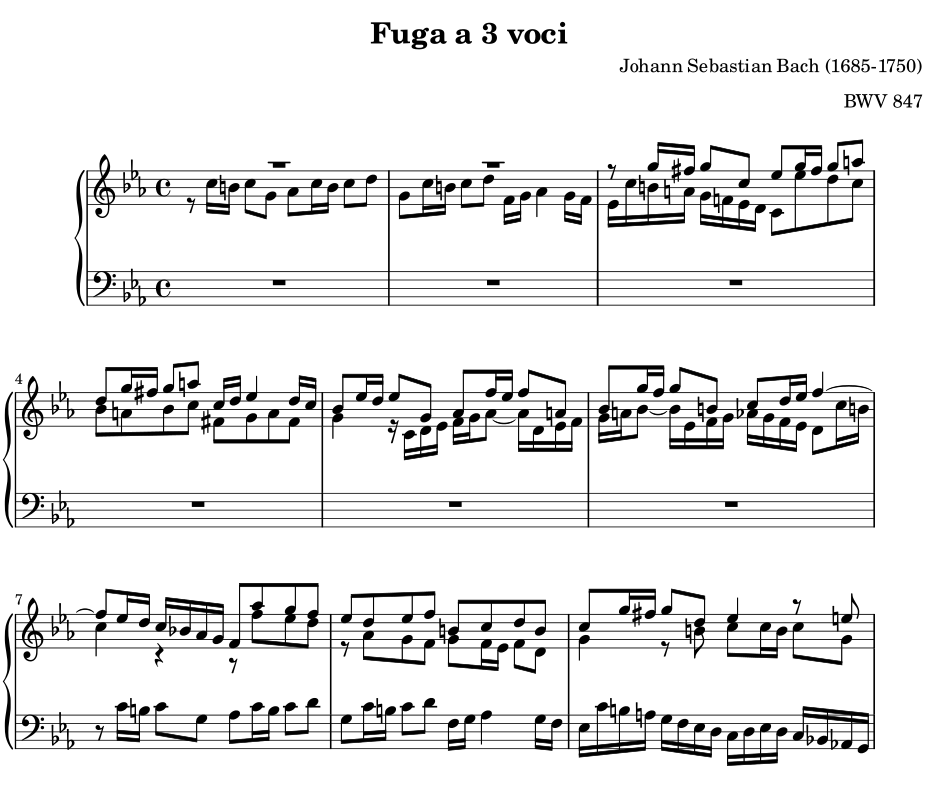
     Me and music:  I lacked this deep affinity with music, and if I came to love both instrumental and operatic music, it’s nothing short of a miracle, since I never learned to read music (still haven’t), couldn’t sing on key (still can’t), and dreaded music class as my worst subject in grade and junior high school.  For two dreary years, in seventh and eighth grade, I was tormented by a gray-haired little harpy, mean, tight, and dry, who professed to be a music teacher.  I still recall my dread as the class ascended the steep stairs to the third floor, where she held forth and terrorized. 


File:BWV847 measures 1-9 Fuga a 3 voci.svg
Yes, the little black dots go up and down, meaning that
the music rises and falls, but what about all that other
stuff?  Worse than algebra!

     Miss Kraus (not her real name) had the best students sit in back and worst ones in front, so they could benefit from her personal and acerbic attention; I was well toward the front.  Moving about the room, she would listen closely to each of us, and if she detected a flaw, she would stop the singing and require the offender to solo, so she could correct him (it was almost always a “him,” as she had it in for adolescent males), while referring to her victim as “this boy.”  Her criticism was edged and wounding; she never hesitated to humiliate you in front of the class.  I’ll grant her a keen sense of beauty, musical and otherwise, but of the few bad teachers that I had, she is the only one I cannot forgive.  I can still see that mean little witch, her lips pressed tight to a pitch pipe, as she surveyed her captive audience.  She once mentioned in passing how, during her childhood in Texas, she had almost been stuck in quicksand, and I have pondered ever since: God put that quicksand there for a purpose.  Why didn’t it do its job?

     Let us ascend now from the trivial to the sublimeIf Miss Kraus had her hands full with a bunch of us, Rudolph Bing had plenty to cope with in managing the Met's stellar singers.  Lauritz Melchior, on the plump side but still one of the best Wagnerian tenors in the world, simply refused to attend rehearsals; if a conductor needed to communicate with him, he could make an appointment to see Melchior in Melchior’s apartment.  Bing was more effective when Franco Corelli, running out of breath while Birgit Nilsson sustained her tone, stalked off the stage in a tizzy.  Informed, Bing rushed to Corelli’s dressing room, where he heard Corelli and his wife screaming because when, in anger, he slammed his hand down on the dressing table, he had picked up a tiny splinter that cost him a drop of blood; the wife was calling for an ambulance.  Bing calmed them, then told Corelli that, to get even, in the love scene in the next act he could bite Miss Nilsson’s ear.  This idea so delighted Corelli that he told Nilsson what he intended, thus unsettling her without the trouble of actually doing it.  Renata Tebaldi was not given to histrionics, but could be quietly and firmly insistent; Bing said she had “dimples of iron.”  On the afternoon of a matinée, Giuseppe di Stefano’s wife phoned to say, once again, how sick he was; in that case, said Bing, he was going to send an ambulance to take the singer to a hospital.  Within an hour di Stefano, hale and robust, was at the theater.  But on another occasion Bing had no solution: when Leonard Warren collapsed onstage during a performance of La Forza del Destino and died.  But the opera world has little time for mourning; the next day Bing was on the phone arranging for a baritone replacement.

For all their ups and downs, I sense real affection
here.  She was, in some ways, a little girl who
needed Big Daddy.
     No singer was more difficult to deal with than Maria Callas.  Bing first heard of her in 1950, with stories of the remarkable range of her voice and the amazing diversity of the roles she could play.  Protracted negotiations began, with much discussion of fees, schedules, and repertoire.  When he met her in Florence in 1951, he was surprised to find her fat and awkward.  Subsequently she lost fifty pounds and became the svelte, dark-featured, strikingly beautiful woman who would conquer the operatic world.  Negotiations dragged on, but Callas ended up signing with the Chicago Lyric Opera for 1954 and 1955.  Finally Bing flew to Chicago, where the Lyric Opera managers were most definitely not glad to see him, knowing that if Callas signed with the Met, Chicago would hear her no more.  Sign she did at last, but while still in Chicago she was served with a summons by a man who claimed that she had long before signed an exclusive management contract with him, which meant that in New York her earnings would have to be carefully sheltered from the claimant.  In the end her then husband, Giovanni Batista Meneghini, insisted on being paid in cash before each performance; annoyed, Bing finally paid him in five-dollar bills, to make the wad as burdensome as possible.

File:Callas-Chicago-1956.jpg
Callas shrieking at the process server who
 served her with a summons backstage in

Chicago.  Widely circulated, this photo
 earned her the name of the Tigress.
     Callas’s 1956 debut at the Met in Norma was less than brilliant, but by now the public’s interest in her had reached a fever pitch.  On the Saturday matinée following the debut, she sent word from her dressing room that she was unable to go on.  Rushing to her, Bing found that she was genuinely ill, but after a few words of encouragement from him she agreed to perform, thus forestalling a riot in the theater.  She then had obligations elsewhere, but agreed to return for future seasons.  In the interim she walked out in mid-performance in Rome, with the President of Italy in the audience, provoking a firestorm of criticism abroad.  Further complications developed, arising in part from Callas’s jealousy of a rival soprano, Renata Tebaldi, who also had commitments with the Met.  Finally the negotiations broke down, and the ill-informed press blazoned the headline  BING  FIRES  CALLAS.  After that there was little love between them; according to his memoir, in Milan she actually canceled a performance, for fear lest he be in the audience.  But in time both mellowed, and after she shed her husband Meneghini, always a difficult go-between, they became friends again.  In his memoir Bing emphasizes that Callas was in fact quite girlish, with an innocent dependence on others when she didn't feel she had to be wary. When Tebaldi sang an opening night Adriana Lecouvreur at the new Met in 1968, Callas was a guest in Bing’s box.  Afterward Callas agreed to go backstage to see Tebaldi; when they met, the two rivals fell into each other’s arms amid an amplitude of tears.

     There were no tears shed in Bing’s engagement with the critics, whom he viewed as frustrated musicians or conductors, ill informed and nasty.  He was well aware that good reviews get little attention, whereas bad ones get a lot.  Reviewers, he insisted, fault the Med for inadequate rehearsals, without ever having bothered to attend one.  Some of them would complain of a singer’s faulty diction in French or German, without themselves knowing a word of the language mentioned.  But Bing too could be harsh.  When columnist Dorothy Kilgallen reviewed the opening night production of the 1961-62 season, Girl of the Golden West, describing it as the story of a Negro saloon keeper and a Jewish cowboy (Leontyne Price and Richard Tucker), he was furious, and decreed that la Kilgallen should never again set foot in the hallowed precincts of the Met.  And to my knowledge, she never did.

     The move to Lincoln Center was preceded by endless negotiations and debate.  One faction on the board wanted a 5,000-seat house, which Bing knew would be far too large, taxing the singers’ lung power, dwarfing certain productions, and guaranteeing a lot of empty seats; even the 3,800 seats that he ended up with struck him as excessive.  Complicating matters was Bing’s admitted ignorance of architecture, and the architects’ and engineers’ ignorance of opera.  Some board members wanted a “popular” house with few boxes, but Bing fought for the boxes as traditional in an opera house.  There must be no seats with an obstructed view, he emphasized, and the acoustics must be perfect.  He was bitterly opposed to the City Center Opera’s also moving to the new site, deeming it an inferior company and fearing its low-priced competition – opposition that he later regretted, finding that the two houses were quite compatible and even mutually beneficial.  The move cost far more than projected, but Bing got from his board everything for which he could demonstrate a need.  When the new house opened in 1966, it had all the backstage facilities required, a splendid and acoustically sound interior, and a glass façade behind high arches, giving at night an impressive view into the interior, with its grand central staircase, and paintings on either side by Chagall.  I have seen that façade at night many times, its central location dominating the whole spacious plaza; it is indeed magnificent.


Metropolitan Opera - listen to online radio streaming


      When not being Big Daddy to the world's most renowned and temperamental opera stars, Bing lived quietly with his wife Nina at Essex House on Central Park South and rarely entertained there.  His entertaining was done at the general manager’s box at the opera house, though he rarely invited singers or conductors currently performing at the Met, or board members or donors either.  Instead, he preferred guests safely removed from the world of opera, chiefly members of the diplomatic corps, especially from the U.N.  The mayor also had access to the box, and John Lindsay brought such stellar guests as Emperor Haile Selassie of Ethiopia, the king of Morocco, and Golda Meir, prime minister of Israel.  Courteous and urbane, Bing surely could exchange small talk – or talk not so small – with all of them.

     By the early 1970s Bing was ready to retire from the Met.  The problems and crises were predictable, the work had lost its challenge.  When he stepped down in 1972, Sir Rudolph (a British citizen, he had been knighted by the queen the year before) tried his hand at teaching, didn’t like it, then found more congenial employment at Columbia Artists Management.  His wife died in 1983, and four years later he surprised everyone when, at 85, he married a woman of 47 who already had three marriages to oldsters under her belt, and three hospitalizations for psychiatric causes; the tabloids ate it up.  But in 1989 a court annulled the marriage, deeming Sir Rudolph too affected by Alzeimer’s to enter responsibly into such a serious commitment.  He died in 1997.

     There is little doubt that Rudolph Bing was one of the great general managers of opera, producing time and again – especially in the early years -- memorable productions with singers and conductors of the highest order.  His memoir gives an idea of the difficulties he constantly faced and often – though not always – overcame.  “There are two sighs of relief every night in the life of an opera manager,” he said.  “The first comes when the curtain goes up.  The second comes when the final curtain goes down without any disaster, and one realizes, gratefully, that the miracle has happened again.”  For twenty-two years his whole life was the Met, where under his supervision the miracle happened over and over again.

     Me and opera:  Though my knowledge of opera lacks the breadth and depth that my partner Bob and our friend John display, I will impose my likes and dislikes anyway.  Here goes!

·      My favorite opera: Lucia di Lammermoor.  A tough choice, given the competition.  Tomorrow it may be Strauss’s Ariadne auf Naxos or something else.
·      The most impressive production I’ve ever seen:  Strauss’s Die Frau ohne Schatten with Leonie Rysanek at the new Met, Karl Bohm conducting.  It was epic, almost cosmic, taking full advantage of the new house’s huge stage and advanced technology.
·      The most painful scene to watch:  Long ago, the presentation of the rose in the City Center’s Der Rosenkavalier.  The attendants raised their right arm in salutation, then were obliged to hold the arm up throughout the entire scene.  Of course their arms sagged, then stiffened, then sagged again.  Painful for them to do, painful for the audience to watch.
·      The most ludicrous production: Lohengrin, as attempted ingloriously by a provincial company in Besançon, France, in the late fall or winter of 1951.  Besançon, where I was studying, was, in Gallic parlance, a trou, a hole, and any opera company that played there had to be at the bottom of the heap.  I sat with the other students up near the heavens, where we could see the Lohengrin, an elderly  who should long since have been put out to pasture, waiting in the wings for his entrance.  The company’s technical skills were such that, in the last act, where the swan is transformed into a young boy, the flat pasteboard swan was simply pushed over and a boy ran onto the stage.  But the high point of the night had come in the first act when a stagehand, needing to fix something onstage, crept out on all fours behind some scenery, thinking himself unseen by the audience.  But he was creeping in front of some lights that cast his shadow, greatly magnified, on a backdrop.  At the sight of this huge creeping shadow, the students howled, setting the tone for the evening.  As we all left afterward, one of the French students remarked, “On a bien rigolé!” – which comes off as, “We’ve had a blast!”  Indeed we had.
·      The house where I always had a good view of the stage, where every scene was skillfully directed, and where I paid the least: the Amato Opera on the Bowery, now, alas, deceased.  So what if the stage was tiny, the orchestra a piano and a handful of other instruments, and the chorus’s entry down the main aisle so close that they brushed you in passing and almost sat in your lap?  That was all part of the charm of it, and somehow it all worked.  Anthony Amato made no claim to be a Rudolph Bing, but he directed his performers with skill; they actually acted!  The voices weren’t of the caliber of the Met’s, but Bob usually assured me that one or two had real promise, might have a distinguished career.  I miss the Amato keenly.


File:Amato Opera 319 Bowery jeh.JPG
Gone but not forgotten.

     I have asked Bob for his three most exceptional performances, for he is much more knowledgeable than I am.  Here they are:

1.    Zinka Milanov in Andrea Chénierher farewell performance at the old Met.
2.    Magda Olivero in Tosca at the new Met.
3.    George London and Leonie Rysanek in The Flying Dutchman at the old Met.


     Source note:  Much of the information in this post comes from Rudolph Bing's memoir, 5000 Nights at the Opera, published in 1972.  It is quite readable and conveys the excitement and woes of managing a major opera house.  The illustrations are excellent.

     Coming soon:  Next Wednesday, another post on Colorful New Yorkers: The Mad Poet of Broadway, Fernandy, and the Mephistopheles of Wall Street.  Next Sunday, September 8: Walter Winchell, a New Kind of Terrorist (with a glance at the super-exclusive Stork Club, where I once got partway in).  In the works: Fifth Avenue: from goats to greatness, and how Mrs. Vanderbilt outmaneuvered Mrs. Astor with help from Bo Peep and the Electric Light.  


©  2013  Clifford Browder