Sunday, June 23, 2013

66. Jim Fisk, part 3: Blue Fire in His Veins


           Here resumes the saga of Jim Fisk, robber baron, impresario, pseudo admiral, and Prince of Flash, who with his partner Jay Gould ran the debt-ridden Erie Railway, whose stock he watered generously, while just as generously raining money and diamonds on Miss Josephine Mansfield, his inamorata.                        


            Colonel Charles H. Braine of the Ninth Regiment of the New York State National Guard, though dressed in civilian clothes, was an erect, slim man of fifty, crisp in his gestures, with a martial air about him and a neatly trimmed mustache.  Calling on Jim Fisk, the Colonel explained that he had come on an urgent mission.  He had served in the Ninth Regiment during the war, when it fought valiantly, and he took great pride in it.  But patriotism wanes in peacetime.  Morale was low, the regiment's numbers were depleted.  The elite youth of the city flocked to the Seventh Regiment, to which the Ninth had always been a poor cousin, looked down upon and even scorned.  The officers had talked of disbanding, but the Colonel had a solution: Jim Fisk.  Not just Prince Erie's cash -- though that would be welcome -- but Jim Fisk himself.  The Colonel would take a voluntary demotion to lieutenant colonel and second-in-command, if Fisk consented to be colonel; his election was assured.

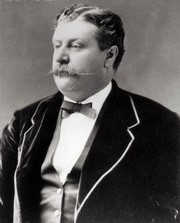
Before his transformation into colonel.
            Jim Fisk brightened.  Though he had graced the battlefields of the recent war by his substantial absence, the thought of himself as a regimental commander sparked the blue fire in his veins.  He confessed to having no military experience whatsoever, but the Colonel assured him that he, as second in command, would be on hand to prompt him with the appropriate commands.  And if the future colonel was rather amply proportioned, Braine assured him that his proportions hardly mattered, since it was his spirit that they wanted.  So Jim Fisk, eager to embrace yet another persona, agreed.

            Elected almost unanimously (a few members were Erie shareholders), the new commander addressed the regiment at its armory on West Twenty-seventh Street and  announced that they were going to be the snappiest, flashiest, most top-dog regiment in the city and have fandangos of fun.  He was wildly cheered.  After that he  urged all able-bodied Erie and Opera House employees to rally to the flag -- his flag -- which they did, and had his tailor design a splendid blue uniform rich in gold epaulets, buttons, and braid, with a cap surmounted by a plume; squeezing into it proved a bit of a tussle. 

            Prince Erie’s meteoric rise to colonelcy occasioned much comment in the city.  Some scoffed, others fretted.  Was this comic opera, or would he use his legion to conquer other railroads or even – a disquieted few claimed to be serious -- stage a coup d’état?  Wags hailed him as the first person in history to be simultaneously an admiral and a colonel and debated the proper form of address.  Colonel-admiral?  Admiral-colonel?  Neither?  Both?  The colonel/admiral relished the fuss.

            The first drills under the command of the new colonel were a bit of a fiasco, but gradually, thanks to Braine's whispered help, order emerged out of chaos.  A moonlight parade up the Fifth Avenue, a bastion of quiet elegance, followed, though the genteel residents shuttered their parlors against the bray of the band.  Colonel Fisk then ordered new dress uniforms for the regiment and enticed some of the best Opera House musicians into the regimental band.  This done, he invited the regiment to a special performance of The Twelve Temptations at the Opera House, where they reveled in free champagne, gawked at the onstage waterfall, and cheered the Demon Cancan.  Who would have thought that soldiering could be such fun?  They adored their free-spending colonel.

            Next, the colonel stunned the city yet again by announcing that the Ninth Regiment would set up its summer encampment – traditionally, an occasion for intensive drill – at the breezy coastal resort of Long Branch, for years a stomping ground of his own, and now the preferred vacation spot of the President, his cabinet, and a host of celebrity watchers and lobbyists.  The spit-and-polish Seventh Regiment sneered, predicting a week-long debauch.  But to the surprise of all, Fisk kept a fairly tight rein on skylarkers, drilled the regiment with only a few gaffes of his own, then invited Governor Hoffman of New York to a formal review that proved impressive.  And when the Ninth returned to New York, the colonel led the regiment once again up the Fifth Avenue, this time marching smartly in spiffy new uniforms with a well-tuned, vibrant band, to the cheers of bystanders.  Warned the Herald, “Let the Seventh look to its laurels.”  The colonel beamed.


            For two years Jim Fisk had capered with ebullience and flash, competing with the President to be the most reported-on man in the nation.  His daily jokes in the Erie offices kept the staff in titters.  Flanked by chorus girls and attended by two white footmen in black and two black footmen in white, he drove six-in-hand in the Park.  And at Long Branch, nursing sour feelings since Black Friday, in full martial regalia before a host of witnesses (so a Tribune scribe insisted), he had thumbed his nose at the Presidential carriage. 


            But while Napoleon was out to conquer gold and strut before his newfound legion, his Josephine had grown restless.  Yes, she enjoyed her status as the best-kept woman in the city, and liked hostessing at her Jimjim’s dinners and receptions, but she was tired of his long absences when business or his regiment claimed him, tired of his abrupt cancellations of rendezvous, his tardy arrivals, or failure to arrive at all.  She lived optimally, but how much time could she spend parading about in her carriage, or looking at her wardrobe and jewels, or giving fresh instructions to the cook?  Afflicted with a want of commitment, she was bored.


            Then into the barren vistas of her life stepped Edward S. Stokes, known as Ned.  While Fisk bounced off into multiple ventures, Mr. Stokes called on her daily, murmured enticingly, pierced her with his soft, probing eyes.  Suddenly her existence was charged with intensity, seasoned with adventure.  In rare quiet moments she pondered: Jim was pudgy, Ned was elegantly thin; Jim whooped, Ned purred; Jim’s mustache scratched, Ned’s tickled.  Her soul stirred, her bottom tingled.        

            Miss Mansfield's new admirer was a fancy dresser,  lithe and slender, who favored satin vests under a frock coat faced with silk, black satin cravats, kid-topped shoes or glossy patent leathers, moss agate sleeve buttons, diamond rings, a spotless gray topper, lilac or lavender kid gloves, and an ivory-headed walking stick.  His curly jet-black hair was always perfectly in place, while over his upper lip curled a dream of a mustache that women found irresistible, its tickle exquisite, enhanced further by aromas of scented soap imported from England and lemony aftershave arising from his taut, smooth skin.  These effects were carefully achieved by his two hours of grooming daily at the Hoffman House, the elegant white marble hotel on Broadway at Twenty-fifth Street where he resided amid sumptuous furnishings.

            Fortune had smiled on Mr. Stokes: unsmirched by toil of battle, he had thrived mightily at the Produce Exchange during the war, and then built a refinery in the outer wilds of Brooklyn and reaped another bonanza in oil, until the oil bubble burst and the refinery’s profits grievously collapsed.  From this mischance he labored to redeem it, his heroic efforts compromised by an addiction to betting on losers at the racetrack, and a tendency to spend money that he didn’t quite have.  Fortune had smiled on him again when he met Mr. James Fisk, Jr., who, seeing its potential, put the prostrate refinery back on its feet.  Thanks to its new alliance with the Erie Railway, with Fisk as president and Stokes as treasurer, the refinery prospered again, and the treasurer would have likewise prospered, had his appetite for debt not proved insatiable, and his thoughts wandered freely from business.  They wandered to his partner’s inamorata, whose green lustrous eyes, fragrant bosom, and abundance of purple-black hair were revealed to him on a number of social occasions.  To discover a nymph so buxom, blithe, and debonair in the glades of Erie astonished him; he was instantly, irrevocably smitten.

            Miss Mansfield warmed to her new admirer’s advances, being weary of Mr. James Fisk, Jr., though not of his money, which came to her in driblets, two hundred today, a hundred the day after that.  Her seasoned eye having discerned in Neddy a fervent but impecunious lover, she was in no rush to kill the goose that laid the golden eggs.  Instead, she importuned Prince Erie for a lump sum that would let her have a bank account of her own.  To which he replied with a flat no, since she would blow it all on diamonds and sables.  If she brought up his parading around in Central Park with Mlle Irma and that Montaland woman, he insisted these were business acquaintances and nothing more.  (True, or almost, since his dalliances, if any, must have been fleeting and rare.)  And always she sensed in him a deep, hidden loyalty to his wife, that starched little goody-goody lodged at a safe remove in Boston, untouched and willfully ignorant, whom he idolized, and to whom she knew she must not refer.  Clearly, vast tracts of Jimjim escaped her.  Their relationship grew turbulent with strife.

            Jim Fisk usually resided with his Dumpling at 359 West Twenty-third Street, where he hosted friends for suppers and cards.  Josie’s blond cousin Marietta Williams also lived there, providing a veneer of respectability while keeping much of the time discreetly apart.  When Fisk and Josie’s quarrels waxed vivid, he and his valet retreated to Prince Erie’s own brownstone at no. 313, a mere four minutes away, where canaries in every room lightened his exile with their singing.  From there he besieged her with numerous epistles insisting that only with the keenest regret had he folded his tent like the Arabs and stolen away, that all their differences could be settled with a kiss.  Soon enough these assurances, and the lady’s pressing need of pocket money, brought him and his valet back to no. 359.
            
            Fisk's partner Jay Gould had watched all this with misgivings.  To his own mind, a citadel of clean, dry thought, Fisk panting for Josie wallowed in the wet and wormy.  For Gould, Josie was a germ of scandal, a flaw in his crystalline schemes.  When he blurted out to Fisk what others had long been hinting at – that in his absence Ned Stokes was seen far too often at Josie’s – Fisk felt it like a knife in his gut.  That a ladies’ man like Stokes should be drawn to his Dolly he could understand, but that she should prefer this debt-tainted fashion plate – this fancy pants, this idler – to him, he simply could not fathom.  Infatuation; surely it would pass.  Confronted, she didn’t trouble to deny the attachment.  What did he expect, being so stingy, so busy with business, or off sleeping with his imported French whores?

            Keenly aware now that the same four-poster that had felt the imprint of his revels with Josie had borne the svelte grace of Edward S. Stokes, he folded his tent once again and withdrew to no. 313, and canceled the verbal agreement whereby that rival’s oil refinery got special low rates from Erie and supplied Erie with oil; at one swoop, Stokes’s income was wiped out.  He expected ravings and lawsuits, but instead got a message suggesting a drink at Delmonico’s.

            “Ned,” he said on arrival, “I thought I could cut nearer a man’s heart than anyone in this city, but you go plump through it.”

            Unruffled, Stokes proposed quite civilly that the two of them go to Josie and ask her to choose between them.  Fisk agreed and they went.  But Josie with dulcet cajolery proposed a solution of her own.  Why should two grown men fight like little boys?  She liked them both.  Why couldn't all three just be friends?  “No go, Josie,” said Fisk.  “You can’t run two engines on the same track in opposite directions at the same time.  You’ve got to choose between us.”  The three of them palavered into the wee hours, but no agreement was reached. 

            Over the weeks, then months, that followed, letters passed between Prince Erie and his Dumpling.  Thanks to help from his secretary, Fisk’s letters were orthographically sound and scaled at least the foothills of eloquence: “I have shown you nothing but kindness.  I have laid at your feet a soul, a heart, a reputation that cost me twenty-five years of struggle to build, and that now, but for the black blot of having in an evil hour linked myself with you, would shine brighter today than any ever seen on earth.”

            Soon after, he sent back a ring she had given him, announcing, "There is no further need of any discourse between us.”  She answered: “Your letter is cruel and unwarranted.  You have often told me that you hold in your keeping some twenty-five thousand dollars that are mine.  If you will pay me that sum, I shall never have to appeal to you for aught.  This will make possible the break between us that you, not I, so ardently desire.”  Her style too had a certain minimal polish; he suspected Stokes’s complicity.

            The proposed lump sum to be settled on her had now become a debt to be paid.  Learning from informants that Stokes had pawned his jewels, he wrote her yet again:  “How you must be saying to your paramour, ‘Man, how beautiful you are to look at, but nothing to lean upon!’"

            Josie appealed to Judge Barnard, then to Boss Tweed himself, to act as arbiter; neither could help.  Then, when another attempt at reconciliation failed, she seized his galoshes – the last vestige of him in her brownstone – and hurled them into the street.

            On New Year’s Day 1871, to efface memories of the reception at Josie’s just one year before, Prince Erie dashed off in a shiny equipage drawn by four high-stepping horses, attended by four footmen in livery, to pay his New Year’s calls.  At each stop the footmen unrolled a purple-and-gold carpet from carriage to door, then stood at attention, two on each side, as James Fisk, Jr., ablaze with diamonds, strode forth to pay his respects.  Bluebloods winced, but the rest of the city laughed, and the caller himself scantly masked the most piquant of grins.

            On a Saturday soon after New Year's Fisk had Stokes arrested, charging embezzlement of oil refinery funds.  Protesting, Stokes was hustled off to Ludlow Street Jail.  Lodged and fed like a common criminal, deprived of clean linen, scented English soap, and the Florida water in which he customarily bathed, the young man fumed with rage.  Released on bail Monday morning, he hired a lawyer and got the embezzlement charge thrown out, then sent eighteen men to seize the refinery and remove its oil to be sold.  Fisk at once countered with fifty who expelled the intruders and gained possession of the premises. 

            Soon afterward a ditty was printed in the press: 


                                    The heart that once on Erie’s walls
                                       The soul of greatness shed,
                                    Now sits as sad in Erie’s halls
                                       As if that soul were fled.

                                    So sleeps the pride of former days;
                                       So glory’s thrill is o’er
                                    When Josie, in her altered ways,
                                       Throws gum shoes out the door.


Beside the verses appeared a cartoon showing Fatty Fisk bedewing his galoshes with tears.  Gotham roared.

            Jim Fisk had always coasted on waves of mirth, often at his own expense, while evincing an engaging charm.  But this was different.  For the first time in his life, people were laughing not with him but at him.  He felt weak, foolish, exposed.  Stokes’s revenge; it hurt.  But worse followed when the scandal-hungry Herald printed an interview with Stokes that blazoned Fisk’s affair with Josie to the world.  “Fisk has never faced a good, square stand-up fight till now,” Stokes was quoted as saying.  “I’ll push him to the wall for sure.”

            Hurrying to Josie’s brownstone, the same reporter described its luxurious appointments and then the lady herself, in white silk, “tall and shaped like a duchess.”  “There has been a great deal said of me that is false,” she announced.  “I blame myself for nothing but my intimacy with Mr. Fisk.  He used me wrong.  If he provokes me, I can defend myself.  I know Mr. Stokes very slightly.”  She then said of  Fisk’s spoils in the Erie war, “I know all about that matter, but don’t care to betray any confidences, unless Mr. Fisk provokes me.  I have his letters.”

            Drawing on dubious classical scholarship, the Herald spared no one in its article, ridiculing "Menelaus" Fisk, "Belle Helene" Mansfield, and "Achilles" Stokes, while announcing "war to the knife all round."

            Reading the interviews, Fisk was stricken.  Not only was his affair with Josie trumpeted to the world, but she herself was sounding the trumpet, discarding any pretense of virtue and brandishing his letters as a threat.  Quickly he wrote his wife in Boston, urging her to take a long-deferred European tour, thus hoping to shield her from the scandal.  As for Josie, any faint hope of a reconciliation had been shredded; from now on it was indeed war to the knife.

            But war of another kind loomed.  To the colonel’s astonishment, the Ninth Regiment had been issued a call to arms.


            Future attractions:  Because I have an overload of posts waiting to be published, I will speed things up by publishing part 4 of Jim Fisk next Wednesday, and part 5, the finale, on the following Wednesday, July 3.  Next Sunday:  Farewells (coffins, kiss-offs, liquidators, and a mother's rage).  In the works: Trees; Secrets of New York (Browder version); Go Ahead: The Mania and Disease of Progress; Me and the Seven Deadly Sins.  Latest inspiration: Liars, Cheats, and Manipulators (no, not our elected officials or corporate CEOs, but people that I've known).


(c)  2013  Clifford Browder


Sunday, June 16, 2013

65. Who is a hero?


     New Yorkers love parades, especially ticker-tape parades honoring heroes and visiting dignitaries.  This has been going on since the 1880s, the heroes being originally showered with a snowstorm of torn-up stock market ticker-tape, and more recently with shredded paper and confetti thrown down from tall office building windows, as they proceed up Broadway, the so-called Canyon of Heroes, from the Battery to City Hall.  Those honored have included royalty and foreign heads of state, athletes and explorers, flyers and astronauts, victorious military commanders, and returning veterans.  Admiral Dewey and General Pershing were so honored, as well as Charles Lindbergh and Dwight D. Eisenhower, Winston Churchill, Douglas MacArthur, and countless others, including the American hostages returning from Iran in 1981.  The only musician to receive a ticker-tape parade was Van Cliburn in 1958, after winning the International Tchaikovsky Competition in Moscow.  The only scientist was Albert Einstein, in 1921.  Significant among the athletes was Jesse Owen, returning in 1936 from the Berlin Olympics with four gold medals.  The ticker-tape parade is an old New York City custom, and one likely to be continued well into the future.


File:Apollo 11 ticker tape parade 1.jpg
The 1969 parade honoring the three Apollo 11 astronauts following their mission to the moon.


     But are all these people really heroes?   The crown prince and princess of Sweden, the winner of a golf tournament, the president-elect of Brazil, the governor-general of Canada, the prime minister of Pakistan, the president of Uruguay, the New York Yankees, the Pope?  With all due respect to all of them, I suspect not, though it depends on your definition of hero.  Who, then, is a hero?

     Recently I put this question to my partner Bob and to our friend John, asking them to just come up with some names off the top of their head.  John suggested Martin Luther King, Nelson Mandela, Gandhi, and then, to my surprise, Beethoven, because he continued to compose in spite of growing deafness.  Bob first mentioned Proust -- for me, another surprise -- citing his race against death to finish his long, now highly acclaimed novel.  Bob then went on to cite Columbus, Churchill, Lindbergh, and the civil rights workers who fought against segregation in the South.  Obviously these choices reflected their personal interests: John is very knowledgeable about classical music, and Bob is currently rereading Proust.

     I then gave them my definition of hero: a hero is someone who, against great odds and at great personal risk, fights on behalf of many to accomplish a worthy goal.  Admittedly, a somewhat narrow definition, since I don't think the designation "hero" should be conferred too liberally; if everyone is a hero, then no one is.  This definition is tentative, since the more I think about it, the more issues come to mind.  I have already decided that a hero -- or heroine -- needn't win his struggle; it's the struggle itself that counts.  Also, that he may have some unattractive traits; this needn't disqualify him, if he otherwise matches the definition.  And finally, it is best to let the designation be tested by time; calling a contemporary a hero is risky, since there may be much we have yet to learn.

File:MKGandhi.jpg
A hero in spite of his flaws.


     So who, by my definition, is or is not a hero?  I certainly agree with my friends that Martin Luther King and Nelson Mandela qualify.  Also Aung San Suu Kyi, the woman who endured more than two decades of detention in Burma (Myanmar) while fighting for democracy and human rights.  Obviously, the persecuted opponents of prejudice and tyranny rank high.  Also on the list is Gandhi, even though a Bengali friend of mine has informed me that his treatment of his women left a lot to be desired.


File:Bradley Manning US Army.jpg
Bradley Manning.
A man I'd like to know. 

     Among others who came immediately to mind were Joan of Arc, Juarez, Bradley Manning, and -- for me, another surprise -- Jesus.  Bradley Manning is admittedly a risk, being very contemporary, but from what I now know of him, he qualifies, whereas I'm not so sure about Julian Assange; as for Edward Snowden, the other whistleblower who recently announced in Hong Kong that he leaked information about government surveillance programs, I need more information before deciding.  Jesus certainly qualifies, regardless of one's own religious beliefs or lack of them, and I might add other religious figures -- maybe Joseph Smith, the founder of Mormonism -- if I knew more about them.  I would also add Greenpeace, when it sails into areas where nuclear tests are about to be carried out, and Doctors Without Borders, when they operate in areas plagued with great violence.


File:Ralph-Nader-1975.jpeg
Ralph Nader, 1975.
Heroes don't have to look heroic.

     Sometimes only one phase of someone's life deserves to be labeled heroic.  Ralph Nader, when he first took on General Motors and proclaimed one of their cars "unsafe at any speed," was, to my mind, heroic, since GM hired private detectives to tap his phones and investigate his past, and had prostitutes try to entrap him in compromising situations; but later, when he became well known, the label seemed less appropriate.  Similarly Fidel Castro was a hero when he fought to overthrow the Batista dictatorship in Cuba, but later, when he himself assumed power, he became an autocrat -- an autocrat who accomplished some worthy things, but nonetheless an autocrat -- and therefore no longer a hero.  The same applies to Charles Lindbergh, a hero when he flew across the Atlantic, but controversial later when he urged this country to sign a neutrality pact with Nazi Germany so as to ward off the menace of the Soviet Union.  And if Columbus was heroic in crossing the Atlantic, for me he loses that status when, upon arriving on the coast of North America, he sees the natives and notes how easily they could be enslaved.


     Who does my definition exclude?  Abraham Lincoln, our greatest president, for one, since his life was not in danger daily and he exercised great power.  There are many admirable figures in history who don't quite qualify as heroes.  Athletes are also to be admired for their accomplishments, but I see those accomplishments as personal and not benefiting others, with Jesse Owens a notable exception.  Which raises a related question: if someone strives to overcome a physical handicap -- victims of the Boston bombing, for example, or wounded veterans struggling to recover use of their limbs, or to learn to use prosthetic limbs instead -- is their struggle to be considered heroic?  By my definition, no, since this is a personal endeavor, not one that will affect large numbers of people.  But this is well worth debating.  Maybe my definition should include a separate provision for those afflicted with a handicap and determined to overcome it, the supreme example being Helen Keller.  A personal struggle, to be sure, but one that can inspire others.

     I find it hard to include political and military leaders, if they exercise power, since they are usually not exposed to great personal risk and often pursue controversial policies.  So I eliminate Churchill, Roosevelt, and de Gaulle, as well as Eisenhower and MacArthur.  But we should not exclude those capable of heroic acts in opposition to our own forces or policies, such as Aguinaldo, who fought for Philippine independence after we acquired the Philippines from Spain, and the niños héroes (boy soldiers), six teen-age Mexican cadets who died valiantly while helping the outnumbered Mexican forces defend Chapultepec Castle against a U.S. attack in 1847.  And of course all the native peoples of North America, who resisted our encroachments in a desperate attempt to preserve not just their lands but their way of life.

File:John Brown by Southworth & Hawes, 1856.png
John Brown in 1856.
Not a man I'd care to meet.
     Perhaps the most controversial figure in American history is the abolitionist John Brown, who in 1859 seized the U.S. arsenal at Harpers Ferry, Virginia, in hopes of starting an armed slave revolt that would lead to the freeing of all slaves in the United States.  Defeated and captured, he was tried for treason against the commonwealth of Virginia, convicted, and hanged.  On the day of his execution he predicted that the crimes of this guilty land would be purged only with much bloodshed -- a prediction soon confirmed by the Civil War.  His raid was at first condemned even by Northern abolitionists, but his trial turned him into something of a martyr, and opinion about him began to change in the North in the course of the war.  Even today it can be hotly debated whether his action was justified.  In other words, does the end justify the means?  I have trouble with this myself, and can't forget how in Bleeding Kansas in 1856 Brown and others pulled several proslavery men out of their homes in the middle of the night and hacked them to death with swords.  If Brown is allowed the status of hero, how can it be denied to the 9/11 terrorists, or any terrorists devoted to their cause?  For me, he is not a hero.  But I freely grant that one man's terrorist is another man's freedom fighter, and one man's hero another man's villain or fool.  These judgments, alas, are always subjective.

File:Rogier van der Weyden - Saint George and the Dragon, NGA, Washington.jpg
Saint George slaying the dragon.
Rogier van der Weyden, ca. 1432.
That's how they did it in the old days.
For us it's not so simple.
     John Brown surely thought of himself as a hero and martyr fighting the monster of slavery.  In myth and legend the hero is a man (almost never a woman) who kills a dragon or other monster and in so doing wins for himself a maiden in distress, or a treasure, or both.  Siegfried in Wagner's Ring kills the dragon Fafner and then is lucky to get -- for a while -- both a magical ring forged from a treasure of gold and also the sleeping Brunnhilde.  But these stories can also suggest the creation myths of many cultures, where a creator god who represents light slays a dragon or she-monster who represents darkness, and from her body creates the world.  In Mesopotamian myth the hero Marduk slays the monster-goddess Tiamat and from her ribs creates the vault of heaven and earth, while her weeping eyes become the source of the Tigris and Euphrates.  The she-monster is primordial chaos, the dark watery mass of unformed matter out of which cosmos is formed.  Some scholars also see in these tales the triumph of a patriarchal society over an earlier matriarchal society that worshiped an all-powerful goddess, which brings us back to the Earth Goddess of post #59; indeed, Big Mama is hard to avoid.


     Today, in our less mythic age, dragons are in short supply, not to mention sleeping Valkyries or other maidens in distress, whom feminism decidedly discourages.  But, metaphorically speaking, there are dragons aplenty meriting destruction: the GM that Nader attacked, other oppressive corporations, malfunctioning government agencies, the military-industrial complex, the prison industrial system, lingering racism, pervasive poverty.  (Post #60 on fascism offers a slew of contemporary dragons.)  Yes, dragons and monsters abound.  If we can't kill them, we can at least lop off an ear or two, defang them, slice them down to size.  But there are risks involved, as Mr. Nader learned early in the game, and Bradley Manning is learning now; those dragons play nasty.

     Here is a list of twelve well-known persons, living or recently deceased.  Which of them, if any, merit a ticker-tape parade up the Canyon of Heroes on Broadway?  How would you describe them?  Select one or more of these terms for each:

  • hero/heroine
  • almost hero/heroine
  • trailblazer
  • martyr
  • troublemaker
  • liar
  • hypocrite
  • rascally yeaforsooth knave (from Shakespeare)
  • criminal
  • traitor
  • murderer
  • fool

Barack Obama                                  
the Dalai Lama
Lance Armstrong
John McCain
ex-Pope Benedict
Michelle Obama
Mayor Bloomberg of New York
Hugo Chavez
Bradley Manning
Julian Assange
ex-President George W. Bush
Dick Cheney


     Finally, what dragons would you like to slay?  Name five or more.  Here are some suggestions.
  • J.P. Morgan Chase (or any other big bank)
  • labor unions (one or all)
  • your state legislature
  • the CIA
  • the FBI
  • the National Rifle Association (NRA)
  • the American Civil Liberties Union (ACLU)
  • ALEC (see post #60, May 2013)
  • the IRS
  • the military-industrial complex
  • the Defense of Marriage Act (DOMA)
  • the Freedom of Information Act (FOIA)
  • Roe v. Wade

     Coming soon:  Jim Fisk, part 3: Blue Fire in His Veins (Jim Fisk, corpulent and unmilitary, becomes a regimental commander, while his lady friend begins to stray); Farewells; Trees; Secrets of New York (Browder version); Go Ahead: The Mania and Disease of Progress.  Still in the works: Me and the Seven Deadly Sins (startling revelations!).

(c)  2013  Clifford Browder


Sunday, June 9, 2013

64. A West Village Murder and the Fear of Night


     In the early hours of Saturday, May 18, two young gay men were walking north along Sixth Avenue in the West Village when they encountered three other young men, one of whom, Elliot Morales, accosted the first two, voiced antigay slurs, and asked one of them, Mark Carson, an openly gay man, "What are you, a gay wrestler?"  Carson and his companion then turned into West Eighth Street and walked east, but Morales followed them and asked Carson if the friend with him was his partner, and when Carson answered yes, Morales drew out a revolver and shot Carson at point-blank range in the face.  Emergency workers came, tried to revive Carson, then took him to Beth Israel Hospital, where he was pronounced dead on arrival.  Morales fled, but a description went out over the police radio, and an officer on foot patrol nearby recognized the suspect and arrested him; he is now being held without bail on a charge of second-degree murder as a hate crime, and illegal possession of a weapon.  Morales, it turned out, had already threatened a bartender in a nearby bar with antigay slurs, showing him a silver revolver in a shoulder holster and threatening to kill him if he called 911.  State correction records indicate that he has served more than ten years in prison for a robbery conviction.  The police immediately labeled the killing a hate crime.  A photograph of Carson shows a black man in his early thirties with a thin mustache and short, closely cropped beard, and a partly shaved head with a thick tuft of hair on top: nothing eye-catching in the West Village, but an appearance that might attract the attention of a homophobe.  Morales's sister has said that he told her he was drunk that night and remembers nothing.

     The whole West Village community, gay and straight, was shocked by this crime, which took place in a gay-friendly neighborhood not far from the Stonewall Inn, where gay liberation first began, and only a short ten-minute walk from my apartment.  Residents immediately brought candles and flowers to create a makeshift memorial for the victim on the site of the killing, and on Monday, May 20, thousands marched through the streets to denounce the murder, chanting "We're here!  We're queer!  We won't live in fear!"  Carson's murder was the first in the West Village precinct this year, but through the first week in May there have been 57 assaults, a sharp increase over the 33 reported in 2012.  Just hours after the Monday march the police received reports of two other antigay bias attacks in downtown Manhattan, unrelated to the West Village attack or to each other.  Others, of course, go unreported.

     Crimes of violence seem to be especially frequent at night.  The West Village march brings readily to mind the Take Back the Night campaign that began in Belgium in 1976 and has since spread worldwide, as women in many different cities march together at night holding candles to protest the violence that often threatens women walking alone at night.  But that such demonstrations are held is in itself an indication of the power of night and the fear it can inspire.

     When I ask myself what the word night suggests to me, I immediately think of darkness, danger, crime, and violence.  If you live in a big city and hear the news, it can hardly be otherwise.  Next, I think of nightmares, pain, insomnia, but also the irrational, the unconscious, the unknown.  And, to be sure, mystery and adventure.  But always, night suggests something wild and primal, something to guard against, something to fear.

     Wait a minute, you may say, New York is the city that never sleeps, a fun city, a place full of night life; at night people flock to night clubs and restaurants and bars, to theater and opera, to parties, to all kinds of amusement, licit and illicit.  And think of Times Square at night -- an amazing light-filled spectacle.  And seen from a distance -- from Brooklyn, for instance, or from the air -- isn't the city, with all its buildings and avenues and bridges, a brilliant, almost magical display of light?

File:Times square at night.jpg
  A feast of light in the heart of darkness.
Rafi B.

     Yes, of course, but this is light surrounded by darkness, triumphing over it through modern technology and wholly dependent on that technology.  Darkness is primal; light in darkness is a marvelous human invention, a contrivance, a defense against menacing, all-encompassing night.

     Some politicians are not above appealing to our fear of night to win votes.  Years ago a candidate for mayor ran an ad on the radio where you heard a lone pedestrian's footsteps on pavement, and then a voice asking if that pedestrian would get to his (or more likely her) destination safely; to guarantee such safety, vote for Candidate X.  I resented that ad then and still resent it now, since Candidate X was not going to appear like Superman to protect the lone walker from whatever threat might materialize.  I detest the politics of fear and will not vote for any candidate who resorts to it.

     City dwellers have little awareness of what night really is.  When, long ago, Bob and I discovered Monhegan Island off midcoast Maine and began vacationing there in the spring and fall, we rediscovered the reality of darkness, the very essence of night.  On Monhegan there are no paved streets and no streetlights, so if you go out at night, you carry a flashlight and slowly grope your way.  The darkness envelops you, and with it a silence unknown in the city, and overhead on cloudless nights there is a feast of stars.  But the night there doesn't threaten; it is vast and awesome.

File:Night Sky Stars Trees 02.jpg
What we miss in the city.
Michael J.Bennett

     Be that as it may, in the city many people venture out at night.  Yes, but not everyone.  When I go out in the daytime, I see the very old and the very young.  The elderly are often going about with an aide, or with a walker or in a wheelchair, and the very young, well escorted, including even toddlers linked together by a rope, turn up in the greenmarkets, where they are instructed in the mysteries of food and its origins.  But these are the most vulnerable of the city's residents and by evening, if not long before, they vanish from the streets.  Evening and night belong to the young and adventurous; they above all are the ones who patronize the bars and restaurants and movie theaters, the ones who revel in the city's infinite offerings of entertainment and adventure, and its opportunities for mating.  Bob and I were among them once, but no more.

File:John Henry Fuseli - The Nightmare.JPG
The Nightmare, by the German artist Johann Heinrich
Füssli (1741-1825).  
     Night is when inhibitions fall, when all that we have mastered or suppressed during the day returns  to haunt us: pain, worries, obsessions, savage and even murderous impulses, and the urge to suicide.  They come in waking thoughts, in dreams, in nightmares.  The mare in the word nightmare, by the way, has nothing to do with horses; it comes from the Old English maere, designating an evil spirit that settled on a sleeping person's chest, causing bad dreams.  In time the word nightmare came to mean, not just those dreams, but any bad dream.


     As the derivation of nightmare makes clear, night has always been associated with the forces of evil, with witches and demons and evil spirits of every kind, and in Christianity with Satan, their lord and master.  In the Middle Ages people believed quite literally in the Witches' Sabbath, a gathering from midnight to dawn in some desolate place of witches and demons and their master, who was often present in the form of a goat or satyr, for a feast, wild dancing, and a Black Mass, followed by a sexual orgy of male and female demons.  Whether they believed in it literally or not, many artists from the Renaissance on have portrayed it, including Dürer, Hans Baldung, and Goya.  The same subject is conveyed musically in Mussorgsky's Night on Bald Mountain, and literarily in the Walpurgisnacht scene of Goethe's Faust. The problem for all writers and artists, I suspect, has been to make the Sabbath fascinating but not too enticing; evil always has its attractions.


File:Andries Jacobsz. Stock - Witches' Sabbath - WGA21799.jpg
A Witches' Sabbath, an engraving by the Dutch artist Andries Jacobsz Stock, circa 1610.

     Many myths and religions have described a cosmic battle between the forces of light and darkness, heaven and hell, good and evil, a struggle that the forces of good are by no means destined to win.   Norse mythology presents Ragnarok, meaning Destiny or Twilight of the Gods, when three winters come without summer, brothers kill brothers, the stars disappear, mountains topple, and the wolf Fenrir, long bound by the gods, bursts loose and swallows the sun and then in battle devours Odin, the ruler of the gods, while the thunderer Thor and other gods are slain by other monsters, and the whole world burns and sinks into the sea.  This cosmic cataclysm, followed by the earth's rising beautiful and green again, and the survival of two humans whose progeny will repopulate the earth, influenced Wagner in the composition of his Ring cycle.

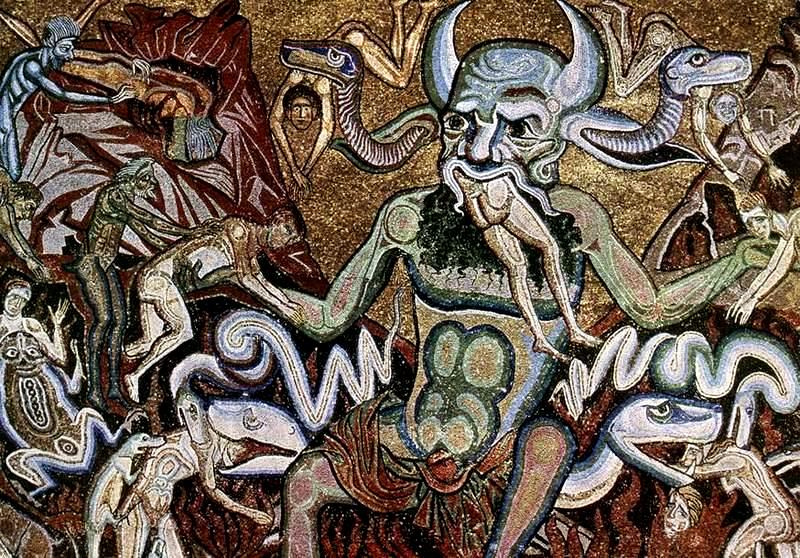
File:Coppo di Marcovaldo, Hell.JPG
Hell, a mosaic by Coppo di Marcovaldo in the baptistery of the cathedral of Florence.
The Christian hell was never meant to be fun.  Installed circa 1301, for me this work
seems surprisingly modern.  

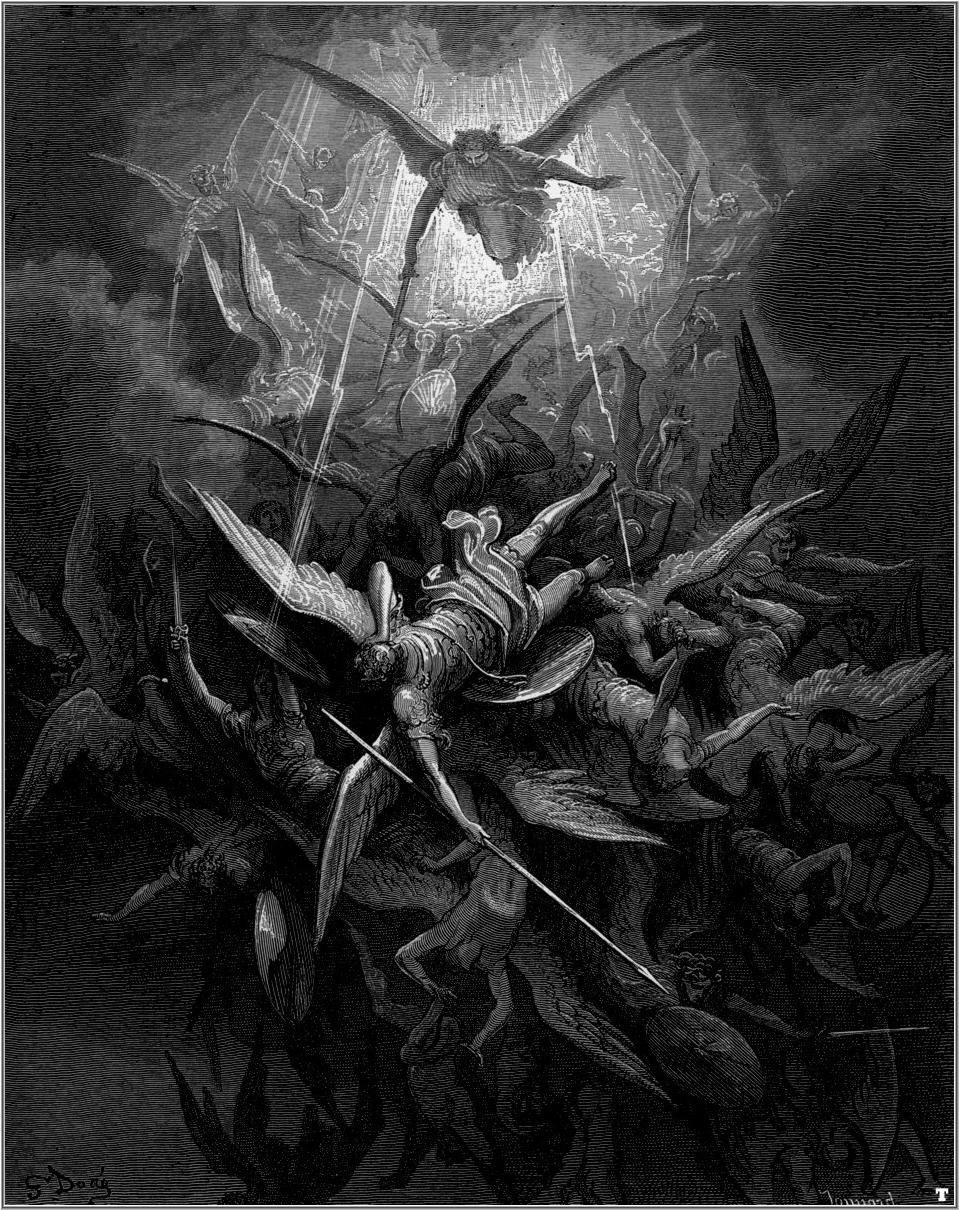
     In traditional Christianity the underworld of darkness is hell, where demons torment the damned, a subject that medieval painters and sculptors have rendered in vivid detail.  Milton, at the beginning of Paradise Lost, tells how Satan and his followers, having revolted against God in heaven, are hurled down into a "dismal Situation waste and wilde, / A Dungeon horrible, on all sides round / As one great Furnace flam'd, yet from those flames / No light, but rather darkness visible ..."  But if Satan and his cohorts are banished from the realm of light, their bleak new abode proves rather fascinating for the reader, and they themselves far more interesting that the light-bedizened denizens of heaven.


File:Paradise Lost 1.jpg
Satan and his cohorts are cast down into hell.  Illustration for 
Paradise Lost by Gustave Doré, 1866.


     In mythology the darkness of night also characterizes the underworld, the land of the dead, usually a gloomy place contrasting sharply with the celestial realm of the gods.  It also characterizes the chaos preceding cosmos, a formless, fluid realm out of which the Creator God, often a god of the sun or of light, brings forth the created world where humans live.  Sometimes chaos is a she-monster or sea serpent or dragon that the hero of light slays and then, from her body, creates the world.  (Big Mama again; see post #59).  In Genesis, darkness is on the face of the deep, until God initiates Creation with the command, "Let there be light!"  So night can suggest both death and the potential for life.

     But it suggests other things, too.  It inspires in some of us a wild freedom, a feeling that no one is watching, that we can get away with things.  My own participation in this has been mild enough: in high school, occasional mindless hollering when out with the guys on Friday night.  And once, when a student in Besançon, France, I joined with other students in an impromptu all-night rural promenade by moonlight, almost noiseless, but just disturbing enough that watchdogs barked, and peasants turned the lights on to ward off these mysterious intruders.  More sinister was my return to the city by train during the blackout of 1977, when I was a target, not a doer.  As the train crept slowly toward the 125th Street station in Harlem, I and the other passengers, all white, could see bonfires in the streets, and suddenly heard two male voices screaming insults and obscenities at us from buildings near the track -- only two, but it seemed like a chorus of hate.  Yes, a wild freedom, a release of fierce passions kept in check by day.

File:Another view of New York at Night (7823233682).jpg
Beautiful at night.  But if those lights go out ...
Stuart Sevastos
     So night is with us even today, when we live surrounded by amenities in towns and cities blazing with light.  Deep in our psyche maybe there lurks the faintest memory of prehistoric times when humans huddled in their caves, guarded by fire at the entrance, wary of the wild creatures prowling outside in the night.  Yet many of us in an urban setting venture forth into that night, going to pleasure, to excitement, to freedom, or to our death.

     A triple invasion of New York:  This week New York has been invaded thrice, twice in Manhattan and once in Staten Island and the suburbs.

1.  The Left Forum, an annual gathering of socialists, Marxists, libertarians, radicals, and progressives of every stripe and hue, is taking place at Pace University June 7-9.  There are more than a thousand speakers, prominent among them Noam Chomsky, filmmaker Oliver Stone, and Garcia Linera, the vice-president of Bolivia.  This year's theme: Mobilizing for Ecological/Economic Transformation, verbiage that in my opinion shows how far the Left still has to go, in order to appeal to a wide spectrum of voters in this country.

2.  Also visiting the city are members of Pussy Riot, the Moscow-based activist group whose 2012 performance of an anti-Kremlin song inside the main Orthodox cathedral in Moscow got three of them convictions for hooliganism and a stay in prison, where two are still confined.  They are here to promote an HBO documentary, "Pussy Riot: A Punk Prayer."  They continue to wear masks in public and use pseudonyms, to avoid further trouble with authorities in Russia.  I confess that I have reservations about their disrupting a religious service; they could have demonstrated outside.  I had the same reservation about gay activists who some years ago rushed into Saint Patrick's Cathedral to disrupt a Mass.

3.  Seventeen-year locusts have now awakened from their lengthy slumber so as to spawn, and are now sounding their cacophonous rasp high in the trees, smashing against windshields, mating on plants and porches, infesting suburban lawns, and crawling up the pant legs of Staten Islanders, under whose feet they perish with a crunch.  Mercifully, they will be gone in about two weeks.

     The newspaper of record gave ample space to Pussy Riot and the locusts, but as of Saturday, none whatsoever to the Left Forum.  In their judgment, I presume, not "news that's fit to print."

     Coming next:  Who is a hero?  My definition, who it includes, and who it excludes.  Bradley Manning?  Julian Assange?  Obama?  Martin Luther King?  John Brown?  Ralph Nader?  The Dalai Lama?  And so on.  Feel free to add your own choices, especially if different from mine.  Also, since heroes traditionally slay monsters, what monsters would you like to slay today?  Not people (I don't encourage murder or mayhem), but monstrous laws, customs, institutions, corporations, and such.  Newly in the works:  Secrets of New York (Browder version), presenting mystery houses, a hidden meadow, Moses' Folly, the groin of summer, and other overlooked or hidden locales.

(c)  2013  Clifford Browder


Sunday, June 2, 2013

63. Jim Fisk, part 2: The Great Gold Corner of 1869, or, Can't a fellow have a little fun?

         
            Most of us have dreamed of doing the impossible, but few have really attempted it.  In 1869 Jay Gould and Jim Fisk really attempted it, and in so doing convulsed markets on both sides of the Atlantic.  This is their story, continuing the saga of Jim Fisk, which began two weeks ago in post #61.


            To corner gold:  speculators on Wall Street had dreamed of it, but no one had ever tried to do it,  since the Treasury Department could sell just a fraction of its gold and smash the corner.  But one day in the spring of 1869 Jay Gould suggested to his partner Jim Fisk that they do exactly that.  Fisk probably raised the usual objections, but Gould countered with the assurance that the Treasury would not sell gold.  How could he be sure?  Because he had made the acquaintance of one Abel Corbin, a speculator of somewhat dubious reputation, who had married the sister of President Ulysses S. Grant.  Jay Gould had made Mr. Corbin’s acquaintance and explained to him that if the Treasury didn’t sell gold, farmers would get good prices for their crops, workers would prosper, industry expand, and the whole economy benefit.  But if the Treasury  -- God forbid! --  sold gold, the whole nation would be stricken.  Mr. Corbin was very impressed.  So when he visited the President recently, he advised him against selling gold.

            By now, Jim Fisk’s eyes must have grown wide with wonder.  Did Jay Gould have the President fixed?  Just about.

File:Jubilee-jim-fisk.jpg

            Except as small, bright specks of glint, Jim Fisk had never seen gold, didn’t know what the substance in bulk looked like.  He only knew that it was valued something fierce; that men had toiled and fought and killed for it; that it was dug out of the earth as dust or bits of rock and somehow got converted into big metal chunks – bars, maybe? --  that were locked away in vaults; and that, in the form of paper contracts and certificates, it was traded daily in the Gold Room, where no one had ever cornered it or even dreamed of trying.  To corner gold:  in his mind the impossible – the unimaginable – became a dazzling, tantalizing prospect.  He tingled at the thought of it.

            In a couple of weeks, Gould continued, the President would be passing through New York on his way to a Peace Jubilee in Boston.  What finer way for him to get from here to there than on one of Jim Fisk steamers, with the two of them as his personal escorts?  Mr. Corbin thought it an excellent idea, would put it to the President at the earliest opportunity.  At the merest possibility of having the Chief Executive to themselves all the way to Boston, the duo simmered with excitement.  But would it really happen?

            On the afternoon of June 15, 1869, at the Chambers Street dock, where his Providence was tied up with its decks scrubbed, brass gleaming, canaries warbling, and pennants aflutter in the breeze, Jim Fisk strutted in his naval uniform and lavender kid gloves, sporting a diamond breastpin, his mustache fiercely waxed.  For this event beyond belief he had marshaled all his reserves of daring, his armament of Flash.  Amid booming cannon and the blare of a band, the President and his entourage arrived.  Fisk at once introduced himself, welcomed the President, and waved him aboard the Providence.

File:UlyssesGrant.png
Chances are, he didn't even laugh at Fisk's jokes.

            Ulysses S. Grant hardly had a martial air.   A bit of a sloucher, he mumbled a greeting and offered a handshake, then shuffled aboard with other dignitaries; Fisk waved him to the grand saloon.  There, as the Providence glided away from the dock, the admiral and Jay Gould offered cigars and champagne, then deftly initiated a discussion about the merits of not selling gold. 

            Bumper harvests were expected, Gould expounded in his silver-toned voice.  If the price of gold stayed high, farmers – the very bedrock of the nation – would get good prices for their crops, millions of bushels of grain would be shipped, railroads would thrive, and tons of breadstuffs would be exported to Europe, bringing in another bumper harvest in the form of foreign exchange.  Jim Fisk vigorously agreed.


            Some of the gentlemen present evinced glimmerings of doubt, others nodded, but the President himself, square-jawed with a close-cut, grizzled beard, proved to be as mumbly and reticent as his hosts were expansive and verbose.  All the way to Boston everyone opined except the presidential sphinx, who puffed on his cigar, said nothing.

            “What do you think, Mr. President?” Fisk finally mustered the temerity to ask.

            “There’s a certain fictitiousness about the country’s prosperity,” he said, flicking an ash from his cigar.  “The bubble might as well be tapped in one way as another.”

            Chilled to the quick, Fisk and Gould exchanged a frantic glance, redoubled their efforts.

File:Great Peace Jubilee, Boston, June 1869.jpg
The Peace Jubilee.  For Admiral Fisk, a stage
that proved irresistible.

            In Boston, where the President and other notables proceeded to the Jubilee amid great acclaim, Admiral Fisk in full naval regalia accompanied them, acknowledging with smiles and gestures those large portions of the applause that he thought intended for himself.  Some spectators took him for Admiral Farragut; others, for the President.  From then on he was known as Jubilee Jim.

            Two days later, when the President passed through New York on his way back to Washington, the duo entertained him, his wife, and the Corbins in a box at Fisk’s Fifth Avenue Theater, chatting with the Chief Executive in full view of an astonished audience packed from dome to pit.  The two ladies swayed gently to the strains of Offenbach’s La Périchole, and Abel Corbin probably quickened to a cancan, but the President watched expressionless, as withdrawn and enigmatic as ever.


            Viewing the box from a distance, respectables in the audience wondered how Grant could appear in such company.  What next?  Would the brazen Fisk dare to present his mistress to the President?  Bets were placed by some, but Josie, though pent with longing and splendidly attired, remained in her own box opposite, briskly fluttering her fan while stealing glances at her Jimjim conversing with the President.

            Over the weeks that followed, Jay Gould had numerous interviews with his newfound friend Mr. Corbin, a jowly old man with thinning hair and a slick manner, who assured him of his influence with the President.  Gould then assured Fisk that, thanks to Corbin’s intervention, the Secretary of the Treasury was “all right,” as was the Assistant Secretary for New York, and even the President himself!

            Nagged by doubts, Fisk went to see Corbin himself.  In his parlor on West Twenty-seventh Street, Abel Corbin swore piously that he had the President’s ear: the Treasury would not sell gold.  Fisk came away half convinced, half teased by flutterings of doubt.  Corbin struck him as slick as a freshly printed bank note, as innocent as a newborn babe.  Could his whiny earnestness and mealy-mouthed piety be trusted?  But Gould assured him that, with help from Gould himself, Corbin was into the speculation for thousands.  Impressed, Jim Fisk too bought gold.

            On the night of July 14, while the masters of Erie were preoccupied with the price of a precious metal, two Erie trains collided in Pennsylvania; nine passengers died in the flames, three of them burned beyond recognition.  “The long, dismal, and bloody catalogue of disasters that marks the history of the Erie Railroad," said the New York Herald, “is made again to bear another burden of human slaughter.”

            Steadily the price of gold rose in the Gold Room, as feverish brokers bought and sold before a crowd of spectators that each day grew larger and more excited, drawn there by rumors of a prodigious feat unheard of: an attempt to corner gold.

            “It can’t be done!” said some.

            “It is being done,” said others.

            Gold: the mere idea of it, that wondrous metal coveted by all but seen by few – less a hard reality than a shimmering illusion, a dream -- gripped the city, the nation.  And it was being cornered on Wall Street!

            On September 2, when Grant, en route to Saratoga, came through New York and breakfasted with the Corbins, Gould called on Corbin and was admitted, though he didn't see Grant.  Gould evidently held a whispered conference with Corbin while the President was in another room and received further assurance that the Treasury would not sell gold.  Exultant, Gould bought more gold.

            But the situation changed dramatically on the evening of Wednesday, September 22, when he called again on Corbin, who showed him a letter that Mrs. Grant had sent to Mrs. Corbin, Grant's sister: "Tell Mr. Corbin that the President is very much distressed by your speculations and you must close them as quick as you can."  Obtuse as he was, the President had finally caught on.

           "Mr. Corbin," said Gould, "I am undone if that letter gets out."

           There was now mistrust between the two, and Corbin wanted out.  Gould promised to think this over, and Corbin agreed to keep the letter to himself.  But Gould now knew for certain that he was dealing with a fixer who couldn't fix.  Having bought fifty million in gold on margin, he had to start selling even while he continued to buy.  Who but Jay Gould could contemplate such a double game?  Of all this, not a word to Fisk.

            On Thursday, September 23, while Jay Gould hovered in the offing, Jim Fisk came bounding and whooping into the Gold Room.  Gold was at 137, he said, but he'd bet any part of $50,000 that it would go over 145.  So unsettled were the bears by now, he found no takers.  Meanwhile it was being whispered that the President and his cabinet were in the game up to their ears.  With gold in turmoil, stocks were plunging, money was scarce, trade disrupted, and markets shaken on both sides of the ocean.  SELL  GOLD  urged an avalanche of telegrams to Washington, while honest men and connivers alike rained curses and threats on Prince Erie, who when the Gold Room closed with gold at 144, departed merrily with a cigar in his teeth at an angle.  Despairing speculators made a dash for Delmonico’s on Broadway, crowded the bar, drank their whiskey straight.  By all accounts, panic loomed, chaos threatened.  Would the government sell gold, or not?

            On Friday morning Jim Fisk reappeared on Broad Street in a stylish carriage, flanked by two glittering actresses under laced domes of parasols, amid the stares and oaths of onlookers.  Well aware that he might be mobbed in the Gold Room, he went to his broker’s office just across the street, bade farewell to the parasols, then commandeered a back room for Gould and himself.

            All morning the Gold Room was jammed with hoarse-voiced brokers and speculators, yelling and jostling, some drunk, all frantic, many of them rushing at intervals to splash water on their fevered faces at the cupid-and-dolphin fountain bubbling in the middle of the room, while a mechanical indicator overhead proclaimed the price of gold.  Small operators had been ruined the previous day; now the bigger bearish houses were crumbling.  A huge crowd seethed in the street outside, while stocks plummeted and business throughout the country was paralyzed. 

The crowd outside Gould's office, just across Broad Street from the Gold Room,
on September 24, 1869.  From a publication of the time.

            In their back office across the street, Jay Gould, a mastermind of cunning but a glutton for anxiety, was tearing stray bits of paper to pieces and whispering orders to messengers, while Jim Fisk strutted up and down, coat off, gripping a gold-headed cane as he dispatched more orders to buy.

            “Put it up to one fifty!  … Put it up to one fifty-five!  …  I’m the Napoleon of Wall Street!”

            With each new high a roar erupted in the Gold Room, echoed by a roar in the street: music to Fisk’s ears.  At 12:30 a deafening howl was heard: gold had hit 160; men were weeping or fainting.

            Jim Fisk exulted.  A peddler from Vermont had cornered the world’s most precious metal!  His spirit soared, his feet barely touched the ground.

            Then, suddenly, a messenger rushed in with dire tidings: the Treasury was selling gold. 

            “That can’t be!” shrieked Fisk.

            Chaos in the Gold Room.  Within minutes the price plummeted to 135; the corner was bust, and with it innumerable denizens of Wall Street.  Several brokers were reported to be raving; one had shot himself.  Standing in a ring of shredded paper, Jay Gould was distraught.

File:Black Friday 1869.jpg
Blackboard of the Gold Room on September 24.  Gold peaked at 162 1/2 (2nd column), then
plunged to 133.  This photograph was used as evidence in the 1870 Congressional hearing.

            “I’m forty miles down the Delaware!” shouted Napoleon Fisk, dazed, out millions.  “Old Corbin run a saw right through us!  We’re skinned!  We’re hung out to dry!”

            Suddenly they heard a commotion outside -- “Lynch the bastards!”  “Hang them!”
“Shoot them!” – as a mob of ruined speculators burst into their broker’s front office.  In a flash, portly Jim Fisk, coatless, and frail Jay Gould were out a side door and darting down the street.  Threats and oaths pursued them as they dashed past startled bystanders and yelping dogs toward the bustling throngs of Broadway.  There they lost their pursuers in the crowd, hailed a cab, and rushed uptown.

            Arriving at the Opera House, the fugitives took refuge behind its thick marble walls, guarded by a squad of Erie stalwarts.  While Jay Gould, shaken to the depths, collapsed on a couch in Fisk’s office, Jim Fisk took sober stock: a fortune lost, markets convulsed, mortal threats still ringing in his ear …  What a lark!   Soon after, performing ablutions at a rose-tinted marble sink adorned with sculpted nymphs, he washed away the toil of the day.  Clean-shirted, donning another coat, he joined Gould in the Erie banquet hall to dine sumptuously; he gobbled, Gould nibbled. 

            Gould, having assembled the scattered fragments of his being, now probably confessed to Fisk that while Fisk was buying, he had been selling.  So Gould had limited their losses and presumably -- there is no record of this, but the assumption is safe, since he and Fisk remained friends -- presumably he shared his profits with Fisk.  But Fisk had contracts to buy gold; he owed millions.  The solution: repudiate them -- in Wall Street parlance, "squat" on them -- don’t pay.  This would mean scores of lawsuits, but their pal Judge Barnard could enjoin the plaintiffs; it would take them years to even try to collect.  So from the depths of his marble fortress, Jim Fisk squatted on his contracts, got sued and denounced and cursed.

            “Rogues!  Knaves!  Thieves!” cried Stock Exchange and press, as tides of scandal, washing over Wall Street, lapped at the White House gates.  The President had in fact had no part in the corner, but his fleeting acquaintance with the conspirators seemed to imply otherwise.  Meanwhile everyone was talking about it: September 24, 1869 -- Black Friday.

            For two weeks Jim Fisk and Jay Gould stuck it out in Castle Erie, conducting business by wire, sipping champagne and feasting on pheasant and quail, while speculators, process servers, and journalists pounded at the door downstairs, until shooed off by Erie thugs reinforced by Tweed’s police.  When word spread that Fisk had been shot dead by a ruined victim, toasts to the assassin were raised at Delmonico’s, until the report proved false.

            At this point Jim Fisk may well have reflected.  No one was toasting the death of Jay Gould.  Had Jay wangled him into this, so Fisk would bear not just the losses but the blame?  Who could fathom Jay Gould’s mind, where schemes masked schemes, subtleties enhanced subtleties, and cunning underlay cunning?      

            Meanwhile Abel Corbin, his role in the affair exposed, had taken to his bed and was whining and weeping to reporters.  Said Fisk, “He’s bleating like an unweaned calf!”

            A reporter was finally admitted into the marble confines of the Opera House.  Announced Gould, “I had nothing to do with the panic.”  Said Fisk, “Can’t a fellow have a little fun?” 

            Months later, freed from their fortress at last, the two conspirators were summoned before the House Banking and Finance Committee to testify with others about the Black Friday panic in gold.  Abel Corbin admitted to a tiny speculation: “Not for myself.  For the sake of a lady, my wife.”  Jay Gould explained that civic duty had caused him at great risk to support the price of gold for the good of the Erie Railway and the nation.  When Fisk’s turn came, he mounted a buoyant spiel about the complexities of railroading and the intricacies of gold, which he too denied ever having tried to corner. 

            Chairman James A. Garfield, a future president, was at a loss in this maze of deceit.   Millions had been at stake that day, yet no one admitted to a profit.  Where did all that money go?”

            “Mr. Garfield,” said Fisk, “it went where the woodbine twineth.”

            Silence among the Congressmen, then ripples, tides of laughter.

            The Committee  vigorously denounced Fisk, Gould, Corbin, and others, but since there was no law against speculating in gold or cozying up to a President, they otherwise escaped unscathed.


File:Gold Bars.jpg
These are what it was all about, though no one involved in the
corner ever laid eyes on them.  Yes, they really do exist, in the
vaults of Fort Knox and elsewhere.


            On New Year’s Day, when gentlemen in Gotham went calling on ladies, and ladies stayed home to receive, Jim Fisk remained with Josie Mansfield, his lady friend, at 359 West Twenty-third Street to play host to a galaxy of callers.  Boss Tweed and his Tammany cronies, judges, bankers, and railroad presidents rubbed elbows in the parlors, treading on thick carpets under frescoed ceilings as they nibbled assorted goodies while quaffing whiskey and champagne.  Among them was Judge Barnard, black locks lustrous as always, eyes flashing, diamond studs gleaming. 

            Also present, no doubt, was Edward S. Stokes, a dapper young man about town dressed in the very pinnacle of fashion, whom Fisk had taken as a partner in an oil deal.  On this or another occasion, Fisk introduced him to Josie, thus setting in motion the engine of his fate.  But Fisk, with the turmoil of gold -- aside from seventeen lawsuits -- behind him, surely proposed a toast to the New Year, 1870, confident that it too would be a ripsnorter.  For Jubilee Jim, the sky was the limit.


            Scandal tours in the Big Apple:  Most cities like to put their best foot forward; they don't want to show their warts.  (If that's a mixed metaphor, forgive.)  But not New York.  According to an article in last Friday's Times, two tour companies now offer guided tours of Manhattan sites where celebrities have misbehaved.  One sponsored by the Post and costing forty-nine dollars revisits sites immortalized by that tabloid's headlines.  Thus the tour bus, going past the Helmsley Park Lane Hotel on Central Park South, recalls the headline "Rich Bitch" hailing the death of Leona Helmsley, the hotel's owner, who left twelve million dollars to her Maltese lap dog.  Passing the fabled Plaza Hotel, it salutes film and TV actor Charlie Sheen's ravaging his room after a fun-filled night with an escort, convinced she had stolen his $165,000 watch, as reported in the headline "Trashed!  Sheen in Coke-&-Hooker Rampage at the Plaza."  But the Post's most famous headline, "Headless Body in Topless Bar," is not included, since it would involve a long trip out to Jamaica in Queens.  These tours must be successful, since a rival company has initiated similar tours.  Where but in New York?


            Coming next:  A West Village Murder and the Fear of Night, prompted by the recent murder of a gay man not far from my apartment.  Our irrational but very real fear of night.  Still in the offing:  Trees; Farewells; Go Ahead: The Mania and Disease of Progress; and Who is a hero?


(c)  2013  Clifford Browder