|
| Kim Traynor |
This post and the previous one deal with our ambivalent
attitude toward death and the dead. Last
week I told how in the eighteenth-century colonies the medical schools’ need
for freshly buried bodies for dissection encouraged the nocturnal pastime of body
snatching, which in turn fired up the populace, the result in New York City being
the Doctors’ Riot of 1788. That riot was
finally squelched by the militia, but the problem persisted well into the
nineteenth century, as seen in Mark Twain’s Tom
Sawyer, where Tom and his buddies happen to witness a body snatching in
progress that results in a murder. Twain
didn’t need to explain the circumstances behind the body snatching, as his
readers were well aware of them. Only
when the various states enacted laws allowing medical schools to obtain
unclaimed bodies from public institutions (prisons, hospitals, almshouses) did
this time-honored practice decline.
But body snatching wasn’t the only threat to the dead. In fast-growing nineteenth-century New York
respect for the dear departed suffered grievously as the city expanded
relentlessly northward. Almost daily, in
this Progress-obsessed city, a cornerstone was laid, a new street laid
out. If a graveyard stood in the way,
the city fathers informed citizens of the need to remove their loved ones to a
more distant site, and gave them a certain amount of time to do so. After that, workmen with spades and pickaxes
moved in (no bulldozers in those days) and pitched out a clutter of bones, and
even skulls with hair still attached to them, a sight that shocked some
bystanders, though others might be pitching pennies nearby. An 1858 entry in the diary of lawyer George
Templeton Strong describes such a scene in the old Potters Field at Fourth
Avenue and Fiftieth Street, where excavation had exposed the close-packed
coffins of the poor, and ribs, clavicles, and vertebrae were strewn along some
railroad tracks, many of the remains already gnawed and crunched by roaming pigs
from nearby Irish shanties. (Roaming pigs were a familiar sight on the city's streets.) And all this,
Strong observed, within a hundred yards of a dense population! He proclaimed it a disgrace and a scandal.
But the claims of science, and specifically medical science,
were just as ruthless as the claims of Progress. In his memoir Recollections of an Old Cartman the cartman I. S. Lyon tells how in
March 1850 he was hired by Dr. Alexander B. Mott to remove the anatomical
collection of his father, Dr. Valentine Mott, a renowned
surgeon and physician, from a downtown institute to a new college on Thirteenth
Street. He describes removing five
barrels of human skulls from battlefields all over the world, boxes and barrels
of loose bones, and several hundred glass jars containing the doctor’s
amputations from over forty years, ranging from an infant’s tiny finger to a thirty-three pound tumor. The doctor enjoined secrecy, “due to
prejudice against the profession.” At the
cartman’s destination there were several stylish new homes across the street
from the college, one of them already occupied; each time he brought a load, two
ladies appeared at the front window, watched closely, and exchanged significant
glances.
On the following day, as the cartman and his helper were
preparing the fifth and final load, the doctor informed him that the last crate
contained “a subject”: a human body floating in a strong-smelling liquid. Returning to his cart, the cartman found a half-drunk
rowdy peering into one of the barrels about to be loaded, whose cover he had
removed. The drunk shouted to a nearby
friend that he had just seen an Indian chief’s head daubed with red and yellow
paint. Given the doctor’s warning, and
memories of the 1788 riot, you can imagine the cartman’s feelings. But the friend, incredulous, dragged his
befuddled buddy off for another drink.
So the cartman finished the job without incident, though the harsh smell
of the preservative fluid remained in his nostrils for days. Dreams about skulls and skeletons haunted him,
and upon seeing fine ladies and gentlemen on Broadway, he imagined a skeleton
following each of them like a shadow.
Detached as it claimed to be, the medical science of the day
reeked of prejudice. Paupers and “inferior” races were the
preferred targets of resurrectionists, and a respected physician thought
nothing of included a native American’s head – obtained how? one wonders – in
his anatomical collection. These
prejudices would persist well into the twentieth century, if not, albeit less openly,
until today.
Journalists of the time – the more sensational fringe of the
tribe – loved to link resurrectionists to another abomination under assault:
abortion. In New York of the 1840s there
were just three professional abortionists, with Ann Lohman, known
professionally as Madame Restell, the queen of the trade. Daily, topped by expensive millinery, she paraded
about town in a carriage, scandalizing the very citizens who secretly sought
out her services. In February 1846 the
newly hatched Police Gazette, long on
rhetoric but short on facts, accused Restell of slaughtering infants and their
mothers en masse, then pondered how such a “demon murderess” could dispose of
the bodies:
We can turn nowhere but to the dissecting knife and
the midnight lectures of secret surgical cliniques for an answer. The female abortionist and the bodysnatcher
are the congenial partners in the work of death, and his hands are loathsome
with the remains of those whose blood has purpled hers! Great God!
Here is a thriving butchery. Here
is gold for the murder, and gold for the murdered victim,--and yet the monster
breathes unharmed among us, and thrives too, apparently, by the very sanction
of the law.
To which a footnote was
appended, stating that a policeman had informed the editors that “a wretch,
notoriously known as a resurrectionist,” had often been seen going in and out
of her house.
 |
| Ann Lohman, as depicted by The Police Gazette of March 13, 1847 |
So respect for human life was pushed to the point of
condemning not only the abortionist and
the body snatcher, but also those lecturing at midnight in “secret surgical
cliniques,” which presumably meant doctors in medical schools, though word of
midnight lectures must have been news to them and their students.
Such allegations seemed to be confirmed when, in April 1846,
William H. Maxwell was brought to trial for body snatching. This was the husband of Madame Costello,
Restell’s arch rival in the trade. The
chief witness against Maxwell was a twice-convicted burglar named Carroll,
whose presence in court had been vastly encouraged by the district attorney’s
clapping him in jail. Carroll told how
Maxwell had expressed an interest in purchasing “substances to sell to
doctors,” and on a subsequent occasion informed him that one of his wife’s
customers “had stepped out” (a term that elicited
laughter in the courtroom) and was therefore available. So Carroll went to Costello’s residence in
Lispenard Street and helped Maxwell remove the bagged body from behind a door, pack
it in a crate, and send it off by Adams Express to a Samuel Whitney of
Woodstock, Vermont. Carroll gave a
grisly description of the body (a blackened head and neck, protruding tongue,
etc.) and quoted Costello as saying her customer “had been screwed up [had an
abortion], and she was never so astonished when she went off in a hurry.” Which was a common inconvenience in the
trade, and the one that practitioners most dreaded. But if your husband, a ropemaker by
profession, is branching out into body snatching, the problem would seem to be
solved, unless, of course, his assistant is induced to testify in court.
Appearing for the defense were both Costello’s married
daughters, who testified that they had visited their ma at the time of the
alleged incident and most decidedly saw no sick female, much less a dead body,
lying about. When the case was delivered
to the jury, they deliberated for sixteen hours and then informed the judge
that they were hopelessly deadlocked.
Obviously, the testimony of a convicted burglar, whom several police
officers had described as being a notorious thief of bad reputation, was not enough
to convict even so unsavory a character as Maxwell, who, getting impatient when
his wife’s dying patient lingered, had threatened “to cut her damned head off.” (An idle threat, since headless bodies were
not acceptable for purposes of dissection.)
As for Samuel Whitney of Woodstock, Vermont, the recipient of the body, he
seems to have escaped further mention, not to say investigation and
arrest.
As testimony in Maxwell’s trial made clear, with a
body-snatching husband whose assistant was a convicted burglar, Madame Costello
could hardly be said to keep the best company.
And with an occasional corpse stashed under a bed or behind a door
downstairs, her establishment was not the most professionally enticing. No wonder Restell got the carriage trade.
(Mrs. Byrd, the third member of this unholy trinity,
apparently ran a rather drab operation, embellished by neither expensive
millinery nor a body-snatching spouse.)
 |
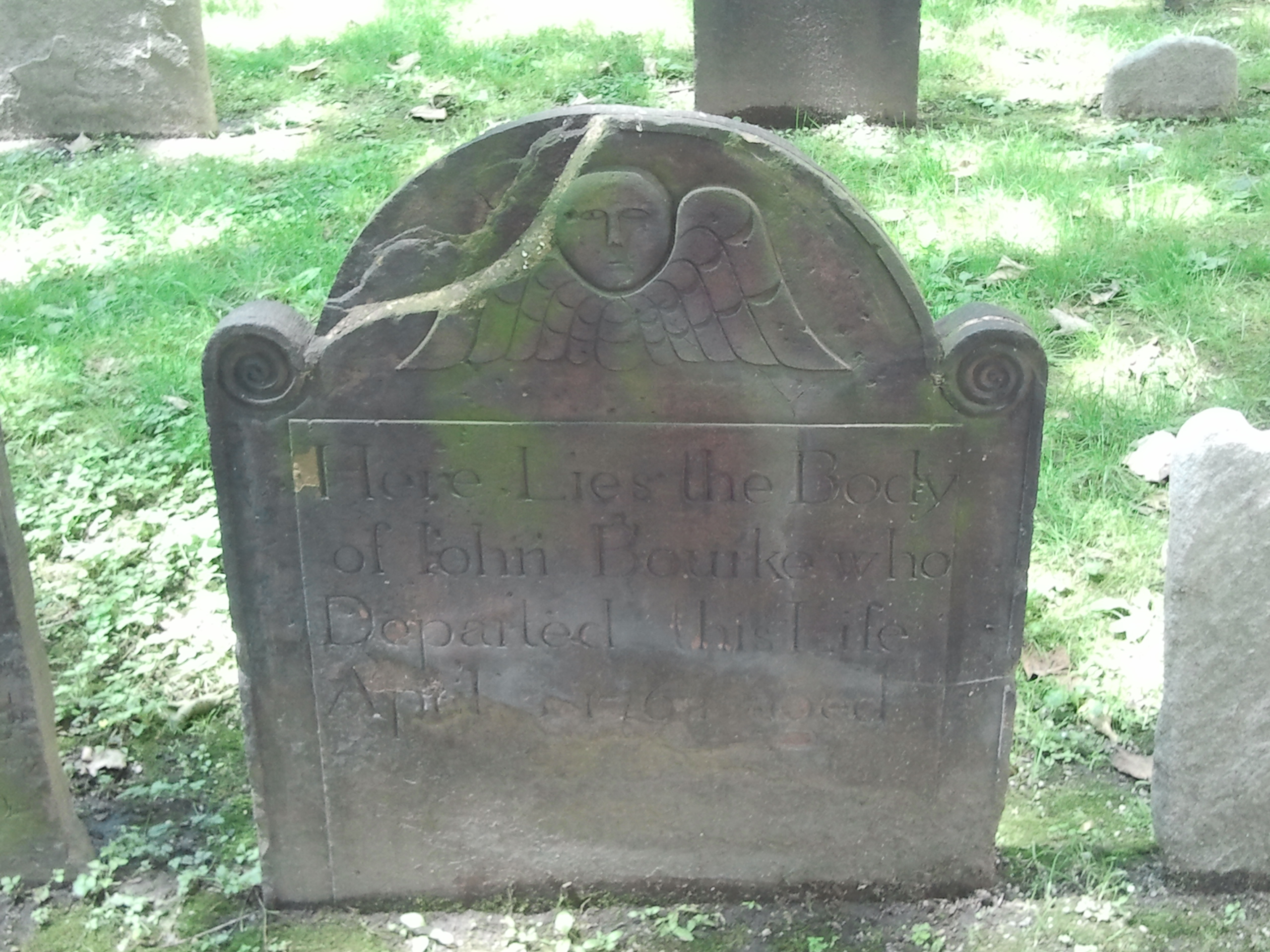
Old gravestone, Trinity Church graveyard
Gigi alt |
In nineteenth-century New York, even as body snatchers
skulked about and abortionists flourished, the good citizens were undergoing a
profound evolution in how they disposed of and honored the deceased. Up till now, funerals of genteel society had
been held in the parlor, following which the dear departed, boxed in a simple
wooden coffin, was removed to a small graveyard, often
adjacent to the church the loved one had attended, and deposited there in a grave
marked by a simple gravestone. The
coffin was provided by an undertaker, usually a carpenter or cabinetmaker by
trade, who oversaw the whole procedure at minimal expense. It was simple, unpretentious, cheap.
 |
A family mausoleum in Greenwood
Jbabich21 |
Too simple, too unpretentious and cheap. The affluent middle class wanted more, and in
New York began to get it when Greenwood Cemetery opened in Brooklyn in
1838. This was no ordinary graveyard
cluttered up with gravestones, but a landscaped park with hillocks and meadows
and vistas graced with impressive monuments featuring pensive female figures,
winged cherubs, draped urns, broken lutes, and the most inconsolable weeping
willows. Here, at a safe remove from the
city’s hurly-burly, the extinguished loved ones could rest in rural peace, with
the holy influence of nature all around
them. Woodlawn in the Bronx would
follow, and countless other park cemeteries throughout the country. Today the
most celebrated (and on occasion satirized) of these cemeteries is Forest Lawn in Glendale,
California, where many a movie star is buried.
But was a simple pinewood coffin appropriate for a
landscaped setting? Surely not.
The departed loved ones deserved something finer. By the 1860s, if not before, stores along
Broadway were displaying in their windows caskets of polished rosewood and
mahogany with silver or silver-plated mountings, some of them with transparent
lids so as to render the deceased’s face visible. There were cushioned interiors (the dear ones
must be comfortable), and baby coffins with pure white satin lining, fringed
with lace. And the hearses to transport
these marvels had panels of plate glass, so as to display their luxury
to all. Just as the graveyard evolved
into the cemetery, the coffin became a casket, and the casket a work of art.
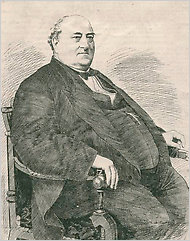
 Funerals were now held in churches, and presiding over them
were the sextons of the fashionable
churches, of whom the foremost was Isaac H. Brown, who from 1845 until his
death in 1880 served as sexton of Grace Episcopal Church at Tenth Street and
Broadway. Tall, red-faced and elegantly
obese, Brown supplemented his routine duties at the church by planning the
weddings and soirées of the affluent, and their funerals. “The Lenten season is a horridly dull
season,” he famously announced, “but we manage to make our funerals as
entertaining as possible.” It was he,
and he alone, who for thirty-five years determined all the details of a
fashionable New York funeral: the casket, the arrangement of furniture, the
laying out of the deceased, the lighting, the drapery, the hearse, the number
of horses, the size and quality of the plumes on the hearse and team. For thirty-five years it was he, and he alone,
who could tell what was last year’s style and therefore to be avoided, and what
was now “in” and to be embraced. No one
questioned his expertise in these matters, his tyranny. He himself was not of society, but society
couldn’t do without him. For those “in
society” or aspiring to it, funerals, like weddings, were now planned so as to
display the family’s wealth and
status, and Brown was the planner extraordinaire. Indeed, it was the dream of many a society
matron “to be buried by Brown from Grace.”
Funerals were now held in churches, and presiding over them
were the sextons of the fashionable
churches, of whom the foremost was Isaac H. Brown, who from 1845 until his
death in 1880 served as sexton of Grace Episcopal Church at Tenth Street and
Broadway. Tall, red-faced and elegantly
obese, Brown supplemented his routine duties at the church by planning the
weddings and soirées of the affluent, and their funerals. “The Lenten season is a horridly dull
season,” he famously announced, “but we manage to make our funerals as
entertaining as possible.” It was he,
and he alone, who for thirty-five years determined all the details of a
fashionable New York funeral: the casket, the arrangement of furniture, the
laying out of the deceased, the lighting, the drapery, the hearse, the number
of horses, the size and quality of the plumes on the hearse and team. For thirty-five years it was he, and he alone,
who could tell what was last year’s style and therefore to be avoided, and what
was now “in” and to be embraced. No one
questioned his expertise in these matters, his tyranny. He himself was not of society, but society
couldn’t do without him. For those “in
society” or aspiring to it, funerals, like weddings, were now planned so as to
display the family’s wealth and
status, and Brown was the planner extraordinaire. Indeed, it was the dream of many a society
matron “to be buried by Brown from Grace.”
 |
| A widow in full mourning |
Among the affluent middle class, Victorian mourning was a
serious matter. Certain clothing and
rules were prescribed for all, but the most onerous restrictions fell upon the
widow, who for a year was in full mourning, wearing lusterless black adorned
only with ample amounts of crape, and shunning all social contact. Then, slowly, she went through several lesser
stages of mourning, adding purple and white and gray, and jet jewelry. Finally she was allowed to wear her more
glittering jewelry and modestly colorful attire (nothing too gaudy, of course),
and appear again in public.
But this too would change.
By the 1880s the professional funeral director, or mortician, had
emerged, a well-dressed gentleman aspiring to rival the doctor or clergyman in
status. Embalming replaced ice as the
preferred way of preserving the loved one, and bodies were interred in their
finest clothing rather than in a shroud.
Funeral homes appeared with facilities for elaborate funerals, sermons
got shorter and cheerier, mourning garb was shunned, and everything conspired
to soothe and console. The well-groomed
body now looked almost alive, and the fact of death was obscured by new
emphasis on the trappings of death. All
this was done with the full consent and encouragement of the mourners, and in
the process the status of the funeral director soared, and with it his salary
and fees. And so developed, in New York
and the rest of the country, the American way of death.
Footnote: The American Way of Death was Jessica Mitford’s 1963 bestseller, exposing the
abuses of the modern funeral industry.
Her points were well taken,
but in one detail she erred: there is substantial
evidence that the grieving public
encouraged funeral directors to assume more responsibility and control of
funerals; the directors were not secretly conspiring to do so, but answering
the public’s expressed need. In so
doing, of course, they lined their own pockets amply. When Mitford died in 1996, her funeral cost
$533.31, and her cremation $475.00.
 |
Egyptian mummies in the British Museum today
Bram Souffreau |
 |
| A pharaoh's mummy in the Cairo Museum, 1900-1920 |
One last note regarding our attitude toward the dead. As a growing boy I loved going to the Field
Museum in Chicago, where I especially prized the dinosaur exhibits and,
appropriately housed in a basement chamber, the Egyptian mummies. The mummies were not unwrapped; I saw them in
their elegant sarcophagi. Since then I
have seen photos in books of mummies that have indeed been unwrapped, so that
the eerily preserved – or half-preserved – features are visible. Egyptian mummies, indeed, are among the prize possessions of museums all over the world. And now, earlier this very year, the Field
Museum offered a new show of its mummies facilitated by noninvasive CT scans
revealing a host of details about them, such as certain limbs missing, teeth with decay or missing, and the
sex of a small boy whose genitals are now at last visible. The Museum invited visitors to “navigate into
a sarcophagus, unwrap the outer wrappings, and explore the interior. You may think that you’ve seen mummies
before, but you’ve never seen mummies like this. For a limited time only, at The Field
Museum.” I’m sure that hordes of
visitors flocked, including boys like myself long ago.
The websites advertising the show have comments from the
public, most of whom express the greatest interest in it. But one comment caught my attention: “Bury
the dead, you sick people!” These were,
after all, human beings like ourselves, buried with all the care and ceremony befitting their rank, in
anticipation of an afterlife. Never could they or those around them have
anticipated that, millennia hence, their
remains would be on display to an alien and voyeuristic public. Are these displays really so different from
Dr. Valentine Mott’s collection of human remains, which included the severed
head of a Native American? Science has
triumphed over respect for the dead, not to mention any sense of the sacred.
Which brings me back to the theme announced at the outset of
these two posts: the ambivalence of our attitude toward the dead. We honor them, fear them, pray for them, disrespect
them, flee the very thought of death and decay at our funerals, and flock to
see the preserved remains of the dead of centuries past. They aren’t us, so we can ogle them without
qualms. We’re a funny bunch, and I
include myself in the comment. What will
people ages hence think of us? So once
again, though now slightly after the fact, Happy Halloween!
 |
| Mrhalloweenster101 |
More presidential wisdom:
“In politics you’ve got to
learn that overnight chicken shit can turn to chicken salad.” Lyndon B. Johnson
"The storm of frenzy and faction must inevitably dash itself against the unshaken rock of the constitution." Franklin Pierce
“Involuntary servitude … is
recognized by the Constitution.”
Franklin Pierce
“The presidency is no bed of
roses.” James Polk
"Civilization and profit go hand in hand." Calvin Coolidge
Mr. Coolidge, to his credit,
was a man of few words. A woman once
addressed him: “Oh Mr. Coolidge, you're so reticent. I just bet a friend that I can make you say
more than two words.” Coolidge’s
response: “You lose.”
But my favorite president is Franklin Pierce, who is so wonderfully and deservedly unremembered. Do you know anything about him? Neither do I.
(c) 2012 Clifford Browder